Electronic and Magnonic Properties of g-Wave Altermagnetism in Intercalated Transition Metal Dichalcogenides
Pith reviewed 2026-05-20 07:25 UTC · model grok-4.3
The pith
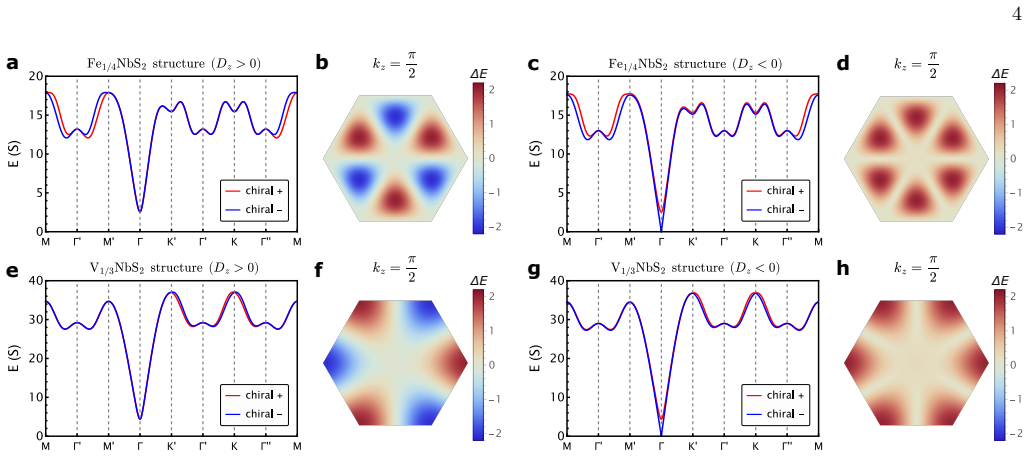
In intercalated transition metal dichalcogenides, g-wave altermagnetism features material-dependent nodal structures from bond-dependent hopping anisotropy in electrons and single-ion anisotropy in magnons.
A machine-rendered reading of the paper's core claim, the machinery that carries it, and where it could break.
Core claim
The g-wave electronic spin splitting originates from bond-dependent hopping anisotropy, leading to material-dependent nodal structures. For the magnetic excitations, the emergence of chiral splitting in the magnon dispersion is controlled by single-ion anisotropy, which manifests as altermagnetic-like nodal structures when spins are oriented along an easy-axis but disappears when the spins are aligned in an easy-plane. The 1/S corrections from magnon-magnon interactions preserve the symmetry and nodal structure of the band splitting while generally reducing its magnitude, with strong antiferromagnetic exchange leading to a non-negligible renormalization of the chiral splitting.
What carries the argument
Bond-dependent hopping anisotropy in the effective tight-binding model for electrons and single-ion anisotropy in the spin model for magnons.
If this is right
- The nodal structures in the electronic band structure vary between different intercalated compounds due to their specific hopping anisotropies.
- Chiral magnon splitting appears only for easy-axis spin orientations and is absent in easy-plane configurations.
- The altermagnetic nodal features in magnon spectra remain intact beyond linear spin-wave theory but decrease in size due to interactions.
- Strong antiferromagnetic exchange causes significant renormalization of the magnon chiral splitting.
Where Pith is reading between the lines
- If these models hold, varying the intercalant or transition metal could tune the nodal structures for different applications.
- The survival of the splitting under 1/S corrections suggests robustness that might enable room-temperature effects in related materials.
- Connections to other altermagnets could be explored by comparing the anisotropy mechanisms across different crystal symmetries.
Load-bearing premise
The effective tight-binding and spin models, with parameters from first-principles calculations, accurately capture the main hopping anisotropy and single-ion anisotropy that set the nodal structures.
What would settle it
Direct measurement via ARPES of the predicted material-specific nodal points in the electronic spin-split bands or via inelastic neutron scattering of the magnon chiral splitting and its dependence on spin orientation.
Figures




read the original abstract
Altermagnetism is a recently identified class of magnetic order characterized by unconventional momentum-dependent spin splitting in the absence of net magnetization, and understanding its electronic and magnetic properties is essential for revealing its fundamental physics and potential applications. In this work we investigate two intercalated transition-metal dichalcogenides, Fe$_{1/4}$NbS$_2$ and V$_{1/3}$NbS$_2$, as candidate altermagnetic materials by using effective tight-binding and spin models complemented by first-principles calculations. We show that the $g$-wave electronic spin splitting originates from bond-dependent hopping anisotropy, leading to material-dependent nodal structures. For the magnetic excitations, the emergence of chiral splitting in the magnon dispersion is controlled by single-ion anisotropy, which manifests as altermagnetic-like nodal structures when spins are oriented along an easy-axis. Conversely, this altermagnetic signature disappears when the spins are aligned in an easy-plane. Beyond linear spin-wave theory, we find that $1/S$ corrections from magnon--magnon interactions preserve the symmetry and nodal structure of the band splitting while generally reducing its magnitude, with strong antiferromagnetic exchange leading to a non-negligible renormalization of the chiral splitting. Our findings establish intercalated transition-metal dichalcogenides as promising platforms for understanding the interplay between crystal symmetry, non-relativistic spin splitting, and magnetic properties in altermagnets.
Editorial analysis
A structured set of objections, weighed in public.
Referee Report
Summary. The manuscript studies g-wave altermagnetism in the intercalated TMDs Fe_{1/4}NbS_2 and V_{1/3}NbS_2. Using effective tight-binding models, spin-wave theory, and first-principles calculations, it shows that the electronic g-wave spin splitting originates from bond-dependent hopping anisotropy and produces material-dependent nodal structures. For magnons, chiral splitting is controlled by single-ion anisotropy, yielding altermagnetic-like nodes for easy-axis orientation that disappear for easy-plane alignment. The 1/S corrections from magnon-magnon interactions are found to preserve the nodal symmetry while renormalizing the splitting magnitude, with strong antiferromagnetic exchange producing non-negligible effects.
Significance. If the central derivations hold, the work supplies concrete material realizations of g-wave altermagnetism and demonstrates the interplay between crystal symmetry, non-relativistic spin splitting, and magnon excitations. The explicit treatment of 1/S corrections that preserve nodal features while allowing renormalization constitutes a clear technical strength, as does the use of DFT-informed parameters to connect model predictions to specific compounds. These results position intercalated TMDs as accessible platforms for exploring altermagnetic physics and potential spintronic applications.
major comments (1)
- [Magnon results section (likely §4)] The statement that 1/S corrections preserve the nodal symmetry of the magnon chiral splitting (abstract and corresponding results section) is load-bearing for the claim that the altermagnetic signature survives quantum corrections. An explicit expansion of the corrected dispersion to first order in 1/S, showing that the single-ion anisotropy term retains its symmetry properties without generating new nodal shifts, would strengthen this point.
minor comments (3)
- [Electronic properties section] The abstract refers to 'material-dependent nodal structures' for the electronic splitting; a side-by-side comparison of the nodal locations or wave-vector coordinates for Fe_{1/4}NbS_2 versus V_{1/3}NbS_2 in the main text or a dedicated figure would make this dependence more transparent.
- [Model construction subsection] Clarify the precise definition of the bond-dependent hopping amplitudes in the tight-binding Hamiltonian and whether they are obtained directly from DFT projections or via a subsequent fitting procedure.
- [Beyond linear spin-wave theory paragraph] The renormalization of the chiral splitting under strong antiferromagnetic exchange is described qualitatively; providing the numerical factor or scaling relation obtained from the 1/S calculation would aid reproducibility.
Simulated Author's Rebuttal
We thank the referee for the careful reading of our manuscript and the constructive suggestion. We address the major comment below.
read point-by-point responses
-
Referee: [Magnon results section (likely §4)] The statement that 1/S corrections preserve the nodal symmetry of the magnon chiral splitting (abstract and corresponding results section) is load-bearing for the claim that the altermagnetic signature survives quantum corrections. An explicit expansion of the corrected dispersion to first order in 1/S, showing that the single-ion anisotropy term retains its symmetry properties without generating new nodal shifts, would strengthen this point.
Authors: We agree that an explicit expansion clarifies the robustness of the nodal structure. The 1/S corrections arise from the quartic terms in the Holstein-Primakoff expansion of the spin Hamiltonian. These interaction terms are invariant under the same space-group operations that enforce the g-wave symmetry of the single-ion anisotropy contribution. Consequently, the functional form of the chiral splitting (including node locations) is unchanged at order 1/S; only its overall magnitude is renormalized. In the revised manuscript we will add this first-order expansion explicitly in the magnon results section, confirming that no symmetry-breaking shifts appear. revision: yes
Circularity Check
Moderate DFT parameter dependence but derivation of nodal structures remains independent
full rationale
The paper derives the g-wave electronic spin splitting from bond-dependent hopping anisotropy and magnon chiral splitting from single-ion anisotropy using effective tight-binding and spin models whose parameters are informed by first-principles calculations on the target compounds. These models are constructed to capture the relevant anisotropies, and the nodal structures plus 1/S corrections are obtained by direct analysis of the model Hamiltonians rather than by fitting or redefinition of inputs. No equation or step reduces a claimed prediction to a tautology or self-citation chain; the first-principles input supplies numerical values while the symmetry and origin statements follow from the model structure itself. This yields a low but non-zero circularity score reflecting parameter sourcing without collapsing the central claims.
Axiom & Free-Parameter Ledger
free parameters (2)
- bond-dependent hopping amplitudes
- single-ion anisotropy strength
axioms (2)
- domain assumption The effective tight-binding Hamiltonian derived from DFT accurately represents the low-energy electronic structure near the Fermi level.
- domain assumption Linear spin-wave theory plus 1/S corrections suffice to capture the leading magnon dispersion and interaction effects.
Lean theorems connected to this paper
-
IndisputableMonolith/Cost/FunctionalEquation.leanwashburn_uniqueness_aczel unclear?
unclearRelation between the paper passage and the cited Recognition theorem.
the g-wave electronic spin splitting originates from bond-dependent hopping anisotropy... ΔE(k)∝δt ky kz(3k²x − k²y)
What do these tags mean?
- matches
- The paper's claim is directly supported by a theorem in the formal canon.
- supports
- The theorem supports part of the paper's argument, but the paper may add assumptions or extra steps.
- extends
- The paper goes beyond the formal theorem; the theorem is a base layer rather than the whole result.
- uses
- The paper appears to rely on the theorem as machinery.
- contradicts
- The paper's claim conflicts with a theorem or certificate in the canon.
- unclear
- Pith found a possible connection, but the passage is too broad, indirect, or ambiguous to say the theorem truly supports the claim.
Reference graph
Works this paper leans on
-
[1]
Libor ˇSmejkal, Jairo Sinova, and Tomas Jungwirth. Beyond conventional ferromagnetism and antiferromag- netism: A phase with nonrelativistic spin and crystal ro- tation symmetry.Physical Review X, 12(3):031042, 2022
work page 2022
-
[2]
Emerging research landscape of altermagnetism.Phys- ical Review X, 12(4):040501, 2022
Libor ˇSmejkal, Jairo Sinova, and Tomas Jungwirth. Emerging research landscape of altermagnetism.Phys- ical Review X, 12(4):040501, 2022
work page 2022
-
[3]
Anomalous hall anti- ferromagnets.Nature Reviews Materials, 7(6):482–496, 2022
Libor ˇSmejkal, Allan H MacDonald, Jairo Sinova, Satoru Nakatsuji, and Tomas Jungwirth. Anomalous hall anti- ferromagnets.Nature Reviews Materials, 7(6):482–496, 2022
work page 2022
-
[4]
Hai-Yang Ma, Mengli Hu, Nana Li, Jianpeng Liu, Wang Yao, Jin-Feng Jia, and Junwei Liu. Multifunctional antiferromagnetic materials with giant piezomagnetism and noncollinear spin current.Nature communications, 12(1):2846, 2021
work page 2021
-
[5]
Satoru Hayami, Yuki Yanagi, and Hiroaki Kusunose. Bottom-up design of spin-split and reshaped electronic band structures in antiferromagnets without spin-orbit coupling: Procedure on the basis of augmented multi- poles.Physical Review B, 102(14):144441, 2020
work page 2020
-
[6]
Satoru Hayami, Yuki Yanagi, and Hiroaki Kusunose. Momentum-dependent spin splitting by collinear antifer- romagnetic ordering.journal of the physical society of japan, 88(12):123702, 2019
work page 2019
-
[7]
Efficient electrical spin splitter based on nonrelativistic collinear antiferromagnetism.Phys
Rafael Gonz´ alez-Hern´ andez, Libor ˇSmejkal, Karel V´ yborn´ y, Yuta Yahagi, Jairo Sinova, Tom´ a ˇ s Jungwirth, and Jakub ˇZelezn´ y. Efficient electrical spin splitter based on nonrelativistic collinear antiferromagnetism.Phys. Rev. Lett., 126:127701, Mar 2021
work page 2021
-
[8]
Giant momentum-dependent spin splitting in centrosymmetric low-z antiferromagnets
Lin-Ding Yuan, Zhi Wang, Jun-Wei Luo, Emmanuel I Rashba, and Alex Zunger. Giant momentum-dependent spin splitting in centrosymmetric low-z antiferromagnets. Physical Review B, 102(1):014422, 2020
work page 2020
-
[9]
Lin-Ding Yuan, Zhi Wang, Jun-Wei Luo, and Alex Zunger. Prediction of low-z collinear and noncollinear antiferromagnetic compounds having momentum- dependent spin splitting even without spin-orbit coupling.Physical Review Materials, 5(1):014409, 2021
work page 2021
-
[10]
Miina Leivisk¨ a, Javier Rial, Anton´ ın Bad’ura, Rafael Lopes Seeger, Isma¨ ıla Kounta, Sebastian Beckert, Dominik Kriegner, Isabelle Joumard, Eva Schmoranzerov´ a, Jairo Sinova, et al. Anisotropy of the anomalous hall effect in thin films of the altermagnet candidate mn 5 si 3.Physical Review B, 109(22):224430, 2024
work page 2024
-
[11]
Toshihiro Sato, Sonia Haddad, Ion Cosma Fulga, Fakher F Assaad, and Jeroen van den Brink. Altermag- netic anomalous hall effect emerging from electronic cor- relations.Physical Review Letters, 133(8):086503, 2024
work page 2024
-
[12]
In- trinsic anomalous hall effect in altermagnets.Physical Review B, 110(9):094425, 2024
Lotan Attias, Alex Levchenko, and Maxim Khodas. In- trinsic anomalous hall effect in altermagnets.Physical Review B, 110(9):094425, 2024
work page 2024
-
[13]
Ching-Te Liao, Yu-Chun Wang, Yu-Cheng Tien, Ssu-Yen Huang, and Danru Qu. Separation of inverse altermag- netic spin-splitting effect from inverse spin hall effect in ruo 2.Physical Review Letters, 133(5):056701, 2024
work page 2024
-
[14]
Hao Jin, Zhibin Tan, Zhirui Gong, and Jian Wang. Anomalous hall effect in two-dimensional vanadium tetrahalogen with altermagnetic phase.Physical Review B, 110(15):155125, 2024
work page 2024
-
[15]
Yuan Fang, Jennifer Cano, and Sayed Ali Akbar Gho- rashi. Quantum geometry induced nonlinear transport in altermagnets.Physical Review Letters, 133(10):106701, 2024
work page 2024
-
[16]
Peng Rao, Alexander Mook, and Johannes Knolle. Tun- able band topology and optical conductivity in altermag- nets.Physical Review B, 110(2):024425, 2024
work page 2024
-
[17]
Kirill Parshukov, Raymond Wiedmann, and Andreas P Schnyder. Topological responses from gapped weyl points in 2d altermagnets.arXiv preprint arXiv:2403.09520, 2024
-
[18]
Chao-Yang Tan, Ze-Feng Gao, Huan-Cheng Yang, Kai Liu, Peng-Jie Guo, and Zhong-Yi Lu. Bipolarized weyl semimetals and quantum crystal valley hall effect in two-dimensional altermagnetic materials.arXiv preprint arXiv:2406.16603, 2024
-
[19]
Shuntaro Sumita, Makoto Naka, and Hitoshi Seo. Fulde- ferrell-larkin-ovchinnikov state induced by antiferromag- netic order inκ-type organic conductors.Physical Review Research, 5(4):043171, 2023
work page 2023
-
[20]
Di Zhu, Zheng-Yang Zhuang, Zhigang Wu, and Zhongbo Yan. Topological superconductivity in two- dimensional altermagnetic metals.Physical Review B, 108(18):184505, 2023
work page 2023
-
[21]
Bjørnulf Brekke, Arne Brataas, and Asle Sudbø. Two-dimensional altermagnets: Superconductivity in a minimal microscopic model.Physical Review B, 108(22):224421, 2023
work page 2023
-
[22]
Finite- momentum cooper pairing in proximitized altermagnets
Song-Bo Zhang, Lun-Hui Hu, and Titus Neupert. Finite- momentum cooper pairing in proximitized altermagnets. Nature Communications, 15(1):1801, 2024
work page 2024
-
[23]
Debmalya Chakraborty and Annica M Black-Schaffer. Zero-field finite-momentum and field-induced super- conductivity in altermagnets.Physical Review B, 110(6):L060508, 2024
work page 2024
-
[24]
Miaomiao Wei, Longjun Xiang, Fuming Xu, Lei Zhang, Gaomin Tang, and Jian Wang. Gapless superconducting state and mirage gap in altermagnets.Physical Review B, 109(20):L201404, 2024
work page 2024
-
[25]
Kristian Mæland, Bjørnulf Brekke, and Asle Sudbø. Many-body effects on superconductivity mediated by double-magnon processes in altermagnets.Physical Re- view B, 109(13):134515, 2024
work page 2024
-
[26]
Thermodynamic proper- ties of a superconductor interfaced with an altermagnet
Simran Chourasia, Aleksandr Svetogorov, Akashdeep Kamra, and Wolfgang Belzig. Thermodynamic proper- ties of a superconductor interfaced with an altermagnet. arXiv preprint arXiv:2403.10456, 2024
-
[27]
Ling Bai, Wanxiang Feng, Siyuan Liu, Libor ˇSmejkal, Yuriy Mokrousov, and Yugui Yao. Altermagnetism: Ex- ploring new frontiers in magnetism and spintronics.Ad- vanced Functional Materials, page 2409327, 2024
work page 2024
-
[28]
Libor ˇSmejkal, Anna Birk Hellenes, Rafael Gonz´ alez- Hern´ andez, Jairo Sinova, and Tomas Jungwirth. Gi- ant and tunneling magnetoresistance in unconventional collinear antiferromagnets with nonrelativistic spin- momentum coupling.Physical Review X, 12(1):011028, 2022
work page 2022
-
[29]
Chiral magnons in altermag- 11 netic ruo 2.Physical Review Letters, 131(25):256703, 2023
Libor ˇSmejkal, Alberto Marmodoro, Kyo-Hoon Ahn, Rafael Gonz´ alez-Hern´ andez, Ilja Turek, Sergiy Mankovsky, Hubert Ebert, Sunil W D’Souza, Ondˇ rej ˇSipr, Jairo Sinova, et al. Chiral magnons in altermag- 11 netic ruo 2.Physical Review Letters, 131(25):256703, 2023
work page 2023
-
[30]
Chiral split magnon in altermagnetic mnte.Physical Review Letters, 133(15):156702, 2024
Zheyuan Liu, Makoto Ozeki, Shinichiro Asai, Shinichi Itoh, and Takatsugu Masuda. Chiral split magnon in altermagnetic mnte.Physical Review Letters, 133(15):156702, 2024
work page 2024
-
[31]
Ob- serving altermagnetism using polarized neutrons.Physi- cal Review B, 111(6):L060405, 2025
Paul A Mcclarty, Arsen Gukasov, and Jeffrey G Rau. Ob- serving altermagnetism using polarized neutrons.Physi- cal Review B, 111(6):L060405, 2025
work page 2025
-
[32]
Altermagnetic splitting of magnons in hematite α-fe 2 o 3.Physical Review B, 112(6):064425, 2025
Rhea Hoyer, P Peter Stavropoulos, Aleksandar Razpopov, Roser Valent´ ı, LiborˇSmejkal, and Alexander Mook. Altermagnetic splitting of magnons in hematite α-fe 2 o 3.Physical Review B, 112(6):064425, 2025
work page 2025
-
[33]
Chiral magnetic ex- citations and domain textures of g-wave altermagnets
Volodymyr P Kravchuk, Kostiantyn V Yershov, Jorge I Facio, Yaqian Guo, Oleg Janson, Olena Gomonay, Jairo Sinova, and Jeroen van den Brink. Chiral magnetic ex- citations and domain textures of g-wave altermagnets. Physical Review B, 112(14):144421, 2025
work page 2025
-
[34]
Niklas Cichutek, Peter Kopietz, and Andreas R¨ uckriegel. Spontaneous magnon decay in two-dimensional altermag- nets.Physical Review Research, 7(3):033208, 2025
work page 2025
-
[35]
Quantum fluctuations in two-dimensional altermagnets
Niklas Cichutek, Peter Kopietz, and Andreas R¨ uckriegel. Quantum fluctuations in two-dimensional altermagnets. Physical Review B, 112(17):174404, 2025
work page 2025
-
[36]
Rintaro Eto, Matthias Gohlke, Jairo Sinova, Masahito Mochizuki, Alexander L Chernyshev, and Alexander Mook. Spontaneous magnon decays from nonrelativistic time-reversal symmetry breaking in altermagnets.Phys- ical Review B, 112(9):094442, 2025
work page 2025
-
[37]
Fe site order and magnetic properties of fe1/4nbs2.Inorganic Chemistry, 62(44):18179–18188, 2023
Erick A Lawrence, Xudong Huai, Dongwook Kim, Maxim Avdeev, Yu Chen, Grigorii Skorupskii, Akira Miura, Austin Ferrenti, Moritz Waibel, Shogo Kawaguchi, et al. Fe site order and magnetic properties of fe1/4nbs2.Inorganic Chemistry, 62(44):18179–18188, 2023
work page 2023
-
[38]
Chao-Chun Wei, Erick Lawrence, Alyssa Tran, and Hui- wen Ji. Crystal chemistry and design principles of alter- magnets.ACS Organic & Inorganic Au, 4(6):604–619, 2024
work page 2024
-
[39]
G. Kresse and D. Joubert. From ultrasoft pseudopoten- tials to the projector augmented-wave method.Phys. Rev. B, 59:1758–1775, Jan 1999
work page 1999
-
[40]
gener- alized gradient approximation made simple
Yingkai Zhang and Weitao Yang. Comment on “gener- alized gradient approximation made simple”.Phys. Rev. Lett., 80:890–890, Jan 1998
work page 1998
-
[41]
S. L. Dudarev, G. A. Botton, S. Y. Savrasov, C. J. Humphreys, and A. P. Sutton. Electron-energy-loss spec- tra and the structural stability of nickel oxide: An lsda+u study.Phys. Rev. B, 57:1505–1509, Jan 1998
work page 1998
-
[42]
Stefan Grimme, Jens Antony, Stephan Ehrlich, and Helge Krieg. A consistent and accurate ab initio parametriza- tion of density functional dispersion correction (dft-d) for the 94 elements h-pu.The Journal of Chemical Physics, 132(15):154104, 04 2010
work page 2010
-
[43]
Stefan Grimme, Stephan Ehrlich, and Lars Goerigk. Ef- fect of the damping function in dispersion corrected den- sity functional theory.Journal of Computational Chem- istry, 32(7):1456–1465, 2011
work page 2011
-
[44]
Shannon S. Fender, Noah Schnitzer, Wuzhang Fang, Lopa Bhatt, Dingbin Huang, Amani Malik, Oscar Gonza- lez, Veronika Sunko, Lilia S. Xie, David A. Muller, Joseph Orenstein, Yuan Ping, Berit H. Goodge, and D. Kwabena Bediako. Unconventional superlattice ordering in interca- lated transition metal dichalcogenide v1/3nbs2.Journal of the American Chemical Soci...
-
[45]
Toshihide Tsuji and Hirokazu Watanabe. M¨ ossbauer spectroscopic studies on fe xnbs2 single crystals.Journal of Alloys and Compounds, 383(1-2):259–264, 2004
work page 2004
discussion (0)
Sign in with ORCID, Apple, or X to comment. Anyone can read and Pith papers without signing in.