Taking Inventory of the Most Promising Lensed Radio Sources for Constraining Fundamental Properties of Dark Matter
Pith reviewed 2026-05-20 04:52 UTC · model grok-4.3
pith:OOXNU24T Add to your LaTeX paper
What is a Pith Number?\usepackage{pith}
\pithnumber{OOXNU24T}
Prints a linked pith:OOXNU24T badge after your title and writes the identifier into PDF metadata. Compiles on arXiv with no extra files. Learn more
The pith
Two searches using a new method identify additional radio lenses that can reveal dark matter substructure through astrometric shifts.
A machine-rendered reading of the paper's core claim, the machinery that carries it, and where it could break.
Core claim
Application of a new search method to existing radio and optical surveys has yielded additional strongly lensed radio sources. These systems are selected because they are expected to display astrometric perturbations at radio wavelengths that arise from dark matter substructure, thereby providing new targets for experiments that constrain the mass scale and other microscopic properties of dark matter.
What carries the argument
The new method for locating radio lenses in existing surveys by cross-matching radio and optical data to isolate systems with measurable astrometric perturbations from substructure.
If this is right
- The expanded set of lenses supplies more targets for high-resolution radio follow-up that can measure substructure-induced shifts.
- Larger numbers of such systems enable statistical constraints on the dark matter halo mass function and related particle properties.
- The completeness assessment identifies which sources should be prioritized for immediate observation campaigns.
- Future dark matter studies can draw on this inventory to design experiments that combine individual and ensemble analyses of perturbations.
Where Pith is reading between the lines
- If perturbations are confirmed in these new systems, the same search technique could be applied to upcoming wide-field radio surveys to grow the sample further.
- Radio-lensing measurements from these sources might be cross-checked against other probes such as stellar streams or Lyman-alpha forest data to test consistency across methods.
- The minimum-information criteria laid out in the paper could serve as a template for evaluating candidate lenses discovered at other wavelengths.
Load-bearing premise
The newly identified lens systems exhibit astrometric perturbations at radio wavelengths that are both observable and produced by dark matter substructure rather than by measurement systematics or other astrophysical causes.
What would settle it
Radio observations at sufficient resolution that show the astrometric positions of the new lens images match the predictions of a smooth main lens with no detectable extra shifts from subhalos would demonstrate that these systems cannot be used to constrain dark matter properties.
Figures


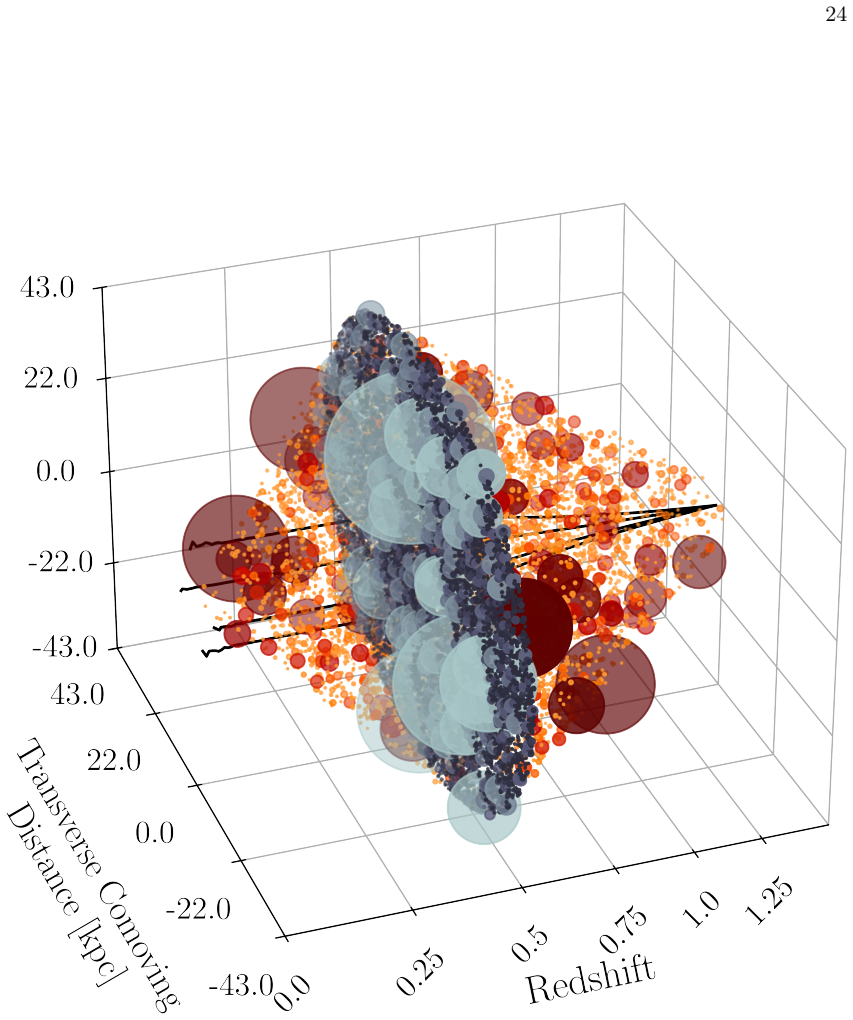
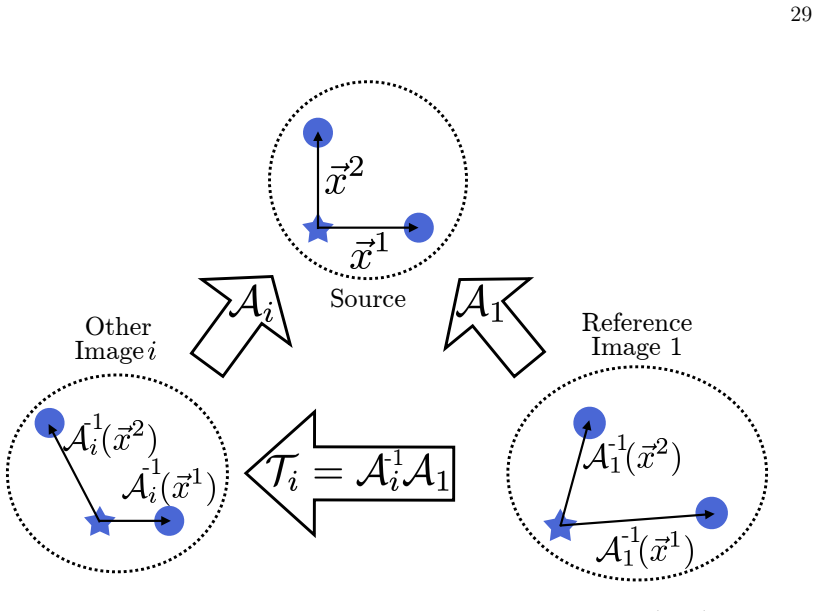
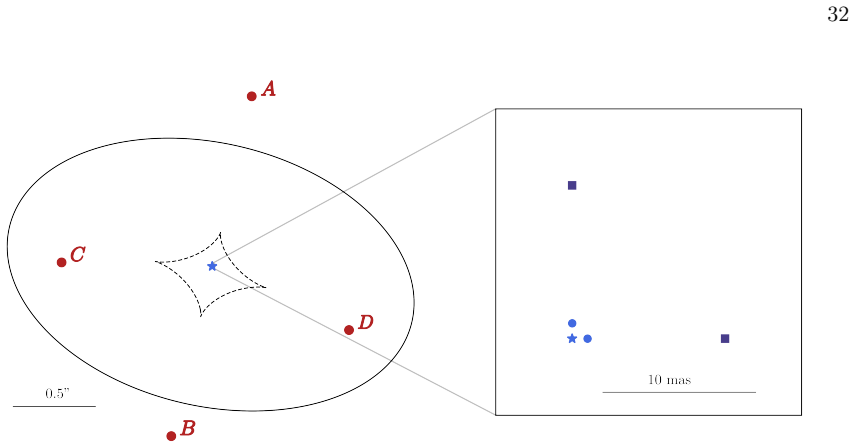


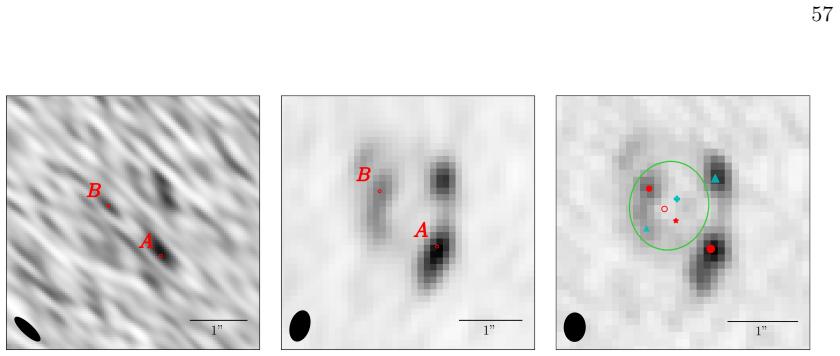
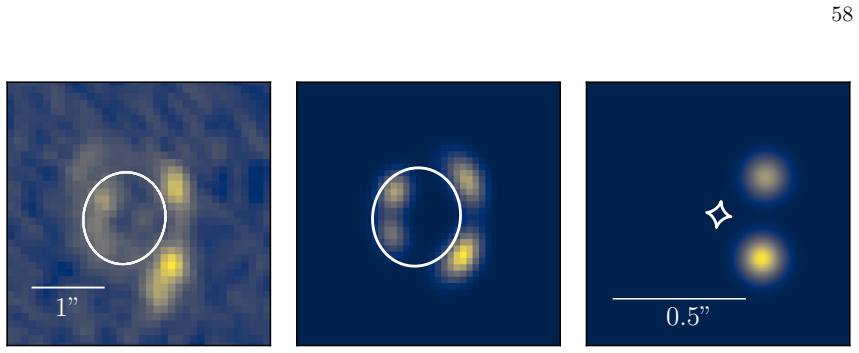
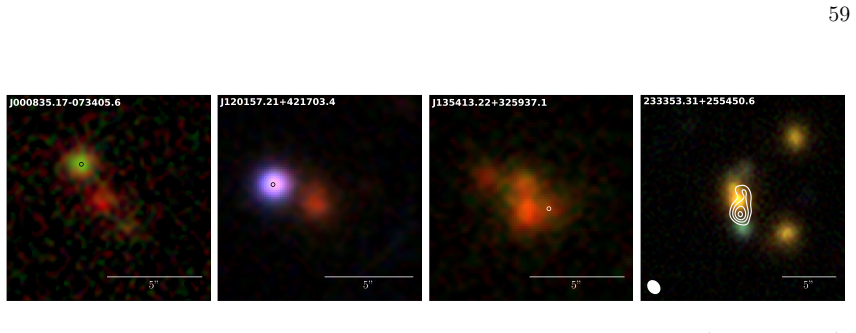
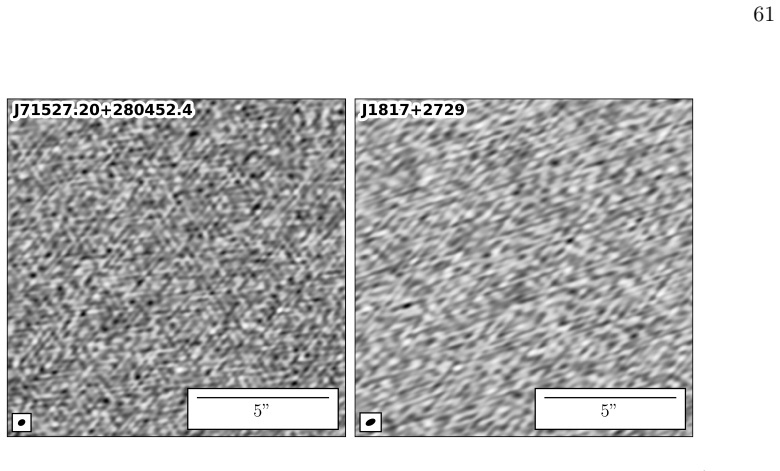
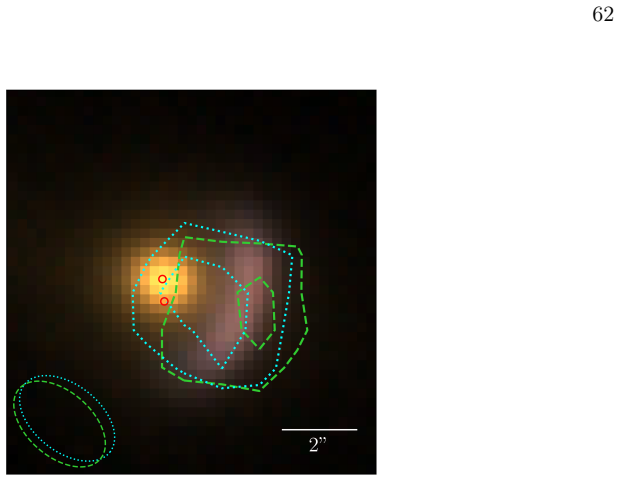

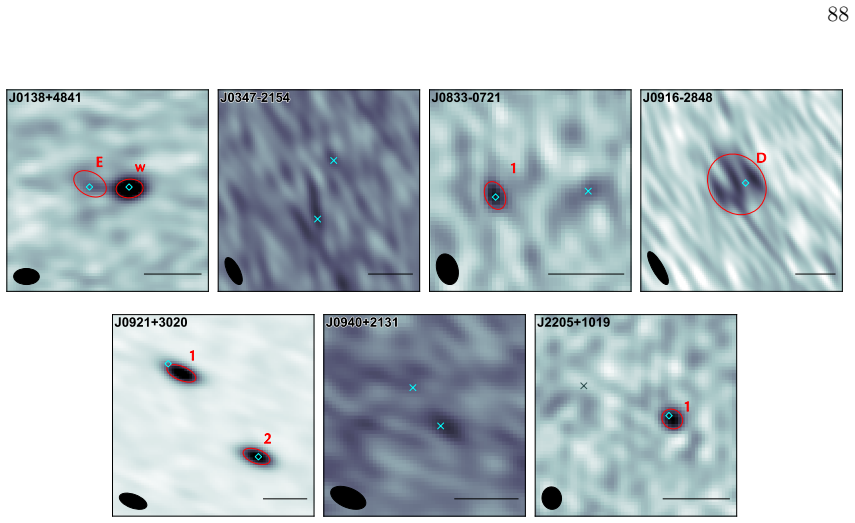

read the original abstract
While dark matter (DM) makes up roughly 80% of the total matter in the Universe, its microscopic properties remain one of the biggest questions in Cosmology today. Fortunately, those properties dictate the distribution and form of macro-scale gravitational structures in the universe, allowing for indirect studies which can distinguish between competing particle models. One such avenue for this research is via strong gravitational lensing systems, where dark halos in the lens substructure and along the line of sight perturb image positions and flux. However, the current population of sources suitable for this analysis is limited, especially at radio wavelengths where astrometric perturbations are observable. I will first discuss which properties of lens systems make them especially useful for DM constraints and examine the minimum amount of information necessary for such an experiment. Then, I present the results of two successful searches for new radio lenses in existing radio and optical surveys, utilizing a new method to expand the potential follow-up population for dark matter studies in the future. I conclude with a discussion of the completeness of this population.
Editorial analysis
A structured set of objections, weighed in public.
Referee Report
Summary. The manuscript first outlines the lens-system properties and minimum observational requirements (astrometric perturbations at radio wavelengths attributable to DM substructure) needed to constrain fundamental DM properties. It then reports the results of two searches that identify new radio-lensed sources in existing radio and optical surveys via a new method, and concludes with an assessment of the completeness of this expanded population for future follow-up.
Significance. Expanding the sample of radio lenses with potential for measurable astrometric perturbations would be valuable for DM substructure studies, given the current scarcity of suitable systems. The work is observational and draws on external survey data; it does not introduce new derivations or machine-checked proofs.
major comments (1)
- [Abstract and search-results section] Abstract and the section presenting the search results: the claim that the two searches successfully expand the usable population for DM constraints is load-bearing, yet no quantitative validation, error analysis, or confirmation that the identified systems exhibit observable radio astrometric perturbations (distinct from lens-modeling errors, source structure, or instrumental effects) is provided. This directly affects whether the new lenses satisfy the minimum-information criteria discussed earlier in the manuscript.
minor comments (2)
- Clarify the exact number of new lenses found and list their basic observables (e.g., image separations, flux ratios) in a table for reproducibility.
- [Completeness discussion] The discussion of completeness would benefit from explicit comparison to the size and properties of the previously known radio-lens sample.
Simulated Author's Rebuttal
We thank the referee for their careful reading and constructive feedback on our manuscript. We address the major comment below and indicate where revisions will be made to strengthen the presentation of our results.
read point-by-point responses
-
Referee: [Abstract and search-results section] Abstract and the section presenting the search results: the claim that the two searches successfully expand the usable population for DM constraints is load-bearing, yet no quantitative validation, error analysis, or confirmation that the identified systems exhibit observable radio astrometric perturbations (distinct from lens-modeling errors, source structure, or instrumental effects) is provided. This directly affects whether the new lenses satisfy the minimum-information criteria discussed earlier in the manuscript.
Authors: We agree that the manuscript would benefit from greater clarity on this point. The two searches were performed to identify radio-lensed sources meeting the basic criteria for potential astrometric DM studies (multiple compact radio images with sufficient separation and flux), as defined in the earlier sections on minimum observational requirements. The new method improves completeness relative to prior catalogs. However, we did not include a full quantitative error budget or explicit modeling of expected perturbation amplitudes for each candidate. In the revised version we will add a dedicated subsection with order-of-magnitude estimates of astrometric shifts based on the lens models and fiducial substructure masses, together with a discussion of how lens-modeling uncertainties and source structure are distinguished from potential DM signals. We note that definitive observational confirmation of DM-induced perturbations requires dedicated high-resolution follow-up (e.g., VLBI), which lies outside the scope of the present inventory paper. revision: partial
Circularity Check
No circularity: observational inventory draws on external surveys
full rationale
The manuscript reports results of two searches for radio lenses in existing radio and optical surveys using a described new method. No equations, fitted parameters, or predictions are defined in terms of the paper's own outputs. The central claims rest on external survey data and completeness discussion rather than any self-referential derivation or self-citation chain that reduces the result to its inputs by construction. This is a standard observational report with independent content from the data.
Axiom & Free-Parameter Ledger
axioms (1)
- domain assumption Strong gravitational lensing produces observable astrometric perturbations from dark matter substructure along the line of sight.
Lean theorems connected to this paper
-
IndisputableMonolith/Foundation/RealityFromDistinction.leanreality_from_one_distinction unclear?
unclearRelation between the paper passage and the cited Recognition theorem.
two successful searches for new radio lenses in existing radio and optical surveys, utilizing a new method to expand the potential follow-up population for dark matter studies
-
IndisputableMonolith/Cost/FunctionalEquation.leanwashburn_uniqueness_aczel unclear?
unclearRelation between the paper passage and the cited Recognition theorem.
Deflection and Magnification Anomalies... Statistical Tests... KS test for each WDM model
What do these tags mean?
- matches
- The paper's claim is directly supported by a theorem in the formal canon.
- supports
- The theorem supports part of the paper's argument, but the paper may add assumptions or extra steps.
- extends
- The paper goes beyond the formal theorem; the theorem is a base layer rather than the whole result.
- uses
- The paper appears to rely on the theorem as machinery.
- contradicts
- The paper's claim conflicts with a theorem or certificate in the canon.
- unclear
- Pith found a possible connection, but the passage is too broad, indirect, or ambiguous to say the theorem truly supports the claim.
Reference graph
Works this paper leans on
-
[1]
The Astropy Project: Sustaining and Growing a Community-oriented Open-source Project and the Latest Major Release (v5.0) of the Core Package. , keywords =. doi:10.3847/1538-4357/ac7c74 , archivePrefix =. 2206.14220 , primaryClass =
work page internal anchor Pith review Pith/arXiv arXiv doi:10.3847/1538-4357/ac7c74
-
[2]
The Astropy Project: Building an inclusive, open-science project and status of the v2.0 core package
The Astropy Project: Building an Open-science Project and Status of the v2.0 Core Package. , keywords =. doi:10.3847/1538-3881/aabc4f , archivePrefix =. 1801.02634 , primaryClass =
work page internal anchor Pith review Pith/arXiv arXiv doi:10.3847/1538-3881/aabc4f
-
[3]
Astropy: A Community Python Package for Astronomy
Astropy: A community Python package for astronomy. , keywords =. 2013. doi:10.1051/0004-6361/201322068 , archivePrefix =. 1307.6212 , primaryClass =
work page internal anchor Pith review Pith/arXiv arXiv doi:10.1051/0004-6361/201322068 2013
-
[4]
SExtractor: Software for source extraction. , keywords =. 1996. doi:10.1051/aas:1996164 , adsurl =
-
[5]
Quantifying the Observational Effort Required for the Radial Velocity Characterization of TESS Planets. , keywords =. 2018. doi:10.3847/1538-3881/aacea9 , archivePrefix =. 1807.01263 , primaryClass =
work page internal anchor Pith review Pith/arXiv arXiv doi:10.3847/1538-3881/aacea9 2018
-
[6]
X-Ray Scattering Echoes and Ghost Halos from the Intergalactic Medium: Relation to the Nature of AGN Variability. , keywords =. 2015. doi:10.1088/0004-637X/805/1/23 , archivePrefix =. 1503.01475 , primaryClass =
work page internal anchor Pith review Pith/arXiv arXiv doi:10.1088/0004-637x/805/1/23 2015
- [7]
-
[8]
T _ E X and LAT _ E X Macro Definition Files for Astronomical Publications. , year = "1989", month = "Mar", pages =
work page 1989
-
[9]
LaTeX: A Document Preparation System. 1994
work page 1994
-
[10]
Quasi-periodic Fast Propagating Magnetoacoustic Waves during the Magnetic Reconnection Between Solar Coronal Loops. , keywords =. 2018. doi:10.3847/2041-8213/aaf167 , archivePrefix =. 1811.08553 , primaryClass =
work page internal anchor Pith review Pith/arXiv arXiv doi:10.3847/2041-8213/aaf167 2018
-
[11]
Nominal values for selected solar and planetary quantities: IAU 2015 Resolution B3
Nominal Values for Selected Solar and Planetary Quantities: IAU 2015 Resolution B3. , keywords =. 2016. doi:10.3847/0004-6256/152/2/41 , archivePrefix =. 1605.09788 , primaryClass =
work page internal anchor Pith review Pith/arXiv arXiv doi:10.3847/0004-6256/152/2/41 2015
-
[12]
Swift X-Ray Observations of Classical Novae. II. The Super Soft Source Sample. , keywords =. 2011. doi:10.1088/0067-0049/197/2/31 , archivePrefix =. 1110.6224 , primaryClass =
work page internal anchor Pith review Pith/arXiv arXiv doi:10.1088/0067-0049/197/2/31 2011
-
[13]
Galaxy emission line classification using 3D line ratio diagrams
Galaxy Emission Line Classification Using Three-dimensional Line Ratio Diagrams. , keywords =. 2014. doi:10.1088/0004-637X/793/2/127 , archivePrefix =. 1406.5186 , primaryClass =
work page internal anchor Pith review Pith/arXiv arXiv doi:10.1088/0004-637x/793/2/127 2014
-
[14]
A search for gravitationally lensed quasars and quasar pairs in Pan-STARRS1: spectroscopy and sources of shear in the diamond 2M1134-2103. MNRAS , keywords =. doi:10.1093/mnras/stz1142 , archivePrefix =. 1803.07175 , primaryClass =
work page internal anchor Pith review Pith/arXiv arXiv doi:10.1093/mnras/stz1142
-
[15]
Finding Multiply Lensed and Binary Quasars in the DESI Legacy Imaging Surveys. , keywords =. doi:10.3847/1538-4365/ad015a , archivePrefix =. 2208.06356 , primaryClass =
-
[16]
HE 0047-1756: A new gravitationally lensed double QSO
HE 0047-1756: A new gravitationally lensed double QSO. , keywords =. doi:10.1051/0004-6361:20040131 , archivePrefix =. astro-ph/0403475 , primaryClass =
work page internal anchor Pith review Pith/arXiv arXiv doi:10.1051/0004-6361:20040131
-
[17]
MiNDSTEp differential photometry of the gravitationally lensed quasars WFI 2033-4723 and HE 0047-1756: microlensing and a new time delay. , keywords =. doi:10.1051/0004-6361/201527422 , archivePrefix =. 1610.03732 , primaryClass =
work page internal anchor Pith review Pith/arXiv arXiv doi:10.1051/0004-6361/201527422 2033
-
[18]
Strong Chromatic Microlensing in HE0047-1756 and SDSS1155+6346
Strong Chromatic Microlensing in HE0047-1756 and SDSS1155+6346. , keywords =. doi:10.1088/0004-637X/797/1/61 , archivePrefix =. 1409.8246 , primaryClass =
work page internal anchor Pith review Pith/arXiv arXiv doi:10.1088/0004-637x/797/1/61
-
[19]
COSMOGRAIL. XIX. Time delays in 18 strongly lensed quasars from 15 years of optical monitoring. , keywords =. doi:10.1051/0004-6361/202037740 , archivePrefix =. 2002.05736 , primaryClass =
-
[20]
High-resolution imaging follow-up of doubly imaged quasars. , keywords =. doi:10.1093/mnras/stab532 , archivePrefix =. 2011.01971 , primaryClass =
-
[21]
H0LiCOW. VI. Testing the fidelity of lensed quasar host galaxy reconstruction. , keywords =. doi:10.1093/mnras/stw3078 , archivePrefix =. 1610.08504 , primaryClass =
work page internal anchor Pith review Pith/arXiv arXiv doi:10.1093/mnras/stw3078
-
[22]
Radio emission from normal galaxies. , keywords =. doi:10.1146/annurev.aa.30.090192.003043 , adsurl =
-
[23]
Discovering strongly lensed quasar candidates with catalogue-based methods from DESI Legacy Surveys. , keywords =. doi:10.1051/0004-6361/202245484 , archivePrefix =. 2301.11080 , primaryClass =
-
[24]
Discovery of strongly lensed quasars in the Ultraviolet Near Infrared Optical Northern Survey (UNIONS). , keywords =. doi:10.1051/0004-6361/202142389 , archivePrefix =. 2110.09535 , primaryClass =
-
[25]
The Red-Sequence Cluster Survey. I. The Survey and Cluster Catalogs for Patches RCS 0926+37 and RCS 1327+29. , keywords =. doi:10.1086/427327 , archivePrefix =. astro-ph/0411075 , primaryClass =
work page internal anchor Pith review Pith/arXiv arXiv doi:10.1086/427327
-
[26]
Null Geodesics in Perturbed Spacetimes
Null Geodesics in Perturbed Spacetimes. , keywords =. doi:10.1086/173178 , archivePrefix =. astro-ph/9303020 , primaryClass =
work page internal anchor Pith review Pith/arXiv arXiv doi:10.1086/173178
-
[27]
Beyond the Thin Lens Approximation
Beyond the Thin Lens Approximation. , keywords =. doi:10.1086/176791 , archivePrefix =. astro-ph/9504060 , primaryClass =
work page internal anchor Pith review Pith/arXiv arXiv doi:10.1086/176791
- [28]
-
[29]
Cosmological dynamics. doi:10.48550/arXiv.astro-ph/9503125 , archivePrefix =. astro-ph/9503125 , primaryClass =
work page internal anchor Pith review Pith/arXiv arXiv doi:10.48550/arxiv.astro-ph/9503125
-
[30]
An introduction to general relativity
Spacetime and geometry. An introduction to general relativity
-
[31]
The classical theory of fields
-
[32]
The history of radio astronomy and the National Radio Astronomy Observatory : evolution toward big science
-
[33]
Gravitational Lensing: Recent Progress and Future Goals , year = 2001, editor =
The First Lenses. Gravitational Lensing: Recent Progress and Future Goals , year = 2001, editor =
work page 2001
-
[34]
The conceptual origins of gravitational lensing
The conceptual origins of gravitational lensing. Albert Einstein Century International Conference , year = 2006, editor =. doi:10.1063/1.2399715 , archivePrefix =. 1206.1165 , primaryClass =
work page internal anchor Pith review Pith/arXiv arXiv doi:10.1063/1.2399715 2006
-
[35]
A Determination of the Deflection of Light by the Sun's Gravitational Field, from Observations Made at the Total Eclipse of May 29, 1919. Philosophical Transactions of the Royal Society of London Series A , year = 1920, month = jan, volume =. doi:10.1098/rsta.1920.0009 , adsurl =
-
[36]
Science , year = 1936, month = dec, volume =
Lens-Like Action of a Star by the Deviation of Light in the Gravitational Field. Science , year = 1936, month = dec, volume =. doi:10.1126/science.84.2188.506 , adsurl =
-
[37]
Physical Review , year = 1937, month = feb, volume =
Nebulae as Gravitational Lenses. Physical Review , year = 1937, month = feb, volume =. doi:10.1103/PhysRev.51.290 , adsurl =
-
[38]
doi:10.1016/C2017-0-01943-2 , publisher =
Modern Cosmology. doi:10.1016/C2017-0-01943-2 , publisher =
-
[39]
The Black Hole Explorer: motivation and vision. Space Telescopes and Instrumentation 2024: Optical, Infrared, and Millimeter Wave , year = 2024, editor =. doi:10.1117/12.3019835 , archivePrefix =. 2406.12917 , primaryClass =
-
[40]
Identifying the Secondary Jet in the RadioAstron Image of OJ 287. , keywords =. doi:10.3847/1538-4357/ae057e , archivePrefix =. 2510.06744 , primaryClass =
-
[41]
survey design, processing, data products, and source counts
The VLBA CANDELS GOODS-North Survey - I. survey design, processing, data products, and source counts. , keywords =. doi:10.1093/mnras/stae253 , archivePrefix =. 2401.12298 , primaryClass =
-
[42]
DESI 2024 VI: Cosmological Constraints from the Measurements of Baryon Acoustic Oscillations
DESI 2024 VI: cosmological constraints from the measurements of baryon acoustic oscillations. , keywords =. doi:10.1088/1475-7516/2025/02/021 , archivePrefix =. 2404.03002 , primaryClass =
work page internal anchor Pith review Pith/arXiv arXiv doi:10.1088/1475-7516/2025/02/021 2024
-
[43]
Planck 2018 results. VI. Cosmological parameters. , keywords =. doi:10.1051/0004-6361/201833910 , archivePrefix =. 1807.06209 , primaryClass =
work page internal anchor Pith review Pith/arXiv arXiv doi:10.1051/0004-6361/201833910 2018
-
[44]
Dismantling Hubble's Legacy?. Origins of the Expanding Universe: 1912-1932 , year = 2013, editor =. doi:10.48550/arXiv.1301.7294 , archivePrefix =. 1301.7294 , primaryClass =
work page internal anchor Pith review Pith/arXiv arXiv doi:10.48550/arxiv.1301.7294 1912
-
[45]
, year = 1981, month = jan, volume =
Inflationary universe: A possible solution to the horizon and flatness problems. , year = 1981, month = jan, volume =. doi:10.1103/PhysRevD.23.347 , adsurl =
-
[46]
New Astronomy Reviews , author =
What drives the growth of black holes: A decade of progress. , keywords =. doi:10.1016/j.newar.2025.101733 , archivePrefix =. 2506.19166 , primaryClass =
-
[47]
Publications of the Astronomical Society of the Pacific , author =
Unified Schemes for Radio-Loud Active Galactic Nuclei. , keywords =. doi:10.1086/133630 , archivePrefix =. astro-ph/9506063 , primaryClass =
work page internal anchor Pith review Pith/arXiv arXiv doi:10.1086/133630
-
[48]
The focusing equation, caustics and the condition for multiple imaging by thick gravitational lenses. , keywords =. doi:10.1093/mnras/233.2.265 , adsurl =
-
[49]
The Thick Gravitational Lens: A Lens Composed of Many Elements at Different Distances. , keywords =. doi:10.1086/165179 , adsurl =
-
[50]
The continuous limit of the multiple lens effect and the optical scalar equation. , keywords =. doi:10.1111/j.1365-2966.2005.08698.x , archivePrefix =. astro-ph/0407040 , primaryClass =
- [51]
-
[52]
Fermat's Principle, Caustics, and the Classification of Gravitational Lens Images. , keywords =. doi:10.1086/164709 , adsurl =
-
[53]
History of dark matter. Reviews of Modern Physics , keywords =. doi:10.1103/RevModPhys.90.045002 , archivePrefix =. 1605.04909 , primaryClass =
work page internal anchor Pith review Pith/arXiv arXiv doi:10.1103/revmodphys.90.045002
-
[54]
How Dark Matter Came to Matter
How dark matter came to matter. Nature Astronomy , keywords =. doi:10.1038/s41550-017-0059 , archivePrefix =. 1703.00013 , primaryClass =
work page internal anchor Pith review Pith/arXiv arXiv doi:10.1038/s41550-017-0059
-
[55]
Helvetica Physica Acta , year = 1933, month = jan, volume =
Die Rotverschiebung von extragalaktischen Nebeln. Helvetica Physica Acta , year = 1933, month = jan, volume =
work page 1933
-
[56]
, year = 1936, month = jan, volume =
The Mass of the Virgo Cluster. , year = 1936, month = jan, volume =. doi:10.1086/143697 , adsurl =
-
[57]
, year = 1970, month = feb, volume =
Rotation of the Andromeda Nebula from a Spectroscopic Survey of Emission Regions. , year = 1970, month = feb, volume =. doi:10.1086/150317 , adsurl =
-
[58]
, year = 1973, month = jan, volume =
Aperture synthesis study of neutral hydrogen in the galaxies NGC 6946 and IC 342. , year = 1973, month = jan, volume =
work page 1973
-
[59]
Cosmology: Part III Mathematical Tripos
-
[60]
The milli-arcsecond images of Q0957+56.1. , keywords =. doi:10.1086/162712 , adsurl =
-
[61]
Planets, Stars and Stellar Systems
History of Dark Matter in Galaxies. Planets, Stars and Stellar Systems. Volume 5: Galactic Structure and Stellar Populations , year = 2013, publisher=. doi:10.1007/978-94-007-5612-0_21 , adsurl =
-
[62]
Revisiting the radio interferometer measurement equation. I. A full-sky Jones formalism. , keywords =. doi:10.1051/0004-6361/201016082 , archivePrefix =. 1101.1764 , primaryClass =
work page internal anchor Pith review Pith/arXiv arXiv doi:10.1051/0004-6361/201016082
-
[63]
Interferometry and synthesis in radio astronomy
-
[64]
Synthesis Imaging in Radio Astronomy , year = 1989, editor =
Self-Calibration. Synthesis Imaging in Radio Astronomy , year = 1989, editor =
work page 1989
-
[65]
The problem of non-coplanar arrays
Radio-interferometric imaging of very large fields. The problem of non-coplanar arrays. , keywords =
-
[66]
IEEE Journal of Selected Topics in Signal Processing , keywords =
The Noncoplanar Baselines Effect in Radio Interferometry: The W-Projection Algorithm. IEEE Journal of Selected Topics in Signal Processing , keywords =. doi:10.1109/JSTSP.2008.2005290 , archivePrefix =. 0807.4161 , primaryClass =
-
[67]
Wide-field wide-band interferometric imaging:The WB A-Projection and hybrid algorithms
Wide-field wide-band Interferometric Imaging: The WB A-Projection and Hybrid Algorithms. , keywords =. doi:10.1088/0004-637X/770/2/91 , archivePrefix =. 1304.4987 , primaryClass =
work page internal anchor Pith review Pith/arXiv arXiv doi:10.1088/0004-637x/770/2/91
-
[68]
Improving efficiency in radio surveys for gravitational lenses. , keywords =. doi:10.1111/j.1365-2966.2006.11126.x , archivePrefix =. astro-ph/0609818 , primaryClass =
-
[69]
The FIRST-Optical-VLA Survey for Lensed Radio Lobes
The FIRST-Optical-VLA Survey for Lensed Radio Lobes. , keywords =. doi:10.1086/466513 , archivePrefix =. astro-ph/0507295 , primaryClass =
work page internal anchor Pith review Pith/arXiv arXiv doi:10.1086/466513
-
[70]
A Quick Look at the 3GHz Radio Sky. II. Hunting for DRAGNs in the VLA Sky Survey. arXiv e-prints , keywords =. doi:10.48550/arXiv.2303.12830 , archivePrefix =. 2303.12830 , primaryClass =
-
[71]
Gravitationally lensed quasars in Gaia: III. 22 new lensed quasars from Gaia Data Release 2
Gravitationally lensed quasars in Gaia - III. 22 new lensed quasars from Gaia data release 2. , keywords =. doi:10.1093/mnras/sty3366 , archivePrefix =. 1810.04480 , primaryClass =
work page internal anchor Pith review Pith/arXiv arXiv doi:10.1093/mnras/sty3366
-
[72]
The Hamburg Quasar Survey. III. Further new bright quasars. , keywords =. doi:10.1051/aas:1999442 , adsurl =
-
[73]
A Quick Look at the 3 GHz Radio Sky. I. Source Statistics from the Very Large Array Sky Survey. , keywords =. doi:10.3847/1538-4365/ac05c0 , archivePrefix =. 2102.11753 , primaryClass =
-
[74]
Overview of the DESI Legacy Imaging Surveys
Overview of the DESI Legacy Imaging Surveys. , keywords =. doi:10.3847/1538-3881/ab089d , archivePrefix =. 1804.08657 , primaryClass =
work page internal anchor Pith review Pith/arXiv arXiv doi:10.3847/1538-3881/ab089d
-
[75]
The Gaia mission. , keywords =. doi:10.1051/0004-6361/201629272 , archivePrefix =. 1609.04153 , primaryClass =
work page internal anchor Pith review Pith/arXiv arXiv doi:10.1051/0004-6361/201629272
-
[76]
The Dark Energy Survey: more than dark energy - an overview
The Dark Energy Survey: more than dark energy - an overview. , keywords =. doi:10.1093/mnras/stw641 , archivePrefix =. 1601.00329 , primaryClass =
work page internal anchor Pith review Pith/arXiv arXiv doi:10.1093/mnras/stw641
-
[77]
Radio Counterpart Candidates to Unassociated 4FGL-DR2 Sources. , keywords =. doi:10.3847/1538-4357/abf73b , archivePrefix =. 2102.07397 , primaryClass =
-
[78]
Gravitationally Lensed Quasars in Gaia: I. Resolving Small-Separation Lenses
Gravitationally lensed quasars in Gaia: I. Resolving small-separation lenses. , keywords =. doi:10.1093/mnras/stx2094 , archivePrefix =. 1709.08976 , primaryClass =
work page internal anchor Pith review Pith/arXiv arXiv doi:10.1093/mnras/stx2094
-
[79]
Gravitationally Lensed Quasars in Gaia: II. Discovery of 24 Lensed Quasars
Gravitationally lensed quasars in Gaia - II. Discovery of 24 lensed quasars. , keywords =. doi:10.1093/mnras/sty911 , archivePrefix =. 1803.07601 , primaryClass =
work page internal anchor Pith review Pith/arXiv arXiv doi:10.1093/mnras/sty911
-
[80]
An Extended Catalog of Galaxy-Galaxy Strong Gravitational Lenses Discovered in DES Using Convolutional Neural Networks. , keywords =. doi:10.3847/1538-4365/ab26b6 , archivePrefix =. 1905.10522 , primaryClass =
discussion (0)
Sign in with ORCID, Apple, or X to comment. Anyone can read and Pith papers without signing in.