Cryogenically Enhanced Laser-Induced Amorphous Phase Transitions in Crystalline Silicon
Pith reviewed 2026-05-20 04:57 UTC · model grok-4.3
The pith
Cryogenic cooling enhances amorphization of silicon under single-shot femtosecond laser pulses.
A machine-rendered reading of the paper's core claim, the machinery that carries it, and where it could break.
Core claim
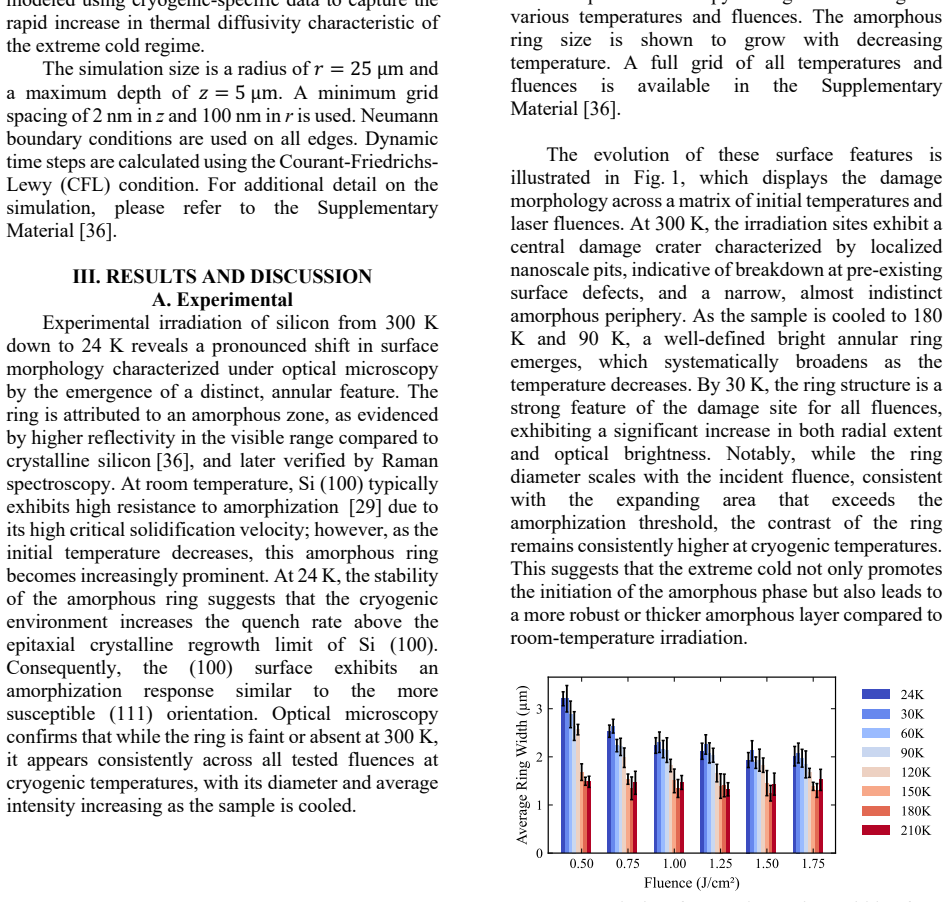
Across the temperature range from room temperature down to 24 K, single-shot femtosecond laser irradiation at 1030 nm produces a pronounced increase in amorphization at lower temperatures. Raman analysis confirms an amorphous surface layer, while AFM and SEM reveal temperature-dependent surface morphology changes such as localized melt redistribution. Carrier-dependent two-temperature model simulations reproduce the trends and indicate that reduced phonon population, modified absorption pathways, and altered lattice relaxation dynamics at cryogenic temperatures favor amorphous freezing over recrystallization.
What carries the argument
The carrier-dependent two-temperature model (nTTM), which tracks electron and lattice subsystems to show how lower temperatures shift the balance toward amorphous freezing rather than recrystallization.
If this is right
- Amorphization efficiency rises at cryogenic temperatures for the same laser fluence.
- Temperature joins laser fluence and pulse duration as a controllable variable in ultrafast silicon modification.
- Surface morphology, including melt redistribution and refrozen material, varies systematically with base temperature.
- These findings apply directly to microstructuring processes used in photonics, microelectronics, and solar cells.
Where Pith is reading between the lines
- The same cryogenic enhancement could be tested in other semiconductors to see whether the phonon-population mechanism is general.
- Cryogenic laser processing might allow finer control of amorphous-crystalline boundaries, potentially improving carrier collection in solar cells or optical confinement in photonic devices.
- Embedding silicon samples in a closed-cycle cryostat during laser writing could become a practical route for creating buried amorphous structures without post-annealing steps.
Load-bearing premise
The carrier-dependent two-temperature model accurately captures the physical origins of the temperature-dependent amorphization enhancement without requiring additional low-temperature-specific adjustments.
What would settle it
Repeating the single-shot irradiation experiments at an intermediate temperature such as 100 K and finding no monotonic increase in amorphous layer thickness, or obtaining direct time-resolved measurements of phonon populations that contradict the model's predicted cooling rates.
Figures



read the original abstract
Amorphization of silicon is crucial to applications in photonics, microelectronics and solar cell technologies. Ultrafast lasers have been used to generate amorphous silicon from crystalline silicon using rapid nonthermal melting and solidification in room temperature. As material temperature can affect cooling rates significantly, adding temperature control in ultrafast laser modification of silicon may allow a new degree of freedom in ultrafast laser modification. In this work, we investigate the role of cryogenic temperature in governing ultrafast damage pathways via single-shot femtosecond laser irradiation of silicon from room temperature down to 24K at 1030nm. Across this temperature range, we observe a pronounced enhancement of amorphization at lower temperatures, revealed through optical microscopy, Raman spectroscopy, and Kelvin probe force microscopy (KPFM). Raman analysis identifies this ring as an amorphous surface layer, while complementary AFM and SEM imaging show temperature-dependent changes in surface morphology, including localized melt redistribution and refrozen material. To elucidate the physical origins of this behavior, we implement a carrier dependent two-temperature model (nTTM). The simulations reproduce the experimentally observed trends and indicate that reduced phonon population, modified absorption pathways, and altered lattice relaxation dynamics at cryogenic temperatures collectively promote amorphous freezing over recrystallization. This study represents the first detailed examination of silicon under ultrafast irradiation below the liquid-nitrogen regime and reveals temperature-governed mechanisms relevant for advanced silicon microstructuring.
Editorial analysis
A structured set of objections, weighed in public.
Referee Report
Summary. The manuscript examines the influence of cryogenic temperatures (down to 24 K) on single-shot femtosecond laser-induced amorphization of crystalline silicon at 1030 nm. Multi-technique characterization (optical microscopy, Raman spectroscopy, KPFM, AFM, SEM) shows enhanced amorphization at lower temperatures, with Raman identifying an amorphous surface layer and morphology changes indicating melt redistribution. A carrier-dependent two-temperature model (nTTM) is implemented to reproduce the trends, attributing the enhancement to reduced phonon population, modified absorption pathways, and altered lattice relaxation dynamics at cryogenic conditions.
Significance. If the experimental trends are robust and the nTTM mechanistic account is independently validated, the work would establish cryogenic temperature as a controllable parameter for ultrafast laser phase engineering in silicon, with relevance to photonics and microelectronics. The extension below liquid-nitrogen temperatures and the consistent multi-probe evidence constitute a clear advance over prior room-temperature studies.
major comments (1)
- [nTTM Simulations] nTTM Simulations section: the model is described at a high level with no quantitative error bars, no tabulated parameter values, and no explicit demonstration that inputs (electron-phonon coupling, carrier relaxation times, temperature-dependent absorption at 1030 nm, lattice heat capacity) were measured or cross-validated independently below ~100 K. Standard nTTM parameterizations are calibrated near or above room temperature; without a sensitivity test restricting the simulation to parameters validated only above 77 K, it remains unclear whether the reproduction of the low-T enhancement is predictive or the result of low-temperature-specific adjustments.
minor comments (2)
- [Figures] Figure captions and text should explicitly state the number of shots (single-shot is claimed but not reiterated in all panels) and include scale bars with temperature labels for direct visual comparison.
- [Results] The phrase 'Raman analysis identifies this ring as an amorphous surface layer' appears to be a typographical reference; clarify whether 'ring' refers to a spectral feature, a spatial region, or another quantity.
Simulated Author's Rebuttal
We thank the referee for their constructive and detailed review of our manuscript. We have addressed the concerns raised about the nTTM simulations by expanding the relevant section with additional quantitative details, parameter tabulation, and a sensitivity analysis.
read point-by-point responses
-
Referee: [nTTM Simulations] nTTM Simulations section: the model is described at a high level with no quantitative error bars, no tabulated parameter values, and no explicit demonstration that inputs (electron-phonon coupling, carrier relaxation times, temperature-dependent absorption at 1030 nm, lattice heat capacity) were measured or cross-validated independently below ~100 K. Standard nTTM parameterizations are calibrated near or above room temperature; without a sensitivity test restricting the simulation to parameters validated only above 77 K, it remains unclear whether the reproduction of the low-T enhancement is predictive or the result of low-temperature-specific adjustments.
Authors: We thank the referee for this important observation on model transparency. In the revised manuscript we have substantially expanded the nTTM Simulations section. We now include a table listing all key input parameters (electron-phonon coupling strength, carrier relaxation times, temperature-dependent absorption coefficient at 1030 nm, and lattice heat capacity) together with their numerical values and literature sources. Quantitative error bars have been added to the simulated fluence thresholds. Direct experimental measurements of these parameters below ~100 K are not available in the existing literature for the relevant conditions; therefore we cannot provide independent cross-validation at those temperatures. However, we have performed and now report a sensitivity analysis that restricts all inputs to parameterizations validated only above 77 K (using established room-temperature calibrations and physically motivated extrapolations). Within the resulting uncertainty range the low-temperature enhancement of amorphization remains robust, indicating that the trend is not an artifact of low-T-specific fitting. This sensitivity study is presented as a new supplementary figure and is discussed in the revised main text. revision: yes
Circularity Check
No significant circularity in derivation chain
full rationale
The paper reports direct experimental observations of enhanced amorphization in silicon at cryogenic temperatures (down to 24 K) using optical microscopy, Raman spectroscopy, and KPFM, with supporting AFM/SEM morphology data. It then deploys a carrier-dependent two-temperature model (nTTM) whose simulations are described as reproducing the observed trends and attributing them to reduced phonon population, modified absorption, and altered lattice dynamics. No quoted step shows model parameters being fitted to the present cryogenic dataset and then relabeled as a prediction; the nTTM is presented as an explanatory tool whose inputs are drawn from standard literature parameterizations rather than being self-defined by the target result. There are no self-citation load-bearing uniqueness theorems, ansatz smuggling, or renaming of known results that collapse the central claim to its own inputs. The derivation therefore remains self-contained against external benchmarks and receives the default non-circularity finding.
Axiom & Free-Parameter Ledger
free parameters (1)
- nTTM model parameters for cryogenic absorption and relaxation
axioms (1)
- domain assumption The two-temperature approximation remains valid down to 24 K for describing carrier and lattice dynamics after femtosecond excitation.
Lean theorems connected to this paper
-
IndisputableMonolith/Foundation/RealityFromDistinction.leanreality_from_one_distinction unclear?
unclearRelation between the paper passage and the cited Recognition theorem.
To elucidate the physical origins of this behavior, we implement a carrier dependent two-temperature model (nTTM). The simulations reproduce the experimentally observed trends and indicate that reduced phonon population, modified absorption pathways, and altered lattice relaxation dynamics at cryogenic temperatures collectively promote amorphous freezing over recrystallization.
-
IndisputableMonolith/Cost/FunctionalEquation.leanwashburn_uniqueness_aczel unclear?
unclearRelation between the paper passage and the cited Recognition theorem.
The nTTM implementation in this study employs an effective heat capacity method to account for the latent heat of fusion... the lattice quench rate... is utilized as a physical proxy for the amorphization window.
What do these tags mean?
- matches
- The paper's claim is directly supported by a theorem in the formal canon.
- supports
- The theorem supports part of the paper's argument, but the paper may add assumptions or extra steps.
- extends
- The paper goes beyond the formal theorem; the theorem is a base layer rather than the whole result.
- uses
- The paper appears to rely on the theorem as machinery.
- contradicts
- The paper's claim conflicts with a theorem or certificate in the canon.
- unclear
- Pith found a possible connection, but the passage is too broad, indirect, or ambiguous to say the theorem truly supports the claim.
Reference graph
Works this paper leans on
-
[1]
A. D. Bristow, N. Rotenberg, and H. M. Van Driel, Applied Physics Letters 90, 191104 (2007). [21] J. K. Chen, D. Y. Tzou, and J. E. Beraun, International Journal of Heat and Mass Transfer 48, 501 (2005). [22] D. P. Korfiatis, K.-A. T. Thoma, and J. C. Vardaxoglou, J. Phys. D: Appl. Phys. 40, 6803 (2007). [23] H. Vaghasiya, S. Krause, and P.-T. Miclea, J. ...
work page 2007
-
[2]
M. Ishimaru, S. Munetoh, and T. Motooka, Phys. Rev. B 56, 15133 (1997). [40] S. Zhang et al., Sci Rep 5, 8590 (2015). [36] See Supplemental Material [url] for [brief description], which includes Refs. [37-47]. [37] J. Bonse, K.-W. Brzezinka, and A. J. Meixner, Applied Surface Science 221, 215 (2004). [38] J. K. Chen, D. Y. Tzou, and J. E. Beraun, Internat...
work page 1997
discussion (0)
Sign in with ORCID, Apple, or X to comment. Anyone can read and Pith papers without signing in.