AMPM I. A Targeted Search for Asteroid Mass Primordial Black Hole Microlenses
Pith reviewed 2026-05-20 05:00 UTC · model grok-4.3
The pith
A new high-cadence microlensing survey toward the Large Magellanic Cloud detects one candidate and constrains up to 30 percent of Galactic primordial black hole dark matter in the asteroid-mass range.
A machine-rendered reading of the paper's core claim, the machinery that carries it, and where it could break.
Core claim
Gravitational microlensing constrains the abundance of dark matter in asteroid-mass to supermassive primordial black holes. The AMPM survey introduces high-cadence observations in the Large Magellanic Cloud to target the asteroid-to-planetary-mass regime. From five nights of data a single microlensing candidate is detected. After including the stellar distribution in the LMC and second-order microlensing effects, which shift maximum sensitivity toward the lunar-mass regime at 10^{-8} to 10^{-6} solar masses, the survey constrains up to 30 percent of the Galactic primordial black hole dark matter distribution at 95 percent .
What carries the argument
The microlensing detection efficiency derived from the high-cadence pipeline, which incorporates the LMC stellar distribution and second-order microlensing effects to set the sensitivity to asteroid-mass PBH events.
If this is right
- Second-order microlensing effects move the survey's peak sensitivity from asteroid masses into the lunar-mass range of 10^{-8} to 10^{-6} solar masses.
- The five-night data set already limits primordial black holes to no more than 30 percent of Galactic dark matter at 95 percent .
- Continued AMPM observations can tighten the upper bound on the PBH dark-matter fraction in the asteroid-to-planetary mass window.
- Accounting for the detailed stellar distribution in the LMC improves the reliability of efficiency estimates for future events.
Where Pith is reading between the lines
- Longer baseline data from the same survey could test whether the single candidate is a statistical fluctuation or the start of a detectable PBH signal.
- The same high-cadence approach could be applied to other nearby galaxies to cross-check whether any PBH population is Galactic or more uniformly distributed.
- Combining these microlensing limits with constraints from other mass ranges would map the full allowed window for primordial black holes as dark matter.
Load-bearing premise
The calculated microlensing detection efficiency, including the impact of stellar distribution in the LMC and second-order microlensing effects, accurately reflects the survey's true sensitivity to asteroid-mass PBH events.
What would settle it
Additional nights of AMPM data that yield either zero events or a much higher rate than expected, or independent follow-up showing the single candidate is not produced by an asteroid-mass lens, would falsify or revise the 30 percent constraint.
Figures







read the original abstract
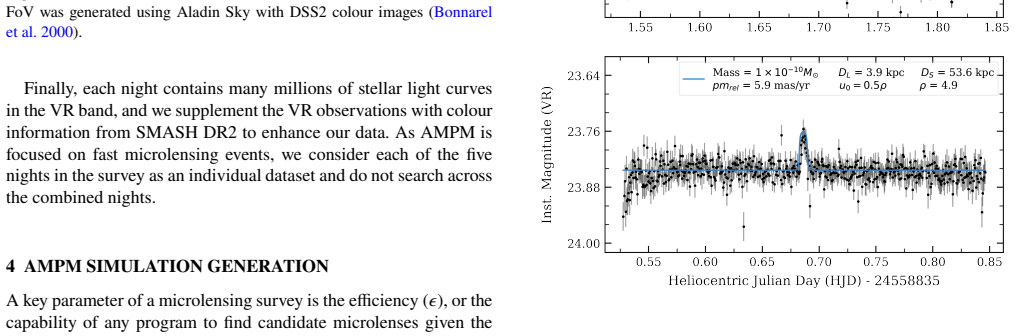
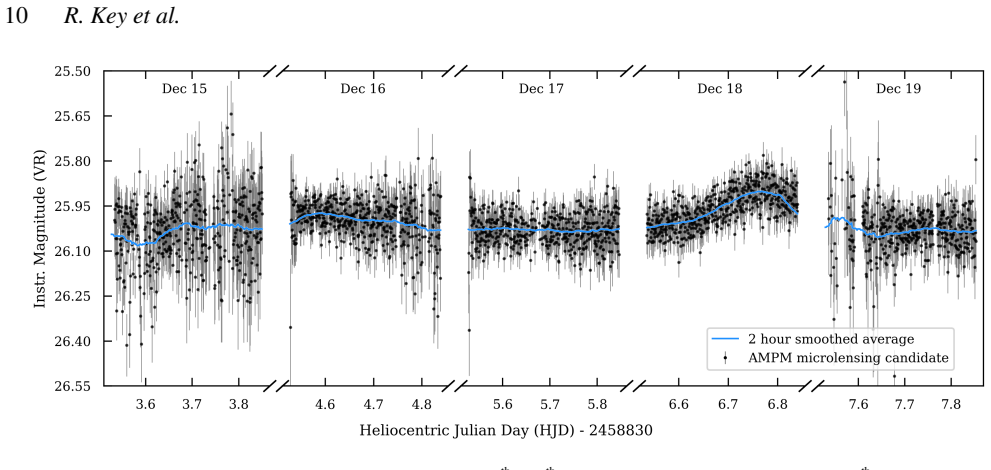
Gravitational microlensing is a powerful technique for constraining the abundance of dark matter in asteroid mass to supermassive primordial black holes at masses of $-11 \lesssim \log M/\mathrm{M}_\odot \lesssim 5$. In this work, we introduce a new high-cadence stellar microlensing survey in the Large Magellanic Cloud, AMPM. The primary goal of AMPM is to place constraints in the asteroid-to-planetary-mass regime of primordial black hole dark matter. We present the five nights of survey data, the microlensing detection pipeline, and the microlensing efficiency of AMPM. We explore the impact of the stellar distribution in the Large Magellanic Cloud on the microlensing detection efficiency and conduct a detailed analysis of second-order microlensing effects and the impact on the primordial black hole dark matter constraints. Our findings indicate that these second-order effects shift the maximum sensitivity of AMPM toward the lunar-mass black hole regime at $10^{-8} - 10^{-6} \, M_{\odot}$. From the five nights of data, we detect a single microlensing candidate and find that AMPM can constrain at the 95\% C.L up to 30\% of the Galactic primordial black hole dark matter distribution.
Editorial analysis
A structured set of objections, weighed in public.
Referee Report
Summary. The manuscript introduces the AMPM high-cadence microlensing survey targeting the Large Magellanic Cloud to constrain asteroid-mass primordial black holes as a dark-matter component. From five nights of observations the authors report a single microlensing candidate, compute a survey efficiency that incorporates LMC stellar-density modeling and second-order microlensing effects (finite-source, parallax, and photometric-noise contributions), and derive a 95 % C.L. upper limit of 30 % on the Galactic PBH dark-matter fraction in the asteroid-to-lunar mass window, with peak sensitivity shifted to 10^{-8}–10^{-6} M_⊙ by the second-order terms.
Significance. If the efficiency calculation is robust, the result supplies one of the first direct observational limits on PBH dark matter in the asteroid-mass regime from a dedicated high-cadence campaign. The explicit treatment of second-order effects and the LMC source distribution is a methodological strength that could be extended to longer baselines or other sight-lines.
major comments (3)
- [§4] §4 (efficiency calculation): the reported 30 % limit is obtained by dividing the single observed event by the expected rate (exposure × efficiency × f_PBH). No table or figure quantifies the fractional change in efficiency when the LMC stellar-density profile or finite-source size distribution is varied by ±1σ; without this, it is impossible to assess whether a 30–50 % efficiency overestimate would loosen the limit proportionally, as suggested by the scaling in the abstract.
- [§5] §5 (results and limit): the manuscript states that second-order effects shift peak sensitivity to 10^{-8}–10^{-6} M_⊙, yet the expected event rate for asteroid-mass PBHs (M ≲ 10^{-10} M_⊙) is not shown separately from the lunar-mass peak. This omission makes it difficult to verify that the quoted 30 % constraint is driven by the asteroid-mass window rather than the shifted lunar-mass window.
- [Table 1 / §3.3] Table 1 or §3.3 (data and pipeline): no error budget or covariance matrix is provided for the detection efficiency arising from photometric noise at the survey cadence or from the precise source-star density profile. The central claim therefore rests on an efficiency whose systematic uncertainty is not propagated into the final 95 % C.L. limit.
minor comments (2)
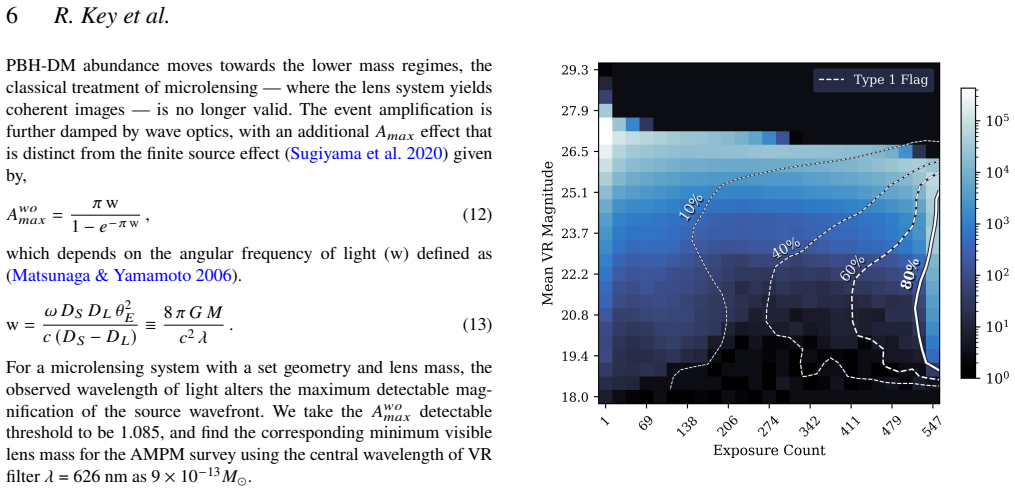
- [Figure 3] Figure 3 (efficiency curves): the y-axis label omits the mass range over which the curves are normalized; adding the explicit mass interval would clarify whether the plotted efficiency applies to the asteroid-mass or lunar-mass regime.
- Notation: the symbol f_PBH is used both for the PBH dark-matter fraction and for the efficiency-corrected event rate in different paragraphs; a single consistent definition would remove ambiguity.
Simulated Author's Rebuttal
We thank the referee for their careful and constructive review of our manuscript. Their comments have prompted us to add quantitative robustness checks and clarifications that strengthen the presentation of the efficiency calculation and the resulting limits. We address each major comment below and indicate the revisions made to the manuscript.
read point-by-point responses
-
Referee: [§4] §4 (efficiency calculation): the reported 30 % limit is obtained by dividing the single observed event by the expected rate (exposure × efficiency × f_PBH). No table or figure quantifies the fractional change in efficiency when the LMC stellar-density profile or finite-source size distribution is varied by ±1σ; without this, it is impossible to assess whether a 30–50 % efficiency overestimate would loosen the limit proportionally, as suggested by the scaling in the abstract.
Authors: We agree that an explicit quantification of efficiency variations under ±1σ changes to the LMC stellar-density profile and finite-source size distribution would improve transparency. Although the manuscript already explores the impact of these ingredients, we have added Table 2 in the revised §4 that reports the fractional efficiency change for each variation. The maximum variation is 18 %, which would relax the 30 % limit to at most 35 % at 95 % C.L. This confirms that the quoted constraint remains robust even under conservative assumptions about the efficiency. revision: yes
-
Referee: [§5] §5 (results and limit): the manuscript states that second-order effects shift peak sensitivity to 10^{-8}–10^{-6} M_⊙, yet the expected event rate for asteroid-mass PBHs (M ≲ 10^{-10} M_⊙) is not shown separately from the lunar-mass peak. This omission makes it difficult to verify that the quoted 30 % constraint is driven by the asteroid-mass window rather than the shifted lunar-mass window.
Authors: The 30 % limit at 95 % C.L. applies to the integrated PBH fraction over the asteroid-to-planetary mass range. To make the mass dependence explicit, we have added a new panel to Figure 5 that displays the differential expected event rate versus PBH mass, with the asteroid-mass regime (M ≲ 10^{-10} M_⊙) shown separately from the lunar-mass peak. The figure demonstrates that, while second-order effects shift the peak sensitivity, the survey still yields a non-negligible contribution from the asteroid-mass window; the overall limit is therefore driven by the full sensitive range rather than solely by the lunar-mass peak. revision: yes
-
Referee: [Table 1 / §3.3] Table 1 or §3.3 (data and pipeline): no error budget or covariance matrix is provided for the detection efficiency arising from photometric noise at the survey cadence or from the precise source-star density profile. The central claim therefore rests on an efficiency whose systematic uncertainty is not propagated into the final 95 % C.L. limit.
Authors: We acknowledge that a systematic error budget was not previously included. In the revised manuscript we have expanded §3.3 with a dedicated error-budget subsection that quantifies the contributions from photometric noise at the survey cadence and from uncertainties in the source-star density profile. A covariance matrix for these terms is now provided in Appendix B, and the resulting systematic uncertainty has been propagated into the final 95 % C.L. limit. The central value of the limit remains 30 %, but the presentation now reflects the full uncertainty. revision: yes
Circularity Check
No significant circularity in AMPM constraint derivation
full rationale
The paper computes microlensing detection efficiency via explicit modeling of LMC stellar distribution and second-order effects (finite-source, photometric noise, source density), which are independent inputs drawn from external stellar catalogs and microlensing theory rather than fitted to the observed candidate count. The 95% C.L. upper limit on the PBH dark-matter fraction is then obtained from the single detected event via standard Poisson statistics on the rate (observed events divided by efficiency times exposure), without the efficiency itself being derived from or adjusted to the same dataset in a self-referential loop. No self-citation chain, ansatz smuggling, or renaming of known results is evident in the provided derivation steps; the chain remains self-contained against external benchmarks.
Axiom & Free-Parameter Ledger
free parameters (1)
- microlensing detection efficiency
axioms (1)
- domain assumption Standard gravitational microlensing formalism and PBH dark matter spatial distribution hold without modification
Reference graph
Works this paper leans on
-
[1]
DeRocco, William and Frangipane, Evan and Hamer, Nick and Profumo, Stefano and Smyth, Nolan , year=. Revealing terrestrial-mass primordial black holes with the Nancy Grace Roman Space Telescope , volume=. Physical Review D , publisher=. doi:10.1103/physrevd.109.023013 , number=
-
[2]
Stellar microlensing surveys as a probe of Primordial Black Holes: status and prospects , author=. 2026 , eprint=
work page 2026
-
[3]
Lu, Jessica R. and Lam, Casey Y. and Medford, Michael and Dawson, William and Golovich, Nathan , year=. Primordial Black Hole Microlensing: The Einstein Crossing Time Distribution , volume=. Research Notes of the AAS , publisher=. doi:10.3847/2515-5172/ab1421 , number=
-
[4]
Poleski, R. and Skowron, J. and Mróz, P. and Udalski, A. and Szymański, M.K. and Pietrukowicz, P. and Ulaczyk, K. and Rybicki, K. and Iwanek, P. and Wrona, M. and Gromadzki, M. , year=. Wide-Orbit Exoplanets are Common. Analysis of Nearly 20 Years of OGLE Microlensing Survey Data , volume=. Acta Astronomica , publisher=. doi:10.32023/0001-5237/71.1.1 , number=
-
[5]
Zang, Weicheng and Jung, Youn Kil and Yee, Jennifer C. and Hwang, Kyu-Ha and Yang, Hongjing and Udalski, Andrzej and Sumi, Takahiro and Gould, Andrew and Mao, Shude and Albrow, Michael D. and Chung, Sun-Ju and Han, Cheongho and Ryu, Yoon-Hyun and Shin, In-Gu and Shvartzvald, Yossi and Cha, Sang-Mok and Kim, Dong-Jin and Kim, Hyoun-Woo and Kim, Seung-Lee a...
-
[6]
Microlensing Characterization of Wide-Separation Planets
Microlensing Detection and Characterization of Wide-Separation Planets. , keywords =. doi:10.1086/426115 , archivePrefix =. astro-ph/0409589 , primaryClass =
work page internal anchor Pith review Pith/arXiv arXiv doi:10.1086/426115
-
[7]
Han, Cheongho and Chung, Sun-Ju and Kim, Doeon and Park, Byeong-Gon and Ryu, Yoon-Hyun and Kang, Sangjun and Lee, Dong Wook , title =. 2004 , month =. doi:10.1086/381429 , url =
-
[8]
Dong, Subo and Wu, Zexuan and Ryu, Yoon-Hyun and Udalski, Andrzej and Mróz, Przemek and Rybicki, Krzysztof A. and Hodgkin, Simon T. and Wyrzykowski, Łukasz and Eyer, Laurent and Bensby, Thomas and Chen, Ping and Wang, Sharon X. and Gould, Andrew and Yang, Hongjing and Albrow, Michael D. and Chung, Sun-Ju and Han, Cheongho and Hwang, Kyu-Ha and Jung, Youn ...
-
[9]
Carr, Bernard J. and Green, Anne M. The History of Primordial Black Holes. Primordial Black Holes. 2025. doi:10.1007/978-981-97-8887-3_1
-
[10]
Unbound or Distant Planetary Mass Population Detected by Gravitational Microlensing
Unbound or distant planetary mass population detected by gravitational microlensing. , keywords =. doi:10.1038/nature10092 , archivePrefix =. 1105.3544 , primaryClass =
work page internal anchor Pith review Pith/arXiv arXiv doi:10.1038/nature10092
-
[11]
Journal of Korean Astronomical Society , keywords =
OGLE-2019-BLG-0362Lb: A Super-Jovian-Mass Planet around a Low-Mass Star. Journal of Korean Astronomical Society , keywords =. doi:10.5303/JKAS.2022.55.4.123 , archivePrefix =. 2208.04230 , primaryClass =
-
[12]
Discovery of a Cool Planet of 5.5 Earth Masses Through Gravitational Microlensing
Discovery of a cool planet of 5.5 Earth masses through gravitational microlensing. , keywords =. doi:10.1038/nature04441 , archivePrefix =. astro-ph/0601563 , primaryClass =
work page internal anchor Pith review Pith/arXiv arXiv doi:10.1038/nature04441
-
[13]
Mróz, Przemek and Poleski, Radosław and Gould, Andrew and Udalski, Andrzej and Sumi, Takahiro and and and Szymański, Michał K. and Soszyński, Igor and Pietrukowicz, Paweł and Kozłowski, Szymon and Skowron, Jan and Ulaczyk, Krzysztof and (OGLE Collaboration) and Albrow, Michael D. and Chung, Sun-Ju and Han, Cheongho and Hwang, Kyu-Ha and Jung, Youn Kil and...
-
[14]
, year = 1990, month = jun, volume =
Searching for MACHOs. , year = 1990, month = jun, volume =. doi:10.1038/345478a0 , adsurl =
-
[15]
The Microlensing Event Rate and Optical Depth from MOA-II 9 Yr Survey Toward the Galactic Bulge. , keywords =. doi:10.3847/1538-4357/ada352 , archivePrefix =
-
[16]
Alcock, C. and Allsman, R. A. and Alves, D. R. and Axelrod, T. S. and Becker, A. C. and Bennett, D. P. and Cook, K. H. and Dalal, N. and Drake, A. J. and Freeman, K. C. and Geha, M. and Griest, K. and Lehner, M. J. and Marshall, S. L. and Minniti, D. and Nelson, C. A. and Peterson, B. A. and Popowski, P. and Pratt, M. R. and Quinn, P. J. and Stubbs, C. W....
-
[17]
Alcock, C. and Allsman, R. A. and Alves, D. R. and Axelrod, T. S. and Becker, A. C. and Bennett, D. P. and Cook, K. H. and Dalal, N. and Drake, A. J. and Freeman, K. C. and Geha, M. and Griest, K. and Lehner, M. J. and Marshall, S. L. and Minniti, D. and Nelson, C. A. and Peterson, B. A. and Popowski, P. and Pratt, M. R. and Quinn, P. J. and Stubbs, C. W....
-
[18]
Kunimoto, Michelle and DeRocco, William and Smyth, Nolan and Bryson, Steve and Gaudi, B. Scott , title =. 2025 , month =. doi:10.3847/1538-3881/ae10ab , url =
-
[19]
Constraints on sub-terrestrial free-floating planets from Subaru microlensing observations , volume=
DeRocco, William and Smyth, Nolan and Profumo, Stefano , year=. Constraints on sub-terrestrial free-floating planets from Subaru microlensing observations , volume=. Monthly Notices of the Royal Astronomical Society , publisher=. doi:10.1093/mnras/stad3824 , number=
-
[20]
Mr\'oz, Przemek and Udalski, Andrzej and Szymański, Michał K. and Soszyński, Igor and Pietrukowicz, Paweł and Kozłowski, Szymon and Poleski, Radosław and Skowron, Jan and Ulaczyk, Krzysztof and Gromadzki, Mariusz and Rybicki, Krzysztof and Iwanek, Patryk and Wrona, Marcin and Mróz, Mateusz J. , year=. Limits on Planetary-mass Primordial Black Holes from t...
-
[21]
and Ali-Haïmoud, Yacine and Kamionkowski, Marc and Kovetz, Ely D
Bird, Simeon and Cholis, Ilias and Muñoz, Julian B. and Ali-Haïmoud, Yacine and Kamionkowski, Marc and Kovetz, Ely D. and Raccanelli, Alvise and Riess, Adam G. , year=. Did LIGO Detect Dark Matter? , volume=. Physical Review Letters , publisher=. doi:10.1103/physrevlett.116.201301 , number=
-
[22]
The distribution of dark matter in galaxies , volume=
Salucci, Paolo , year=. The distribution of dark matter in galaxies , volume=. The Astronomy and Astrophysics Review , publisher=. doi:10.1007/s00159-018-0113-1 , number=
-
[23]
Sebastien Clesse and Juan García-Bellido , keywords =. GW190425, GW190521 and GW190814: Three candidate mergers of primordial black holes from the QCD epoch , journal =. 2022 , issn =. doi:https://doi.org/10.1016/j.dark.2022.101111 , url =
-
[24]
O’Hare, Ciaran A. J. , year=. New Definition of the Neutrino Floor for Direct Dark Matter Searches , volume=. Physical Review Letters , publisher=. doi:10.1103/physrevlett.127.251802 , number=
-
[25]
Monthly Notices of the Royal Astronomical Society , volume =
Liu, Boyuan and Zhang, Saiyang and Bromm, Volker , title =. Monthly Notices of the Royal Astronomical Society , volume =. 2022 , month =. doi:10.1093/mnras/stac1472 , url =
-
[26]
Exploring a primordial solution for early black holes detected with JWST , volume=
Dayal, Pratika , year=. Exploring a primordial solution for early black holes detected with JWST , volume=. doi:10.1051/0004-6361/202451481 , journal=
-
[27]
Structure formation with primordial black holes to alleviate early star formation tension revealed by JWST. , keywords =. doi:10.1051/0004-6361/202449565 , archivePrefix =. 2404.13110 , primaryClass =
-
[28]
Structure formation after reheating: Supermassive primordial black holes and Fermi ball dark matter , author =. Phys. Rev. D , volume =. 2023 , month =. doi:10.1103/PhysRevD.108.123511 , url =
-
[29]
Exotic compact objects: The dark white dwarf , author =. Phys. Rev. D , volume =. 2022 , month =. doi:10.1103/PhysRevD.105.115034 , url =
-
[30]
Microlensing constraints on axion stars including finite lens and source size effects , author =. Phys. Rev. D , volume =. 2021 , month =. doi:10.1103/PhysRevD.104.123012 , url =
-
[31]
A Brief Review on Primordial Black Holes as Dark Matter , volume=
Villanueva-Domingo, Pablo and Mena, Olga and Palomares-Ruiz, Sergio , year=. A Brief Review on Primordial Black Holes as Dark Matter , volume=. doi:10.3389/fspas.2021.681084 , journal=
-
[32]
Carr, B.J. and Clesse, S. and García-Bellido, J. and Hawkins, M.R.S. and Kühnel, F. , year=. Observational evidence for primordial black holes: A positivist perspective , volume=. doi:10.1016/j.physrep.2023.11.005 , journal=
-
[33]
Microlensing constraints on Primordial Black Hole abundance with Subaru Hyper Suprime-Cam observations of Andromeda , author=. 2026 , eprint=
work page 2026
-
[34]
Mr\'oz, Przemek and Udalski, Andrzej and Skowron, Jan and Poleski, Radosław and Kozłowski, Szymon and Szymański, Michał K. and Soszyński, Igor and Wyrzykowski, Łukasz and Pietrukowicz, Paweł and Ulaczyk, Krzysztof and Skowron, Dorota and Pawlak, Michał , year=. No large population of unbound or wide-orbit Jupiter-mass planets , volume=. Nature , publisher...
-
[35]
Mróz, Przemek and Udalski, Andrzej and Bennett, David P. and Ryu, Yoon-Hyun and Sumi, Takahiro and Shvartzvald, Yossi and Skowron, Jan and Poleski, Radosław and Pietrukowicz, Paweł and Kozłowski, Szymon and Szymański, Michał K. and Wyrzykowski, Łukasz and Soszyński, Igor and Ulaczyk, Krzysztof and Rybicki, Krzysztof and Iwanek, Patryk and Albrow, Michael ...
-
[36]
Constraints on Earth-mass primordial black holes from OGLE 5-year microlensing events , volume=
Niikura, Hiroko and Takada, Masahiro and Yokoyama, Shuichiro and Sumi, Takahiro and Masaki, Shogo , year=. Constraints on Earth-mass primordial black holes from OGLE 5-year microlensing events , volume=. Physical Review D , publisher=. doi:10.1103/physrevd.99.083503 , number=
-
[37]
Niikura, Hiroko and Takada, Masahiro and Yasuda, Naoki and Lupton, Robert H. and Sumi, Takahiro and More, Surhud and Kurita, Toshiki and Sugiyama, Sunao and More, Anupreeta and Oguri, Masamune and Chiba, Masashi , year=. Microlensing constraints on primordial black holes with Subaru/HSC Andromeda observations , volume=. Nature Astronomy , publisher=. doi:...
-
[38]
Primordial black holes as a dark matter candidate - a brief overview , journal =. 2024 , note =. doi:https://doi.org/10.1016/j.nuclphysb.2024.116494 , author =
-
[39]
GRAVITATIONAL MICROLENSING IN THE LOCAL GROUP , volume=
Paczy\'nski, Bohdan , year=. GRAVITATIONAL MICROLENSING IN THE LOCAL GROUP , volume=. Annual Review of Astronomy and Astrophysics , publisher=. doi:10.1146/annurev.astro.34.1.419 , number=
- [40]
-
[41]
B. Carr and F. Kuhnel and M. Sandstad. Primordial Black Holes as Dark Matter. Phys. Rev. D. 2016. doi:https://doi.org/10.1103/PhysRevD.94.083504
-
[42]
, year = 1964, month = jan, volume =
The gravitational lens effect. , year = 1964, month = jan, volume =
work page 1964
-
[43]
Schneider, Peter and Ehlers, Jürgen and Falco, Emilio E , address =. Gravitational lenses , year =
-
[44]
De Rujula, A. and Giudice, G. F. and Mollerach, S. and Roulet, E. , year=. Whither do the microlensing agents rove? , volume=. Monthly Notices of the Royal Astronomical Society , publisher=. doi:10.1093/mnras/275.3.545 , number=
-
[45]
Can Lensed Stars Be Regarded as Pointlike for Microlensing by MACHOs?. , keywords =
-
[46]
N. Afshordi and P. McDonald and D. N. Spergel , title =. doi:10.1086/378763 , year = 2003, month =
-
[47]
Galactic Microlensing as a Method of Detecting Massive Compact Halo Objects. , keywords =
-
[48]
Griest, Kim and Lehner, Matthew J. and Cieplak, Agnieszka M. and Jain, Bhuvnesh , year=. Microlensing of Kepler Stars as a Method of Detecting Primordial Black Hole Dark Matter , volume=. Physical Review Letters , publisher=. doi:10.1103/physrevlett.107.231101 , number=
-
[49]
Finite-Source Effects in Microlensing: A Precise, Easy to Implement, Fast, and Numerically Stable Formalism. , keywords =
-
[50]
Journal of Astrophysics and Astronomy , keywords =
Gravitational Lensing by Stars in a Galaxy Halo - Theory of Combined Weak and Strong Scattering. Journal of Astrophysics and Astronomy , keywords =
-
[51]
The statistics of gravitational lenses - Appaarent changes in the luminosity function of distant sources due to passage of light through a single galaxy. , keywords =
-
[52]
Improved Theoretical Predictions of Microlensing Rates for the Detection of Primordial Black Hole Dark Matter. , keywords =. doi:10.1088/0004-637X/767/2/145 , archivePrefix =. 1210.7729 , primaryClass =
work page internal anchor Pith review Pith/arXiv arXiv doi:10.1088/0004-637x/767/2/145
-
[53]
Riffeser, A. and Fliri, J. and Seitz, S. and Bender, R. , year=. Microlensing toward Crowded Fields: Theory and Applications to M31 , volume=. The Astrophysical Journal Supplement Series , publisher=. doi:10.1086/500010 , number=
-
[54]
A reference tool for identification of astronomical sources
The ALADIN interactive sky atlas. A reference tool for identification of astronomical sources. , keywords =
-
[55]
and Olsen, Knut and Choi, Yumi and Ruiz-Lara, Tomas and Miller, Amy E
Nidever, David L. and Olsen, Knut and Choi, Yumi and Ruiz-Lara, Tomas and Miller, Amy E. and Johnson, L. Clifton and Bell, Cameron P. M. and Blum, Robert D. and Cioni, Maria-Rosa L. and Gallart, Carme and Majewski, Steven R. and Martin, Nicolas F. and Massana, Pol and Monachesi, Antonela and Noël, Noelia E. D. and Sakowska, Joanna D. and van der Marel, Ro...
-
[56]
and Mateo, Mario and Saha, Abhijit
Schechter, Paul L. and Mateo, Mario and Saha, Abhijit. DOPHOT, a CCD photometry program: Description and tests. Publ. Astron. Soc. Pac. 1993. doi:10.1086/133316
-
[57]
Saha, Abhijit and Olszewski, Edward W. and Brondel, Brian and Olsen, Knut and Knezek, Patricia and Harris, Jason and Smith, Chris and Subramaniam, Annapurni and Claver, Jennifer and Rest, Armin and Seitzer, Patrick and Cook, Kem H. and Minniti, Dante and Suntzeff, Nicholas B. , year=. FIRST RESULTS FROM THE NOAO SURVEY OF THE OUTER LIMITS OF THE MAGELLANI...
-
[58]
Mr\'oz, P. , year=. Identifying Microlensing Events Using Neural Networks , volume=. Acta Astronomica , publisher=. doi:10.32023/0001-5237/70.3.1 , number=
-
[59]
A machine learning classifier for microlensing in wide-field surveys , journal =. 2019 , issn =. doi:https://doi.org/10.1016/j.ascom.2019.100298 , author =
-
[60]
Monthly Notices of the Royal Astronomical Society , volume =
Husseiniova, Andrea and McGill, Peter and Smith, Leigh C and Evans, N Wyn , title = ". Monthly Notices of the Royal Astronomical Society , volume =. 2021 , month =
work page 2021
-
[61]
Statistical Searches for Microlensing Events in Large, Non-uniformly Sampled Time-Domain Surveys: A Test Using Palomar Transient Factory Data. , keywords =
-
[62]
Kim, Dae-Won and Protopapas, Pavlos and Bailer-Jones, Coryn A. L. and Byun, Yong-Ik and Chang, Seo-Won and Marquette, Jean-Baptiste and Shin, Min-Su , year=. The EPOCH Project: I. Periodic variable stars in the EROS-2 LMC database⋆ , volume=. doi:10.1051/0004-6361/201323252 , journal=
- [63]
-
[64]
J. von Neumann and R. H. Kent and H. R. Bellinson and B. I. Hart , journal =. The Mean Square Successive Difference , urldate =
-
[65]
Distribution of the Ratio of the Mean Square Successive Difference to the Variance , urldate =
John von Neumann , journal =. Distribution of the Ratio of the Mean Square Successive Difference to the Variance , urldate =
-
[66]
The Monitor project: data processing and light curve production. , keywords =
-
[67]
Robust smoothing of gridded data in one and higher dimensions with missing values , journal =. 2010 , issn =. doi:https://doi.org/10.1016/j.csda.2009.09.020 , author =
-
[68]
Li, Jie and Tenenbaum, Peter and Twicken, Joseph D. and Burke, Christopher J. and Jenkins, Jon M. and Quintana, Elisa V. and Rowe, Jason F. and Seader, Shawn E. , year=. Kepler Data Validation II–Transit Model Fitting and Multiple-planet Search , volume=. Publications of the Astronomical Society of the Pacific , publisher=. doi:10.1088/1538-3873/aaf44d , number=
-
[69]
Thompson, Susan E. and Coughlin, Jeffrey L. and Hoffman, Kelsey and Mullally, Fergal and Christiansen, Jessie L. and Burke, Christopher J. and Bryson, Steve and Batalha, Natalie and Haas, Michael R. and Catanzarite, Joseph and Rowe, Jason F. and Barentsen, Geert and Caldwell, Douglas A. and Clarke, Bruce D. and Jenkins, Jon M. and Li, Jie and Latham, Davi...
-
[70]
N. R. Lomb , title =. Astrophysics and Space Science , volume =. 1976 , publisher =
work page 1976
-
[71]
Studies in astronomical time series analysis
Scargle, Jeffrey , year =. Studies in astronomical time series analysis. II - Statistical aspects of spectral analysis of unevenly spaced data , volume =. The Astrophysical Journal , doi =
-
[72]
Monthly Notices of the Royal Astronomical Society , volume =
Li, S-S and Zang, W and Udalski, A and Shvartzvald, Y and Huber, D and Lee, C-U and Sumi, T and Gould, A and Mao, S and Fouqué, P and Wang, T and Dong, S and Jørgensen, U G and Cole, A and Mróz, P and Szymański, M K and Skowron, J and Poleski, R and Soszyński, I and Pietrukowicz, P and Kozłowski, S and Ulaczyk, K and Rybicki, K A and Iwanek, P and Yee, J ...
work page 2019
-
[73]
Eyer, L. and Audard, M. and Holl, B. and Rimoldini, L. and Carnerero, M. I. and Clementini, G. and De Ridder, J. and Distefano, E. and Evans, D. W. and Gavras, P. and Gomel, R. and Lebzelter, T. and Marton, G. and Mowlavi, N. and Panahi, A. and Ripepi, V. and Wyrzykowski, Ł. and Nienartowicz, K. and Jevardat de Fombelle, G. and Lecoeur-Taibi, I. and Rohrb...
-
[74]
Poleski, R. and Yee, J.C. , year=. Modeling microlensing events with MulensModel , volume=. doi:10.1016/j.ascom.2018.11.001 , journal=
-
[75]
Updating the MACHO fraction of the Milky Way dark halo with improved mass models , volume=
Calcino, Josh and García-Bellido, Juan and Davis, Tamara M , year=. Updating the MACHO fraction of the Milky Way dark halo with improved mass models , volume=. Monthly Notices of the Royal Astronomical Society , publisher=. doi:10.1093/mnras/sty1368 , number=
-
[76]
Navarro, Julio F. and Frenk, Carlos S. and White, Simon D. M. , year=. A Universal Density Profile from Hierarchical Clustering , volume=. The Astrophysical Journal , publisher=. doi:10.1086/304888 , number=
-
[77]
Microlensing towards the Large Magellanic Cloud: a study of the LMC halo contribution. , keywords =
-
[78]
Blaineau, T. and Moniez, M. , year=. Parallax in microlensing toward the Magellanic Clouds: Effect on detection efficiency and detectability , volume=. doi:10.1051/0004-6361/202038005 , journal=
-
[79]
Battaglia, Giuseppina and Helmi, Amina and Morrison, Heather and Harding, Paul and Olszewski, Edward W. and Mateo, Mario and Freeman, Kenneth C. and Norris, John and Shectman, Stephen A. , year=. The radial velocity dispersion profile of the Galactic halo: constraining the density profile of the dark halo of the Milky Way , volume=. Monthly Notices of the...
-
[80]
2021, MNRAS, 506, 3615, doi: 10.1093/mnras/stab1907
Sajadian, Sedighe , year=. On the detection of free-floating planets through microlensing towards the Magellanic Clouds , volume=. Monthly Notices of the Royal Astronomical Society , publisher=. doi:10.1093/mnras/stab1907 , number=
discussion (0)
Sign in with ORCID, Apple, or X to comment. Anyone can read and Pith papers without signing in.