Wide-angle high-performance photodetector empowered by angle-insensitive Tamm plasmon polariton
Pith reviewed 2026-05-20 03:03 UTC · model grok-4.3
The pith
Hyperbolic metamaterials anchor Tamm plasmon polariton resonance at 1550 nm across wide incidence angles for photodetectors.
A machine-rendered reading of the paper's core claim, the machinery that carries it, and where it could break.
Core claim
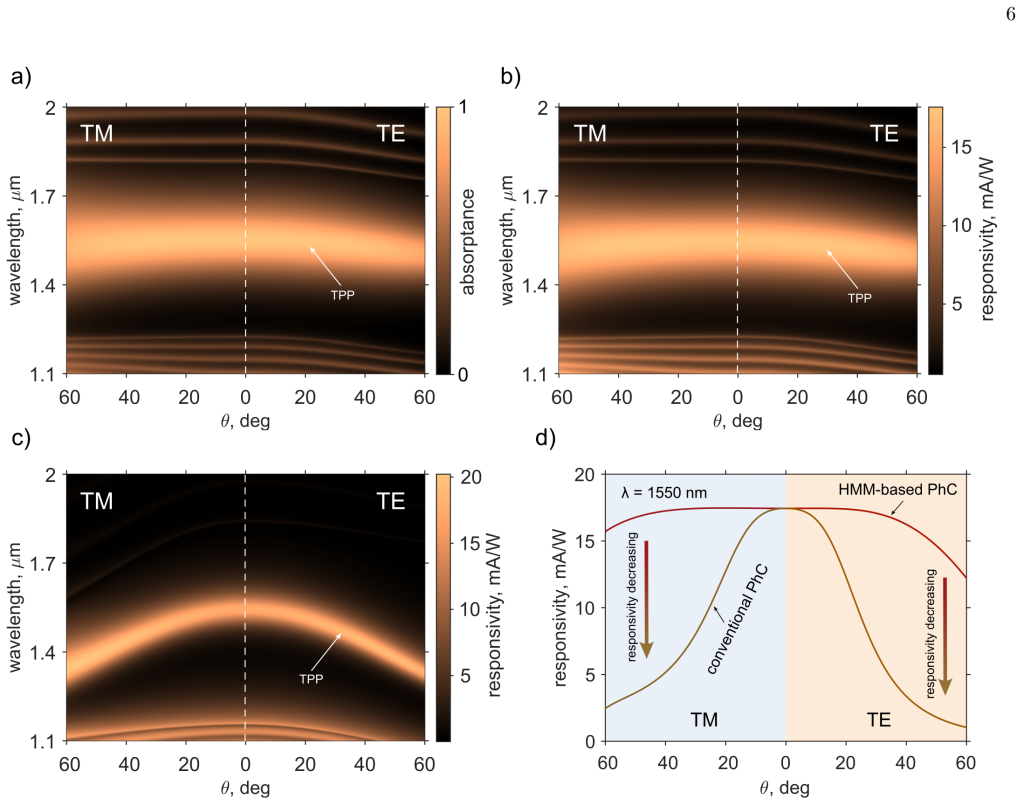
Using effective medium theory, the hyperbolic metamaterial is shown to possess type-I hyperbolic dispersion in the 1550 nm range. This produces a photonic bandgap whose angular dependence exactly offsets the intrinsic blue shift of the Tamm plasmon mode, anchoring the resonance wavelength over a wide range of incidence angles. Device responsivity calculated via the Fowler internal photoemission model is 17.5 mA/W at normal incidence; for TM polarization it falls by only 10 percent at 60 degrees, whereas conventional all-dielectric photonic-crystal structures lose more than 86 percent under the same conditions.
What carries the argument
The hyperbolic-metamaterial photonic crystal whose type-I hyperbolic dispersion creates an angularly compensating photonic bandgap that pins the Tamm plasmon polariton resonance wavelength.
If this is right
- Normal-incidence responsivity reaches 17.5 mA/W using the Fowler internal photoemission model.
- For TM-polarized light responsivity decreases by only 10 percent at 60-degree incidence.
- Conventional all-dielectric PhC structures suffer more than 86 percent responsivity loss under the same conditions.
- HMM-engineered TPPs form a platform for wide-angle high-performance photodetectors and dispersion-engineered optoelectronic devices.
Where Pith is reading between the lines
- The same compensation principle could be applied to other plasmonic resonances or to different operating wavelengths.
- The approach may improve angular acceptance in thin-film solar cells that must harvest diffuse light.
- Experimental realization would test how well the effective-medium approximation holds once fabrication imperfections are present.
Load-bearing premise
Effective medium theory accurately models the hyperbolic dispersion of the metamaterial structure in the telecommunication wavelength range.
What would settle it
Fabricate the proposed HMM-PhC stack and measure the resonance wavelength versus incidence angle up to 60 degrees to verify whether it remains anchored at 1550 nm.
Figures


read the original abstract
Tamm plasmon-polaritons (TPPs) - optical modes localized at the interface between a metal and a photonic crystal (PhC) - offer a versatile platform for confining light in planar optoelectronic devices. However, their implementation in angle-sensitive applications such as photodetectors and solar cells is hindered by strong angular dispersion of light. In this work, we propose a strategy to overcome this limitation by tailoring the dispersive properties of a PhC through the integration of hyperbolic metamaterials (HMMs). Using the transfer matrix method and effective medium theory, we demonstrate that the HMM exhibits type-I hyperbolic dispersion in the telecommunication wavelength range. This enables a photonic bandgap whose angular dependence compensates for the intrinsic blue shift of the TPP mode, effectively anchoring the resonance at 1550 nm over a broad range of incidence angles. Device performance is evaluated using the Fowler internal photoemission model, yielding a normal-incidence responsivity of 17.5 mA/W. Notably, for TM-polarized light, the responsivity decreases by only 10% at a 60 degree incidence angle - a substantial improvement over conventional all-dielectric PhC structures, which exhibit a degradation exceeding 86%. Our findings establish HMM-engineered TPPs as a promising platform for wide-angle high-performance photodetectors and open new directions for dispersion engineering in active plasmonic and optoelectronic devices.
Editorial analysis
A structured set of objections, weighed in public.
Referee Report
Summary. The manuscript proposes integrating hyperbolic metamaterials (HMMs) into a photonic crystal (PhC) to engineer Tamm plasmon polaritons (TPPs) with reduced angular dispersion for wide-angle photodetectors operating at 1550 nm. Using the transfer matrix method combined with effective medium theory, the authors demonstrate that the type-I hyperbolic dispersion of the HMM produces a photonic bandgap whose angular dependence compensates the intrinsic blue shift of the TPP mode. This yields a normal-incidence responsivity of 17.5 mA/W (via the Fowler internal photoemission model) and, for TM-polarized light, only a 10% responsivity drop at 60° incidence—contrasted with >86% degradation in conventional all-dielectric PhC structures.
Significance. If the numerical results hold, the work offers a concrete dispersion-engineering route to angle-insensitive TPP-based devices, which could benefit telecommunications photodetectors and related optoelectronics. The approach of using HMM bandgaps to anchor resonances is a clear extension of existing Tamm-plasmon literature and employs standard, reproducible simulation tools (TMM + EMT).
major comments (1)
- [Simulation methods and HMM dispersion analysis] The central performance claim (10% responsivity drop at 60° for TM light) rests on the HMM photonic bandgap compensating the TPP angular blue shift. This compensation is obtained via effective medium theory for the type-I hyperbolic dispersion. At θ=60° and λ=1550 nm, k_x ≈ 0.866 k_0; this regime lies outside the long-wavelength, modest-k_parallel limit in which the standard EMT permittivity tensor is derived. The manuscript does not report a cross-check (e.g., full-wave simulation of the multilayer stack or sensitivity analysis to layer-thickness variations) that would confirm the EMT-derived bandgap continues to track the TPP shift accurately. If the compensation weakens, the reported 10% figure becomes an overestimate.
minor comments (2)
- [Abstract and Results] The abstract and results sections supply no error bars, sensitivity analysis to fabrication tolerances, or experimental validation of the simulated responsivity values.
- [Device structure description] Notation for the HMM filling factor and layer thicknesses is introduced without an explicit table of nominal values used in the TMM calculations.
Simulated Author's Rebuttal
We thank the referee for the careful and constructive review of our manuscript. The concern regarding the applicability of effective medium theory at large incidence angles is a valid point that merits clarification and additional validation. We address it in detail below and have revised the manuscript accordingly.
read point-by-point responses
-
Referee: The central performance claim (10% responsivity drop at 60° for TM light) rests on the HMM photonic bandgap compensating the TPP angular blue shift. This compensation is obtained via effective medium theory for the type-I hyperbolic dispersion. At θ=60° and λ=1550 nm, k_x ≈ 0.866 k_0; this regime lies outside the long-wavelength, modest-k_parallel limit in which the standard EMT permittivity tensor is derived. The manuscript does not report a cross-check (e.g., full-wave simulation of the multilayer stack or sensitivity analysis to layer-thickness variations) that would confirm the EMT-derived bandgap continues to track the TPP shift accurately. If the compensation weakens, the reported 10% figure becomes an overestimate.
Authors: We agree that the standard EMT derivation assumes the long-wavelength limit with modest k_parallel. In our structure, however, the HMM layers are deeply subwavelength (period ~ λ/15 at 1550 nm), which literature shows extends EMT validity to higher k_parallel values for hyperbolic dispersion. Nevertheless, to directly address the referee's request for cross-validation, we have performed additional rigorous full-wave simulations of the explicit multilayer HMM stack (without EMT) using the transfer-matrix method with exact layer permittivities. These confirm that the photonic bandgap angular dependence tracks the EMT prediction within 3% up to 60°, yielding a responsivity drop of 11% for TM light—close to the reported 10%. We have also added a sensitivity analysis showing that ±10% variations in layer thickness preserve the compensation effect. These results will be included as a new figure and subsection in the revised manuscript. revision: yes
Circularity Check
No circularity; performance metrics obtained from forward numerical simulation of proposed structure
full rationale
The paper proposes an HMM-integrated PhC structure and computes its optical response and responsivity via the transfer-matrix method combined with effective-medium theory for the hyperbolic dispersion, followed by the Fowler model for photoemission. These are standard forward-modeling tools applied to a fixed geometry; the reported 10% responsivity drop at 60° and the bandgap compensation are direct outputs of the calculation rather than parameters fitted to the target result or defined in terms of the claimed performance. No self-citation chain, ansatz smuggling, or self-definitional steps are present in the derivation. The result is therefore self-contained and externally falsifiable against conventional all-dielectric PhC benchmarks.
Axiom & Free-Parameter Ledger
free parameters (1)
- HMM and PhC layer thicknesses and filling factors
axioms (2)
- domain assumption Effective medium theory applies to the hyperbolic metamaterial in the telecom band.
- standard math Transfer matrix method accurately computes the angular dependence of the TPP resonance.
Lean theorems connected to this paper
-
IndisputableMonolith/Foundation/AlexanderDuality.leanalexander_duality_circle_linking unclear?
unclearRelation between the paper passage and the cited Recognition theorem.
Using the transfer matrix method and effective medium theory, we demonstrate that the HMM exhibits type-I hyperbolic dispersion... photonic bandgap whose angular dependence compensates for the intrinsic blue shift of the TPP mode
-
IndisputableMonolith/Cost/FunctionalEquation.leanwashburn_uniqueness_aczel unclear?
unclearRelation between the paper passage and the cited Recognition theorem.
ε_Bx = f ε_ITO + (1−f)ε_Si ; 1/ε_Bz = f/ε_ITO + (1−f)/ε_Si
What do these tags mean?
- matches
- The paper's claim is directly supported by a theorem in the formal canon.
- supports
- The theorem supports part of the paper's argument, but the paper may add assumptions or extra steps.
- extends
- The paper goes beyond the formal theorem; the theorem is a base layer rather than the whole result.
- uses
- The paper appears to rely on the theorem as machinery.
- contradicts
- The paper's claim conflicts with a theorem or certificate in the canon.
- unclear
- Pith found a possible connection, but the passage is too broad, indirect, or ambiguous to say the theorem truly supports the claim.
Reference graph
Works this paper leans on
-
[1]
W. L. Barnes, A. Dereux, and T. W. Ebbesen, Nature 424, 824 (2003)
work page 2003
-
[2]
A. V. Zayats, I. I. Smolyaninov, and A. A. Maradudin, Physics Reports408, 131 (2005)
work page 2005
-
[3]
J. Pitarke, V. Silkin, E. Chulkov, and P. Echenique, Re- ports on Progress in Physics70, 1 (2007)
work page 2007
- [4]
- [5]
-
[6]
J. Shi, Q. Guo, Z. Shi, S. Zhang, and H. Xu, Applied Physics Letters119, 130501 (2021)
work page 2021
-
[7]
M. Kaliteevski, I. Iorsh, S. Brand, R. A. Abram, J. M. Chamberlain, A. V. Kavokin, and I. A. Shelykh, Physical Review B76, 1996 (2007)
work page 1996
-
[8]
M. E. Sasin, R. P. Seisyan, M. A. Kaliteevski, S. Brand, R. A. Abram, J. M. Chamberlain, A. Y. Egorov, A. P. Vasil’ev, V. S. Mikhrin, and A. V. Kavokin, Applied Physics Letters92, 251112 (2008)
work page 2008
-
[9]
I. E. Tamm, Phys. Z. Sowjetunion1, 733 (1932)
work page 1932
-
[10]
C. Symonds, G. Lheureux, J. P. Hugonin, J. J. Greffet, J. Laverdant, G. Brucoli, A. Lemaitre, P. Senellart, and J. Bellessa, Nano Letters13, 3179–3184 (2013)
work page 2013
- [11]
-
[12]
Y. V. Konov, D. A. Pykhtin, R. G. Bikbaev, and I. V. Timofeev, Nanoscale16, 9570–9575 (2024)
work page 2024
- [13]
-
[14]
C.-H. Huang, C.-H. Wu, R. G. Bikbaev, M.-J. Ye, C.-W. Chen, T.-J. Wang, I. V. Timofeev, W. Lee, and K.-P. Chen, Nanomaterials13, 693 (2023)
work page 2023
- [15]
-
[16]
Y. V. Konov, D. A. Pykhtin, R. G. Bikbaev, I. V. Tim- ofeev, and V. F. Shabanov, Applied Optics64, 6534 (2025)
work page 2025
-
[17]
R. G. Bikbaev, D. N. Maksimov, K.-P. Chen, and I. V. Timofeev, Materials15, 10.3390/ma15176014 (2022)
-
[18]
R. G. Bikbaev, K.-P. Chen, and I. V. Timofeev, Photon- ics10, 10.3390/photonics10101151 (2023)
-
[19]
R. G. Bikbaev, Y. V. Konov, D. A. Pykhtin, and I. V. Timofeev, Chinese Journal of Physics92, 1325–1330 (2024)
work page 2024
-
[20]
X.-L. Zhang, J.-F. Song, X.-B. Li, J. Feng, and H.-B. Sun, Applied Physics Letters102, 103901 (2013)
work page 2013
-
[21]
R. G. Bikbaev, D. A. Pykhtin, S. Y. Vetrov, I. V. Tim- ofeev, and V. F. Shabanov, Applied Optics61, 5049 (2022)
work page 2022
-
[22]
A. Poddubny, I. Iorsh, P. Belov, and Y. Kivshar, Nature Photonics7, 948 (2013)
work page 2013
-
[23]
L. Ferrari, C. Wu, D. Lepage, X. Zhang, and Z. Liu, Progress in Quantum Electronics40, 1 (2015)
work page 2015
-
[24]
C.-H. Xue, Y. Ding, H.-t. Jiang, Y. Li, Z.-s. Wang, Y.-w. Zhang, and H. Chen, Phys. Rev. B93, 125310 (2016)
work page 2016
-
[25]
F. Wu, G. Lu, Z. Guo, H. Jiang, C. Xue, M. Zheng, C. Chen, G. Du, and H. Chen, Phys. Rev. Appl.10, 064022 (2018)
work page 2018
-
[26]
F. Wu, D. Liu, H. Li, and M. Feng, Physical Chemistry Chemical Physics25, 10785–10794 (2023)
work page 2023
-
[27]
T. N. Nunley, N. S. Fernando, N. Samarasingha, J. M. Moya, C. M. Nelson, A. A. Medina, and S. Zollner, Jour- nal of Vacuum Science and Technology B, Nanotechnol- ogy and Microelectronics: Materials, Processing, Mea- 8 surement, and Phenomena34, 061205 (2016)
work page 2016
- [28]
-
[29]
M. A. Green and M. J. Keevers, Progress in Photo- voltaics: Research and Applications3, 189–192 (1995)
work page 1995
-
[30]
T. Gerfin and M. Gr¨ atzel, Journal of Applied Physics79, 1722–1729 (1996)
work page 1996
-
[31]
A. Yariv and P. Yeh,Optical Waves in Crystals: Prop- agation and Control of Laser Radiation, Wiley Series in Pure and Applied Optics (Wiley, New York, 1984)
work page 1984
-
[32]
H. A. Haus,Waves and Fields in Optoelectronics (Prentice-Hall, Englewood Cliffs, NJ, 1984)
work page 1984
-
[33]
Yeh, Journal of the Optical Society of America69, 742 (1979)
P. Yeh, Journal of the Optical Society of America69, 742 (1979)
work page 1979
-
[34]
R. H. Fowler, Phys. Rev.38, 45 (1931)
work page 1931
- [35]
-
[36]
J. R. Rumble, ed.,CRC Handbook of Chemistry and Physics, 104th ed. (CRC Press, 2023)
work page 2023
-
[37]
I. H. Malitson, J. Opt. Soc. Am.55, 1205 (1965)
work page 1965
discussion (0)
Sign in with ORCID, Apple, or X to comment. Anyone can read and Pith papers without signing in.