Spectro Capture: A Software System for Automated Small-Observatory Spectroscopy
Pith reviewed 2026-05-20 02:29 UTC · model grok-4.3
The pith
Integrating target acquisition, guiding, scheduling and calibration in one software system makes reliable unattended spectroscopy practical at small observatories.
A machine-rendered reading of the paper's core claim, the machinery that carries it, and where it could break.
Core claim
The paper establishes that reliable unattended spectroscopy is practical at a small observatory when target acquisition, guiding, scheduling and calibration control are treated as an integrated software problem, as shown by the 98.3 percent completion rate achieved across five months of primary batch runs at Shenton Park Observatory.
What carries the argument
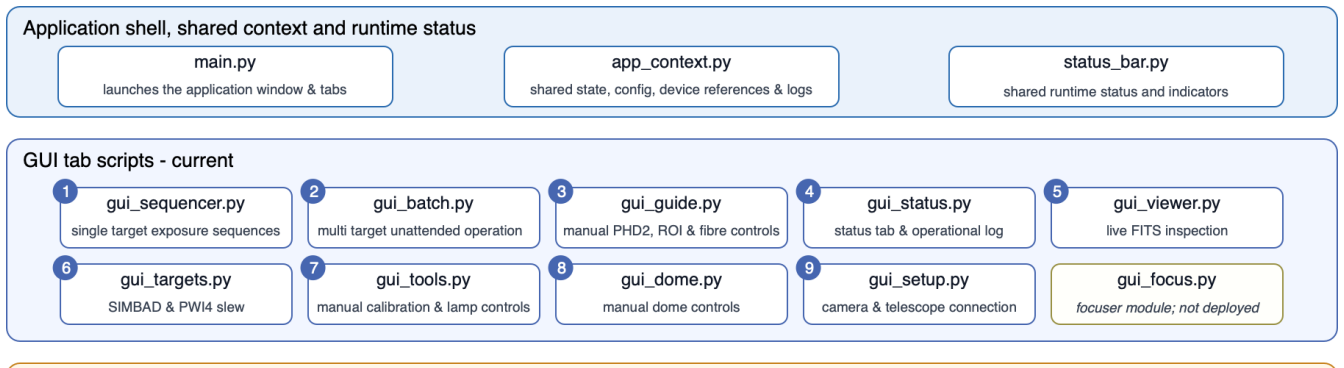
Spectro Capture, the Python software that unifies target selection, slewing, guide star acquisition, fibre position restoration, calibration sequencing and science exposures into one observing workflow.
If this is right
- Small observatories can execute multi-target spectroscopic campaigns without on-site staff during the run.
- Treating acquisition, guiding and calibration as linked software tasks reduces interruptions that arise from separate manual or disconnected controls.
- Unattended batch operation becomes feasible for extended periods once the full workflow is automated.
- The approach supports more efficient scheduling of limited telescope resources at educational and amateur facilities.
Where Pith is reading between the lines
- The same integrated control pattern could apply to automated photometry or other small-telescope programs beyond spectroscopy.
- Deployment at additional observatories would reveal how sensitive the success rate is to local weather statistics and hardware variations.
- Wider use might expand the number of sites able to contribute to time-domain spectroscopic surveys.
Load-bearing premise
The 98.3 percent completion rate recorded at one specific small observatory will hold at other sites and under future conditions without major drops caused by weather, hardware differences or target biases.
What would settle it
Logs from a second small observatory running the same system that show a completion rate well below 90 percent over a comparable period.
Figures




read the original abstract
Spectro Capture is a Python-based software system developed to automate small- observatory fibre-fed spectroscopy. The system integrates target selection, telescope slewing, guide star acquisition, fibre position restoration, calibration and science exposure sequencing within a single observing workflow. The paper describes the design and operational behaviour of the system at Shenton Park Observatory, where it has been used for unattended multi-target spectroscopic observing. Log analysis from January to May 2026 shows that the system completed 339 of 345 attempted science target blocks in primary unattended batch runs, corresponding to a completion rate of 98.3%. The results demonstrate that reliable unattended spectroscopy is practical at a small observatory when target acquisition, guiding, scheduling and calibration control are treated as an integrated software problem.
Editorial analysis
A structured set of objections, weighed in public.
Referee Report
Summary. The manuscript introduces Spectro Capture, a Python-based software system designed to automate fibre-fed spectroscopy for small observatories. The system combines target selection, telescope control, guide star acquisition, fibre position restoration, calibration, and science exposure sequencing into a unified workflow. Operational logs from January to May 2026 at Shenton Park Observatory indicate that 339 out of 345 attempted science target blocks were successfully completed in unattended mode, yielding a 98.3% success rate. The authors conclude that this demonstrates the practicality of reliable unattended spectroscopy at small observatories through integrated software management of acquisition, guiding, scheduling, and calibration.
Significance. Should the reported performance be robust and generalizable, the work would be significant for advancing automation in small-scale astronomical facilities, potentially allowing more efficient use of telescope time with reduced human intervention. A key strength is the grounding in real-world log data from actual observations rather than purely theoretical or simulated performance. This empirical approach provides concrete evidence for the efficacy of the integrated approach, which is valuable in the instrumentation and methods community.
major comments (2)
- [Log analysis section] The performance metric of 339/345 blocks completed (98.3%) is central to the paper's claim, yet the manuscript does not specify how 'blocks' were defined, what constituted a failure (e.g., acquisition failure, guiding loss, or weather-related abort), or if any post-hoc selection of logs occurred. This lack of detail undermines the ability to fully assess the soundness of the reported completion rate.
- [Conclusions or discussion of results] The assertion that the results show practicality 'at a small observatory' when using integrated software is load-bearing for the paper's contribution, but it is based solely on data from one observatory (Shenton Park) during a five-month period in 2026. No comparison to manual observing at the same site or results from other small observatories is provided, leaving open the possibility that site-specific factors contribute substantially to the high rate.
minor comments (3)
- [Abstract] The abstract could more explicitly state the telescope aperture or typical seeing conditions at Shenton Park to help readers contextualize the 98.3% rate.
- [Methods or software description] Some technical details on the fibre position restoration algorithm or the scheduling logic would benefit from additional pseudocode or flowcharts for clarity.
- Check for consistency in terminology, such as 'unattended batch runs' versus 'primary unattended batch runs'.
Simulated Author's Rebuttal
We thank the referee for their constructive comments, which have helped us improve the clarity and robustness of our manuscript on the Spectro Capture system. We address each major comment below and indicate the revisions we will make.
read point-by-point responses
-
Referee: [Log analysis section] The performance metric of 339/345 blocks completed (98.3%) is central to the paper's claim, yet the manuscript does not specify how 'blocks' were defined, what constituted a failure (e.g., acquisition failure, guiding loss, or weather-related abort), or if any post-hoc selection of logs occurred. This lack of detail undermines the ability to fully assess the soundness of the reported completion rate.
Authors: We agree that additional detail is required to substantiate the performance metric. In the revised manuscript, we will add a dedicated paragraph in the log analysis section defining a 'science target block' as the complete automated sequence encompassing target selection, telescope slewing, guide star acquisition, fibre position restoration, calibration exposures, and the science exposure itself. A failure is defined as any block where the sequence was terminated before completion of the science exposure, with specific causes including acquisition failures, loss of guiding, or weather-related aborts as logged by the system. We explicitly state that the analysis encompasses all 345 attempted blocks from the January to May 2026 period with no post-hoc filtering or selection applied. This revision will allow readers to better evaluate the reported 98.3% completion rate. revision: yes
-
Referee: [Conclusions or discussion of results] The assertion that the results show practicality 'at a small observatory' when using integrated software is load-bearing for the paper's contribution, but it is based solely on data from one observatory (Shenton Park) during a five-month period in 2026. No comparison to manual observing at the same site or results from other small observatories is provided, leaving open the possibility that site-specific factors contribute substantially to the high rate.
Authors: We recognize that the results are derived from a single site and observational campaign, which limits direct claims of broad generalizability. However, the manuscript's focus is on demonstrating the feasibility of reliable unattended spectroscopy through integrated software control rather than claiming universality across all small observatories. We will revise the conclusions and add a paragraph in the discussion to acknowledge potential site-specific influences, such as the particular weather conditions and hardware setup at Shenton Park Observatory, while highlighting how the software's unified management of the workflow mitigates common failure modes. Although we lack comparative data from manual observations at the same site or deployments at other facilities, we will suggest this as an avenue for future validation studies. revision: partial
Circularity Check
Empirical performance report with no circular derivation
full rationale
The paper describes a Python software system for automated spectroscopy and supports its central claim solely through direct log analysis of 339/345 completed blocks (98.3% rate) at one observatory. No equations, fitted parameters, predictions, or self-citations appear in the provided text. The demonstration rests on observed operational data rather than any self-referential reduction, making the derivation self-contained against external benchmarks.
Axiom & Free-Parameter Ledger
Reference graph
Works this paper leans on
-
[1]
DeepSky Instruments. RC14C telescope information. Available at: https://www. deepskyinstruments.com. Accessed May 2026
work page 2026
-
[2]
L-series mount and PWI4 information
PlaneWave Instruments. L-series mount and PWI4 information. Available at: https:// planewave.com. Accessed May 2026
work page 2026
-
[3]
eShel spectrograph information
Shelyak Instruments. eShel spectrograph information. Available at: https://www.shelyak. com/?lang=en. Accessed May 2026
work page 2026
-
[4]
ZWO. ASI camera information. Available at: https://www.zwoastro.com. Accessed May 2026
work page 2026
- [5]
-
[6]
Available at:https://www.ccdcommander.com
CCD Commander. Available at:https://www.ccdcommander.com. Accessed May 2026
work page 2026
-
[7]
Available at:https://openphdguiding.org
PHD2 Guiding. Available at:https://openphdguiding.org. Accessed May 2026
work page 2026
-
[8]
Python Software Foundation. Python. Available at: https://www.python.org/. Accessed May 2026
work page 2026
-
[9]
ASCOM Initiative. ASCOM Standards. Available at: https://ascom-standards.org. Accessed May 2026
work page 2026
-
[10]
Available at: https://simbad.cds.unistra.fr/simbad/
SIMBAD Astronomical Database, Centre de Donn´ ees astronomiques de Strasbourg (CDS), Strasbourg, France. Available at: https://simbad.cds.unistra.fr/simbad/. Accessed May 2026
work page 2026
-
[11]
Galasso, A. phd2client. Available at: https://github.com/agalasso/phd2client. Ac- cessed January 2026
work page 2026
-
[12]
Available at:http://basebe.obspm.fr/
BeSS Database. Available at:http://basebe.obspm.fr/. Accessed May 2026
work page 2026
-
[13]
Available at: https://aras-database
ARAS Spectral Database, Eruptive Stars Section. Available at: https://aras-database. github.io/database/about.html. Accessed May 2026. 23
work page 2026
discussion (0)
Sign in with ORCID, Apple, or X to comment. Anyone can read and Pith papers without signing in.