On the disjunctive domination numbers of the torus grid graphs
Pith reviewed 2026-05-20 04:24 UTC · model grok-4.3
The pith
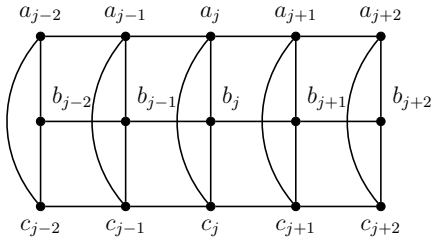
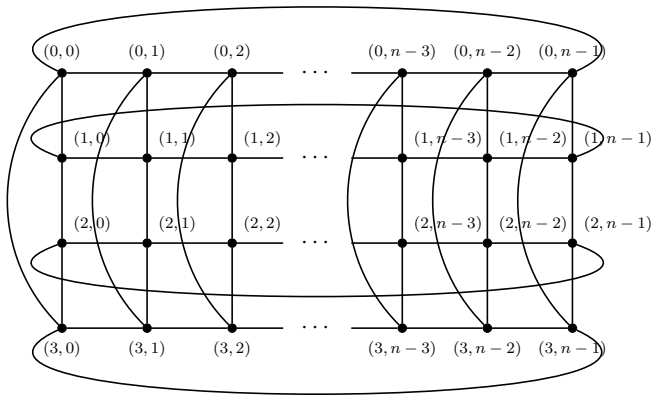
Bounds are given for disjunctive domination numbers on all torus grid graphs C_m □ C_n, with exact values determined for the cases m=3 and m=4.
A machine-rendered reading of the paper's core claim, the machinery that carries it, and where it could break.
Core claim
The disjunctive domination number of the torus grid C_m □ C_n is bounded above and below by expressions that depend on m and n; when m equals 3 or 4 the number equals an explicit formula that counts the minimum number of vertices needed to satisfy the adjacency-or-two-distance-two condition across the periodic grid.
What carries the argument
A disjunctive dominating set, which covers non-members either by direct adjacency or by requiring two set members at distance two.
If this is right
- The disjunctive domination number of every torus grid C_m □ C_n lies between the stated lower and upper bounds.
- For every n the exact number for C_3 □ C_n equals the value given by the construction.
- For every n the exact number for C_4 □ C_n equals the value given by the construction.
- The same covering technique yields a concrete upper bound that works for arbitrary m and n.
Where Pith is reading between the lines
- The same counting ideas may extend to grids with a few defects or to higher-dimensional tori.
- One could test whether the exact formulas continue to hold when both cycles are larger than 4 by checking small additional cases.
- These numbers give a relaxed covering measure that could be compared directly with ordinary domination numbers on the same graphs.
Load-bearing premise
The combinatorial constructions and lower-bound arguments used to achieve exact values for C_3 □ C_n and C_4 □ C_n remain valid for all sufficiently large n without additional case-by-case exceptions.
What would settle it
Direct computation or exhaustive search of the disjunctive domination number for C_3 □ C_100 that fails to match the formula claimed for large n.
Figures

read the original abstract
Let $\Gamma=(V,E)$ be a graph. The disjunctive domination number of $\Gamma$ is the minimum cardinality of a set $S\subseteq V$ such that every vertex not in $S$ is adjacent to a vertex of $S$, or has at least two vertices in $S$ at distance $2$ from it. In this paper, we give bounds for the disjunctive domination numbers of the torus grid graphs $C_m\Box C_n$, and determine the disjunctive domination numbers of $C_3\Box C_n$, $C_4\Box C_{n}$ and $C_8\Box C_{4n}$.
Editorial analysis
A structured set of objections, weighed in public.
Referee Report
Summary. The paper defines the disjunctive domination number of a graph and studies it for torus grid graphs C_m □ C_n. It derives general upper and lower bounds on this parameter and obtains exact closed-form expressions for the cases m=3 and m=4, valid for all n.
Significance. If the constructions and matching lower bounds are correct and uniform, the exact determinations for C_3 □ C_n and C_4 □ C_n supply concrete, usable results in domination theory for a standard family of vertex-transitive graphs. Such closed forms are relatively rare and can serve as test cases for broader conjectures on disjunctive domination.
major comments (2)
- [§4] §4 (exact value for C_3 □ C_n): the lower-bound argument must be checked for uniformity across all residue classes of n. If the discharging or counting step implicitly assumes n is divisible by the pattern period (e.g., 3 or 4), then the claimed exact formula fails for an arithmetic progression of n and the central determination is incomplete.
- [§5] §5 (exact value for C_4 □ C_n): the periodic placement used for the upper bound must be shown to tile the torus without uncovered vertices or extra dominators when n mod k ≠ 0 for the construction period k. An explicit verification or case analysis for the remaining residue classes is needed to support the exact-value claim.
minor comments (2)
- [Abstract] The abstract and introduction should state the precise closed-form expressions obtained for γ_d(C_3 □ C_n) and γ_d(C_4 □ C_n) rather than only announcing that they are determined.
- [§1] Notation for the disjunctive domination number should be introduced once and used consistently; the current alternation between descriptive phrases and symbols in the early sections reduces readability.
Simulated Author's Rebuttal
Thank you for the referee's careful reading and constructive feedback on our manuscript. The major comments raise valid points about ensuring the proofs for the exact values on C_3 □ C_n and C_4 □ C_n are fully uniform and cover all residue classes of n. We address each comment below, indicating planned revisions where appropriate.
read point-by-point responses
-
Referee: [§4] §4 (exact value for C_3 □ C_n): the lower-bound argument must be checked for uniformity across all residue classes of n. If the discharging or counting step implicitly assumes n is divisible by the pattern period (e.g., 3 or 4), then the claimed exact formula fails for an arithmetic progression of n and the central determination is incomplete.
Authors: We thank the referee for highlighting this potential issue. Re-examining the lower-bound argument in Section 4, the discharging method assigns and redistributes charges based solely on local vertex configurations (each vertex and its distance-2 neighbors), without any global assumption that n is divisible by 3 or 4. The total charge sum is computed over the entire vertex set and divided by the maximum charge per vertex to obtain the bound, which holds algebraically for arbitrary n. No implicit periodicity assumption on n was used. To eliminate any possible reader confusion, we will insert a clarifying sentence stating that the argument applies uniformly to all n ≥ 3. This is a minor expository addition; the claimed exact value requires no alteration. revision: partial
-
Referee: [§5] §5 (exact value for C_4 □ C_n): the periodic placement used for the upper bound must be shown to tile the torus without uncovered vertices or extra dominators when n mod k ≠ 0 for the construction period k. An explicit verification or case analysis for the remaining residue classes is needed to support the exact-value claim.
Authors: We agree that an explicit verification for all residue classes strengthens the upper-bound construction. The periodic pattern in Section 5 is defined so that it wraps around the toroidal identification correctly for any n; however, to make the coverage and cardinality explicit when n is not a multiple of the base period, we will add a short case analysis (for n mod 4 = 0,1,2,3) confirming that the same number of vertices is selected and every vertex is either in the set or satisfies the disjunctive domination condition. This case analysis will be included in the revised manuscript. revision: yes
Circularity Check
No circularity: direct combinatorial constructions and lower bounds for torus grids
full rationale
The paper determines exact disjunctive domination numbers for C_3 □ C_n and C_4 □ C_n via explicit constructions (periodic placements of disjunctive dominators) paired with matching lower-bound arguments (counting or discharging). These steps are self-contained graph-theoretic proofs that do not reduce any claimed value to a fitted parameter, self-definition, or prior self-citation chain. No equations equate a derived quantity to an input by construction, and the abstract plus described methods contain no load-bearing self-referential steps. The result is therefore independent of the target quantities.
Axiom & Free-Parameter Ledger
axioms (1)
- standard math The Cartesian product C_m □ C_n is the standard torus grid graph with wrap-around adjacency in both directions.
Lean theorems connected to this paper
-
IndisputableMonolith/Cost/FunctionalEquation.leanwashburn_uniqueness_aczel unclear?
unclearRelation between the paper passage and the cited Recognition theorem.
Theorem 1.2: γ_d2(C3□Cn)=⌈n/2⌉; Theorem 1.3 gives the mod-4 case split for C4□Cn; lower bound via weight sum ≤8|S| and discharging on empty columns.
-
IndisputableMonolith/Foundation/DimensionForcing.leanalexander_duality_circle_linking unclear?
unclearRelation between the paper passage and the cited Recognition theorem.
Construction S' = even-even pairs with x'+y'≡0 mod 4, lifted periodically to the torus.
What do these tags mean?
- matches
- The paper's claim is directly supported by a theorem in the formal canon.
- supports
- The theorem supports part of the paper's argument, but the paper may add assumptions or extra steps.
- extends
- The paper goes beyond the formal theorem; the theorem is a base layer rather than the whole result.
- uses
- The paper appears to rely on the theorem as machinery.
- contradicts
- The paper's claim conflicts with a theorem or certificate in the canon.
- unclear
- Pith found a possible connection, but the passage is too broad, indirect, or ambiguous to say the theorem truly supports the claim.
discussion (0)
Sign in with ORCID, Apple, or X to comment. Anyone can read and Pith papers without signing in.