Wrinkling in the Lam\'e problem: a Gamma-convergence approach
Pith reviewed 2026-05-20 04:06 UTC · model grok-4.3
The pith
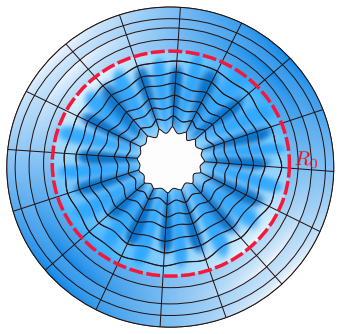
A Gamma-convergence result shows that the wrinkling contribution in a radially stretched thin elastic annulus is captured by a limiting scalar convex measure-valued energy subject to a marginal constraint on wrinkle frequencies.
A machine-rendered reading of the paper's core claim, the machinery that carries it, and where it could break.
Core claim
We establish a Γ-convergence result for suitably rescaled energies after subtraction of the relaxed membrane energy. The limiting functional is a scalar convex measure-valued energy coupled with a constraint on the marginal of the limiting measure, describing the distribution of wrinkle frequencies. We also prove existence and qualitative properties of minimizers of the limiting functional.
What carries the argument
The Gamma-limit of the rescaled wrinkling energy after membrane subtraction, realized as a convex functional on measures with a marginal constraint that tracks wrinkle frequency distribution.
If this is right
- Minimizers of the limiting functional exist and satisfy certain regularity or concentration properties.
- The marginal constraint forces the measure to encode a well-defined radial profile of wrinkle wavelengths.
- The Gamma-convergence supplies a rigorous justification for using the limiting energy to predict asymptotic energy scaling.
- Qualitative features of the optimal measures can be read off from convexity and the marginal condition.
Where Pith is reading between the lines
- The measure-valued formulation suggests that optimal wrinkling may involve a continuum of frequencies rather than a single dominant wavelength.
- The same subtraction-and-rescaling strategy could be tested on other annular or radial geometries with different boundary loads.
- The approach opens a route to deriving effective models for wrinkle coarsening or refinement under slow parameter variation.
- Connections to other variational problems with oscillating microstructures in elasticity may become visible through the common use of Young measures or varifolds.
Load-bearing premise
The Föppl-von Kármán plate model remains faithful for the thin annulus in radial stretching, and the chosen subtraction plus rescaling isolates exactly the wrinkling part of the energy in the vanishing-thickness limit.
What would settle it
Direct numerical minimization of the original three-dimensional or plate energy for a sequence of decreasing thicknesses that yields wrinkle frequency statistics incompatible with the minimizers of the proposed limiting measure-valued functional.
Figures

read the original abstract
We study wrinkling patterns in a thin elastic annulus subjected to radial stretching within the framework of the F\"oppl--von K\'arm\'an theory. Building on the analysis of the Lam\'e problem in Bella and Kohn, we investigate the asymptotic regime $h\to0$ and establish a $\Gamma$-convergence result for suitably rescaled energies after subtraction of the relaxed membrane energy. The limiting functional is a scalar convex measure-valued energy coupled with a constraint on the marginal of the limiting measure, describing the distribution of wrinkle frequencies. We also prove existence and qualitative properties of minimizers of the limiting functional.
Editorial analysis
A structured set of objections, weighed in public.
Referee Report
Summary. The manuscript establishes a Γ-convergence result for suitably rescaled energies in the Föppl-von Kármán model of a thin elastic annulus under radial stretching, after subtracting the relaxed membrane energy from the analysis of the Lamé problem. The limiting functional is a scalar convex measure-valued energy subject to a constraint on the marginal of the limiting measure that encodes the distribution of wrinkle frequencies. Existence and qualitative properties of minimizers of this limiting functional are also proven.
Significance. If the Γ-convergence holds, the work supplies a rigorous variational description of the asymptotic wrinkling contribution in the radial stretching regime as thickness tends to zero. The measure-valued limit with its marginal constraint offers a precise way to track wrinkle frequencies, extending the prior analysis of Bella and Kohn and providing a template for similar pattern-formation problems in thin elastic sheets.
major comments (1)
- [Main Γ-convergence theorem and its proof (likely §§4–5)] The central Γ-convergence claim (as stated in the abstract and presumably proved in the main theorem) rests on the subtraction of the relaxed membrane energy followed by a specific rescaling of the remainder. It is not evident that all residual membrane-bending cross terms and geometry-dependent lower-order contributions vanish or converge at exactly the rate needed to produce the claimed marginal constraint on the limiting measure; a detailed verification that the liminf inequality is unaffected by such terms is required.
minor comments (2)
- [Introduction and notation section] Notation for the rescaled energy functional and the measure-valued limit could be introduced earlier and used consistently throughout to improve readability.
- [Existence theorem] The statement of existence of minimizers for the limiting functional would benefit from an explicit reference to the compactness result used to extract the limiting measure.
Simulated Author's Rebuttal
We thank the referee for the careful reading of our manuscript and for highlighting the need for explicit verification of the residual terms in the Γ-convergence analysis. We address the major comment below and will incorporate additional clarifying material in the revised version.
read point-by-point responses
-
Referee: [Main Γ-convergence theorem and its proof (likely §§4–5)] The central Γ-convergence claim (as stated in the abstract and presumably proved in the main theorem) rests on the subtraction of the relaxed membrane energy followed by a specific rescaling of the remainder. It is not evident that all residual membrane-bending cross terms and geometry-dependent lower-order contributions vanish or converge at exactly the rate needed to produce the claimed marginal constraint on the limiting measure; a detailed verification that the liminf inequality is unaffected by such terms is required.
Authors: In Section 4 we prove the liminf inequality after subtracting the relaxed membrane energy of the Lamé problem (as constructed in Bella and Kohn) and rescaling the remainder by the factor h^{-3/2}. The rescaled energy is decomposed into the bending contribution, the excess membrane energy, and the membrane-bending cross terms that arise from the radial geometry and the coupling between the in-plane and out-of-plane displacements. Lemmas 4.2 and 4.3 establish that the cross terms are bounded by C h^{1/2} times the rescaled energy plus lower-order geometric contributions that vanish uniformly on the annulus; these estimates rely on the closeness of the in-plane displacement to the Lamé solution in W^{1,2} and on the control of the out-of-plane displacement in H^2. Consequently, the cross terms contribute o(1) to the liminf and do not alter the lower bound given by the convex measure-valued functional. The marginal constraint on wrinkle frequencies is obtained by testing the Young measure with functions that depend only on the frequency variable; because the vanishing cross terms are independent of this test function, the constraint passes to the limit unchanged. We will insert a short additional paragraph immediately after the statement of the main theorem that summarizes these estimates and explicitly confirms that they leave the marginal constraint intact. revision: yes
Circularity Check
No circularity: direct Γ-convergence proof building on independent prior analysis
full rationale
The paper performs a standard Γ-convergence analysis in the Föppl-von Kármán regime for the annulus, subtracting the relaxed membrane energy (whose existence and properties are taken from the cited Bella-Kohn result on the Lamé problem) and rescaling the remainder. The limiting functional is derived as a convex measure-valued energy with a marginal constraint on wrinkle frequencies; this construction follows from the variational definition of Γ-convergence and does not reduce any quantity to a fitted parameter, self-definition, or load-bearing self-citation. The cited Bella-Kohn work is external (different authors) and supplies the base relaxed energy without the present paper's target result being presupposed. No step in the derivation chain is equivalent to its inputs by construction.
Axiom & Free-Parameter Ledger
axioms (1)
- domain assumption The Föppl--von Kármán theory is an appropriate model for the thin elastic annulus subjected to radial stretching.
Lean theorems connected to this paper
-
IndisputableMonolith/Cost/FunctionalEquation.leanwashburn_uniqueness_aczel unclear?
unclearRelation between the paper passage and the cited Recognition theorem.
the limiting functional is a scalar convex measure-valued energy coupled with a constraint on the marginal of the limiting measure, describing the distribution of wrinkle frequencies
What do these tags mean?
- matches
- The paper's claim is directly supported by a theorem in the formal canon.
- supports
- The theorem supports part of the paper's argument, but the paper may add assumptions or extra steps.
- extends
- The paper goes beyond the formal theorem; the theorem is a base layer rather than the whole result.
- uses
- The paper appears to rely on the theorem as machinery.
- contradicts
- The paper's claim conflicts with a theorem or certificate in the canon.
- unclear
- Pith found a possible connection, but the passage is too broad, indirect, or ambiguous to say the theorem truly supports the claim.
Reference graph
Works this paper leans on
-
[1]
L. Ambrosio, N. Fusco, and D. Pallara,Functions of bounded variation and free discontinuity problems, Oxford Mathematical Monographs, The Clarendon Press, Oxford University Press, New York, 2000
work page 2000
-
[2]
A. Bach, T. Esposito, R. Marziani, C. I. Zeppieri,Gradient damage models for heterogeneous materials, SIAM J. Math. Anal. 55 (2023), no. 6, 7206–7253
work page 2023
-
[3]
A. Bach, T. Esposito, R. Marziani, C. I. Zeppieri,Interaction between oscillations and sin- gular perturbations in a one-dimensional phase-field model, AWM Volume - Research in the Mathematics of Materials Science (2022)
work page 2022
-
[4]
A. Bach, R. Marziani, C. I. Zeppieri, Γ-convergence and stochastic homogenisation of singularly-perturbed elliptic functionals, Calc. Var. Partial Differential Equations 62 (2023), Art. 199
work page 2023
-
[5]
J. Bedrossian, and R. V. Kohn,Blister patterns and energy minimization in compressed thin films on compliant substrates, Comm. Pure Appl. Math.68(2015), no. 3, 472–510. 53
work page 2015
-
[6]
P. Bella, and R. V. Kohn,Wrinkles as the result of compressive stresses in an annular thin film, Comm. Pure Appl. Math.67(2014), no. 5, 693–747
work page 2014
-
[7]
P. Bella, and R. V. Kohn,The annulus problem, using a von K´ arm´ an membrane model.Prelim- inary versionhttps://math.nyu.edu/ ~kohn/pcmi/annulus-problem-notes-for-pcmi.pdf
-
[8]
P. Bella, and R. V. Kohn,Coarsening of folds in hanging drapes, Comm. Pure Appl. Math. 70(2017), no. 5, 978–1021
work page 2017
-
[9]
P. Bella, and R. V. Kohn,Wrinkling of a thin circular sheet bonded to a spherical substrate, Phil. Trans. R. Soc. A375(2017), no. 2093
work page 2017
-
[10]
P. Bella,The Transition Between Planar and Wrinkled Regions in a Uniaxially Stretched Thin Elastic Film, Arch. Ration. Mech. Anal.216(2015), no. 2, 623–672
work page 2015
-
[11]
P. Bella, and R. V. Kohn,Metric-induced wrinkling of a thin elastic sheet, J. Nonlinear Sci. 24(2014), no. 6, 1147–1176
work page 2014
-
[12]
P. Bella, and R. Marziani, Γ-convergence for plane to wrinkles transition problem, J. Nonlinear Sci.35, 23 (2025)
work page 2025
-
[13]
P. Bella, and C. Rom´ an,Wrinkling of an elastic sheet floating on a liquid sphere, Calc. Var. Partial Differential Equations65(2026), 127
work page 2026
-
[14]
H. Ben Belgacem, S. Conti, A. DeSimone, and S. M¨ uller,Rigorous bounds for the F¨ oppl-von K´ arm´ an theory of isotropically compressed plates, J. Nonlinear Sci.10(2000), no. 6, 661–683
work page 2000
-
[15]
H. Ben Belgacem, S. Conti, A. DeSimone, and S. M¨ uller,Energy scaling of compressed elastic films—three-dimensional elasticity and reduced theories, Arch. Ration. Mech. Anal.164(2002), no. 1, 1–37
work page 2002
- [16]
-
[17]
J. Brandman, R. V. Kohn, and H.-M. Nguyen,Energy scaling laws for conically constrained thin elastic sheets, J. Elasticity113(2013), no. 2, 251–264
work page 2013
-
[18]
B. Brietzke, and H. Kn¨ upfer,Onset of pattern formation in thin ferromagnetic films with perpendicular anisotropy, Calc. Var. Partial Differential Equations62(2023), no. 4, Paper No. 133, 22
work page 2023
-
[19]
A. Capella, and F. Otto,A rigidity result for a perturbation of the geometrically linear three- well problem, Comm. Pure Appl. Math.62(2009), no. 12, 1632–1669
work page 2009
-
[20]
A. Capella, and F. Otto,A quantitative rigidity result for the cubic-to-tetragonal phase transi- tion in the geometrically linear theory with interfacial energy, Proc. Roy. Soc. Edinburgh Sect. A142(2012), no. 2, 273–327
work page 2012
-
[21]
Choksi,Scaling laws in microphase separation of diblock copolymers, J
R. Choksi,Scaling laws in microphase separation of diblock copolymers, J. Nonlinear Sci.11 (2001), no. 3, 223–236
work page 2001
-
[22]
Conti,Branched microstructures: scaling and asymptotic self-similarity, Comm
S. Conti,Branched microstructures: scaling and asymptotic self-similarity, Comm. Pure Appl. Math.53(2000), no. 11, 1448–1474. 54
work page 2000
- [23]
-
[24]
S. Conti, and F. Maggi,Confining thin elastic sheets and folding paper, Arch. Ration. Mech. Anal.187(2008), no. 1, 1–48
work page 2008
- [25]
-
[26]
B. Davidovitch, R. D. Schroll, and E. Cerda,Nonperturbative model for wrinkling in highly bendable sheets, Phys. Rev. E85(2012), 066115
work page 2012
-
[27]
B. Davidovitch, R. D. Schroll, D. Vella, M. Adda-Bedia, and E. Cerda,Prototypical model for tensional wrinkling in thin sheets, Proc. Natl. Acad. Sci.108(2011), no. 45, 18227–18232
work page 2011
-
[28]
A. Garroni, R. Marziani, and R. Scala,Derivation of a line-tension model for dislocations from a nonlinear three-dimensional energy: The case of quadratic growth, SIAM J. Math. Anal., 53:4252-4302, 2021
work page 2021
-
[29]
J.-C. G´ eminard, R. Bernal, and F. Melo,Wrinkle formations in axi-symmetrically stretched membranes, Eur. Phys. J. E15(2004), no. 2, 117–126
work page 2004
- [30]
- [31]
-
[32]
W. Jin and, P. Sternberg,Energy estimates for the von K´ arm´ an model of thin-film blistering, J. Math. Phys.42(2001), no. 1, 192–199
work page 2001
-
[33]
H. Kn¨ upfer, R. V. Kohn, and F. Otto,Nucleation barriers for the cubic-to-tetragonal phase transformation, Comm. Pure Appl. Math.66(2013), no. 6, 867–904
work page 2013
-
[34]
R. V. Kohn, and S. M¨ uller,Surface energy and microstructure in coherent phase transitions, Comm. Pure Appl. Math.47(1994), no. 4, 405–435
work page 1994
-
[35]
R. V. Kohn,Energy-driven pattern formation, International Congress of Mathematicians. Vol. I, Eur. Math. Soc., Z¨ urich, 2007, pp. 359–383
work page 2007
-
[36]
R. V. Kohn, and H.-M. Nguyen,Analysis of a compressed thin film bonded to a compliant substrate: the energy scaling law, J. Nonlinear Sci.23(2013), no. 3, 343–362
work page 2013
-
[37]
R. V. Kohn, and E. O’Brien,The wrinkling of a twisted ribbon, J. Nonlinear Sci.28(2018), no. 4, 1221–1249
work page 2018
-
[38]
C. Maor, and A. Shachar,On the role of curvature in the elastic energy of non-Euclidean thin bodies, J. Elasticity134(2019), no. 2, 149–173
work page 2019
-
[39]
R. Marziani, Γ-convergence and stochastic homogenisation of phase-transition functionals, ESAIM Control Optim. Calc. Var. 29 (2023), Paper No. 72
work page 2023
-
[40]
R. Marziani, F. Solombrino,Non-local approximation of free-discontinuity problems in linear elasticity and application to stochastic homogenisation, Proc. Roy. Soc. Edinburgh Sect. A 154 (2024), 1049–1092. 55
work page 2024
-
[41]
S. M¨ uller,Variational Models for Microstructure and Phase Transitions, lecture notes for the CIME Course held in Cetraro, Italy, 2013, CIME Foundation Subseries, Springer, 2015
work page 2013
-
[42]
H. Olbermann,The shape of low energy configurations of a thin elastic sheet with a single disclination, Anal. PDE11(2018), no. 5, 1285–1302
work page 2018
-
[43]
Olbermann,On a boundary value problem for conically deformed thin elastic sheets, Anal
H. Olbermann,On a boundary value problem for conically deformed thin elastic sheets, Anal. PDE12(2019), no. 1, 245–258
work page 2019
-
[44]
F. Otto,Cross-over in scaling laws: a simple example from micromagnetics, Proceedings of the International Congress of Mathematicians, Vol. III (Beijing, 2002), Higher Ed. Press, Beijing, 2002, pp. 829–838
work page 2002
-
[45]
D. Padilla-Garza,An asymptotic variational problem modeling a thin elastic sheet on a liquid, lifted at one end, Math. Methods Appl. Sci.43(2020), no. 8, 4956–4973
work page 2020
-
[46]
A. C. Pipkin,Relaxed energy densities for large deformations of membranes, IMA J. Appl. Math.52(1994), no. 3, 297–308
work page 1994
-
[47]
T. Ried, and C. Rom´ an,Domain branching in micromagnetism: scaling law for the global and local energies, 2023
work page 2023
-
[48]
A. R¨ uland, and A. Tribuzio,On scaling laws for multi-well nucleation problems without gauge invariances, J. Nonlinear Sci.33(2023), no. 2, Paper No. 25, 41
work page 2023
-
[49]
A. R¨ uland, and A. Tribuzio,On the energy scaling behaviour of singular perturbation models with prescribed Dirichlet data involving higher order laminates, ESAIM Control Optim. Calc. Var.29(2023), Paper No. 68, 54
work page 2023
-
[50]
F. Santambrogio,Optimal transport for applied mathematicians, Progress in Nonlinear Differ- ential Equations and their Applications, vol. 87, Birkh¨ auser/Springer, Cham, 2015, Calculus of variations, PDEs, and modeling
work page 2015
-
[51]
S. Serfaty,Coulomb gases and Ginzburg-Landau vortices, Zurich Lectures in Advanced Math- ematics, European Mathematical Society (EMS), Z¨ urich, 2015
work page 2015
-
[52]
Tobasco,Axial compression of a thin elastic cylinder: bounds on the minimum energy scaling law, Comm
I. Tobasco,Axial compression of a thin elastic cylinder: bounds on the minimum energy scaling law, Comm. Pure Appl. Math.71(2018), no. 2, 304–355
work page 2018
-
[53]
Tobasco,Curvature-driven wrinkling of thin elastic shells, Arch
I. Tobasco,Curvature-driven wrinkling of thin elastic shells, Arch. Ration. Mech. Anal.239 (2021), no. 3, 1211–1325
work page 2021
-
[54]
H. Vandeparre, M. Pi˜ neirua, F. Brau, B. Roman, J. Bico, C. Gay, W. Bao, C. N. Lau, P. M. Reis, and P. Damman,Wrinkling hierarchy in constrained thin sheets from suspended graphene to curtains, Phys. Rev. Lett.106(2011), 224301
work page 2011
-
[55]
S. Venkataramani,Lower bounds for the energy in a crumpled elastic sheet—a minimal ridge, Nonlinearity17(2004), no. 1, 301–312. 56
work page 2004
discussion (0)
Sign in with ORCID, Apple, or X to comment. Anyone can read and Pith papers without signing in.