Sensitivity Bounds of Multiparameter Metrology at Thermal Equilibrium
Pith reviewed 2026-05-20 06:27 UTC · model grok-4.3
The pith
Quantum probes in thermal equilibrium can achieve the Heisenberg limit when estimating multiple parameters at once.
A machine-rendered reading of the paper's core claim, the machinery that carries it, and where it could break.
Core claim
The paper establishes fundamental sensitivity bounds for multiparameter estimation using a quantum probe prepared in a thermal equilibrium state. It demonstrates that the Heisenberg limit with respect to the number of probes can be reached, and that the bound matches the established single-parameter bound whenever only one parameter is considered. In the low-temperature limit the precision scaling differs from the finite-temperature case. An illustrative example is given, and the conditions under which the bound is attainable together with the corresponding optimal measurements are derived.
What carries the argument
Sensitivity bounds obtained from the quantum Fisher information matrix evaluated on thermal equilibrium states of the probe.
If this is right
- The Heisenberg limit with respect to probe number is reachable for simultaneous estimation of several parameters.
- The multiparameter bound reduces to the known single-parameter bound when only one parameter is estimated.
- Precision scaling at low temperature differs qualitatively from the finite-temperature regime.
- Optimal measurements exist that attain the bound under stated conditions.
- The results apply to any quantum probe whose thermal state depends on the parameters only through Hamiltonian or coupling terms.
Where Pith is reading between the lines
- The bounds suggest thermal-state sensors may be practical when maintaining pure or entangled states is difficult.
- Similar limits could be examined for probes coupled to environments that drive them slightly away from exact thermal equilibrium.
- Concrete tests could involve estimating magnetic field components and temperature simultaneously in an atomic ensemble held at fixed temperature.
Load-bearing premise
The probe is prepared in a thermal equilibrium state and the parameters affect the system only through the Hamiltonian or coupling operators.
What would settle it
An experiment on a thermal-state probe estimating two parameters that achieves precision better than the derived bound for any number of probes would falsify the claimed limit.
Figures

read the original abstract
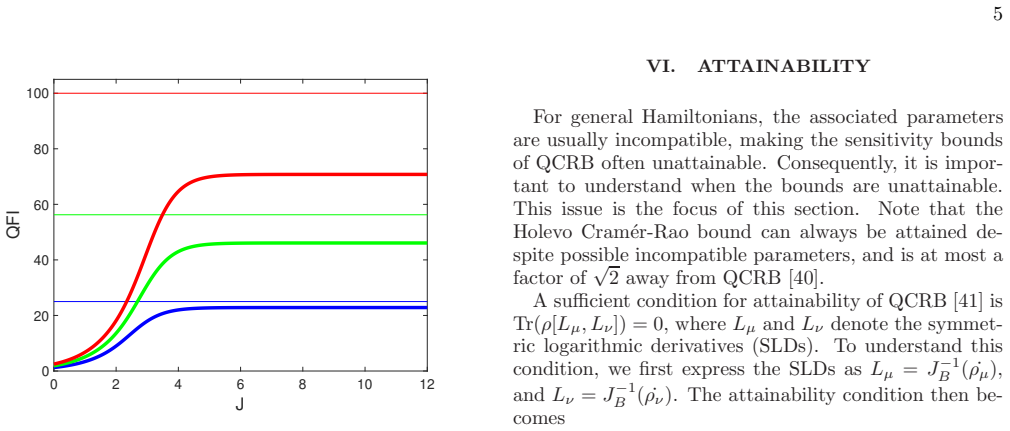
Quantum metrology aims to enhance measurement precision beyond the classical limit by leveraging quantum resources. Unlike multi-parameter dynamic quantum metrology, many questions regarding multiparameter quantum metrology at thermal equilibrium remain elusive. In particular, the ultimate precision limits achievable in this equilibrium setting are not yet well understood. In this work, we examine the fundamental limits of estimating multiple parameters with a quantum probe at thermal equilibrium. We first show that the Heisenberg limit with respect to the number of probes can be achieved, and our bound coincides with the known single-parameter bound when only one parameter is estimated. We then consider the low temperature limit, revealing a qualitatively different behavior compared to the finite temperature case. We give an example to illustrate the usage of our main results. Finally, we show the conditions under which the sensitivity bound can be attained and the optimal measurements to achieve it.
Editorial analysis
A structured set of objections, weighed in public.
Referee Report
Summary. The manuscript derives fundamental sensitivity bounds for estimating multiple parameters using a quantum probe prepared in a thermal equilibrium state ρ = exp(−βH(θ))/Z. It shows that the Heisenberg limit with respect to the number of probes is achievable, demonstrates that the multiparameter bound reduces to the known single-parameter bound when only one parameter is estimated, analyzes a qualitatively different low-temperature regime, provides an illustrative example, and specifies the conditions under which the bound is attainable along with the corresponding optimal measurements.
Significance. If the central derivations hold, the work addresses an open question in multiparameter quantum metrology at thermal equilibrium by providing explicit bounds that achieve the Heisenberg limit and reduce correctly to the single-parameter case. The explicit treatment of attainability conditions and optimal measurements, together with the low-temperature analysis, offers practical guidance for quantum sensing applications where thermal states are natural. These elements constitute a clear contribution to the field.
minor comments (3)
- The abstract states that the bound 'coincides with the known single-parameter bound'; adding a brief citation to the relevant single-parameter result would improve immediate clarity for readers.
- In the low-temperature analysis, the transition from finite-temperature scaling to the reported qualitatively different behavior would benefit from an explicit equation or scaling comparison to make the distinction sharper.
- The illustrative example would be strengthened by specifying the explicit form of the Hamiltonian or coupling operators used, allowing readers to reproduce the numerical or analytic steps more readily.
Simulated Author's Rebuttal
We thank the referee for their careful reading of the manuscript and for the positive assessment that our work addresses an open question in multiparameter quantum metrology at thermal equilibrium. The referee recommends minor revision, yet no specific major comments were provided in the report. We therefore have no points requiring rebuttal or revision.
Circularity Check
No significant circularity; derivation self-contained
full rationale
The paper applies the quantum Fisher information matrix to a thermal state ρ = exp(−βH(θ))/Z to derive multiparameter sensitivity bounds. The Heisenberg-limit scaling with probe number follows from standard QFI properties under the thermal-equilibrium assumption, and the reduction to the known single-parameter bound is obtained directly by setting off-diagonal QFI elements to zero. No self-definitional steps, fitted inputs renamed as predictions, or load-bearing self-citations appear in the derivation chain; the central claims rest on external quantum-metrology results applied to the given Hamiltonian parametrization.
Axiom & Free-Parameter Ledger
Reference graph
Works this paper leans on
-
[1]
Sensitivity Bounds of Multiparameter Metrology at Thermal Equilibrium
and Fisher information [21] to tangible experimental outcomes. In doing so, it also drives innovation in quan- tum technologies more broadly, including quantum com- munication [22] and computation [23]. As experimen- tal control over quantum systems continues to advance, quantum metrology stands as one of the most promising avenues for translating the cou...
work page internal anchor Pith review Pith/arXiv arXiv 2026
-
[2]
Nevertheless, the weaker condition Tr( ρ[Lµ,L ν ]) = 0 still holds, implying that the precision limits for all parameters remain attainable. The reason is as follows. First of all, the commutation relations [ ρ, ˙Hν ] = 0 and [ρ, ˙Hµ ] = 0 are satisfied for this Hamiltonian. Under these conditions, Tr(ρ[Lµ,L ν ]) = 0 is equivalent to Tr(ρ[ ˙Hµ, ˙Hν ]) = 0....
-
[3]
Spectral range of Hn. Each generator has the structure Hk =ǫk Nk∑ i=1 hk,i, ǫ k = sgn(nk), (D5) wherehk,i has eigenvalues± 1/ 2. Hence the maximal and minimal eigenvalues of Hk are±Nk/ 2. It follows that Hn = M∑ k=1 |nk| Nk∑ i=1 hk,i, (D6) whose extremal eigenvalues are obtained when all spins are aligned: λ max = 1 2 M∑ k=1 |nk|Nk, λ min =− 1 2 M∑ k=1 |n...
-
[4]
Saturation by the GHZ-like state. The upper bound is saturated by a pure state that is an equal superposition of the eigenstates corresponding to λ max and λ min. The states |Nm, 1⟩, |Nm,− 1⟩, (D12) are fully polarized states of the m-th block, with all local eigenvalues equal to +1 / 2 or − 1/ 2, respectively. The tensor product |N1,ǫ 1⟩⊗···⊗| NM,ǫ M⟩ (D...
-
[5]
V. Giovannetti, S. Lloyd, and L. Maccone, Quantum- enhanced measurements: beating the standard quantum limit, Science 306, 1330 (2004)
work page 2004
-
[6]
V. Giovannetti, S. Lloyd, and L. Maccone, Quantum metrology, Physical review letters 96, 010401 (2006)
work page 2006
-
[7]
C. L. Degen, F. Reinhard, and P. Cappellaro, Quantum sensing, Reviews of modern physics 89, 035002 (2017)
work page 2017
-
[8]
V. Giovannetti, S. Lloyd, and L. Maccone, Advances in quantum metrology, Nature photonics 5, 222 (2011)
work page 2011
-
[9]
R. Demkowicz-Dobrza´ nski and L. Maccone, Using entan- glement against noise in quantum metrology, Physical re- view letters 113, 250801 (2014)
work page 2014
-
[10]
R. Demkowicz-Dobrza´ nski, J. Ko/suppress lody´ nski, and M. Gut ¸˘ a, The elusive heisenberg limit in quantum-enhanced metrology, Nature communications 3, 1063 (2012)
work page 2012
-
[11]
S. F. Huelga, C. Macchiavello, T. Pellizzari, A. K. Ekert, M. B. Plenio, and J. I. Cirac, Improvement of frequency standards with quantum entanglement, Physical Review Letters 79, 3865 (1997)
work page 1997
-
[12]
A. W. Chin, S. F. Huelga, and M. B. Plenio, Quantum metrology in non-markovian environments, Physical re- view letters 109, 233601 (2012)
work page 2012
-
[13]
M. J. Hall and H. M. Wiseman, Does nonlinear metrol- ogy offer improved resolution? answers from quantum information theory, Physical Review X 2, 041006 (2012)
work page 2012
-
[14]
D. W. Berry, M. Tsang, M. J. Hall, and H. M. Wise- man, Quantum bell-ziv-zakai bounds and heisenberg lim- its for waveform estimation, Physical Review X 5, 031018 (2015)
work page 2015
-
[15]
S. Alipour, M. Mehboudi, and A. Rezakhani, Quan- tum metrology in open systems: dissipative cram´ er-rao bound, Physical review letters 112, 120405 (2014)
work page 2014
-
[16]
M. Beau and A. del Campo, Nonlinear quantum metrol- ogy of many-body open systems, Physical review letters 119, 010403 (2017)
work page 2017
-
[17]
R. Schnabel, N. Mavalvala, D. E. McClelland, and P. K. Lam, Quantum metrology for gravitational wave astron- omy, Nature communications 1, 121 (2010)
work page 2010
-
[18]
M. Tse, H. Yu, N. Kijbunchoo, A. Fernandez-Galiana, P. Dupej, L. Barsotti, C. Blair, D. Brown, S. e. Dwyer, A. Effler, et al. , Quantum-enhanced advanced ligo detec- tors in the era of gravitational-wave astronomy, Physical Review Letters 123, 231107 (2019)
work page 2019
- [19]
-
[20]
D. Le Sage, K. Arai, D. R. Glenn, S. J. DeVience, L. M. Pham, L. Rahn-Lee, M. D. Lukin, A. Yacoby, A. Komeili, and R. L. Walsworth, Optical magnetic imaging of living cells, Nature 496, 486 (2013)
work page 2013
-
[21]
V. Buˇ zek, R. Derka, and S. Massar, Optimal quantum clocks, Physical review letters 82, 2207 (1999)
work page 1999
-
[22]
E. Pedrozo-Pe˜ nafiel, S. Colombo, C. Shu, A. F. Adiy- atullin, Z. Li, E. Mendez, B. Braverman, A. Kawasaki, D. Akamatsu, Y. Xiao, et al., Entanglement on an optical atomic-clock transition, Nature 588, 414 (2020)
work page 2020
-
[23]
S. D. Bass and M. Doser, Quantum sensing for particle physics, Nature Reviews Physics 6, 329 (2024)
work page 2024
- [24]
-
[25]
J. Liu, H. Yuan, X.-M. Lu, and X. Wang, Quantum fisher information matrix and multiparameter estima- tion, Journal of Physics A: Mathematical and Theoretical 53, 023001 (2020)
work page 2020
-
[26]
N. Gisin and R. Thew, Quantum communication, Nature photonics 1, 165 (2007)
work page 2007
-
[27]
D. P. DiVincenzo, Quantum computation, Science 270, 255 (1995)
work page 1995
- [28]
-
[29]
S. Zhou, M. Zhang, J. Preskill, and L. Jiang, Achiev- ing the heisenberg limit in quantum metrology using quantum error correction, Nature communications 9, 78 (2018)
work page 2018
-
[30]
M. Gessner, L. Pezz` e, and A. Smerzi, Sensitivity bounds for multiparameter quantum metrology, Physical review letters 121, 130503 (2018)
work page 2018
-
[31]
C.-F. Chen, M. Kastoryano, F. G. Brand˜ ao, and A. Gily´ en, Efficient quantum thermal simulation, Nature 646, 561 (2025). 11
work page 2025
-
[32]
There are also other types of quantum metrology in addi- tion to the two mentioned. For example, non-equilibrium thermal metrology uses a thermal state as the probe and encodes the parameter via unitary time evolution [43]
- [33]
-
[34]
G. Mihailescu, A. Bayat, S. Campbell, and A. K. Mitchell, Multiparameter critical quantum metrology with impurity probes, Quantum Science and Technology 9, 035033 (2024)
work page 2024
-
[35]
G. Mihailescu, S. Sarkar, A. Bayat, S. Campbell, and A. K. Mitchell, Metrological symmetries in singular quan- tum multi-parameter estimation, Quantum Science and Technology (2025)
work page 2025
-
[36]
M. G. Paris, Quantum estimation for quantum technol- ogy, International Journal of Quantum Information 7, 125 (2009)
work page 2009
- [37]
-
[38]
P. Zanardi and N. Paunkovi´ c, Ground state overlap and quantum phase transitions, Physical Review E 74, 031123 (2006)
work page 2006
- [39]
-
[40]
S.-J. Gu, Fidelity approach to quantum phase transi- tions, International Journal of Modern Physics B 24, 4371 (2010)
work page 2010
-
[41]
M. M. Rams and B. Damski, Quantum fidelity in the thermodynamic limit, Physical Review Letters 106, 055701 (2011)
work page 2011
-
[42]
I. Fr´ erot and T. Roscilde, Quantum critical metrology, Physical Review Letters 121, 020402 (2018)
work page 2018
- [43]
-
[44]
F. Albarelli, J. F. Friel, and A. Datta, Evaluating the holevo cram´ er-rao bound for multiparameter quantum metrology, Phys. Rev. Lett. 123, 200503 (2019)
work page 2019
-
[45]
P. J. Crowley, A. Datta, M. Barbieri, and I. A. Walms- ley, Tradeoff in simultaneous quantum-limited phase and loss estimation in interferometry, Physical Review A 89, 023845 (2014)
work page 2014
-
[46]
M. Hassani, S. Scheiner, M. G. Paris, and D. Markham, Privacy in networks of quantum sensors, Physical Review Letters 134, 030802 (2025)
work page 2025
- [47]
discussion (0)
Sign in with ORCID, Apple, or X to comment. Anyone can read and Pith papers without signing in.