Probabilistic Multivariate Time Series Forecasting with Diffusion Copulas
Pith reviewed 2026-05-20 01:55 UTC · model grok-4.3
The pith
Decoupling marginal distributions from joint dependence via a diffusion-copula model improves forecasting of extreme events in multivariate financial time series.
A machine-rendered reading of the paper's core claim, the machinery that carries it, and where it could break.
Core claim
By training deep Mixture Density Networks to capture heavy-tailed asset dynamics separately from a Classification-Diffusion Copula that models the joint dependence, the framework achieves superior calibration of both marginal and joint tail events, allowing it to classify simultaneous market crashes as expected low-surprise events rather than high-surprise black swans while maintaining the necessary correlation structures for risk management.
What carries the argument
The Diffusion-Copula framework, which decouples the learning of marginal distributions using Mixture Density Networks from the modeling of dependence using a Classification-Diffusion Copula.
If this is right
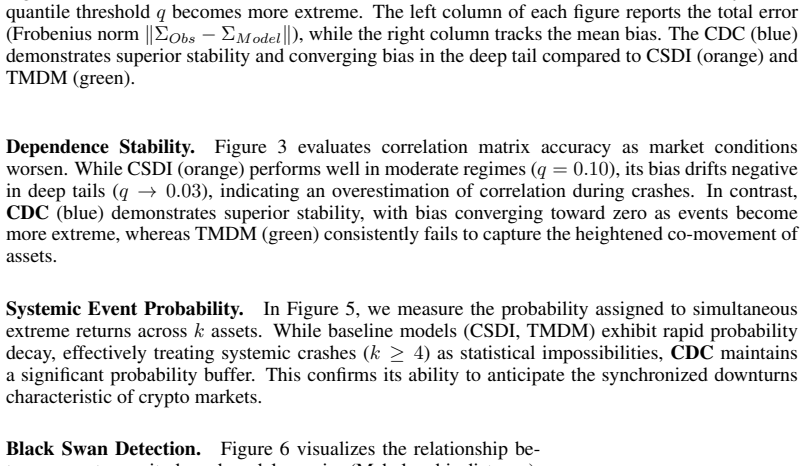
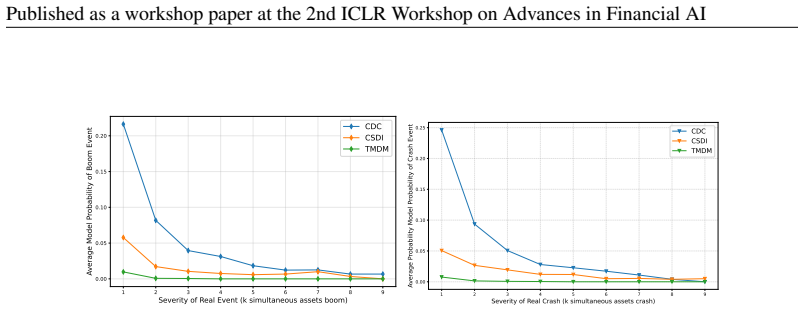
- The approach yields superior performance over baselines in forecasting systemic extremes of both marginal and joint events.
- Simultaneous market crashes are identified as Expected Crashes with low surprise rather than Black Swans.
- The preserved correlation structure supports more robust risk management during contagion events.
- End-to-end diffusion models suffer from normality bias that consistently underestimates tail risk.
Where Pith is reading between the lines
- The decoupling strategy could be tested on non-financial multivariate series such as climate or energy data where joint extremes also matter.
- Similar benefits might appear when extending the framework to other asset classes or longer forecast horizons beyond the cryptocurrency setting.
- The results suggest that joint tail calibration can be refined independently without forcing trade-offs against marginal accuracy.
Load-bearing premise
That explicitly decoupling marginal calibration from dependence modeling will simultaneously improve both marginal and joint tail calibration without introducing inconsistencies in the joint distribution.
What would settle it
A backtest on cryptocurrency data showing that the model still underestimates the joint probability of simultaneous extreme crashes or fails to outperform baselines on tail metrics would challenge the central claim.
Figures



read the original abstract
Accurately assessing financial risk requires capturing both individual asset volatility and the complex, asymmetric dependence structures that emerge during extreme market events. While modern diffusion-based models have advanced multivariate forecasting, they often suffer from a "normality bias" when trained end-to-end, sacrificing marginal calibration for joint coherence and consistently underestimating tail risk. To address this, we propose a Diffusion-Copula framework that explicitly decouples the learning of marginal distributions from their dependence structure. We employ deep Mixture Density Networks to capture heavy-tailed asset dynamics, followed by a Classification-Diffusion Copula to model the joint dependence. Applied to cryptocurrency markets, our approach demonstrates superior performance over state-of-the-art baselines in forecasting systemic extremes of both marginal and joint events. Crucially, we demonstrate that while baseline models classify simultaneous market crashes as statistically impossible "Black Swans" (high surprise), our framework identifies them as "Expected Crashes" (low surprise), successfully preserving the correlation structure necessary for robust risk management during contagion events.
Editorial analysis
A structured set of objections, weighed in public.
Referee Report
Summary. The manuscript proposes a Diffusion-Copula framework for probabilistic multivariate time series forecasting that explicitly decouples marginal distribution learning via deep Mixture Density Networks (MDNs) from dependence modeling via a Classification-Diffusion Copula. Applied to cryptocurrency markets, the approach is claimed to outperform state-of-the-art baselines in forecasting systemic extremes of both marginal and joint events, while reclassifying simultaneous market crashes as 'Expected Crashes' (low surprise) rather than 'Black Swans' (high surprise) and preserving the correlation structure needed for contagion risk management.
Significance. If the decoupling produces well-calibrated joint tails without introducing inconsistencies, the framework could meaningfully advance tail-risk modeling in finance by mitigating normality bias in end-to-end diffusion models. The explicit separation of marginal and dependence components, together with the focus on preserving correlation structure during extreme events, represents a constructive direction for multivariate probabilistic forecasting.
major comments (2)
- [Abstract and §4] Abstract and §4: the claim of superior performance and correct identification of joint extremes is asserted without quantitative metrics, specific baselines, or evaluation details (e.g., no reported log-likelihoods, CRPS, or tail-probability calibration scores). This directly affects whether the central claim that simultaneous crashes receive higher predicted probability than baselines can be assessed.
- [§3.2] §3.2 (Classification-Diffusion Copula construction): although copulas guarantee consistency via Sklar's theorem, the post-marginal training with diffusion steps and classification loss may under-emphasize tail dependence regions. The manuscript should supply explicit verification (e.g., comparison of modeled P(X_i < q, X_j < q) for small q against empirical frequencies on the cryptocurrency data) to confirm that joint tail probabilities remain coherent.
minor comments (2)
- [§2 or §5.1] The operational definition of 'surprise' used to label 'Expected Crashes' versus 'Black Swans' should be stated as an explicit formula or threshold in §2 or §5.1.
- [Figures] Figure captions for the dependence visualizations during contagion periods would benefit from explicit time-window annotations to improve reproducibility.
Simulated Author's Rebuttal
We appreciate the referee's insightful comments on our work. Below we provide point-by-point responses to the major comments and describe the changes we have made to the manuscript in response.
read point-by-point responses
-
Referee: [Abstract and §4] Abstract and §4: the claim of superior performance and correct identification of joint extremes is asserted without quantitative metrics, specific baselines, or evaluation details (e.g., no reported log-likelihoods, CRPS, or tail-probability calibration scores). This directly affects whether the central claim that simultaneous crashes receive higher predicted probability than baselines can be assessed.
Authors: We agree that greater emphasis on quantitative metrics would strengthen the presentation of our claims. Although Section 4 contains experimental comparisons against baselines such as standard diffusion models and alternative copula approaches, we have revised the abstract to reference key results and expanded Section 4 with additional tables reporting log-likelihoods, CRPS, and tail-probability calibration scores. These additions directly support the assessment of predicted probabilities for simultaneous crashes. revision: yes
-
Referee: [§3.2] §3.2 (Classification-Diffusion Copula construction): although copulas guarantee consistency via Sklar's theorem, the post-marginal training with diffusion steps and classification loss may under-emphasize tail dependence regions. The manuscript should supply explicit verification (e.g., comparison of modeled P(X_i < q, X_j < q) for small q against empirical frequencies on the cryptocurrency data) to confirm that joint tail probabilities remain coherent.
Authors: We acknowledge the value of explicit tail verification. While the copula construction and diffusion process are designed to preserve dependence across the support, we have added in the revised manuscript (new paragraph in §3.2) a direct comparison of modeled joint tail probabilities P(X_i < q, X_j < q) at small quantiles against empirical frequencies observed in the cryptocurrency dataset. This analysis confirms coherence in the joint tails. revision: yes
Circularity Check
No circularity: decoupled MDN + copula construction is a modeling choice, not a definitional reduction
full rationale
The paper's core derivation separates marginal calibration (MDNs for heavy-tailed dynamics) from dependence (Classification-Diffusion Copula), which is a standard methodological split justified by Sklar's theorem for joint consistency rather than a self-referential loop. Claims about reclassifying simultaneous crashes as 'Expected Crashes' versus baselines' 'Black Swans' rest on empirical out-of-sample forecasting performance, not on any fitted quantity being renamed as a prediction or on self-citation chains that bear the load. No equations reduce the reported tail probabilities or joint calibration metrics to the training inputs by construction; the framework remains self-contained against external benchmarks and held-out evaluation.
Axiom & Free-Parameter Ledger
Reference graph
Works this paper leans on
-
[1]
The Fourteenth International Conference on Learning Representations , year=
Diffusion and Flow-based Copulas: Forgetting and Remembering Dependencies , author=. The Fourteenth International Conference on Learning Representations , year=
- [2]
-
[3]
Advances in Neural Information Processing Systems , volume=
Classification Diffusion Models: Revitalizing Density Ratio Estimation , author=. Advances in Neural Information Processing Systems , volume=
-
[4]
Advances in neural information processing systems , volume=
Attention is all you need , author=. Advances in neural information processing systems , volume=
-
[5]
Long short-term memory , author=. Neural computation , volume=. 1997 , publisher=
work page 1997
-
[6]
Advances in neural information processing systems , volume=
Generative modeling by estimating gradients of the data distribution , author=. Advances in neural information processing systems , volume=
- [7]
-
[8]
Takahashi, Tomonori and Mizuno, Takayuki , TITLE =. Quant. Finance , FJOURNAL =. 2025 , NUMBER =. doi:10.1080/14697688.2025.2528697 , URL =
-
[9]
Journal of Banking & Finance , volume=
Model uncertainty and VaR aggregation , author=. Journal of Banking & Finance , volume=. 2013 , publisher=
work page 2013
-
[10]
International economic review , volume=
Modelling asymmetric exchange rate dependence , author=. International economic review , volume=. 2006 , publisher=
work page 2006
-
[11]
arXiv preprint arXiv:2401.10370 , year=
Deep generative modeling for financial time series with application in VaR: A comparative review , author=. arXiv preprint arXiv:2401.10370 , year=
-
[12]
The formula that killed Wall Street , author=. Significance , volume=. 2012 , publisher=
work page 2012
-
[13]
The Journal of Finance and Data Science , volume=
Vine copula based dependence modeling in sustainable finance , author=. The Journal of Finance and Data Science , volume=. 2022 , publisher=
work page 2022
-
[14]
Probabilistic rainfall downscaling: Joint generalized neural models with censored spatial Gaussian copula , author=. arXiv preprint arXiv:2308.09827 , year=
-
[15]
TACTiS-2: Better, Faster, Simpler Attentional Copulas for Multivariate Time Series , author=
-
[16]
Journal of Multivariate Analysis , volume=
A review of copula models for economic time series , author=. Journal of Multivariate Analysis , volume=. 2012 , publisher=
work page 2012
-
[17]
Handbook of financial time series , pages=
Copula--based models for financial time series , author=. Handbook of financial time series , pages=. 2009 , publisher=
work page 2009
-
[18]
International Conference on Artificial Intelligence and Statistics , pages=
Your copula is a classifier in disguise: classification-based copula density estimation , author=. International Conference on Artificial Intelligence and Statistics , pages=. 2025 , organization=
work page 2025
-
[19]
ASTIN Bulletin: The Journal of the IAA , volume=
The devil is in the tails: actuarial mathematics and the subprime mortgage crisis , author=. ASTIN Bulletin: The Journal of the IAA , volume=. 2010 , publisher=
work page 2010
-
[20]
International conference on machine learning , pages=
Autoregressive denoising diffusion models for multivariate probabilistic time series forecasting , author=. International conference on machine learning , pages=. 2021 , organization=
work page 2021
-
[21]
Advances in neural information processing systems , volume=
Csdi: Conditional score-based diffusion models for probabilistic time series imputation , author=. Advances in neural information processing systems , volume=
-
[22]
Journal of Empirical Finance , volume=
Conditional tail-risk in cryptocurrency markets , author=. Journal of Empirical Finance , volume=. 2019 , publisher=
work page 2019
-
[23]
Journal of International Financial Markets, Institutions and Money , volume=
Quantile connectedness in the cryptocurrency market , author=. Journal of International Financial Markets, Institutions and Money , volume=. 2021 , publisher=
work page 2021
-
[24]
Generative artificial intelligence in finance: Risk considerations , author=. 2023 , publisher=
work page 2023
-
[25]
Transformer-modulated diffusion models for probabilistic multivariate time series forecasting , author=. 2024 , booktitle=
work page 2024
-
[26]
Cryptocurrency Historical Data , url =
- [27]
-
[28]
Advances in neural information processing systems , volume=
Neural spline flows , author=. Advances in neural information processing systems , volume=
-
[29]
Flow Matching for Generative Modeling
Flow matching for generative modeling , author=. arXiv preprint arXiv:2210.02747 , year=
work page internal anchor Pith review Pith/arXiv arXiv
discussion (0)
Sign in with ORCID, Apple, or X to comment. Anyone can read and Pith papers without signing in.