Heuristic approaches for solving a bilevel optimistic scheduling problem on parallel machines
Pith reviewed 2026-05-20 04:12 UTC · model grok-4.3
The pith
A property of the follower problem enables optimal schedules for any leader decision, supporting a bilevel-specific branching scheme for Recovering Beam Search in parallel machine scheduling.
A machine-rendered reading of the paper's core claim, the machinery that carries it, and where it could break.
Core claim
Exploiting a property of the follower that enables the construction of optimal schedules for any leader decision yields a bilevel-specific branching scheme. This scheme is used to design a Recovering Beam Search algorithm and a Multi-Start Local Search that couples the beam search with local search for solving the optimistic bilevel scheduling problem on uniform parallel machines.
What carries the argument
The branching scheme derived from the follower property, which simultaneously accounts for leader and follower decisions.
If this is right
- The Recovering Beam Search constitutes a significant contribution from a bilevel perspective through its use of the derived branching scheme.
- The hybrid MSLS algorithm explores the search space efficiently by leveraging the bilevel-specific branching scheme.
- Bayesian optimization for heuristic parameters reduces computational resource needs and outperforms usual empirical tuning.
- The methods solve problem instances containing up to 500 jobs and 10 machines.
Where Pith is reading between the lines
- Similar follower-property branching could be sought in other bilevel scheduling or allocation problems to obtain tailored search schemes.
- The hybrid MSLS structure might be tested on unrelated parallel machines or with swapped leader and follower objectives to check transferability.
- Automated Bayesian tuning of search parameters could be applied to other metaheuristics that combine beam search and local search.
Load-bearing premise
A property of the follower problem exists that enables the construction of optimal schedules for any leader decision.
What would settle it
If the Recovering Beam Search and MSLS fail to produce competitive solution quality or require excessive time on the reported test instances with known good reference values, the practical value of the derived branching scheme would be in doubt.
Figures


read the original abstract
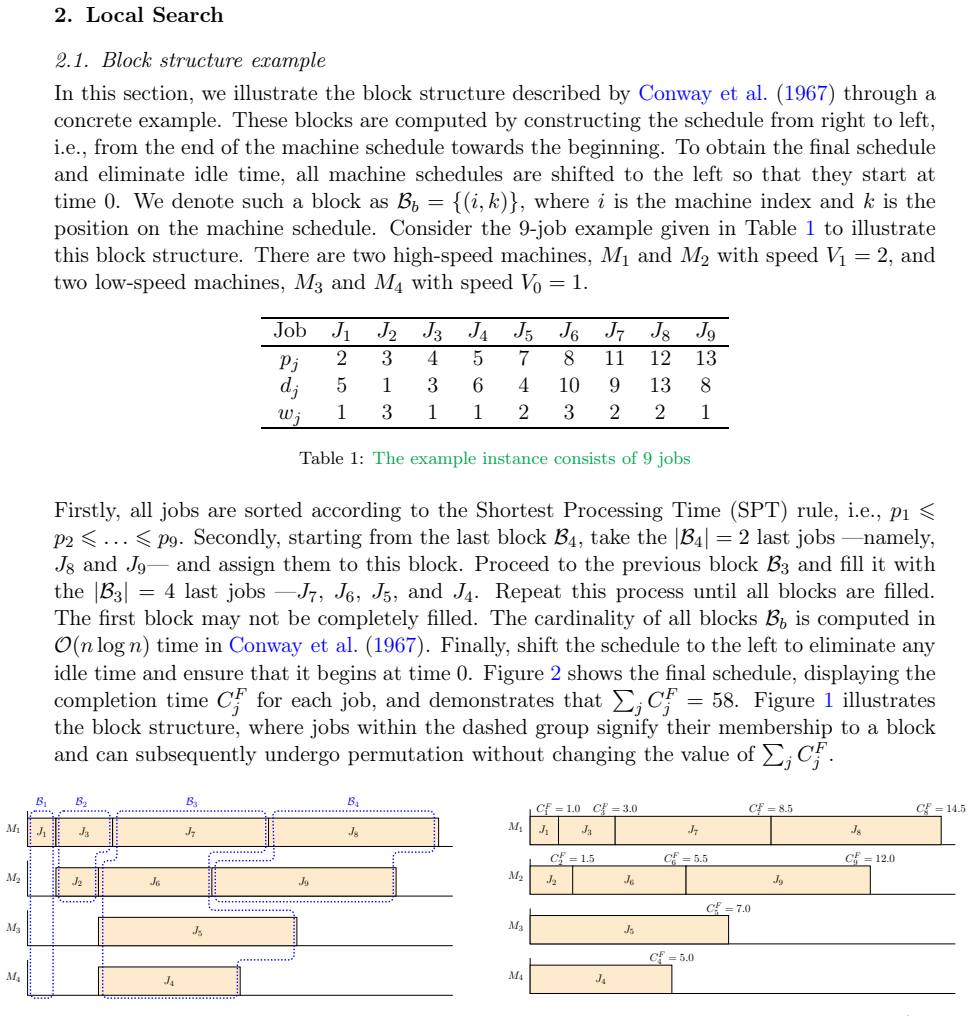
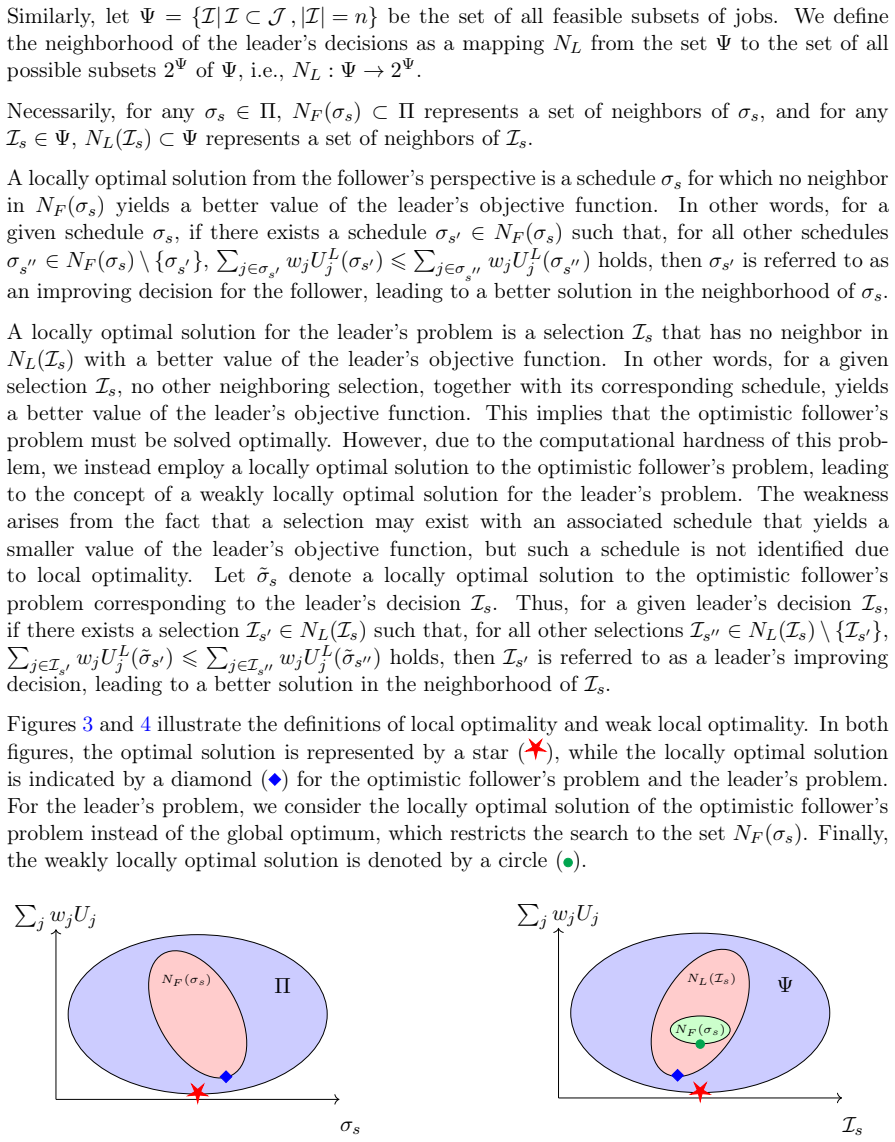
This work addresses the uniform parallel machine scheduling problem within an optimistic bilevel optimization framework. The leader seeks to minimize the weighted number of tardy jobs, while the follower aims to minimize the total completion time across a set of uniform machines. The hierarchical decision-making process of the bilevel problem makes designing effective heuristics challenging. To tackle this, we exploit a property of the follower that enables the construction of optimal schedules. From this property, we derive an effective branching scheme that simultaneously accounts for both leader and follower decisions. This branching scheme allows us to design a Recovering Beam Search (RBS), which represents a significant contribution from a bilevel perspective. Then we propose a Multi-Start Local Search (MSLS) algorithm based on an innovative scheme that couples the RBS and a Local Search (LS). To the best of our knowledge, while hybridizing beam search with local search is known in other contexts, our approach of leveraging a bilevel-specific branching scheme to efficiently explore the search space is novel. Moreover, we propose an automated method for determining heuristic parameters via Bayesian optimization. This reduces computational resource requirements and yields better parameters than the usual empirical approach. Finally, computational experiments are presented for instances with up to 500 jobs and 10 machines.
Editorial analysis
A structured set of objections, weighed in public.
Referee Report
Summary. The manuscript addresses an optimistic bilevel uniform parallel machine scheduling problem in which the leader minimizes the weighted number of tardy jobs and the follower minimizes total completion time. The authors exploit an asserted property of the follower that permits construction of optimal follower schedules for arbitrary leader decisions; this property is used to derive a bilevel-specific branching scheme for a Recovering Beam Search (RBS). The RBS is hybridized with local search inside a Multi-Start Local Search (MSLS) framework, heuristic parameters are tuned by Bayesian optimization, and computational results are reported on instances with up to 500 jobs and 10 machines.
Significance. If the follower property is correctly stated and the branching rule is valid under optimistic bilevel semantics, the RBS-MSLS hybrid would constitute a structured heuristic contribution that exploits problem-specific structure to explore the joint leader-follower space more efficiently than generic methods. The use of Bayesian optimization for parameter selection is a positive methodological feature that improves reproducibility.
major comments (2)
- [Abstract and RBS design section] The precise statement, proof, or counter-example verification of the follower property (that optimal schedules can be constructed for every leader decision) is not supplied in the abstract and, if absent from the main text, is load-bearing for the claimed correctness of the bilevel branching scheme used in the RBS (see abstract and the RBS design section).
- [RBS design section] The derivation of the branching rule from the follower property must be shown to respect optimistic bilevel semantics; any implicit assumption that the follower always responds optimally for the leader's objective could invalidate the search scheme if the property does not hold for all leader choices.
minor comments (2)
- [Abstract] The abstract describes the algorithmic ideas and experimental scale but supplies no quantitative results, baseline comparisons, or implementation details on how the follower property is proven or used.
- [Problem formulation section] Notation for the bilevel model (leader and follower objectives, decision variables) should be introduced with explicit symbols and consistency checks against the uniform-machine completion-time objective.
Simulated Author's Rebuttal
We thank the referee for the constructive feedback and the recommendation for major revision. We address each major comment below, clarifying the presence of the follower property in the manuscript and indicating where revisions will strengthen the presentation.
read point-by-point responses
-
Referee: [Abstract and RBS design section] The precise statement, proof, or counter-example verification of the follower property (that optimal schedules can be constructed for every leader decision) is not supplied in the abstract and, if absent from the main text, is load-bearing for the claimed correctness of the bilevel branching scheme used in the RBS (see abstract and the RBS design section).
Authors: The follower property is formally stated with a proof and counter-example verification in Section 3.2 of the main text. We agree that the abstract would benefit from an explicit reference to this property and its role in the branching scheme. We will revise the abstract in the next version to include a concise statement of the property. revision: yes
-
Referee: [RBS design section] The derivation of the branching rule from the follower property must be shown to respect optimistic bilevel semantics; any implicit assumption that the follower always responds optimally for the leader's objective could invalidate the search scheme if the property does not hold for all leader choices.
Authors: The branching rule is derived under the optimistic bilevel assumption, where the follower responds with an optimal schedule for its own objective (total completion time) and the leader evaluates the resulting joint outcome. The property is proven to hold for every leader decision in Section 3.2, and the RBS branching explicitly constructs these responses. We will add a clarifying paragraph in the RBS design section to explicitly connect the derivation to optimistic semantics and confirm that no implicit assumption about the follower optimizing the leader's objective is made. revision: yes
Circularity Check
No circularity; branching scheme derived from asserted follower property without self-referential reduction
full rationale
The paper states it exploits a property of the follower (minimize total completion time on uniform machines) that enables constructing optimal schedules for any leader decision, then derives a bilevel-specific branching scheme from this property to build the Recovering Beam Search. This is presented as an external structural fact about the follower problem rather than a result fitted to or defined by the target leader objective or the algorithm's own outputs. No equations reduce the branching rule to a tautology of the inputs, no parameters are fitted to the performance metric being optimized, and no load-bearing claim rests on a self-citation chain that itself lacks independent verification. The approach is self-contained against the stated assumptions even if the property's proof or scope requires separate validation.
Axiom & Free-Parameter Ledger
free parameters (1)
- heuristic parameters (beam width, etc.)
axioms (1)
- domain assumption The follower problem admits an optimal schedule construction property that can be exploited for branching.
Reference graph
Works this paper leans on
-
[1]
Computational Management Sci ence 2, 279–293
Bilevel programming approach applied to t he flow shop schedul- ing problem under fuzziness. Computational Management Sci ence 2, 279–293. doi: 10.1007/s10287-005-0035-z . Bianco, L., Caramia, M., Giordani, S., Mari, R.,
-
[2]
European Journal of Indust rial Engineering 9, 101–125
Grid sc heduling by bilevel pro- gramming: A heuristic approach. European Journal of Indust rial Engineering 9, 101–125. doi:10.1504/EJIE.2015.067450. Brochu, E., Cora, V.M., de Freitas, N.,
-
[3]
A tutorial on bay esian optimization of expen- sive cost functions, with application to active user modeli ng and hierarchical reinforcement learning. doi: 10.48550/arXiv.1012.2599. Brown, G.G., Carlyle, W.M., Royset, J.O., Wood, R.K.,
work page internal anchor Pith review Pith/arXiv arXiv doi:10.48550/arxiv.1012.2599
-
[4]
O n the Complexity of Delaying an Adversary’s Project, in: The Next Wave in Computing, Opti mization, and Decision Technologies, Springer US. pp. 3–17. doi: 10.1007/0-387-23529-9_1 . Clemente, E.C., Prokopyev, O.A.,
-
[5]
Annals of Operations Research 153, 235–256
An overview of bil evel optimization. Annals of Operations Research 153, 235–256. doi: 10.1007/s10479-007-0176-2 . Conway, R.W., Maxwell, W.L., Miller, L.W.,
-
[6]
Journal of Heuristics 10, 89–104
Recovering Be am Search: Enhancing the Beam Search Approach for Combinatorial Optimization Proble ms. Journal of Heuristics 10, 89–104. doi: 10.1023/B:HEUR.0000019987.10818.e0. Della Croce, F., T’kindt, V.,
-
[7]
Journal of the Operational Research Society 53, 1275–1280
A Recovering Beam Search a lgorithm for the one-machine dynamic total completion time scheduling problem. Journal of the Operational Research Society 53, 1275–1280. doi: 10.1057/palgrave.jors.2601389. Esteve, B., Aubijoux, C., Chartier, A., T’kindt, V.,
-
[8]
Eu ropean Journal of Operational Research 172, 798–813
A r ecovering beam search algorithm for the single machine Just-in-Time scheduling problem. Eu ropean Journal of Operational Research 172, 798–813. doi: 10.1016/j.ejor.2004.11.014. Framinan, J.M., Perez-Gonzalez, P.,
-
[9]
European Journal of Operati onal Research 266, 840–850
Order schedulin g with tardiness objective: Im- proved approximate solutions. European Journal of Operati onal Research 266, 840–850. doi:10.1016/j.ejor.2017.10.064. Garrido-Merchán, E.C., Hernández-Lobato, D.,
-
[10]
Deali ng with categorical and integer- valued variables in bayesian optimization with gaussian pr ocesses. Neurocomputing 380, 20–35. doi: 10.1016/j.neucom.2019.11.004. 23 Ghirardi, M., Potts, C.N.,
-
[11]
European Jour nal of Operational Research 165, 457–467
Makespan minimization for scheduling unrelated parallel machines: A recovering beam search approach. European Jour nal of Operational Research 165, 457–467. doi: 10.1016/j.ejor.2004.04.015. Hoffmann, J., Neufeld, J.S., Buscher, U.,
-
[12]
Journal of Scheduling 27, 525–543
Minimizing th e earliness–tardiness for the cus- tomer order scheduling problem in a dedicated machine envir onment. Journal of Scheduling 27, 525–543. doi: 10.1007/s10951-024-00814-z . Karlof, J.K., Wang, W.,
-
[13]
Computers & Operations Research 23, 443–451
Bilevel programming applied to the flow shop scheduling prob- lem. Computers & Operations Research 23, 443–451. doi: 10.1016/0305-0548(95)00034-8. Kis, T., Kovács, A.,
-
[14]
On bilevel machine scheduling pro blems. OR Spectrum 34, 43–68. doi:10.1007/s00291-010-0219-y . Konur, D., Golias, M.M.,
-
[15]
Computers & Industria l Engineering 65, 663–672
Analysis of different approac hes to cross-dock truck scheduling with truck arrival time uncertainty. Computers & Industria l Engineering 65, 663–672. doi:10.1016/j.cie.2013.05.009. Kovács, A., Kis, T.,
-
[16]
Constraint programming approach to a bilevel scheduling problem. Constraints 16, 317–340. doi: 10.1007/s10601-010-9102-3 . Kuhn, H.W.,
-
[17]
Naval Re- search Logistics Quarterly2(1-2), 83–97 (1955).https://doi.org/https://doi
The Hungarian method for the assignment pr oblem. Naval Research Logistics Quarterly 2, 83–97. doi: 10.1002/nav.3800020109. Lukač, Z., Šorić, K., Rosenzweig, V.V.,
-
[18]
Europea n Journal of Operational Research 187, 1504–1512
Production pl anning problem with sequence dependent setups as a bilevel programming problem. Europea n Journal of Operational Research 187, 1504–1512. doi: 10.1016/j.ejor.2006.09.029. Ow, P.S., Morton, T.E.,
-
[19]
International Journal of Production Research 26, 35–62
Filtered beam search in schedu ling. International Journal of Production Research 26, 35–62. doi: 10.1080/00207548808947840. Schau, Q.,
-
[20]
Mathematical Pr ogramming Computation 15, 1–51
Mixed integer bilevel optimization with a k-optimal follower: A hierarchy of bounds. Mathematical Pr ogramming Computation 15, 1–51. doi: 10.1007/s12532-022-00227-z . T’kindt, V., Della Croce, F., Agnetis, A.,
-
[21]
European Journal of Operatio nal Research 315, 63–72
Single mach ine adversarial bilevel scheduling problems. European Journal of Operatio nal Research 315, 63–72. doi:10.1016/j.ejor.2023.11.018. Valente, J.M.S., Alves, R.A.F.S.,
-
[22]
Compu ters & Industrial Engineering 48, 363–375
Filtered and recov ering beam search algorithms for the early/tardy scheduling problem with no idle time. Compu ters & Industrial Engineering 48, 363–375. doi: 10.1016/j.cie.2005.01.020. Zare, M.H., Prokopyev, O.A., Sauré, D.,
-
[23]
On Bilevel Opti mization with Inexact Follower. Decision Analysis 17, 74–95. doi: 10.1287/deca.2019.0392. 24
discussion (0)
Sign in with ORCID, Apple, or X to comment. Anyone can read and Pith papers without signing in.