Material for Thought: Generative AI as an Active Creative Medium
Pith reviewed 2026-05-20 04:08 UTC · model grok-4.3
The pith
Generative AI serves creative work best as an active medium shaped through human conversation rather than as outputs to be evaluated for correctness.
A machine-rendered reading of the paper's core claim, the machinery that carries it, and where it could break.
Core claim
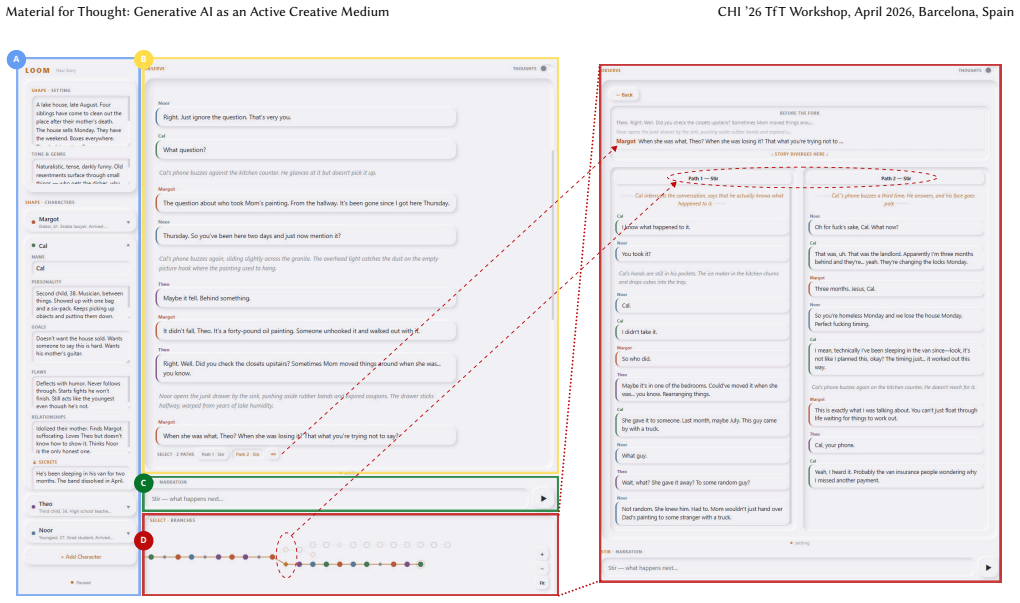
The paper claims that in creative contexts, the dominant framing of AI as a decision-support system misdirects human effort toward assessing output correctness. Treating generative AI as an active creative medium instead allows humans to engage in reflective practice by shaping the medium through ongoing conversation, using the SOSS cycle of Shape, Observe, Stir, and Select. Because the AI tends to converge and resolve, the human role becomes one of essential disruption and curation to maintain creative quality. This is demonstrated through the Loom probe for orchestrating narrative agents in writing.
What carries the argument
The SOSS framework for engaging with generative AI as an active creative medium, where Shape, Observe, Stir, and Select describe the conversational actions that sustain creative exploration against the AI's convergence.
If this is right
- Creative interfaces should prioritize ongoing conversational interaction over single-generation evaluation cycles.
- Human roles in AI-assisted creativity center on disruption and curation rather than judgment.
- Tools like Loom show how users can orchestrate multiple AI agents in narrative work.
- Design should account for AI's inherent tendency toward resolution by building in support for human intervention.
Where Pith is reading between the lines
- If the SOSS approach holds, it could extend to visual or musical creation by enabling similar iterative disruption in those mediums.
- Longer creative sessions might benefit more from this medium framing than short tasks, as sustained reflection builds depth.
- Future systems could be designed to prompt users toward stirring and selecting rather than accepting defaults.
Load-bearing premise
That Schön's reflective practice theory applies directly to generative AI and that the AI's convergence requires human disruption to achieve creative quality.
What would settle it
A controlled study measuring creative output quality and user engagement when using a decision-support AI tool versus a SOSS conversational interface for the same writing task.
Figures

read the original abstract
Human-AI collaboration research has largely positioned the human as a judge of AI output, centering effort on evaluating whether rec- ommendations are reliable enough to accept. This decision-support framing leaves little room for the human as creator. We argue that for creative work, this framing misdirects human effort toward eval- uating correctness rather than exploring and shaping the creative space. Drawing on Sch\"on's theory of reflective practice, we propose an alternative: treating generative AI as an active creative medium. As a potter works with clay, humans Shape, Observe, Stir, and Se- lect (SOSS) their medium through ongoing conversation. Where generative AI actively tends toward convergence and resolution, the human role of disruption and curation becomes essential for sustaining creative quality. We present a creative writing probe, Loom, in which users orchestrate simulated narrative agents. We also introduce the SOSS framework for this mode of engagement, and discuss design implications.
Editorial analysis
A structured set of objections, weighed in public.
Referee Report
Summary. The manuscript claims that human-AI collaboration research has centered on a decision-support model in which humans evaluate the reliability of AI outputs, leaving little scope for the human as creator. Drawing on Schön's theory of reflective practice, it proposes reframing generative AI as an active creative medium analogous to clay. Humans engage with it through ongoing conversation by Shaping, Observing, Stirring, and Selecting (SOSS), with the human role of disruption and curation becoming essential because generative AI inherently tends toward convergence and resolution. The paper introduces the Loom probe, in which users orchestrate simulated narrative agents for creative writing, presents the SOSS framework, and discusses design implications.
Significance. If the SOSS framework and its critique of decision-support framing hold, the work could usefully redirect HCI research on generative AI toward designs that support reflective, exploratory creative processes rather than correctness evaluation. The conceptual synthesis with Schön's reflective practice and the concrete Loom example provide a starting point for new interaction paradigms that treat AI as malleable medium rather than oracle.
major comments (2)
- [Abstract] Abstract: The claim that 'generative AI actively tends toward convergence and resolution' is presented as an intrinsic property of the medium that makes human disruption essential in SOSS. No generation statistics, temperature effects, diversity metrics, or comparisons to alternative prompting regimes are supplied to ground this premise, which is load-bearing for the argument that decision-support misdirects effort and that SOSS is required to sustain creative quality.
- [Loom probe] Loom probe description: The probe is introduced only at the level of 'users orchestrate simulated narrative agents,' without details on interaction mechanics, iteration trajectories, output diversity measures, or any observed user outcomes. This leaves the claim that Loom exemplifies SOSS unsupported by concrete evidence of how the framework counters convergence in practice.
minor comments (1)
- [Abstract] Abstract: 'rec- ommendations' contains an apparent line-break artifact that should be corrected for readability.
Simulated Author's Rebuttal
We thank the referee for the constructive and detailed comments, which highlight important aspects of how our conceptual argument is presented. We respond to each major comment below, clarifying the theoretical orientation of the work while indicating targeted revisions to improve clarity and support.
read point-by-point responses
-
Referee: [Abstract] Abstract: The claim that 'generative AI actively tends toward convergence and resolution' is presented as an intrinsic property of the medium that makes human disruption essential in SOSS. No generation statistics, temperature effects, diversity metrics, or comparisons to alternative prompting regimes are supplied to ground this premise, which is load-bearing for the argument that decision-support misdirects effort and that SOSS is required to sustain creative quality.
Authors: We acknowledge that this premise is load-bearing and is advanced conceptually, grounded in the observed tendencies of autoregressive generative models during extended creative interactions rather than in new quantitative metrics. The claim draws from the models' training to favor high-probability continuations, which can produce convergence without external disruption, aligning with Schön's reflective practice. In revision we will expand the relevant section with a concise explanation of these mechanisms and cite supporting literature on generative model behaviors in open-ended tasks. As the manuscript is a position paper proposing a reframing rather than an empirical evaluation, we will not add original generation statistics or experiments. revision: partial
-
Referee: [Loom probe] Loom probe description: The probe is introduced only at the level of 'users orchestrate simulated narrative agents,' without details on interaction mechanics, iteration trajectories, output diversity measures, or any observed user outcomes. This leaves the claim that Loom exemplifies SOSS unsupported by concrete evidence of how the framework counters convergence in practice.
Authors: The Loom probe is presented as a concrete illustration to instantiate the SOSS framework in a creative writing setting, not as a system accompanied by user studies or quantitative evaluation. The current description emphasizes the conceptual orchestration of narrative agents to show human roles in shaping and curation. We will revise this section to include additional specifics on interaction mechanics, such as iterative prompt refinement and observation of narrative emergence. Since the work does not include a formal user study, we cannot provide observed outcomes or diversity measures; we will explicitly note that the example demonstrates the framework's application in principle rather than supplying empirical validation. revision: partial
Circularity Check
No significant circularity; proposal rests on external Schön theory
full rationale
The paper derives its SOSS framework directly from Schön's established external theory of reflective practice rather than from any internal definitions, fitted parameters, or self-referential results. No equations or quantitative derivations appear; the Loom probe is presented illustratively without data that would force predictions back to inputs. The premise that generative AI tends toward convergence is asserted as a property of the medium (analogous to clay) but is not constructed from the paper's own outputs or prior self-citations, leaving the central argument self-contained against external benchmarks.
Axiom & Free-Parameter Ledger
axioms (1)
- domain assumption Schön's theory of reflective practice applies directly to human interactions with generative AI systems in creative tasks
invented entities (1)
-
SOSS framework
no independent evidence
Lean theorems connected to this paper
-
IndisputableMonolith/Foundation/RealityFromDistinction.leanreality_from_one_distinction unclear?
unclearRelation between the paper passage and the cited Recognition theorem.
We propose treating generative AI as an active creative medium where humans Shape, Observe, Stir, and Select (SOSS) their medium through ongoing conversation.
What do these tags mean?
- matches
- The paper's claim is directly supported by a theorem in the formal canon.
- supports
- The theorem supports part of the paper's argument, but the paper may add assumptions or extra steps.
- extends
- The paper goes beyond the formal theorem; the theorem is a base layer rather than the whole result.
- uses
- The paper appears to rely on the theorem as machinery.
- contradicts
- The paper's claim conflicts with a theorem or certificate in the canon.
- unclear
- Pith found a possible connection, but the passage is too broad, indirect, or ambiguous to say the theorem truly supports the claim.
Reference graph
Works this paper leans on
-
[1]
Johnson, Casey Dugan, and Michelle Bachman
Zahra Ashktorab, Qian Pan, Werner Geyer, Michael Desmond, Marina Danilevsky, James M. Johnson, Casey Dugan, and Michelle Bachman. 2025. Emerging Re- liance Behaviors in Human-AI Content Grounded Data Generation: The Role of Cognitive Forcing Functions and Hallucinations. arXiv:2409.08937 [cs.HC]
-
[2]
Gagan Bansal, Tongshuang Wu, Joyce Zhou, Raymond Fok, Besmira Nushi, Ece Kamar, Marco Tulio Ribeiro, and Daniel Weld. 2021. Does the Whole Exceed Its Parts? The Effect of AI Explanations on Complementary Team Performance. InProceedings of the ACM Conference on Human Factors in Computing Systems. ACM, New York, NY, USA
work page 2021
-
[3]
Zana Buçinca, Maja Barbara Malaya, and Krzysztof Z Gajos. 2021. To Trust or to Think: Cognitive Forcing Functions Can Reduce Overreliance on AI in AI-Assisted Decision-Making.Proceedings of the ACM on Human-Computer Interaction5, CSCW1 (2021), 1–21
work page 2021
-
[4]
Peter Dalsgaard. 2025. Generative AI as a Tool for Designerly Thinking. InCHI ’25 Workshop on Tools for Thought. ACM, Yokohama, Japan
work page 2025
-
[5]
Peter Dalsgaard. 2025. Reflective Friction in Generative AI: Designing for Slow Thinking in Fast Systems. Preprint
work page 2025
-
[6]
Davis, Chih-Pin Hsiao, Yanna Popova, and Brian Magerko
Nicholas M. Davis, Chih-Pin Hsiao, Yanna Popova, and Brian Magerko. 2015. An Enactive Model of Creativity for Computational Collaboration and Co-creation. InCreativity in the Digital Age
work page 2015
-
[7]
Philip Galanter. 2016. Generative Art Theory. InA Companion to Digital Art. Wiley, Hoboken, NJ
work page 2016
- [8]
-
[9]
Hao-Ping (Hank) Lee, Advait Sarkar, Lev Tankelevitch, Ian Drosos, Sean Rintel, Richard Banks, and Nicholas Wilson. 2025. The Impact of Generative AI on Critical Thinking: Self-Reported Reductions in Cognitive Effort and Confidence Effects From a Survey of Knowledge Workers. InProceedings of the ACM Confer- ence on Human Factors in Computing Systems. ACM, ...
work page 2025
- [10]
-
[11]
Joon Sung Park, Joseph C O’Brien, Carrie J Cai, Meredith Ringel Morris, Percy Liang, and Michael S Bernstein. 2023. Generative Agents: Interactive Simulacra of Human Behavior. InProceedings of the ACM Symposium on User Interface Software and Technology. ACM, New York, NY, USA. Material for Thought: Generative AI as an Active Creative Medium CHI ’26 Tf T W...
work page 2023
-
[12]
Leon Reicherts, Zelun Tony Zhang, Elisabeth von Oswald, Yuanting Liu, Yvonne Rogers, and Mariam Hassib. 2025. AI, help me think—but for myself: Assisting people in complex decision-making by providing different kinds of cognitive support. InProceedings of the ACM Conference on Human Factors in Computing Systems. 1–19
work page 2025
-
[13]
Advait Sarkar. 2024. AI Should Challenge, Not Obey.Commun. ACM67, 10 (Sept. 2024), 18–21
work page 2024
-
[14]
Donald A. Schön. 1983.The Reflective Practitioner: How Professionals Think in Action. Basic Books, New York
work page 1983
-
[15]
Bowman, Newton Cheng, Esin Durmus, Zac Hatfield-Dodds, Scott R
Mrinank Sharma, Meg Tong, Tomasz Korbak, David Duvenaud, Amanda Askell, Samuel R. Bowman, Newton Cheng, Esin Durmus, Zac Hatfield-Dodds, Scott R. Johnston, Shauna Kravec, Timothy Maxwell, Sam McCandlish, Kamal Ndousse, Oliver Rauber, Nicholas Schiefer, Da Yan, Miranda Zhang, and Ethan Perez. 2024. Towards Understanding Sycophancy in Language Models. InPro...
work page 2024
-
[16]
Ben Shneiderman. 2022.Human-Centered AI. Oxford University Press
work page 2022
-
[17]
Alex Singla, Alexander Sukharevsky, Bryce Hall, Lareina Yee, and Michael Chui
-
[18]
The State of AI in 2025: Agents, Innovation, and Transformation. McKinsey Global Survey
work page 2025
-
[19]
Lev Tankelevitch, Elena L Glassman, Jessica He, Aniket Kittur, Mina Lee, Srishti Palani, Advait Sarkar, Gonzalo Ramos, Yvonne Rogers, and Hari Subramonyam
- [20]
-
[21]
Michelle Vaccaro, Abdullah Almaatouq, and Thomas Malone. 2024. When Com- binations of Humans and AI Are Useful: A Systematic Review and Meta-Analysis. Nature Human Behaviour8 (2024), 2293–2303
work page 2024
-
[22]
Qian Yang, Justin Cranshaw, Saleema Amershi, Shamsi T. Iqbal, and Jaime Teevan
-
[23]
InProceedings of the 2019 CHI Conference on Human Factors in Computing Systems (CHI ’19)
Sketching NLP: A Case Study of Exploring the Right Things To Design with Language Intelligence. InProceedings of the 2019 CHI Conference on Human Factors in Computing Systems (CHI ’19). Association for Computing Machinery, 1–12
work page 2019
-
[24]
Yunfeng Zhang, Q. Vera Liao, and Rachel K. E. Bellamy. 2020. Effect of Confidence and Explanation on Accuracy and Trust Calibration in AI-Assisted Decision Making. InProceedings of the ACM Conference on Fairness, Accountability, and Transparency. ACM, New York, NY, USA, 295–305
work page 2020
discussion (0)
Sign in with ORCID, Apple, or X to comment. Anyone can read and Pith papers without signing in.