SPA-MAE: A Physics-Guided CSI Foundation Model for Wireless Physical Layer
Pith reviewed 2026-05-20 02:01 UTC · model grok-4.3
The pith
A physics-guided masked autoencoder pretrains a compact CSI foundation model by aligning encoder features to multipath parameters and sparse 2D-FFT structure.
A machine-rendered reading of the paper's core claim, the machinery that carries it, and where it could break.
Core claim
SPA-MAE introduces a physical prior module that produces two complementary guidance signals during masked autoencoder pretraining: a parameter-aware branch that extracts features from multipath parameters and aligns the encoder output to them, and a structure-aware branch that encourages the encoder to represent the sparse CSI pattern obtained after 2D FFT. After end-to-end pretraining the MAE encoder is kept and transferred to downstream wireless tasks, where it delivers higher accuracy than existing CSI foundation models despite having fewer parameters.
What carries the argument
The physical prior module, which injects parameter-aware alignment to multipath parameters and structure-aware capture of sparse 2D-FFT CSI as complementary guidance signals into the MAE pretraining stage.
If this is right
- The retained encoder supports direct fine-tuning on multiple physical layer tasks including channel estimation and beamforming.
- Performance advantages appear most clearly in low-SNR regimes and when only small amounts of task-specific data are available.
- The model achieves these results with a smaller total parameter count than current state-of-the-art CSI foundation models.
- End-to-end training lets the physical priors shape the encoder representations for broader transfer.
Where Pith is reading between the lines
- Embedding explicit physical structure and parameter knowledge into self-supervised pretraining can reduce the need for ever-larger models in wireless applications.
- The same two-branch guidance pattern could be tested on real measured channels rather than purely simulated data.
- Analogous priors might be added to foundation models for other structured signal domains such as radar or acoustic processing.
Load-bearing premise
The two guidance signals cause the encoder to learn features that genuinely improve generalization on new tasks rather than simply memorizing patterns from the pretraining data.
What would settle it
Measuring no accuracy gain, or a loss, when the pretrained encoder is tested on an unseen wireless task under low SNR with limited labeled data would show the guidance signals do not deliver the claimed benefit.
Figures


read the original abstract
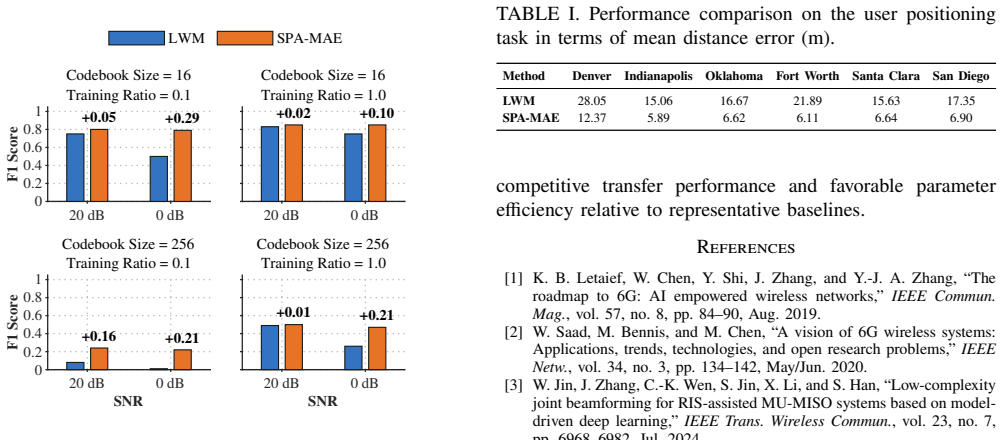
Deep learning (DL) has been widely used in future 6G physical layer communications, but task-specific DL models are difficult to generalize across different physical layer tasks. Recently emerging wireless foundation models demonstrate strong generalization capability. However, existing methods mainly adapt pretrained language/vision models or rely on CSI reconstruction objectives for pretraining, with limited use of channel knowledge, and thus have limited performance. To address this limitation, we propose SPA-MAE, a physics-guided wireless foundation model by exploiting the adapted MAE backbone and channel knowledge. A physical prior module is developed to provide two complementary guidance signals in the pretraining stage. Specifically, the parameter-aware guidance branch extracts features from explicit multipath parameters and encourages the encoder output to align them, while the structure-aware guidance branch encourages the encoder to capture the sparse transformed-domain CSI structure obtained after a 2D FFT. After end-to-end learning, the MAE encoder will be retained for downstream tasks. Experiments on four wireless tasks show that SPA-MAE outperforms state-of-the-art CSI foundation models with smaller number of parameters, especially under low-SNR and limited-data conditions.
Editorial analysis
A structured set of objections, weighed in public.
Referee Report
Summary. The manuscript proposes SPA-MAE, a physics-guided masked autoencoder foundation model for channel state information (CSI) in wireless physical-layer communications. It augments a standard MAE pretraining objective with a physical prior module that supplies two guidance signals: a parameter-aware branch aligning encoder features to explicit multipath parameters and a structure-aware branch encouraging capture of sparse structure in the 2D-FFT domain of CSI. After pretraining, the encoder is retained and applied to four downstream wireless tasks, with the central claim that the resulting model outperforms prior CSI foundation models while using fewer parameters, especially under low-SNR and limited-data regimes.
Significance. If the reported gains are shown to arise from the physics-guided components rather than from the MAE backbone or dataset specifics, the work would advance domain-informed self-supervised learning for 6G physical-layer applications. Embedding multipath parameters and sparse transformed-domain structure as complementary priors could improve robustness in challenging propagation conditions and reduce the need for task-specific retraining.
major comments (2)
- [Experimental results section] The central claim attributes performance gains on the four downstream tasks to the two complementary guidance signals from the physical prior module, yet the manuscript provides no ablation studies that disable the parameter-aware branch, the structure-aware branch, or both while keeping the MAE architecture and training protocol fixed. Without these controls, it remains possible that the observed advantages stem from the adapted MAE backbone, CSI data distribution, or optimization choices rather than the physics-specific guidance.
- [Abstract and §4] The abstract and experimental description assert superiority over state-of-the-art CSI foundation models under low-SNR and limited-data conditions but supply no information on the specific baselines, pretraining and downstream dataset sizes, number of independent runs, or statistical testing procedures. These omissions prevent verification of the magnitude and reliability of the claimed improvements.
minor comments (1)
- [Abstract] The abstract contains a minor grammatical issue: 'with smaller number of parameters' should be revised to 'with a smaller number of parameters'.
Simulated Author's Rebuttal
We thank the referee for the detailed and constructive feedback. We address each major comment below and have revised the manuscript to strengthen the experimental validation and reporting of results.
read point-by-point responses
-
Referee: [Experimental results section] The central claim attributes performance gains on the four downstream tasks to the two complementary guidance signals from the physical prior module, yet the manuscript provides no ablation studies that disable the parameter-aware branch, the structure-aware branch, or both while keeping the MAE architecture and training protocol fixed. Without these controls, it remains possible that the observed advantages stem from the adapted MAE backbone, CSI data distribution, or optimization choices rather than the physics-specific guidance.
Authors: We agree that ablation studies are necessary to attribute gains specifically to the physics-guided components. In the revised manuscript, we have added a new subsection in the Experimental results section presenting ablation experiments. We evaluate four variants while fixing the MAE backbone, pretraining objective, optimizer, and all datasets: (1) full SPA-MAE, (2) parameter-aware branch disabled, (3) structure-aware branch disabled, and (4) both branches disabled. Results across the four downstream tasks show that disabling either branch degrades performance relative to the full model, with the largest drops observed under low-SNR and limited-data conditions. The combined ablation yields the weakest results. These controls confirm that the complementary guidance signals are responsible for the reported advantages rather than the MAE architecture or data distribution alone. revision: yes
-
Referee: [Abstract and §4] The abstract and experimental description assert superiority over state-of-the-art CSI foundation models under low-SNR and limited-data conditions but supply no information on the specific baselines, pretraining and downstream dataset sizes, number of independent runs, or statistical testing procedures. These omissions prevent verification of the magnitude and reliability of the claimed improvements.
Authors: We appreciate this observation and have revised both the Abstract and Section 4 to provide the requested details. The revised text now explicitly lists the state-of-the-art CSI foundation model baselines compared (including their architectures and parameter counts), reports the pretraining dataset size (number of CSI samples and SNR range), specifies the downstream dataset sizes and splits for each of the four tasks, states that all experiments were repeated over 5 independent runs with different random seeds, and includes statistical significance testing via paired t-tests with reported p-values (<0.05) for the key performance improvements. These additions enable direct verification of the magnitude and reliability of the gains, particularly in the low-SNR and limited-data regimes. revision: yes
Circularity Check
No circularity: physics priors are external inputs, not self-referential fits
full rationale
The paper's method adds a physical prior module (parameter-aware alignment to multipath parameters plus structure-aware 2D-FFT sparsity) to a standard MAE pretraining objective. This guidance uses known channel properties as external signals rather than deriving them from the model's own outputs or fitted parameters. Downstream performance claims rest on empirical comparisons across four tasks, not on any quantity that reduces by construction to the pretraining loss or to a self-citation chain. No equations or steps in the provided description equate a claimed prediction to its own inputs; the architecture remains self-contained against external benchmarks.
Axiom & Free-Parameter Ledger
axioms (1)
- domain assumption CSI measurements exhibit explicit multipath parameters and sparse structure after 2D FFT that can serve as complementary guidance signals.
Reference graph
Works this paper leans on
-
[1]
The roadmap to 6G: AI empowered wireless networks,
K. B. Letaief, W. Chen, Y. Shi, J. Zhang, and Y.-J. A. Zhang, “The roadmap to 6G: AI empowered wireless networks,”IEEE Commun. Mag., vol. 57, no. 8, pp. 84–90, Aug. 2019
work page 2019
-
[2]
A vision of 6G wireless systems: Applications, trends, technologies, and open research problems,
W. Saad, M. Bennis, and M. Chen, “A vision of 6G wireless systems: Applications, trends, technologies, and open research problems,”IEEE Netw., vol. 34, no. 3, pp. 134–142, May/Jun. 2020
work page 2020
-
[3]
W. Jin, J. Zhang, C.-K. Wen, S. Jin, X. Li, and S. Han, “Low-complexity joint beamforming for RIS-assisted MU-MISO systems based on model- driven deep learning,”IEEE Trans. Wireless Commun., vol. 23, no. 7, pp. 6968–6982, Jul. 2024
work page 2024
-
[4]
Deep learning for mmWave beam and blockage prediction using sub-6 GHz channels,
M. Alrabeiah and A. Alkhateeb, “Deep learning for mmWave beam and blockage prediction using sub-6 GHz channels,”IEEE Trans. Commun., vol. 68, no. 9, pp. 5504–5518, Sep. 2020
work page 2020
-
[5]
Model- driven deep learning for physical layer communication
H. He, S. Jin, C.-K. Wen, F. Gao, G. Y. Li, and Z. Xu, “Model- driven deep learning for physical layer communication”,IEEE Wireless Communications, vol. 26, no. 5, pp. 77-83, Oct. 2019
work page 2019
-
[6]
BERT: Pre-training of deep bidirectional transformers for language understanding,
J. Devlin, M.-W. Chang, K. Lee, and K. Toutanova, “BERT: Pre-training of deep bidirectional transformers for language understanding,” inProc. North Amer. Chapter Assoc. Comput. Linguistics: Human Language Technologies (NAACL-HLT), Minneapolis, MN, USA, Jun. 2019, pp. 4171–4186
work page 2019
-
[7]
BEiT: BERT pre-training of image transformers,
H. Bao, L. Dong, S. Piao, and F. Wei, “BEiT: BERT pre-training of image transformers,” inProc. Int. Conf. Learn. Represent. (ICLR), Virtual, Apr. 2022
work page 2022
-
[8]
A. Kirillov, E. Mintun, N. Ravi, H. Mao, C. Rolland, L. Gustafson, T. Xiao, S. Whitehead, A. C. Berg, W.-Y. Lo, P. Dollár, and R. Girshick, “Segment anything,” inProc. IEEE/CVF Int. Conf. Comput. Vis. (ICCV), Paris, France, Oct. 2023, pp. 4015–4026
work page 2023
-
[9]
LVM4CSI: Enabling direct application of pre-trained large vision models for wireless channel tasks,
J. Guo, P. Jiang, C.-K. Wen, S. Jin, and J. Zhang, “LVM4CSI: Enabling direct application of pre-trained large vision models for wireless channel tasks,” arXiv preprint arXiv:2507.05121, 2025
-
[10]
LLM4WM: Adapting LLM for wireless multi-tasking,
X. Liu, S. Gao, B. Liu, X. Cheng, and L. Yang, “LLM4WM: Adapting LLM for wireless multi-tasking,”IEEE Trans. Mach. Learn. Commun. Netw., vol. 3, pp. 835–847, Jul. 2025
work page 2025
-
[11]
Large wireless model (LWM): A foundation model for wireless channels,
S. Alikhani, G. Charan, and A. Alkhateeb, “Large wireless model (LWM): A foundation model for wireless channels,” arXiv preprint arXiv:2411.08872, 2024
-
[12]
CSI-MAE: A masked autoencoder-based channel foundation model,
J. Jiang, X. Ruan, and S. Xu, “CSI-MAE: A masked autoencoder-based channel foundation model,” arXiv preprint arXiv:2601.03789, 2026
-
[13]
WiFo: Wireless foundation model for channel prediction,
B. Liu, S. Gao, X. Liu, X. Cheng, and L. Yang, “WiFo: Wireless foundation model for channel prediction,”Sci. China Inf. Sci., vol. 68, no. 6, Art. no. 162302, Jun. 2025
work page 2025
-
[14]
WirelessGPT: A generative foundation model for multi-task integrated sensing and communication,
T. Yang, P. Zhang, M. Zheng, Y. Shi, L. Jing, J. Huang, and N. Li, “WirelessGPT: A generative foundation model for multi-task integrated sensing and communication,”IEEE J. Sel. Areas Commun., vol. 44, pp. 2259–2273, 2026
work page 2026
-
[15]
A. Vaswani, N. Shazeer, N. Parmar, J. Uszkoreit, L. Jones, A. N. Gomez, Ł. Kaiser, and I. Polosukhin, “Attention is all you need,” inProc. Adv. Neural Inf. Process. Syst. (NeurIPS), 2017, pp. 5998–6008
work page 2017
-
[16]
Masked autoencoders are scalable vision learners,
K. He, X. Chen, S. Xie, Y. Li, P. Dollár, and R. Girshick, “Masked autoencoders are scalable vision learners,” inProc. IEEE/CVF Conf. Comput. Vis. Pattern Recognit., 2022, pp. 16000–16009
work page 2022
-
[17]
DeepMIMO: A generic deep learning dataset for mil- limeter wave and massive MIMO applications,
A. Alkhateeb, “DeepMIMO: A generic deep learning dataset for mil- limeter wave and massive MIMO applications,” inProc. Inf. Theory Appl. Workshop (ITA), San Diego, CA, USA, Feb. 2019, pp. 1–8
work page 2019
-
[18]
Deep residual learning for image recognition,
K. He, X. Zhang, S. Ren, and J. Sun, “Deep residual learning for image recognition,” inProc. IEEE Conf. Comput. Vis. Pattern Recognit. (CVPR), Las Vegas, NV, USA, Jun. 2016, pp. 770–778
work page 2016
discussion (0)
Sign in with ORCID, Apple, or X to comment. Anyone can read and Pith papers without signing in.