Facing the phase: Gravity-mode offset and buoyancy glitches in red--giant branch stars
Pith reviewed 2026-05-20 01:56 UTC · model grok-4.3
The pith
Buoyancy glitches contribute to the g-mode frequency phase in red-giant stars in addition to the standard reflection offset.
A machine-rendered reading of the paper's core claim, the machinery that carries it, and where it could break.
Core claim
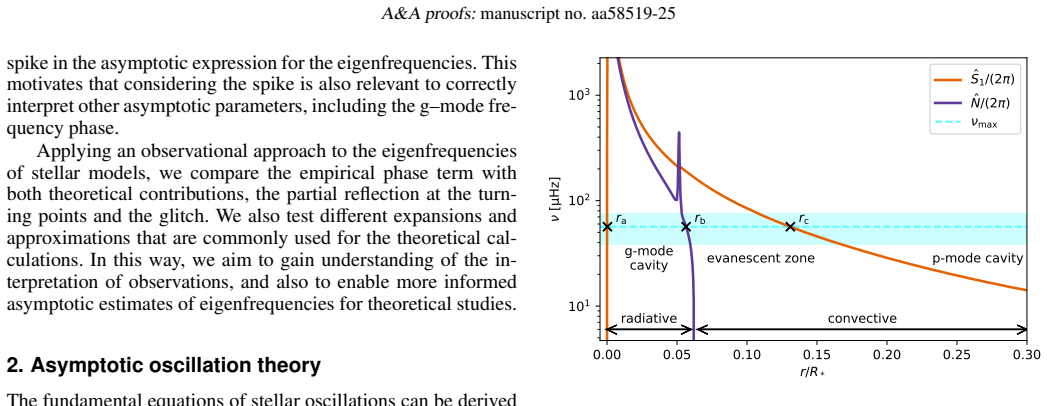
The total observable phase of g-mode frequencies in red-giant stars is produced by the sum of the reflection-related offset ε_g and contributions from buoyancy glitches. Numerical models demonstrate that glitches in the Brunt-Väisälä frequency, including those located in the evanescent zone, produce measurable shifts in the asymptotic pattern of mixed dipole modes. A formalism is given to isolate the glitch-induced phase term, and a modification to the standard expression for ε_g is proposed that incorporates these effects.
What carries the argument
The modified expression for the g-mode offset ε_g that folds in the phase contribution from buoyancy glitches, tested empirically on stellar models.
Load-bearing premise
The numerical stellar models accurately place and size the buoyancy glitches and evanescent-zone structure so that their phase effects are not artifacts of resolution, input physics, or boundary conditions.
What would settle it
High-precision frequency measurements of a red giant whose period spacings independently reveal clear buoyancy glitches, tested to see whether the modified ε_g formula matches the observed phase better than the unmodified version.
Figures


read the original abstract
With the increasing precision of asteroseismic observations, it becomes possible to reliably measure oscillation properties of an increasing number of stars. Interpreting these measurements requires a good theoretical understanding of their link to fundamental stellar properties. In this study, we focus on the phase offset in gravity(g)-mode frequencies, which is imprinted in the asymptotic eigenfrequency pattern of mixed dipole modes observed in red--giant branch stars. We aim to unravel its physical origin and thus enable an informed interpretation of observations. Using stellar models, we empirically test the contribution of the g-mode offset $\varepsilon_\mathrm{g}$ (which is related to the wave reflection at cavity boundaries and commonly considered to be the dominant phase term) and glitches to the total observable phase. We find that, additionally to $\varepsilon_\mathrm{g}$, buoyancy glitches play an important role in the correct interpretation of the g--mode frequency phase. We further find that glitches in the evanescent zone also contribute to the phase, and we present a formalism to quantify this contribution. Finally, we propose a modification to the widely used formula for $\varepsilon_\mathrm{g}$. The g--mode frequency phase carries more information than previously considered. It has large analytic potential to study not only the reflection properties of the buoyancy cavity, but also the properties of glitches in the Brunt-V\"ais\"al\"a frequency.
Editorial analysis
A structured set of objections, weighed in public.
Referee Report
Summary. The paper uses stellar evolution models to empirically test the contributions to the observed phase offset in g-mode frequencies of mixed dipole modes in red-giant branch stars. It claims that buoyancy glitches and glitches in the evanescent zone contribute substantially in addition to the standard ε_g term (related to wave reflection at cavity boundaries), presents a formalism to quantify the evanescent-zone contribution, and proposes a modification to the widely used formula for ε_g. The g-mode phase is argued to carry information about both reflection properties and Brunt-Väisälä frequency glitches.
Significance. If the results hold, the work would be significant for asteroseismology by showing that the g-mode frequency phase encodes more interior information than previously assumed, enabling better constraints on glitch properties and cavity boundaries from high-precision observations. The model-based empirical approach and new formalism for evanescent-zone effects are strengths, though the absence of direct observational validation limits immediate applicability.
major comments (3)
- [§3] §3 (model grid and glitch extraction): The central claims rest on phase measurements extracted from 1D stellar models, yet the manuscript provides no details on the model grid (masses, metallicities, evolutionary stages), glitch identification criteria, or error propagation. This is load-bearing because the reported glitch contributions to the phase could be sensitive to these choices.
- [§4.2] §4.2 (resolution and convergence): No resolution-convergence tests or cross-code comparisons are presented for the Brunt-Väisälä frequency profile or the resulting phase shifts. Since glitch amplitudes and phase effects scale with local gradients and widths of N(r), under-resolution in the radiative core or μ-gradient region could introduce artifacts comparable to the claimed effects, undermining the empirical support for the modified ε_g formula.
- [§5] §5 (proposed modification): The suggested revision to the ε_g formula is motivated by the model results but lacks a direct comparison to observed mixed-mode frequencies from Kepler or TESS data. Without this, it is unclear whether the modification improves fits to real stars or remains an artifact of the specific input physics.
minor comments (2)
- [Abstract and §1] The abstract and introduction use ε_g and ε_g interchangeably without a clear initial definition; a dedicated notation table would improve readability.
- [Figures] Figure captions should explicitly state which panels show total phase, ε_g contribution, and glitch contributions to allow quick assessment of the relative magnitudes.
Simulated Author's Rebuttal
We thank the referee for the constructive and detailed report. We address each major comment point by point below, indicating where revisions have been made to the manuscript.
read point-by-point responses
-
Referee: [§3] §3 (model grid and glitch extraction): The central claims rest on phase measurements extracted from 1D stellar models, yet the manuscript provides no details on the model grid (masses, metallicities, evolutionary stages), glitch identification criteria, or error propagation. This is load-bearing because the reported glitch contributions to the phase could be sensitive to these choices.
Authors: We agree that these details are essential for reproducibility and robustness. In the revised manuscript we have expanded Section 3 with a dedicated subsection that specifies the model grid (masses 1.0–2.0 M⊙, metallicities [Fe/H] = −0.5 to +0.3, and evolutionary stages from the base of the RGB to the luminosity bump), the precise criteria used to identify buoyancy glitches from the Brunt–Väisälä frequency profile, and the propagation of numerical uncertainties into the extracted phase offsets. revision: yes
-
Referee: [§4.2] §4.2 (resolution and convergence): No resolution-convergence tests or cross-code comparisons are presented for the Brunt-Väisälä frequency profile or the resulting phase shifts. Since glitch amplitudes and phase effects scale with local gradients and widths of N(r), under-resolution in the radiative core or μ-gradient region could introduce artifacts comparable to the claimed effects, undermining the empirical support for the modified ε_g formula.
Authors: We acknowledge the importance of demonstrating numerical robustness. We have added resolution-convergence tests for a representative subset of models, varying the radial mesh in the core and μ-gradient region; the glitch-induced phase contributions change by less than 5 % once the local resolution exceeds the adopted threshold. These tests are now reported in a new appendix. Cross-code comparisons lie outside the scope of the present study, which focuses on a single, well-documented stellar-evolution code. revision: partial
-
Referee: [§5] §5 (proposed modification): The suggested revision to the ε_g formula is motivated by the model results but lacks a direct comparison to observed mixed-mode frequencies from Kepler or TESS data. Without this, it is unclear whether the modification improves fits to real stars or remains an artifact of the specific input physics.
Authors: The primary goal of the work is to isolate and quantify the physical contributions to the g-mode phase using controlled stellar models. We have added a forward-looking discussion that outlines how the modified ε_g expression can be applied to Kepler and TESS mixed-mode data and explicitly states that such observational tests constitute the natural next step. We maintain that the model-based evidence already provides a physically motivated justification for the proposed revision. revision: partial
Circularity Check
No circularity: empirical tests via forward stellar modeling are independent of the interpreted phase quantities
full rationale
The paper employs numerical stellar evolution models to compute mixed-mode frequencies and extract the observable g-mode phase, then compares these against the asymptotic expression involving ε_g and separate glitch contributions. No equation or result is shown to be defined in terms of the target phase itself, nor is any fitted parameter from a data subset renamed as a prediction of a closely related quantity. The proposed modification to the ε_g formula arises from direct model measurements of reflection and glitch effects rather than from self-referential definitions or load-bearing self-citations. The derivation chain therefore remains self-contained against external model benchmarks.
Axiom & Free-Parameter Ledger
axioms (1)
- standard math Asymptotic eigenfrequency pattern for mixed dipole modes holds with identifiable phase contributions from reflection and glitches
Lean theorems connected to this paper
-
IndisputableMonolith/Cost/FunctionalEquation.leanwashburn_uniqueness_aczel unclear?
unclearRelation between the paper passage and the cited Recognition theorem.
ε_g = −1/π d/dν ∫ ν·k(r,ν) dr + Ψ/π; glitch phase Φ_δ = 1/π arcsin[C/ω B sin²(ϕ + π/4)]
-
IndisputableMonolith/Foundation/AlexanderDuality.leanalexander_duality_circle_linking unclear?
unclearRelation between the paper passage and the cited Recognition theorem.
Dirac-delta glitch in N²(r) and Gaussian glitch parametrization for late RGB
What do these tags mean?
- matches
- The paper's claim is directly supported by a theorem in the formal canon.
- supports
- The theorem supports part of the paper's argument, but the paper may add assumptions or extra steps.
- extends
- The paper goes beyond the formal theorem; the theorem is a base layer rather than the whole result.
- uses
- The paper appears to rely on the theorem as machinery.
- contradicts
- The paper's claim conflicts with a theorem or certificate in the canon.
- unclear
- Pith found a possible connection, but the passage is too broad, indirect, or ambiguous to say the theorem truly supports the claim.
Reference graph
Works this paper leans on
- [1]
-
[2]
2012, in Astronomical Society of the Pacific Conference Series, Vol
Christensen-Dalsgaard , J. 2012, in Astronomical Society of the Pacific Conference Series, Vol. 462, Progress in Solar/Stellar Physics with Helio- and Asteroseismology, ed. H. Shibahashi , M. Takata , & A. E. Lynas-Gray , 503
work page 2012
-
[3]
Corsaro , E., McKeever , J. M., & Kuszlewicz , J. S. 2020, , 640, A130
work page 2020
-
[4]
Cunha , M. S., Avelino , P. P., Christensen-Dalsgaard , J., et al. 2019, Monthly Notices of the Royal Astronomical Society, 490, 909
work page 2019
-
[5]
Cunha , M. S., Damasceno , Y. C., Amaral , J., et al. 2024, , 687, A100
work page 2024
-
[6]
Cunha, M. S., Stello, D., Avelino, P. P., Christensen-Dalsgaard, J., & Townsend, R. H. D. 2015, The Astrophysical Journal, 805, 127
work page 2015
-
[7]
Garc \' a Saravia Ortiz de Montellano , A., Hekker , S., & Theme l , N. 2018, , 476, 1470
work page 2018
-
[8]
Gough , D. O. 1993, in Astrophysical Fluid Dynamics - Les Houches 1987, ed. J. P. Zahn & J. Zinn-Justin , 399--560
work page 1993
-
[9]
Hekker, S., Elsworth, Y., & Angelou, G. C. 2018, , 610, A80
work page 2018
-
[10]
Hekker, S., Gilliland, R. L., Elsworth, Y., et al. 2011, Monthly Notices of the Royal Astronomical Society, 414, 2594
work page 2011
- [11]
-
[12]
Jiang, C., Christensen-Dalsgaard, J., & Cunha, M. 2018, , 474, 5413
work page 2018
-
[13]
Jiang, C., Cunha, M., Christensen-Dalsgaard, J., & Zhang, Q. 2020, , 495, 621
work page 2020
-
[14]
Jiang, C., Cunha, M., Christensen-Dalsgaard, J., Zhang, Q. S., & Gizon, L. 2022, , 515, 3853
work page 2022
-
[15]
2019, Release note: Massive peak bagging of red giants in the Kepler field
Kallinger, T. 2019, Release note: Massive peak bagging of red giants in the Kepler field
work page 2019
- [16]
-
[17]
Kuszlewicz , J. S., Hon , M., & Huber , D. 2023, , 954, 152
work page 2023
-
[18]
2012, in Astronomical Society of the Pacific Conference Series, Vol
Mathur , S., Hekker , S., Trampedach , R., et al. 2012, in Astronomical Society of the Pacific Conference Series, Vol. 462, Progress in Solar/Stellar Physics with Helio- and Asteroseismology, ed. H. Shibahashi , M. Takata , & A. E. Lynas-Gray , 375
work page 2012
- [19]
-
[20]
Mosser , B., Goupil , M. J., Belkacem , K., et al. 2012, , 540, A143
work page 2012
- [21]
- [22]
- [23]
- [24]
- [25]
- [26]
-
[27]
H., Elsworth , Y., Epstein , C., et al
Pinsonneault , M. H., Elsworth , Y., Epstein , C., et al. 2014, , 215, 19
work page 2014
-
[28]
Pinsonneault , M. H., Elsworth , Y. P., Tayar , J., et al. 2018, , 239, 32
work page 2018
- [29]
- [30]
- [31]
- [32]
- [33]
- [34]
-
[35]
Townsend, R. H. D. & Teitler, S. A. 2013, , 435, 3406–3418
work page 2013
- [36]
-
[37]
E., Miglio, A., & Montalbán, J
van Rossem, W. E., Miglio, A., & Montalbán, J. 2024, , 691, A177
work page 2024
- [38]
- [39]
discussion (0)
Sign in with ORCID, Apple, or X to comment. Anyone can read and Pith papers without signing in.