Realization of a parity-violating antiferromagnetic state in LaMnSi
Pith reviewed 2026-05-20 04:11 UTC · model grok-4.3
The pith
LaMnSi realizes a parity-violating antiferromagnetic state with momentum-asymmetric electronic bands.
A machine-rendered reading of the paper's core claim, the machinery that carries it, and where it could break.
Core claim
LaMnSi realizes a parity-violating antiferromagnetic state. Soft x-ray ARPES resolves the three-dimensional bulk band structures in agreement with density functional theory calculations for the AFM phase, while SHG microscopy detects sign-reversing nonlinear optical responses from opposite AFM domains that carry T-odd parity-violating order.
What carries the argument
Parity-violating antiferromagnetic order, which breaks both space inversion and time reversal but preserves their product, producing spin-degenerate yet momentum-asymmetric bands.
If this is right
- LaMnSi functions as a parity-violating AFM metal.
- This class of antiferromagnets provides a platform for symmetry-controlled nonreciprocal and nonlinear electronic responses.
- Momentum asymmetry in the bands supplies a microscopic origin for unconventional transport and optical effects.
- Opposite AFM domains produce distinct nonlinear optical signals.
Where Pith is reading between the lines
- Screening isostructural compounds could identify materials with stronger nonreciprocal responses.
- Temperature-dependent measurements might reveal how the order evolves near magnetic transitions.
- Device geometries that exploit domain walls could test predicted nonlinear currents.
Load-bearing premise
The sign-reversing SHG responses are taken to prove T-odd parity violation and the ARPES data are taken to match the AFM phase specifically rather than other magnetic arrangements.
What would settle it
Observation of spin-split bands in ARPES or absence of SHG sign reversal between opposite domains would contradict the parity-violating AFM assignment.
Figures



read the original abstract
Spontaneous symmetry breaking underlies functional electronic phenomena in quantum materials. Breaking space-inversion ($\mathcal{P}$) or time-reversal ($\mathcal{T}$) symmetry can generate spin-split electronic bands central to modern spintronics. By contrast, parity-violating antiferromagnetic (AFM) order breaks both $\mathcal{P}$ and $\mathcal{T}$ while preserving the combined $\mathcal{PT}$ symmetry, enabling spin-degenerate yet momentum-asymmetric electronic bands. This momentum asymmetry has been proposed as a microscopic origin of unconventional nonreciprocal and nonlinear responses but its experimental verification has remained challenging because it requires establishing both the symmetry-breaking magnetic order and the associated electronic structure. Here we combine soft x-ray angle-resolved photoemission spectroscopy (ARPES) and polarization-resolved optical second-harmonic generation (SHG) microscopy to study LaMnSi, a candidate parity-violating AFM metal. Soft x-ray ARPES resolves the three-dimensional bulk band structures in agreement with density functional theory calculations for the AFM phase, whereas SHG microscopy detects sign-reversing nonlinear optical responses from opposite AFM domains that carry $\mathcal{T}$-odd parity-violating order. Together, these results provide direct evidence for parity-violating AFM state in LaMnSi, establish LaMnSi as a parity-violating AFM metal, and identify this class of AFMs as a promising platform for symmetry-controlled nonreciprocal and nonlinear electronic responses.
Editorial analysis
A structured set of objections, weighed in public.
Referee Report
Summary. The manuscript reports experimental realization of a parity-violating antiferromagnetic (AFM) state in LaMnSi. Soft x-ray ARPES resolves three-dimensional bulk band structures in agreement with DFT calculations for the AFM phase. Polarization-resolved SHG microscopy detects sign-reversing nonlinear optical responses from opposite AFM domains that carry T-odd parity-violating order. The work concludes that these results provide direct evidence for the parity-violating AFM state, establish LaMnSi as a parity-violating AFM metal, and identify the class as a platform for symmetry-controlled nonreciprocal and nonlinear responses.
Significance. If the central claims hold after addressing the controls below, the result would be significant for the field. Parity-violating AFM order (breaking P and T while preserving PT) is predicted to produce momentum-asymmetric yet spin-degenerate bands that can drive unconventional nonreciprocal and nonlinear responses; experimental verification in a metallic system has been limited. The combination of bulk-sensitive soft x-ray ARPES with domain-resolved SHG microscopy is a technically strong approach that directly probes both the electronic structure and the magnetic symmetry breaking. The manuscript also supplies machine-readable DFT comparisons and domain imaging data that could support reproducibility.
major comments (2)
- [SHG microscopy results and abstract] The abstract and SHG results section state that sign-reversing SHG responses from opposite AFM domains indicate T-odd parity-violating order, but no explicit calculation of the SHG susceptibility tensor is shown for the proposed magnetic point group versus candidate alternatives (ferromagnetic, paramagnetic, or other AFM structures). Without this comparison the observed reversal is compatible with multiple magnetic configurations and does not yet constitute unique evidence for the claimed order.
- [ARPES results and DFT comparison] The ARPES-DFT agreement is presented as support for the AFM phase, yet the manuscript does not include side-by-side band-structure comparisons or simulations against paramagnetic, ferromagnetic, or alternative AFM configurations. This omission leaves open whether the observed dispersions uniquely match the proposed parity-violating AFM state or could be reproduced by other magnetic orders.
minor comments (3)
- [Abstract and ARPES figures] Quantitative metrics of the ARPES-DFT match (e.g., RMS deviation in band positions, error bars on extracted Fermi velocities) are absent from the abstract and main figures; adding these would strengthen the claim of agreement.
- [SHG microscopy figures] SHG images and line profiles should include explicit error bars on the sign-reversal amplitude and a clear statement of the polarization geometry used to isolate the T-odd component.
- [Discussion section] A brief table summarizing the magnetic point-group symmetries and allowed SHG tensor elements for the proposed structure versus alternatives would improve clarity for readers.
Simulated Author's Rebuttal
We thank the referee for the positive evaluation of our work's significance and for the detailed, constructive comments. We address each major point below and will incorporate revisions to strengthen the uniqueness of the evidence presented.
read point-by-point responses
-
Referee: [SHG microscopy results and abstract] The abstract and SHG results section state that sign-reversing SHG responses from opposite AFM domains indicate T-odd parity-violating order, but no explicit calculation of the SHG susceptibility tensor is shown for the proposed magnetic point group versus candidate alternatives (ferromagnetic, paramagnetic, or other AFM structures). Without this comparison the observed reversal is compatible with multiple magnetic configurations and does not yet constitute unique evidence for the claimed order.
Authors: We agree that an explicit tensor calculation would provide stronger differentiation. The observed sign reversal between opposite domains follows directly from the T-odd character of the order parameter under the magnetic point group that preserves PT. In the revised manuscript we will add a symmetry analysis section (or supplementary note) computing the allowed SHG tensor elements for the proposed parity-violating AFM point group and contrasting them with those permitted by ferromagnetic, paramagnetic, and alternative AFM groups. This will demonstrate that only the claimed order produces the domain-dependent sign change reported in our data. revision: yes
-
Referee: [ARPES results and DFT comparison] The ARPES-DFT agreement is presented as support for the AFM phase, yet the manuscript does not include side-by-side band-structure comparisons or simulations against paramagnetic, ferromagnetic, or alternative AFM configurations. This omission leaves open whether the observed dispersions uniquely match the proposed parity-violating AFM state or could be reproduced by other magnetic orders.
Authors: The referee is correct that direct side-by-side comparisons to other magnetic phases are absent from the current version. We will add these in the revision: DFT band structures for the paramagnetic, ferromagnetic, and alternative AFM configurations will be shown alongside the experimental soft x-ray ARPES maps. The comparisons will highlight that the measured three-dimensional dispersions, including the momentum asymmetry expected under PT symmetry, are reproduced only by the parity-violating AFM state, while other phases fail to capture the observed band topology and Fermi-surface features. revision: yes
Circularity Check
No circularity: experimental claims rest on direct measurements and external DFT comparison
full rationale
The manuscript reports ARPES band structures in agreement with standard DFT calculations for the AFM phase and SHG sign-reversing responses from opposite domains. No equations, fitted parameters, or derivations appear in the provided text; the central claim is framed as direct experimental evidence rather than a mathematical reduction. No self-citations are invoked to justify uniqueness or to smuggle in an ansatz, and the DFT comparison is presented as an independent benchmark rather than a self-referential fit. The derivation chain is therefore self-contained against external data and does not reduce to its own inputs by construction.
Axiom & Free-Parameter Ledger
axioms (1)
- domain assumption DFT calculations accurately describe the AFM phase electronic structure in LaMnSi.
Lean theorems connected to this paper
-
IndisputableMonolith/Foundation/AlexanderDuality.leanalexander_duality_circle_linking unclear?
unclearRelation between the paper passage and the cited Recognition theorem.
parity-violating AFM order breaks both P and T while preserving the combined PT symmetry, enabling spin-degenerate yet momentum-asymmetric electronic bands
-
IndisputableMonolith/Foundation/BranchSelection.leanbranch_selection unclear?
unclearRelation between the paper passage and the cited Recognition theorem.
SHG microscopy detects sign-reversing nonlinear optical responses from opposite AFM domains that carry T-odd parity-violating order
What do these tags mean?
- matches
- The paper's claim is directly supported by a theorem in the formal canon.
- supports
- The theorem supports part of the paper's argument, but the paper may add assumptions or extra steps.
- extends
- The paper goes beyond the formal theorem; the theorem is a base layer rather than the whole result.
- uses
- The paper appears to rely on the theorem as machinery.
- contradicts
- The paper's claim conflicts with a theorem or certificate in the canon.
- unclear
- Pith found a possible connection, but the passage is too broad, indirect, or ambiguous to say the theorem truly supports the claim.
Reference graph
Works this paper leans on
-
[1]
Among these responses, nonreciprocal electronic phenomena, in which transport properties depend on the propagation direction, have be- come a central theme in modern quantum materials re- search 2,3. Crucially, the simultaneous breaking of space- inversion ( P) and time-reversal ( T ) symmetries induces such direction-dependent responses 4. Microscopicall...
-
[2]
When AFM or- der develops on these sublattices, the hidden local inver- arXiv:2605.19891v1 [cond-mat.mtrl-sci] 19 May 2026 2 (a) (b) (c) (d) E E E k E k k k FIG. 1. Classification of electronic band structures based on P, T and PT symmetries. (a) When P is preserved while T is broken, exchange spin splitting occurs but the band dispe rsion remains momentum...
work page internal anchor Pith review Pith/arXiv arXiv 2026
-
[3]
1(d)], which underpin nonreciprocal responses 25–29
Instead, parity-violating AFM states host spin-degenerate yet momentum-asymmetric electronic states [ E(k) ̸= E(− k), Fig. 1(d)], which underpin nonreciprocal responses 25–29. The essential symmetry principle is captured by a mini- mal zigzag-chain model with collinear AFM order 21 [see also the bottom of Fig. 1(d)]. A hallmark of this state is that spont...
-
[4]
As shown in Fig. 2(a), LaMnSi crystallizes in the nonsymmorphic space group P 4/nmm , whose unit cell contains two Mn sublattices (highlighted by red and blue tetrahedra). Although the crystal as a whole preserves P symmetry (crystal class D4h), it is locally broken at individual Mn sites (site symmetry D2d). Below the N´ eel temperature ( TN = 293 K), th...
-
[5]
2(d, e) and Supplementary Note 3]
15 eV [see Figs. 2(d, e) and Supplementary Note 3]. Predicted asymmetric electronic structures. To examine how this symmetry setting manifests in the elec- tronic structure, we calculated the band dispersions in- cluding spin–orbit coupling (SOC) for both the param- agnetic (PM) and AFM phases [Figs. 2(d, e)]. Although the AFM structure has a zero propaga...
-
[6]
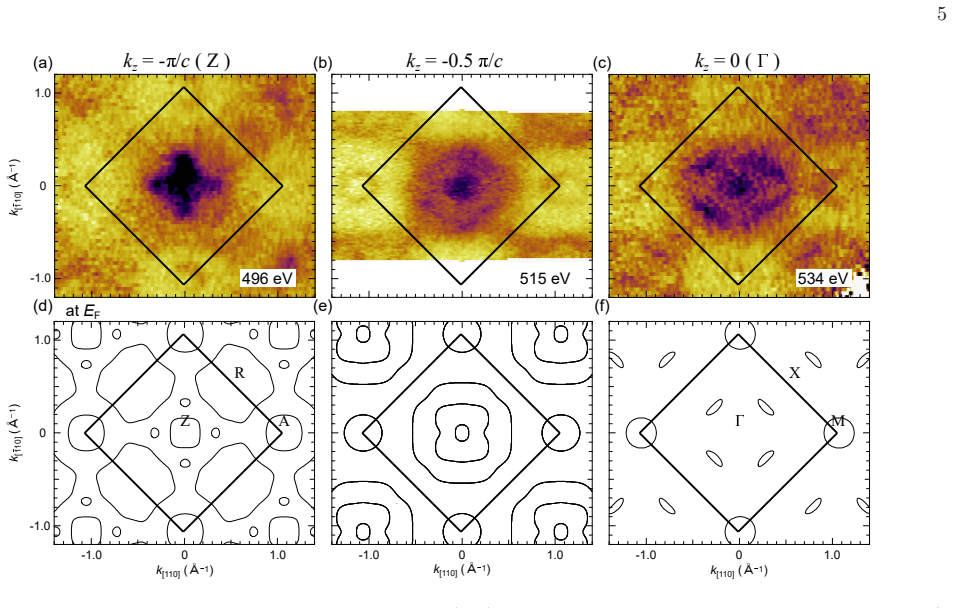
k[110] (Å 1) M k[110] (Å 1) -1.0 0 1.0 FIG. 4. Fermi-surface mappings at selected kz values. (a–c) ARPES intensity maps at EF measured at kz ≈ − π/c (a), − 0. 5π/c (b), and 0 ( c), using photon energies ( hν) of 496, 515, and 534 eV, respectively. The solid squares ind icate the projected tetragonal Brillouin zone [see Fig. 3(a)]. ( d–f ) Corresponding ca...
-
[7]
In LaMnSi, we find that the growth of χ 2ω AFM at low temperatures correlates with the reported drop in electrical resistivity around 200 K 41, in- dicating the development of coherent itinerant electronic states well below the AFM transition. These observa- tions suggest that the parity-violating AFM states and the associated electronic response emerge wh...
-
[8]
The experiments uti- lized circularly polarized light with photon energies ( hν) ranging from 400 to 600 eV. The incident synchrotron radiation was focused to a spot size of less than 10 µm at the sample surface. The energy resolution was set to approximately 80 meV. Vacuum ultraviolet ARPES experiments were per- formed at BL9A beamline of the Research In...
-
[9]
The model was constructed by including Mn 3d, La 4 f and 5 d, and Si 3 s and 3 p orbitals as initial projections, and fitting the hopping parameters between them on an 8 × 8 × 6 real-grid. The disentanglement pro- cedure was performed only within an energy window from − 10 eV to +4 eV relative to the Fermi level, without fur- ther iterative wannierization....
-
[10]
Tokura, Y., Kawasaki, M. & Nagaosa, N. Emergent func- tions of quantum materials. Nat. Phys. 13, 1056–1068 (2017)
work page 2017
-
[11]
Tokura, Y. & Nagaosa, N. Nonreciprocal responses from non-centrosymmetric quantum materials. Nat. Commun. 9, 3740 (2018)
work page 2018
-
[12]
Nadeem, M., Fuhrer, M. S. & Wang, X. The supercon- ducting diode effect. Nat. Rev. Phys. 5, 558–577 (2023)
work page 2023
-
[13]
Nagaosa, N. & Yanase, Y. Nonreciprocal transport and optical phenomena in quantum materials. Annu. Rev. Condens. Matter Phys. 15, 63–83 (2024)
work page 2024
-
[14]
Rikken, G. L. J. A., F¨ olling, J. & Wyder, P. Electrical magnetochiral anisotropy. Phys. Rev. Lett. 87, 236602 (2001)
work page 2001
-
[15]
Okuda, T. & Kimura, A. Spin- and angle-resolved pho- toemission of strongly spin-orbit coupled systems. J. Phys. Soc. Jpn. 82, 021002 (2013)
work page 2013
-
[16]
Dil, J. H. Spin- and angle-resolved photoemission on topological materials. Electron. Struct. 1, 023001 (2019)
work page 2019
-
[17]
Manchon, A., Koo, H. C., Nitta, J., Frolov, S. M. & Duine, R. A. New perspectives for Rashba spin-orbit coupling. Nat. Mater. 14, 871–882 (2015)
work page 2015
-
[18]
ˇZuti´ c, I., Fabian, J. & Das Sarma, S. Spintronics: Funda- mentals and applications. Rev. Mod. Phys. 76, 323–410 (2004)
work page 2004
-
[19]
Ideue, T. et al. Bulk rectification effect in a polar semi- conductor. Nat. Phys. 13, 578–583 (2017)
work page 2017
-
[20]
Wakatsuki, R. et al. Nonreciprocal charge transport in noncentrosymmetric superconductors. Sci. Adv. 3, e1602390 (2017)
work page 2017
-
[21]
Choe, D. et al. Gate-tunable giant nonreciprocal charge transport in noncentrosymmetric oxide interfaces. Nat. Commun. 10, 4510 (2019)
work page 2019
-
[22]
Kondo, M. et al. Nonreciprocal charge transport in polar Dirac metals with tunable spin-valley coupling. Phys. Rev. Res. 7, 013041 (2025)
work page 2025
-
[23]
He, P. et al. Nonlinear magnetotransport shaped by Fermi surface topology and convexity. Nat. Commun. 10, 1290 (2019)
work page 2019
-
[24]
Relativistic N´ eel-order fields induced by electrical current in antiferromagnets
ˇZelezn´ y, J.et al. Relativistic N´ eel-order fields induced by electrical current in antiferromagnets. Phys. Rev. Lett. 113, 157201 (2014)
work page 2014
-
[25]
Yuan, L.-D., Wang, Z., Luo, J.-W. & Zunger, A. Predic- tion of low-Z collinear and noncollinear antiferromagneti c compounds having momentum-dependent spin splitting even without spin-orbit coupling. Phys. Rev. Mater. 5, 014409 (2021)
work page 2021
-
[26]
Hayami, S., Yanagi, Y. & Kusunose, H. Momentum- dependent spin splitting by collinear antiferromagnetic ordering. J. Phys. Soc. Jpn. 88, 123702 (2019)
work page 2019
-
[27]
Hayami, S. & Kusunose, H. Unified description of elec- tronic orderings and cross correlations by complete mul- tipole representation. J. Phys. Soc. Jpn. 93, 072001 (2024)
work page 2024
-
[28]
Watanabe, H. & Yanase, Y. Magnetic hexade- capole order and magnetopiezoelectric metal state in 10 Ba1− xKxMn2As2. Phys. Rev. B 96, 064432 (2017)
work page 2017
-
[29]
Jungwirth, T. et al. Symmetry, microscopy and spec- troscopy signatures of altermagnetism. Nature 649, 837– 847 (2026)
work page 2026
-
[30]
Magneto-electric effect in three-dimension al coupled zigzag chains
Yanase, Y. Magneto-electric effect in three-dimension al coupled zigzag chains. J. Phys. Soc. Jpn. 83, 014703 (2014)
work page 2014
-
[31]
Watanabe, H. & Yanase, Y. Chiral photocurrent in parity-violating magnet and enhanced response in topo- logical antiferromagnet. Phys. Rev. X 11, 011001 (2021)
work page 2021
-
[32]
Winkler, R. & Z¨ ulicke, U. Theory of electric, magnetic , and toroidal polarizations in crystalline solids with ap- plications to hexagonal lonsdaleite and cubic diamond. Phys. Rev. B 107, 155201 (2023)
work page 2023
-
[33]
Watanabe, H. & Yanase, Y. Magnetic parity violation and parity-time-reversal-symmetric magnets. J. Phys.: Condens. Matter 36, 373001 (2024)
work page 2024
-
[34]
Wang, N. et al. Quantum-metric-induced nonlinear transport in a topological antiferromagnet. Nature 621, 487–492 (2023)
work page 2023
-
[35]
Gao, A. et al. Quantum metric nonlinear Hall effect in a topological antiferromagnetic heterostructure. Science 381, 181–186 (2023)
work page 2023
-
[36]
Zhang, Y. et al. Switchable magnetic bulk photovoltaic effect in the two-dimensional magnet CrI 3. Nat. Com- mun. 10, 3783 (2019)
work page 2019
-
[37]
Sun, Z. et al. Giant nonreciprocal second-harmonic gen- eration from antiferromagnetic bilayer CrI 3. Nature 572, 497–501 (2019)
work page 2019
-
[38]
Mayo, A. H. et al. Band asymmetry-driven nonreciprocal electronic transport in a helimagnetic semimetal α -EuP3. Proc. Natl. Acad. Sci. 122, e2405839122 (2025)
work page 2025
-
[39]
Watanabe, H. & Yanase, Y. Group-theoretical classifica - tion of multipole order: Emergent responses and candi- date materials. Phys. Rev. B 98, 245129 (2018)
work page 2018
-
[40]
Sudo, K., Yanagi, Y., Akaki, M., Tanida, H. & Kimata, M. Large spontaneous nonreciprocal charge transport in a zero-magnetization antiferromagnet. Phys. Rev. Lett. 136, 016503 (2026)
work page 2026
-
[41]
Sakai, H. et al. Transport evidence of current-induced nematic Dirac valleys in a parity-time-symmetric anti- ferromagnet. Nat. Commun. 16, 11112 (2025)
work page 2025
- [42]
-
[43]
Ye, L. et al. Massive Dirac fermions in a ferromagnetic kagome metal. Nature 555, 638–642 (2018)
work page 2018
-
[44]
LaShell, S., McDougall, B. & Jensen, E. Spin splitting of an Au (111) surface state band observed with angle resolved photoelectron spectroscopy. Phys. Rev. Lett. 77, 3419 (1996)
work page 1996
-
[45]
Krempask` y, J. et al. Entanglement and manipulation of the magnetic and spin–orbit order in multiferroic Rashba semiconductors. Nat. Commun. 7, 13071 (2016)
work page 2016
-
[46]
J Grenz, P., Kr¨ uger, P. & Donath, M. Inter- play of spin–orbit and exchange interaction in a ferromagnet/heavy-metal hybrid system: Ni on W(110). New J. Phys. 25, 103037 (2023)
work page 2023
-
[47]
Edwards, B. et al. Giant valley-Zeeman coupling in the surface layer of an intercalated transition metal dichalco - genide. Nat. Mater. 22, 459–465 (2023)
work page 2023
-
[48]
Fedchenko, O. et al. Direct observation of antiferro- magnetic parity violation in the electronic structure of Mn2Au. J. Phys.: Condens. Matter 34, 425501 (2022)
work page 2022
-
[49]
Lytvynenko, Y. et al. Control of the asymmetric band structure in Mn 2Au by a ferromagnetic driver layer. Phys. Rev. B 108, 104413 (2023)
work page 2023
-
[50]
Tanida, H. et al. Nonsymmorphic antiferromagnet LaMnSi: single-crystal studies. J. Phys. Soc. Jpn. 91, 013704 (2022)
work page 2022
-
[51]
Sakai, Y. et al. Microscopic determination of the c-axis- oriented antiferromagnetic structure in LaMnSi by 55Mn and 139La NMR. J. Phys. Soc. Jpn. 95, 024702 (2026)
work page 2026
-
[52]
Welter, R., Venturini, G. & Malaman, B. High rare earth sublattice ordering temperatures in RMnSi compounds (R ≡ La–Sm, Gd) studied by susceptibility measure- ments and neutron diffraction. J. Alloys Compd. 206, 55–71 (1994)
work page 1994
-
[53]
Strocov, V. N. et al. Soft-X-ray ARPES facility at the ADRESS beamline of the SLS: concepts, technical reali- sation and scientific applications. J. Synchrotron Radiat. 21, 32–44 (2014)
work page 2014
-
[54]
Kuroda, K. et al. Experimental determination of the topological phase diagram in Cerium monopnictides. Phys. Rev. Lett. 120, 086402 (2018)
work page 2018
-
[55]
Petersen, J. C. et al. Nonlinear optical signatures of the tensor order in Cd 2Re2O7. Nat. Phys. 2, 605–608 (2006)
work page 2006
-
[56]
Fiebig, M., Pavlov, V. V. & Pisarev, R. V. Second- harmonic generation as a tool for studying electronic and magnetic structures of crystals: review. J. Opt. Soc. Am. B 22, 96–118 (2005)
work page 2005
-
[57]
Wu, L. et al. Giant anisotropic nonlinear optical response in transition metal monopnictide Weyl semimetals. Nat. Phys. 13, 350–355 (2017)
work page 2017
-
[58]
Birss, R. R. Symmetry and Magnetism (North-Holland, 1964)
work page 1964
-
[59]
Fiebig, M., Fr¨ ohlich, D., Krichevtsov, B. & Pisarev, R. V. Second harmonic generation and magnetic-dipole- electric-dipole interference in antiferromagnetic Cr 2O3. Phys. Rev. Lett. 73, 2127 (1994)
work page 1994
-
[60]
Shiomi, Y. et al. Observation of a magnetopiezoelectric effect in the antiferromagnetic metal EuMnBi 2. Phys. Rev. Lett. 122, 127207 (2019)
work page 2019
-
[61]
Revival of the magnetoelectric effect
Fiebig, M. Revival of the magnetoelectric effect. J. Phys. D: Appl. Phys. 38, R123–R152 (2005)
work page 2005
-
[62]
Tokura, Y., Seki, S. & Nagaosa, N. Multiferroics of spin origin. Rep. Prog. Phys. 77, 076501 (2014)
work page 2014
-
[63]
Wadley, P. et al. Electrical switching of an antiferromag- net. Science 351, 587–590 (2016)
work page 2016
-
[64]
Bodnar, S. Y. et al. Writing and reading antiferro- magnetic Mn 2Au by N´ eel spin-orbit torques and large anisotropic magnetoresistance. Nat. Commun. 9, 348 (2018)
work page 2018
-
[65]
Nair, N. L. et al. Electrical switching in a magnetically intercalated transition metal dichalcogenide. Nat. Mater. 19, 153–157 (2020)
work page 2020
-
[66]
Tanida, H., Matsuoka, H., Kawamura, Y. & Mitsumoto, K. Possible Heavy-Fermion State in PT -Symmetric An- tiferromagnet CeMnSi. J. Phys. Soc. Jpn. 92, 044703 (2023)
work page 2023
-
[67]
Muro, T. et al. Soft X-ray ARPES for three-dimensional crystals in the micrometre region. J. Synchrotron Radiat. 28, 1631–1638 (2021)
work page 2021
-
[68]
Blaha, P. et al. WIEN2k: An APW+ lo program for calculating the properties of solids. J. Chem. Phys. 152 (2020)
work page 2020
-
[69]
Perdew, J. P., Burke, K. & Ernzerhof, M. Generalized gradient approximation made simple. Phys. Rev. Lett. 11 77, 3865–3868 (1996)
work page 1996
-
[70]
0 ! " kx (Å # $ ) - % ! -0.5 0 E - EF (eV) - ! & - !
Pizzi, G. et al. Wannier90 as a community code: new features and applications. J. Phys.: Condens. Matter 32, 165902 (2020). 12 Supplementary Information for: Realization of a parity-violating antiferromagnetic stat e in LaMnSi Takuma Iwata1,2, K. Shiraishi 1, T. Aoyama 1,2, D. Senba 1, T. Takeda 1,3, Y. Fujisawa 4, M. Nurmamat 1, K. Nakanishi 1, K. Yamaga...
work page 2020
-
[71]
• Crystallographic (axial- i tensor): χ 3 = χ xyz = − χ yzx
Here, the independent parameters are defined based on their physical origin s and symmetry properties: • AFM (polar- c tensor): χ 1 = χ xyz = χ yzx and χ 2 = χ zxy . • Crystallographic (axial- i tensor): χ 3 = χ xyz = − χ yzx. 20 • Surface (polar- i tensor): χ a = χ xzx = χ yyz = χ zyy = χ zxx and χ b = χ zzz . Here, the Cartesian coordinates x, y , and z ...
- [72]
- [73]
- [74]
- [75]
- [76]
- [77]
- [78]
-
[79]
V. N. Strocov, X. Wang, M. Shi, M. Kobayashi, J. Krempasky , C. Hess, T. Schmitt, and L. Patthey, J. Synchrotron Radiat. 21, 32 (2014)
work page 2014
-
[80]
S. H¨ ufner,Photoelectron spectroscopy: principles and applications (Springer Science & Business Media, 2013)
work page 2013
discussion (0)
Sign in with ORCID, Apple, or X to comment. Anyone can read and Pith papers without signing in.