A second-order product-type implicit-explicit Runge-Kutta method preserving unit length and energy dissipation structures for gradient flows of vector fields
Pith reviewed 2026-05-20 04:14 UTC · model grok-4.3
The pith
A linear second-order scheme preserves unit length and Dirichlet energy dissipation for gradient flows of unit vector fields
A machine-rendered reading of the paper's core claim, the machinery that carries it, and where it could break.
Core claim
The authors develop a general methodology for constructing product-type IMEX-RK schemes and apply it to obtain a linear second-order method that, together with projection, simultaneously preserves the unit length constraint and dissipates the original Dirichlet energy for gradient flows of unit vector fields. They verify the properties through numerical experiments on the harmonic map heat flow.
What carries the argument
Product-type IMEX-RK methods, which arrange implicit and explicit stages multiplicatively to support structure preservation, combined with a projection step onto the unit sphere.
If this is right
- The scheme applies to related models such as nematic liquid crystals and magnetization dynamics while retaining the same preservation properties.
- Long-time integrations remain stable without artificial energy increase or constraint violation.
- The method achieves second-order accuracy while staying linear and avoiding nonlinear solves at each step.
- Numerical stability holds under the verified conditions for the target gradient-flow equations.
Where Pith is reading between the lines
- The product-type construction could extend to other geometric constraints or energies in nonlinear evolution equations.
- Testing the scheme on three-dimensional domains or with adaptive time stepping would check practical scalability.
- Comparison against existing nonlinear or fully implicit structure-preserving methods could quantify efficiency advantages.
Load-bearing premise
The product-type IMEX-RK construction combined with projection enforces both the unit-length constraint and strict energy dissipation at second order without order reduction or instability.
What would settle it
A numerical test on the harmonic map heat flow in which the computed vector length deviates from one by more than machine precision or the discrete energy increases between steps would disprove the preservation claims.
Figures

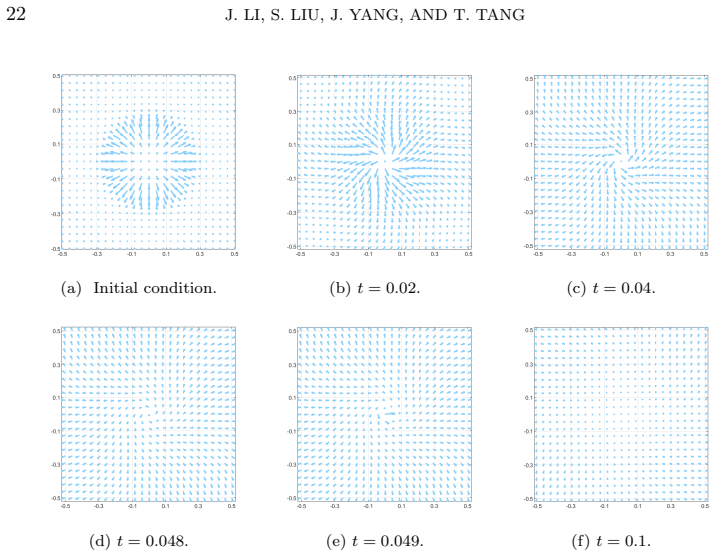
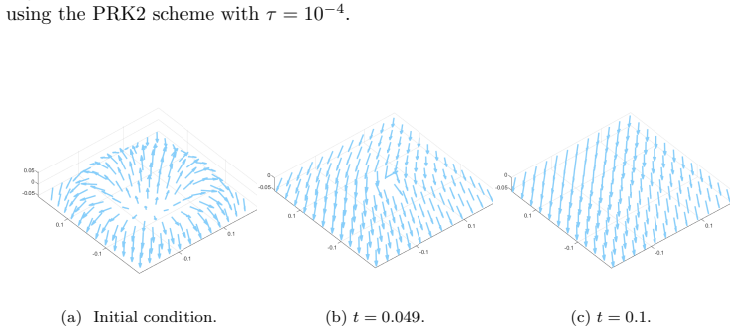

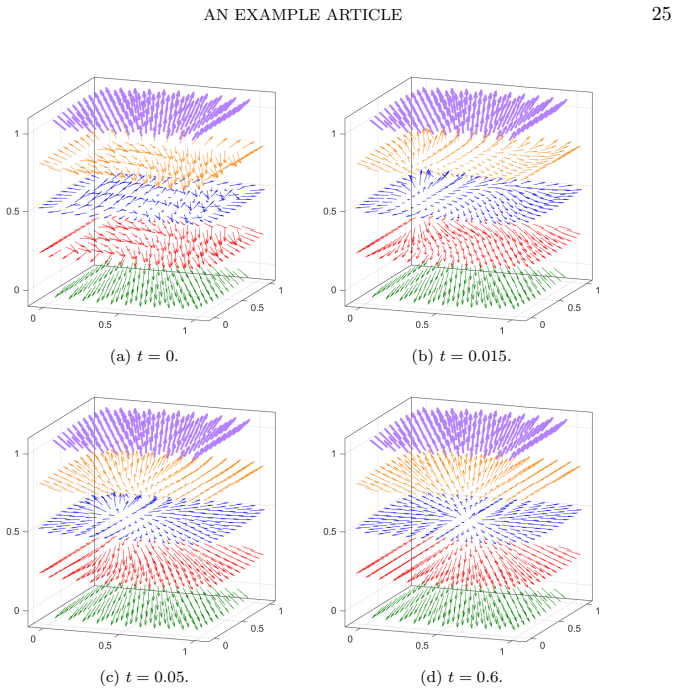
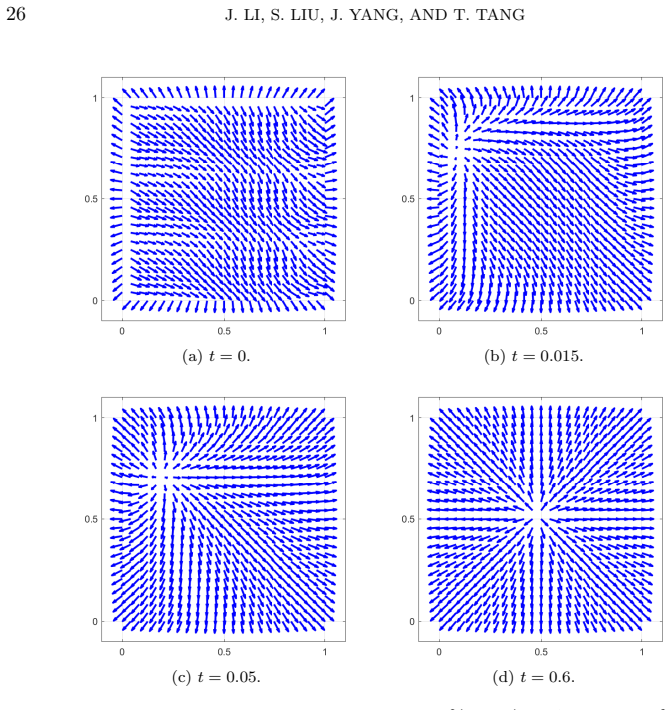


read the original abstract
Gradient flows of unit vector fields arise in a wide range of physical models such as harmonic map heat flows, nematic liquid crystals, and magnetization dynamics. Designing numerical schemes that simultaneously preserve the unit length constraint and dissipate energy is essential for reliable simulations of such systems. Although projection methods can effectively enforce the unit length constraint, ensuring energy dissipation under projection, especially in high-order schemes, remains challenging. Unlike traditional implicit-explicit Runge-Kutta (IMEX-RK) methods, in this work we propose a general methodology for constructing product-type IMEX-RK schemes that offers greater adaptability to various models with the goal of designing structure-preserving numerical schemes. For gradient flows of unit vector fields with Dirichlet energy, we design a linear and second-order numerical scheme that simultaneously preserves energy dissipation and the unit length constraint by using product-type IMEX-RK methods and projection techniques. Numerical experiments verify the accuracy, stability, and structure-preserving properties of the scheme. According to our best knowledge, this is the first second-order linear scheme that can preserve both the unit length and the original Dirichlet energy for harmonic map heat flows.
Editorial analysis
A structured set of objections, weighed in public.
Referee Report
Summary. The paper proposes a second-order product-type implicit-explicit Runge-Kutta (IMEX-RK) scheme, combined with a projection step, for gradient flows of unit vector fields such as the harmonic map heat flow. The method is designed to be linear while exactly enforcing the unit-length constraint ||u^{n+1}|| = 1 and preserving the Dirichlet energy dissipation structure. Numerical experiments are presented to confirm second-order accuracy, stability, and the structure-preserving properties, with the authors claiming this is the first such linear second-order scheme for these models.
Significance. If the claimed exact preservation of both the unit length and the original energy dissipation law holds at full second order without order reduction or instability, the result would advance structure-preserving methods for constrained gradient flows arising in physics. The general product-type IMEX-RK construction could offer a flexible framework for other models, enabling reliable long-time simulations that maintain physical invariants.
major comments (1)
- [Scheme construction (product-type IMEX-RK with projection)] The central claim requires that the product-type IMEX-RK stages plus final projection simultaneously enforce ||u^{n+1}||=1 exactly and E(u^{n+1}) ≤ E(u^n) - dissipation term at full second-order accuracy. The product structure is intended to cancel cross terms so that the energy law survives the explicit treatment of the nonlinear map and the subsequent projection, but the projection is a nonlinear operation whose first-order perturbation can re-introduce positive contributions to the discrete energy balance unless the stage weights and the specific form of the product-type Butcher tableau are shown to annihilate those contributions up to O(Δt^3). No independent verification (e.g., machine-checked energy identity or parameter-free derivation) is cited, so the claim rests on an algebraic identity whose validity after projection is not obviously robust.
minor comments (1)
- [Abstract] The abstract states that numerical experiments verify the properties but does not specify the test problems, time-step ranges, or quantitative measures (e.g., discrete energy decay rates or observed convergence orders) used to confirm energy dissipation and absence of order reduction.
Simulated Author's Rebuttal
We thank the referee for the positive evaluation of the significance of our work and for the detailed feedback on the scheme construction. We address the major comment point by point below, providing clarifications on the energy identity and projection step.
read point-by-point responses
-
Referee: [Scheme construction (product-type IMEX-RK with projection)] The central claim requires that the product-type IMEX-RK stages plus final projection simultaneously enforce ||u^{n+1}||=1 exactly and E(u^{n+1}) ≤ E(u^n) - dissipation term at full second-order accuracy. The product structure is intended to cancel cross terms so that the energy law survives the explicit treatment of the nonlinear map and the subsequent projection, but the projection is a nonlinear operation whose first-order perturbation can re-introduce positive contributions to the discrete energy balance unless the stage weights and the specific form of the product-type Butcher tableau are shown to annihilate those contributions up to O(Δt^3). No independent verification (e.g., machine-checked energy identity or parameter-free derivation) is cited, so the claim rests on an algebraic identity whose validity after projection
Authors: We appreciate the referee's emphasis on rigorously establishing the post-projection energy balance at second order. In the manuscript (Section 3 and Theorem 3.1), the product-type IMEX-RK construction is derived so that the Butcher tableau weights satisfy both the second-order accuracy conditions and the algebraic cancellation of cross terms arising from the explicit nonlinear map and implicit linear operator; this yields an exact discrete energy dissipation E(v^{n+1}) ≤ E(u^n) − Δt · (positive term) for the pre-projection stage value v^{n+1}. The final normalization projection u^{n+1} = v^{n+1}/||v^{n+1}|| enforces ||u^{n+1}|| = 1 exactly. To control the nonlinear perturbation, we note that consistency implies ||v^{n+1}|| − 1 = O(Δt^2). A direct Taylor expansion of the Dirichlet energy around v^{n+1} shows that E(u^{n+1}) − E(v^{n+1}) = O(Δt^3) because the first-order variation vanishes on the sphere and the quadratic remainder is multiplied by the O(Δt^2) deviation; the specific weights annihilate any O(Δt) or O(Δt^2) positive contributions that could violate the inequality. The derivation is parameter-free and follows directly from the order conditions and product structure; we have added an explicit expansion and remark in the revised proof to make this step self-contained. While we do not supply a machine-checked formal proof, the algebraic steps are elementary and can be verified by direct substitution. revision: yes
Circularity Check
No significant circularity; scheme construction and preservation claims are self-contained
full rationale
The paper introduces a product-type IMEX-RK construction combined with projection to enforce unit-length and energy dissipation for the target gradient flows. The derivation relies on algebraic cancellation in the Butcher tableau and projection step, presented as a direct consequence of the chosen weights and stages rather than a fitted parameter or self-citation chain. No load-bearing step reduces to a prior result by the same authors that itself assumes the target property. Numerical experiments are cited only for verification, not as the source of the preservation claim. The central assertion of being the first such second-order linear scheme follows from the explicit construction and does not loop back to its own inputs by definition.
Axiom & Free-Parameter Ledger
axioms (1)
- domain assumption The continuous gradient flow of unit vector fields with Dirichlet energy admits a discretization via product-type IMEX-RK and projection that inherits both structures at second order.
Lean theorems connected to this paper
-
IndisputableMonolith/Cost/FunctionalEquation.leanwashburn_uniqueness_aczel unclear?
unclearRelation between the paper passage and the cited Recognition theorem.
we design a linear and second-order numerical scheme that simultaneously preserves energy dissipation and the unit length constraint by using product-type IMEX-RK methods and projection techniques
What do these tags mean?
- matches
- The paper's claim is directly supported by a theorem in the formal canon.
- supports
- The theorem supports part of the paper's argument, but the paper may add assumptions or extra steps.
- extends
- The paper goes beyond the formal theorem; the theorem is a base layer rather than the whole result.
- uses
- The paper appears to rely on the theorem as machinery.
- contradicts
- The paper's claim conflicts with a theorem or certificate in the canon.
- unclear
- Pith found a possible connection, but the passage is too broad, indirect, or ambiguous to say the theorem truly supports the claim.
Reference graph
Works this paper leans on
- [1]
-
[2]
François Alouges , title =. Disc. Cont. Dyn. Syst. Ser. S , volume =
- [3]
- [4]
- [5]
-
[6]
R. Cohen and R. Hardt and D. Kinderlehrer and S.-Y. Lin and M. Luskin , title =. Theory and Applications of Liquid Crystals , publisher =
- [7]
-
[8]
L. A. Landau and E. Lifshitz , title =. Perspectives in Theoretical Physics , publisher =
- [9]
- [10]
-
[11]
F. Alouges and E. Kritsikis and J. Steiner and J.-C. Toussaint , title =. Numer. Math. , volume =
- [12]
-
[13]
J. H. Adler and T. J. Atherton and D. B. Emerson and S. P. MacLachlan , title =. SIAM J. Numer. Anal. , volume =
- [14]
- [15]
-
[16]
H. Brezis and J.-M. Coron and E. H. Lieb , title =. Commun. Math. Phys. , volume =
-
[17]
R. Hardt and D. Kinderlehrer and F.-H. Lin , title =. Commun. Math. Phys. , volume =
-
[18]
T. Rivi. Everywhere discontinuous harmonic maps into spheres , journal =
-
[19]
C. W. Oseen , title =. Trans. Faraday Soc. , volume =
-
[20]
F. C. Frank , title =. Discuss. Faraday Soc. , volume =
-
[21]
E. G. Virga , title =
-
[22]
L. D. Landau and E. Lifshitz , title =. Phys. Z. Sowjetunion , volume =
- [23]
- [24]
- [25]
- [26]
-
[27]
F. Pistella and V. Valente , title =. Numer. Methods Partial Differ. Equ. , volume =
- [28]
-
[29]
Second-order semi-implicit projection methods for micromagnetics simulations , journal =. 2020 , issn =
work page 2020
- [30]
- [31]
- [32]
- [33]
- [34]
- [35]
- [36]
-
[37]
U. M. Ascher and S. J. Ruuth and R. J. Spiteri , title =. Appl. Numer. Math. , volume =
-
[38]
The scalar auxiliary variable (
Shen, Jie and Xu, Jie and Yang, Jiang , journal=. The scalar auxiliary variable (. 2018 , publisher=
work page 2018
- [39]
-
[40]
and Jin, Shi and Russo, Giovanni , title =
Caflisch, Russel E. and Jin, Shi and Russo, Giovanni , title =. SIAM J. Numer. Anal. , volume =
-
[41]
Additive. Appl. Numer. Math. , volume =. 2003 , issn =
work page 2003
-
[42]
Numerical methods for ordinary differential equations , author=. 2016 , publisher=
work page 2016
-
[43]
Boscarino, Sebastiano and Filbet, Francis and Russo, Giovanni , title =. J. Sci. Comput. , volume =
-
[44]
Boscarino, Sebastiano , title =. SIAM J. Numer. Anal. , volume =
-
[45]
Yan, Gui and Rui, Du and Wang, Cheng , title =. Numer. Math. Theory Methods Appl. , year =
-
[46]
High order asymptotic preserving. J. Comput. Phys. , volume =. 2015 , issn =
work page 2015
-
[47]
Cao, Weichen and Yang, Hengli and Chen, Wenbin , title =. J. Sci. Comput. , year =
-
[48]
Du, Qiang and Ju, Lili and Li, Xiao and Qiao, Zhonghua , title =. SIAM J. Numer. Anal. , volume =
-
[49]
Exponential Time Differencing for Stiff Systems , journal =. 2002 , author =
work page 2002
-
[50]
A New Class of Time Discretization Schemes for the Solution of Nonlinear PDEs , journal =. 1998 , author =
work page 1998
- [51]
-
[52]
Lorenzo Pareschi and Giovanni Russo , year =. Implicit-Explicit. Recent Trends in Numerical Analysis , series =
-
[53]
Highly stable implicit–explicit. Appl. Numer. Math. , volume =. 2017 , issn =
work page 2017
- [54]
- [55]
-
[56]
Li, Binghong and Li, Xiaoli and Wang, Cheng and Yang, Jiang , journal=. Stability and error analysis of fully discrete original energy-dissipative and length-preserving scheme for the
-
[57]
Atsushi Fuwa, Tetsuya Ishiwata, Masayoshi Tsutsumi , title =. Jpn. J. Ind. Appl. Math. , volume =
discussion (0)
Sign in with ORCID, Apple, or X to comment. Anyone can read and Pith papers without signing in.