SphericalDreamer: Generating Navigable Immersive 3D Worlds with Panorama Fusion
Pith reviewed 2026-05-20 06:25 UTC · model grok-4.3
The pith
SphericalDreamer generates long-range navigable 3D worlds with full omnidirectional views by fusing lifted panoramic images from text prompts.
A machine-rendered reading of the paper's core claim, the machinery that carries it, and where it could break.
Core claim
SphericalDreamer produces highly detailed, fully immersive 3D environments from textual prompts by generating multiple panoramic images, lifting them into 3D, and fusing them while maintaining visual and geometric consistency across long-range spatial extents, substantially improving scale and navigability compared to prior approaches.
What carries the argument
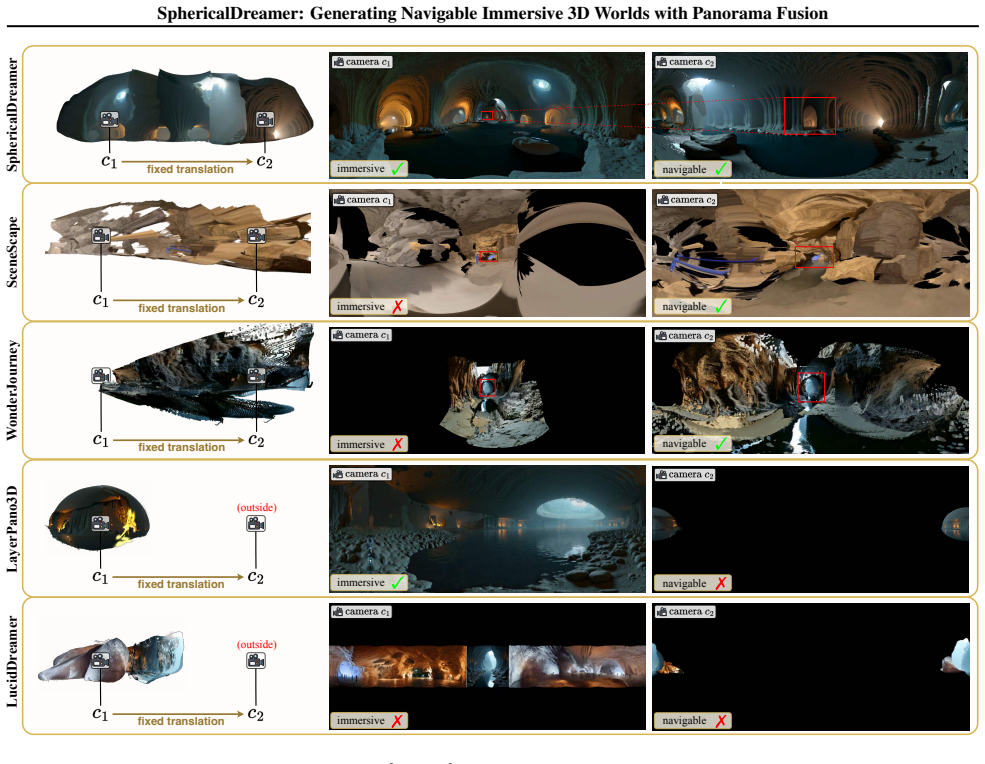
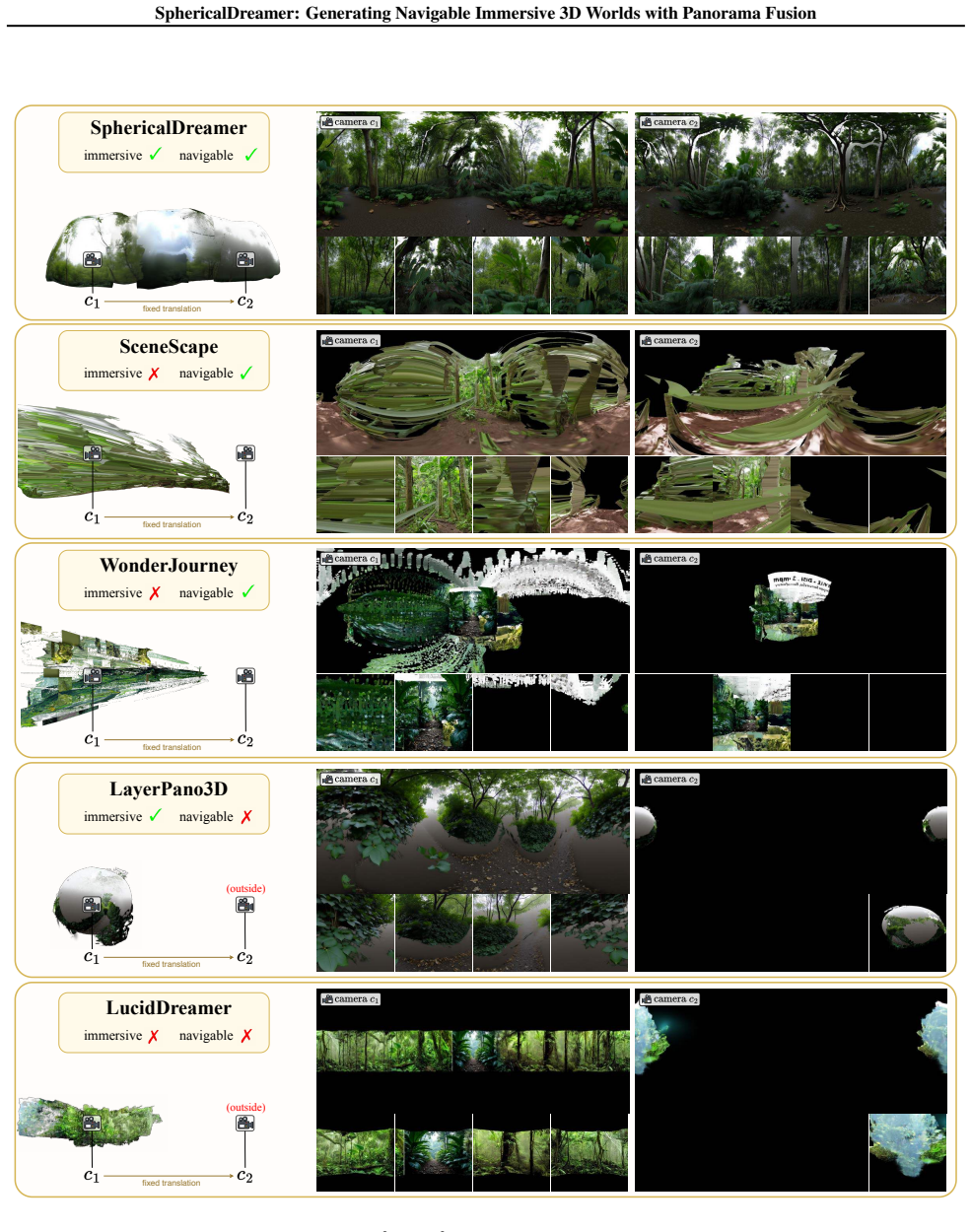
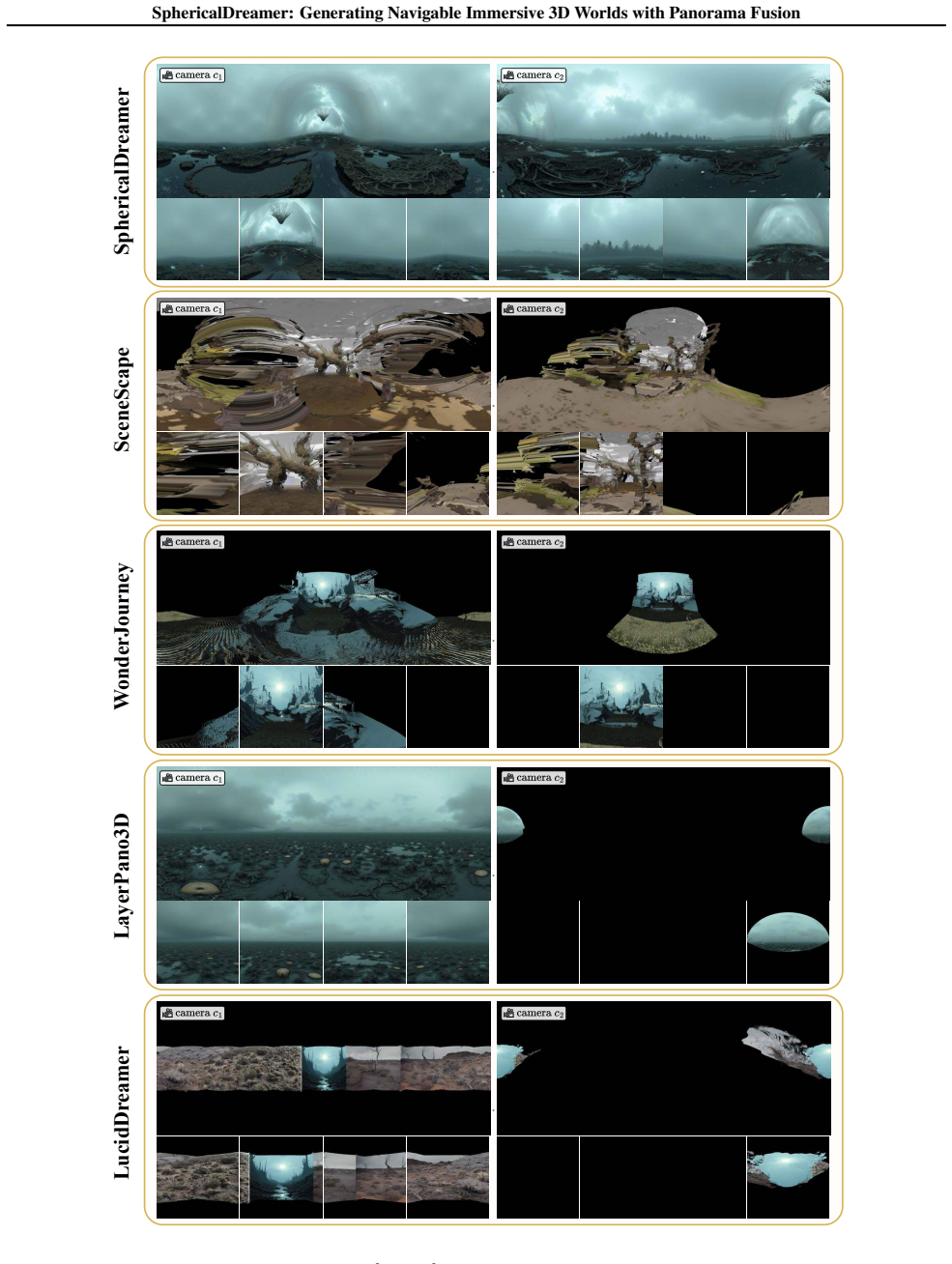
Fusion of multiple lifted panoramic images to create a single consistent 3D representation.
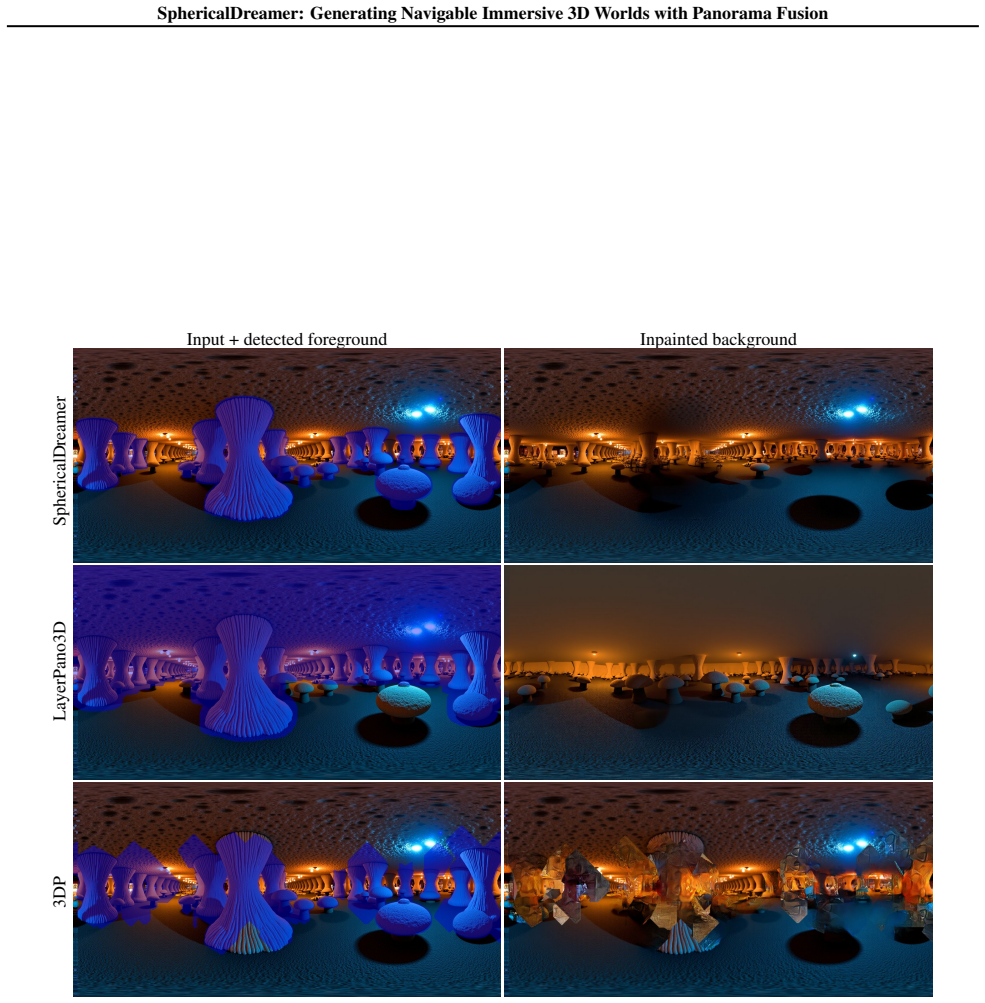
If this is right
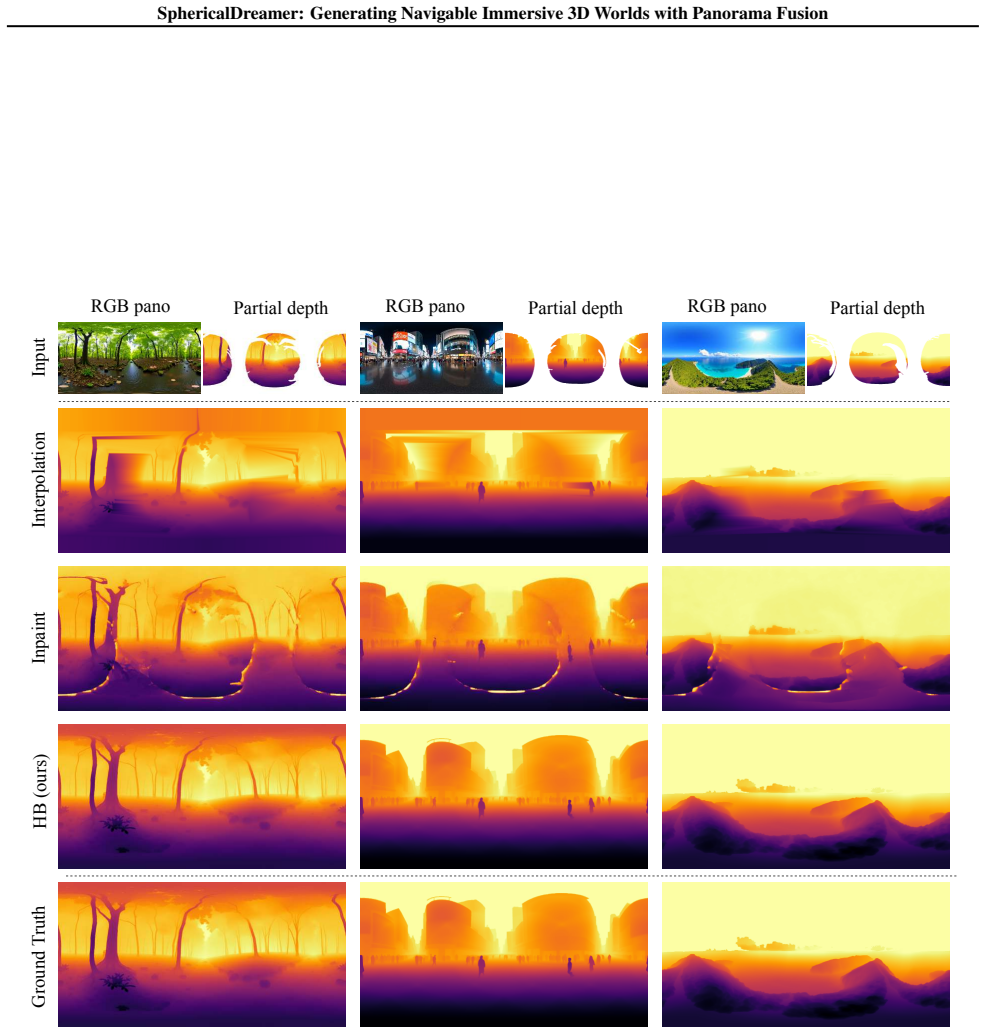
- Enables creation of large-scale outdoor 3D scenes from text prompts alone.
- Supports full omnidirectional field of view in the resulting navigable environments.
- Improves the reachable spatial extent and movement freedom compared to earlier methods.
- Keeps both visual detail and structural coherence during the fusion step.
Where Pith is reading between the lines
- The fusion approach could extend to adding time-varying elements such as changing lighting or weather.
- Similar lifting and fusion steps might apply to indoor or mixed indoor-outdoor scenes.
- The resulting models could support integration with physics simulation for interactive use cases.
Load-bearing premise
Lifting multiple panoramic images into 3D and fusing them maintains visual and geometric consistency across long-range spatial extents without introducing noticeable artifacts.
What would settle it
Visible seams, distortions, or loss of consistency appearing when a user navigates in the generated 3D environment across distances larger than a single panorama's coverage.
Figures








read the original abstract
The generation of immersive and navigable 3D environments is increasingly prevalent with the growing adoption of virtual reality and 3D content. However, recent methods face a fundamental limitation: they cannot produce 3D worlds that simultaneously (i) are navigable over long-range spatial extents and (ii) cover the complete omnidirectional field of view ($360^\circ$ horizontally and $180^\circ$ vertically). To address this challenge, we introduce SphericalDreamer, a method for generating fully immersive and long-range 3D outdoor environments from textual prompts. Our approach is built on the generation of multiple panoramic images, which are subsequently lifted into 3D and fused together while maintaining visual and geometric consistency. SphericalDreamer produces highly detailed, fully immersive 3D environments, while substantially improving scale and navigability compared to prior approaches.
Editorial analysis
A structured set of objections, weighed in public.
Referee Report
Summary. The manuscript introduces SphericalDreamer, a method to generate fully immersive, long-range navigable 3D outdoor environments from textual prompts. It proceeds by synthesizing multiple panoramic images, lifting each into 3D, and fusing the resulting geometry and appearance while enforcing visual and geometric consistency across large spatial extents and full omnidirectional (360° × 180°) coverage, claiming substantial gains in scale and navigability over prior text-to-3D approaches.
Significance. If the consistency and scale claims are substantiated, the work would be significant for VR and immersive content generation: panorama-based lifting plus fusion offers a plausible route to large, navigable scenes that current single-view or limited-FOV methods cannot produce. The approach directly targets two stated limitations of existing pipelines and could influence downstream applications in virtual environments.
major comments (2)
- [§3] §3 (Method), fusion stage: the description of how geometric consistency is maintained across long-range extents after depth lifting is high-level only; without explicit regularization terms, overlap weighting, or consistency loss definitions, it is unclear whether the central claim of artifact-free navigability follows from the construction.
- [§5] §5 (Experiments): no quantitative consistency metrics (e.g., depth error across fused seams, view-synthesis PSNR at large distances, or navigability success rate) or ablation on the fusion module are reported, so the assertion of “substantially improving scale and navigability” cannot be evaluated against baselines.
minor comments (2)
- [§3.2] Notation for the lifting operator and fusion weights is introduced without a compact equation or diagram; a single equation summarizing the fusion step would improve clarity.
- [Figure 4] Figure captions for the qualitative results should explicitly state the prompt used and the spatial extent shown to allow readers to judge the claimed long-range performance.
Simulated Author's Rebuttal
We thank the referee for the thoughtful and constructive comments on our manuscript. We address each of the major comments below and outline the revisions we plan to make.
read point-by-point responses
-
Referee: [§3] §3 (Method), fusion stage: the description of how geometric consistency is maintained across long-range extents after depth lifting is high-level only; without explicit regularization terms, overlap weighting, or consistency loss definitions, it is unclear whether the central claim of artifact-free navigability follows from the construction.
Authors: We agree that the description of the fusion stage in Section 3 is presented at a high level. In the revised manuscript, we will provide a more detailed account of the geometric consistency maintenance, including the explicit regularization terms, overlap weighting mechanisms, and consistency loss definitions employed after depth lifting. This elaboration will better substantiate how the construction leads to artifact-free navigability over long-range extents. revision: yes
-
Referee: [§5] §5 (Experiments): no quantitative consistency metrics (e.g., depth error across fused seams, view-synthesis PSNR at large distances, or navigability success rate) or ablation on the fusion module are reported, so the assertion of “substantially improving scale and navigability” cannot be evaluated against baselines.
Authors: We acknowledge the absence of quantitative consistency metrics and ablations in the current experimental section. To address this, we will incorporate additional evaluations in the revised version, such as depth error measurements across fused seams, view-synthesis PSNR at large distances, navigability success rates, and an ablation study on the fusion module. These additions will allow for a more rigorous comparison against baselines and better support the claims regarding improvements in scale and navigability. revision: yes
Circularity Check
No significant circularity detected
full rationale
The paper describes a forward constructive pipeline: generate multiple panoramic images from text prompts, lift them into 3D, and fuse the results while enforcing visual and geometric consistency. No equations, fitted parameters presented as predictions, self-definitional loops, or load-bearing self-citations appear in the abstract or method outline. The central claim is an engineering combination of generation, lifting, and fusion steps that directly targets stated limitations of prior work without reducing any result to its own inputs by construction. The derivation chain is therefore self-contained.
Axiom & Free-Parameter Ledger
Lean theorems connected to this paper
-
IndisputableMonolith/Foundation/AlexanderDuality.leanalexander_duality_circle_linking unclear?
unclearRelation between the paper passage and the cited Recognition theorem.
Our approach is built on the generation of multiple panoramic images, which are subsequently lifted into 3D and fused together while maintaining visual and geometric consistency.
-
IndisputableMonolith/Cost/FunctionalEquation.leanwashburn_uniqueness_aczel unclear?
unclearRelation between the paper passage and the cited Recognition theorem.
Harmonic Blending... minimizing a Laplacian smoothness energy on a k-NN graph, subject to Dirichlet constraints
What do these tags mean?
- matches
- The paper's claim is directly supported by a theorem in the formal canon.
- supports
- The theorem supports part of the paper's argument, but the paper may add assumptions or extra steps.
- extends
- The paper goes beyond the formal theorem; the theorem is a base layer rather than the whole result.
- uses
- The paper appears to rely on the theorem as machinery.
- contradicts
- The paper's claim conflicts with a theorem or certificate in the canon.
- unclear
- Pith found a possible connection, but the passage is too broad, indirect, or ambiguous to say the theorem truly supports the claim.
Reference graph
Works this paper leans on
-
[1]
GitHub reposi- tory, Accessed: 08-01-2026. Blender Foundation. Blender. https://www.blender. org,
work page 2026
-
[2]
doi: 10.1109/TVCG.2025.3611489. Deitke, M., Schwenk, D., Salvador, J., Weihs, L., Michel, O., VanderBilt, E., Schmidt, L., Ehsani, K., Kembhavi, A., and Farhadi, A. Objaverse: A Universe of Annotated 3D Objects. InProceedings of the IEEE/CVF Conference on Computer Vision and Pattern Recognition (CVPR), pp. 13142–13153, June
-
[3]
Liu, Z., Li, H., Zhang, Y ., Ding, H., Xia, D., Lu, Z., Sun, X., Peng, Y ., Liu, M.-Y ., and Shi, J. InFusion: Inpainting 3D Gaussians via learning depth completion from diffusion prior.arXiv preprint arXiv:2404.11613,
-
[4]
Paliwal, A., Zhou, X., Tsarov, A., and Kalantari, N. Pan- oDreamer: Optimization-Based Single Image to 360 3D 9 SphericalDreamer: Generating Navigable Immersive 3D Worlds with Panorama Fusion Scene With Diffusion. InProceedings of the SIGGRAPH Asia 2025 Conference Papers, SA Conference Papers ’25, New York, NY , USA,
work page 2025
-
[5]
360MonoDepth: High-Resolution 360° Monocular Depth Estimation
Rey–Area, M., Yuan, M., and Richardt, C. 360MonoDepth: High-Resolution 360° Monocular Depth Estimation. In 2022 IEEE/CVF Conference on Computer Vision and Pattern Recognition (CVPR), pp. 3752–3762,
work page 2022
-
[6]
Wang, F.-E., Yeh, Y .-H., Tsai, Y .-H., Chiu, W.-C., and Sun, M. BiFuse++: Self-supervised and efficient bi-projection fusion for 360° depth estimation.IEEE Transactions on Pattern Analysis and Machine Intelligence, 45(5):5448– 5460, 2023a. Wang, T., Zhang, B., Zhang, T., Gu, S., Bao, J., Baltrusaitis, T., Shen, J., Chen, D., Wen, F., Chen, Q., and Guo, B...
work page 2024
-
[7]
doi: 10.1109/TVCG.2025.3644849. 10 SphericalDreamer: Generating Navigable Immersive 3D Worlds with Panorama Fusion (a)Original panorama and mask. (b)Generated background. (c)Original depth. (d)Generated background depth. Figure 6.Layered depth panorama (LDP).Foreground regions (purple mask) of the panorama (a) are removed and inpainted to produce a backgr...
-
[8]
Across all scenes and prompts, SphericalDreamer is consistently the only method to be simultaneously navigable and immersive. 14 SphericalDreamer: Generating Navigable Immersive 3D Worlds with Panorama Fusion Table 4.Text prompts used in our experiments for generating 3D environments. Scene Name Text Prompt cave river A large-scale subterranean cave inspi...
-
[9]
and 3D Photography (Shih et al., 2020, 3DP). For each method, we show the input panorama overlaid with the detected foreground (left) and the inpainted background obtained after removing the detected foreground (right). As shown in the figures, SphericalDreamer produces more realistic background panoramas without artifacts, owing to more accurate foregrou...
work page 2020
-
[10]
Our approach consistently outperforms all baselines on every metric
and UniFuse (Jiang et al., 2021). Our approach consistently outperforms all baselines on every metric. Model AbsRel↓RMSE↓SI-RMSE↓δ <1.25↑δ <1.25 2 ↑δ <1.25 3 ↑ BiFuseV2 1.0077 1.8958 1.0858 0.1736 0.3368 0.4906 EGFormer 0.8048 1.6097 0.8338 0.2107 0.3952 0.5744 HoHoNet 1.1524 2.0839 1.1094 0.1711 0.3301 0.4723 UniFuse 1.0445 1.9659 1.1372 0.1738 0.3250 0....
work page 2021
-
[11]
and UniFuse (Jiang et al., 2021). Qualitatively (Figure 11), our depth maps are the most accurate and present the fewest artifacts compared to other approaches. Quantitatively (Table 9), we report comparisons on the Replica2K dataset using standard depth evaluation metrics: Absolute Relative Error (AbsRel), Root Mean Squared Error (RMSE) and Scale-Invaria...
work page 2021
-
[12]
Our depth maps are the most accurate with the fewest artifacts
and UniFuse (Jiang et al., 2021). Our depth maps are the most accurate with the fewest artifacts. 22 SphericalDreamer: Generating Navigable Immersive 3D Worlds with Panorama Fusion Input + detected foreground Inpainted background SphericalDreamer LayerPano3D 3DP Figure 12.LDP qualitative comparison.Each row shows, for one method, the input panorama with d...
discussion (0)
Sign in with ORCID, Apple, or X to comment. Anyone can read and Pith papers without signing in.