Tunable magnetotransport through kinetically hindered first-order phase transitions in an antiferromagnetic metal
Pith reviewed 2026-05-20 04:02 UTC · model grok-4.3
The pith
Cooling CeCoGe3 through a kinetically hindered first-order magnetic transition in an applied field produces a magnetic glass state with field-tunable multilevel resistance.
A machine-rendered reading of the paper's core claim, the machinery that carries it, and where it could break.
Core claim
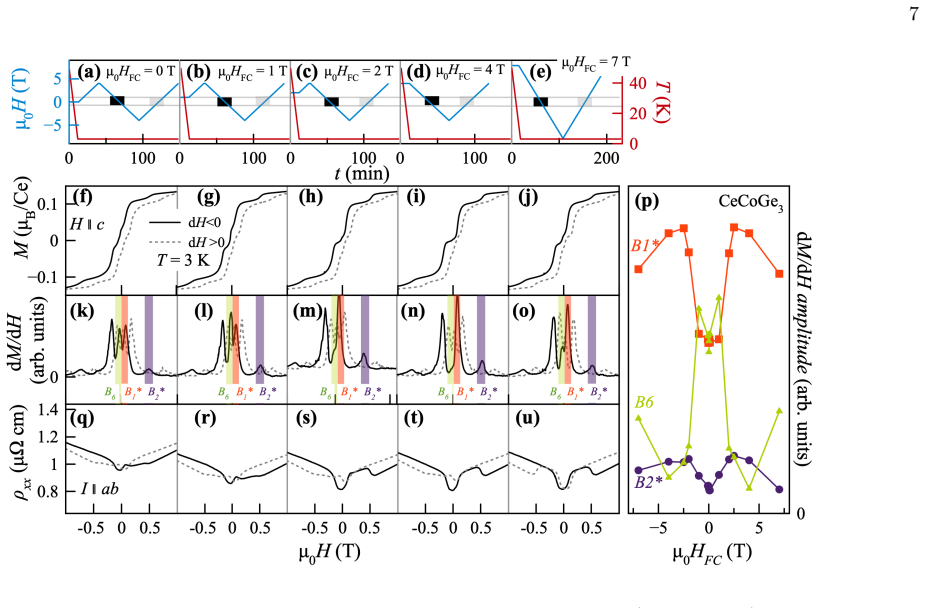
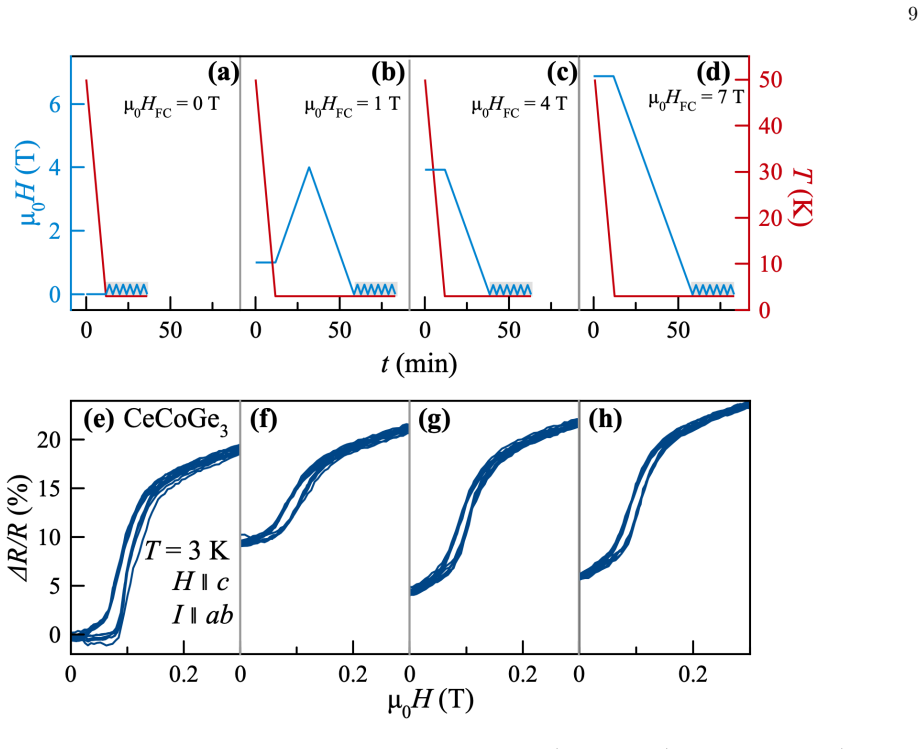
Cooling through the kinetically hindered first-order transition in an applied magnetic field produces a magnetic glass state in which high- and low-temperature magnetic phases coexist. The relative fraction of these phases can be controlled by the applied field in which the sample is cooled, and the electrical resistance is directly sensitive to that fraction. As a result, CeCoGe3 supports stable multilevel resistive states.
What carries the argument
The magnetic glass state arising from a kinetically hindered first-order antiferromagnetic transition, whose phase fraction is locked by the cooling magnetic field and read out by resistance.
If this is right
- Different cooling fields produce multiple distinct, non-volatile resistance values that can be selected and read at zero field.
- The resistance of the mixed state directly encodes the volume fraction of the coexisting magnetic phases.
- The multilevel states persist after the cooling field is removed, enabling field-programmed memory elements.
- Kinetically hindered first-order transitions become a design principle for achieving tunable magnetotransport in other antiferromagnetic metals.
Where Pith is reading between the lines
- The same cooling-field protocol could be applied to other non-centrosymmetric materials that show similar kinetic hindrance, potentially broadening the range of available multilevel resistive platforms.
- Resistance measurements in this regime might serve as a bulk probe of hidden phase coexistence that is complementary to local microscopy.
- If the phase fractions can be set continuously rather than in discrete steps, the material could support analog-like resistance values useful for neuromorphic hardware.
Load-bearing premise
The coexisting magnetic phases remain fixed in their volume fractions after field cooling, and the measured resistance stably reflects those fractions without relaxation or other contributions.
What would settle it
A time-dependent drift in resistance at fixed low temperature and zero field after different cooling-field protocols, or identical resistance values obtained from cooling paths that should produce different phase fractions.
Figures

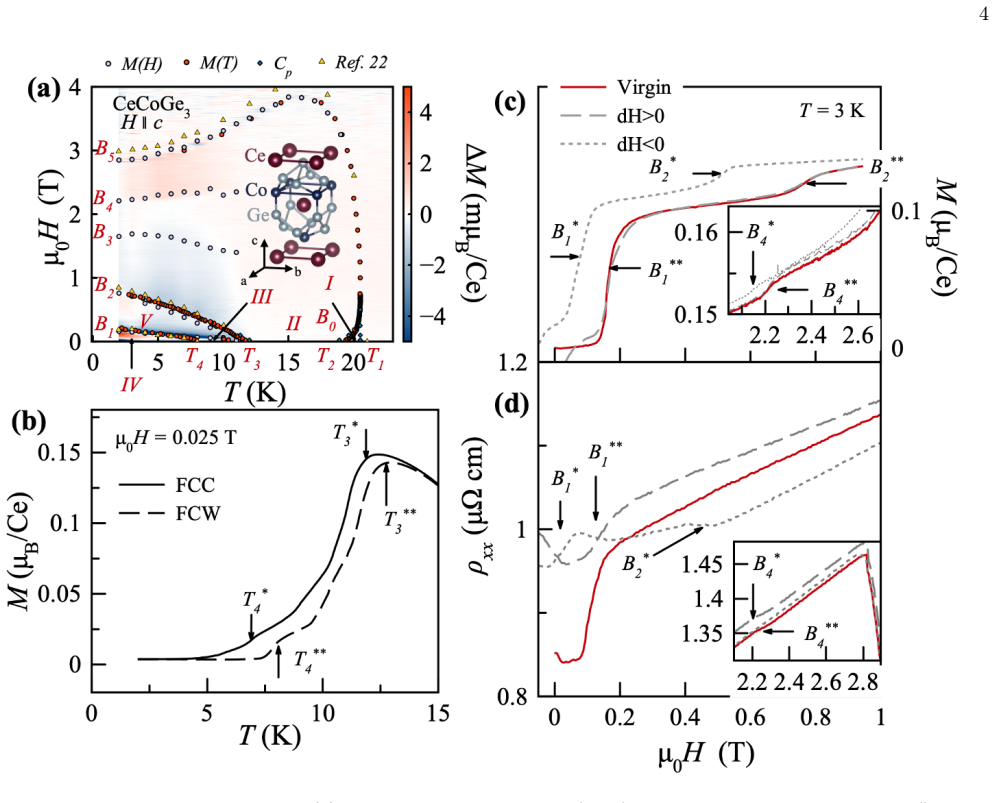

read the original abstract
Controllable multilevel resistance states are of interest for memory technologies like neuromorphic computing, but robust materials platforms toward such behavior remain limited. Here, we show that the non-centrosymmetric antiferromagnetic metal CeCoGe$_3$ suggests one such route through a kinetically hindered first-order magnetic transition. Cooling through the kinetically hindered first-order transition in an applied magnetic field produces a magnetic glass state in which high- and low-temperature magnetic phases coexist. The relative fraction of these phases can be controlled by the applied field in which the sample is cooled, and the electrical resistance is directly sensitive to that fraction. As a result, it is demonstrated that CeCoGe$_3$ supports stable multilevel resistive states. These results identify kinetically hindered first-order phase transitions as a promising route towards controllable multilevel magnetoresistive states.
Editorial analysis
A structured set of objections, weighed in public.
Referee Report
Summary. The manuscript reports experimental magnetotransport studies on the non-centrosymmetric antiferromagnetic metal CeCoGe3. It demonstrates that cooling through a kinetically hindered first-order magnetic transition in an applied field produces a magnetic glass state with coexisting high- and low-temperature phases. The relative phase fractions are tunable by the cooling-field value, and the electrical resistance is presented as directly sensitive to this fraction, resulting in stable multilevel resistive states.
Significance. If the claimed direct and stable mapping from phase fraction to resistance holds after accounting for other magnetotransport contributions, the work identifies kinetically hindered first-order transitions as a viable route to controllable multilevel states in antiferromagnetic metals. This could be relevant for neuromorphic or multistate memory applications and adds to the phenomenology of magnetic glasses in itinerant systems.
major comments (2)
- [§3.2 and Figure 4] §3.2 and Figure 4: The central claim that resistance is 'directly sensitive' to the relative volume fraction of coexisting phases (abstract and final paragraph) is load-bearing for the multilevel-state interpretation. The presented R(H_cool) data do not include a quantitative extraction of phase fraction (e.g., via simultaneous magnetization or local probes) after subtraction of ordinary magnetoresistance; without this, contributions from domain-wall scattering or anisotropic effects remain possible and the direct-mapping assumption is under-constrained.
- [§4.3] §4.3: The stability of the multilevel states after field cooling is asserted but lacks explicit time- or temperature-dependent relaxation data over relevant timescales; this is needed to confirm that the mixed state remains fixed rather than evolving via slow kinetics.
minor comments (3)
- [Introduction] Introduction: A brief operational definition or literature reference for 'magnetic glass state' would help readers unfamiliar with kinetically arrested transitions in metals.
- [Figure 3 caption] Figure 3 caption: The labeling of cooling-field values could be made more explicit to match the data traces in the main panel.
- [Methods] Methods: Sample preparation details (e.g., single-crystal growth conditions) are adequate but could include a statement on reproducibility across multiple crystals.
Simulated Author's Rebuttal
We thank the referee for their careful reading of the manuscript and for the constructive comments, which have helped us improve the presentation of our results. We address each major comment below and have revised the manuscript where appropriate to strengthen the claims.
read point-by-point responses
-
Referee: [§3.2 and Figure 4] §3.2 and Figure 4: The central claim that resistance is 'directly sensitive' to the relative volume fraction of coexisting phases (abstract and final paragraph) is load-bearing for the multilevel-state interpretation. The presented R(H_cool) data do not include a quantitative extraction of phase fraction (e.g., via simultaneous magnetization or local probes) after subtraction of ordinary magnetoresistance; without this, contributions from domain-wall scattering or anisotropic effects remain possible and the direct-mapping assumption is under-constrained.
Authors: We appreciate this observation and agree that a clearer separation of contributions would reinforce the interpretation. In the revised manuscript we have expanded §3.2 to include an explicit estimate of the ordinary magnetoresistance, obtained from high-temperature isotherms and subtracted from the low-temperature field-cooled data. The residual resistance change is shown to track the cooling-field dependence expected for the high- versus low-temperature phase fractions, consistent with the established first-order transition line. We have also added a short discussion of why domain-wall scattering and anisotropic magnetoresistance are expected to be secondary in this itinerant antiferromagnet. While simultaneous magnetization or local-probe measurements in the same run would provide the most direct quantification, such data are not available in the present experiment; we therefore present the correlation as supporting rather than definitive evidence. Figure 4 has been updated to display the subtracted curves. revision: partial
-
Referee: [§4.3] §4.3: The stability of the multilevel states after field cooling is asserted but lacks explicit time- or temperature-dependent relaxation data over relevant timescales; this is needed to confirm that the mixed state remains fixed rather than evolving via slow kinetics.
Authors: We agree that explicit relaxation measurements strengthen the claim of stable multilevel states. In the revised §4.3 we now include time-dependent resistance traces recorded at fixed temperature and field for up to ten hours after field cooling; the resistance remains constant within the noise floor of the measurement. We have also added warming curves that demonstrate the states persist until the transition temperature is crossed. These data confirm that the phase coexistence is kinetically arrested on laboratory timescales, as expected for the hindered first-order transition. revision: yes
Circularity Check
No circularity: purely experimental claims with no derivations
full rationale
The paper reports experimental observations of field-cooled magnetotransport in CeCoGe3, demonstrating multilevel resistance states arising from a kinetically hindered first-order magnetic transition. No equations, theoretical models, fitted parameters, or predictions appear in the provided abstract or described content. The central claim—that resistance directly reports the controllable high-T/low-T phase fraction—is presented as an empirical result from direct measurements, not as a derivation that reduces to its own inputs by construction. No self-citations, ansatzes, or uniqueness theorems are invoked to support any load-bearing step. The work is self-contained against external benchmarks as a materials characterization study.
Axiom & Free-Parameter Ledger
Reference graph
Works this paper leans on
-
[1]
Single-crystal synthesis Details of the synthesis conditions can be found in Ref. [61]
-
[2]
Single-crystal X-ray diffraction Measurements were performed at 100 K using an APEX2 charge-coupled device (CCD) diffractometer equipped with a Mo Kα(λ= 0.71073 Å), sealed-tube X-ray source and a graphite monochromator. Data col- lection covered a full hemisphere up to a resolution of 0.65 Å, with indexation and integration carried out us- ing APEX2 softw...
-
[3]
Samples were mounted on quartz braces and inserted onto the brass sample holder
Direct-current (DC) magnetization measurements DC magnetization measurements up to 7 T were per- formed in a Quantum Design (QD) Magnetic Prop- erty Measurement System (MPMS3) using the vibrat- ing sample magnetometer–superconducting quantum in- terference device (VSM–SQUID) option. Samples were mounted on quartz braces and inserted onto the brass sample ...
-
[4]
Typical measurement parameters werei= 3–5 mA andf= 18.31Hz
Resistivity measurements Longitudinal resistivity measurements were performed in a standard four-point collinear geometry with the ap- plied currentiand measured voltage along thea(or by the tetragonal symmetryb) axis in a QD Dyna- Cool PPMS equipped with the electrical transport option (ETO). Typical measurement parameters werei= 3–5 mA andf= 18.31Hz. Th...
-
[5]
The sample was contacted to the sapphire substrate using Apiezon N-grease
Heat capacity measurements Heat capacity measurements were measured in a QD DynaCool equipped with the heat capacity option. The sample was contacted to the sapphire substrate using Apiezon N-grease. Three measurements were performed ateachtemperatureusingthesemi-adiabaticmethodand averaged together. ACKNOWLEDGMENTS This work is supported by an NSF CAREER...
-
[6]
A. Sebastian, M. Le Gallo, R. Khaddam-Aljameh, and E. Eleftheriou, Nature Nanotechnology15, 529 (2020)
work page 2020
- [7]
-
[8]
H. Zhou, S. Li, K.-W. Ang, and Y.-W. Zhang, Nano- Micro Letters16, 121 (2024)
work page 2024
-
[9]
K. Jonason, E. Vincent, J. Hammann, J.-P. Bouchaud, and P. Nordblad, Physical Review Letters81, 3243 (1998)
work page 1998
-
[10]
J. A. Mydosh,Spin glasses: an experimental introduction (CRC Press, 1993)
work page 1993
-
[11]
J. J. Hopfield, Proceedings of the national academy of sciences79, 2554 (1982)
work page 1982
-
[12]
J. Grollier, D. Querlioz, K. Y. Camsari, K. Everschor- Sitte, S. Fukami, and M. D. Stiles, Nature electronics3, 360 (2020)
work page 2020
-
[13]
M.Manekar,S.Chaudhary,M.Chattopadhyay,K.Singh, S. Roy, and P. Chaddah, Physical Review B64, 104416 (2001)
work page 2001
-
[14]
M. Chattopadhyay, S. Roy, and P. Chaddah, Physical Review B—Condensed Matter and Materials Physics72, 180401 (2005)
work page 2005
-
[15]
S. Roy, M. Chattopadhyay, P. Chaddah, J. Moore, G. Perkins, L. Cohen, K. Gschneidner Jr, and V. Pecharsky, Physical Review B—Condensed Matter and Materials Physics74, 012403 (2006)
work page 2006
- [16]
- [17]
- [18]
-
[19]
S. Roy, G. Perkins, M. Chattopadhyay, A. Nigam, K. Sokhey, P. Chaddah, A. Caplin, and L. Cohen, Phys- ical review letters92, 147203 (2004)
work page 2004
-
[20]
M. Chattopadhyay, M. Manekar, A. Pecharsky, V. Pecharsky, K. Gschneidner Jr, J. Moore, G. Perkins, Y. Bugoslavsky, S. Roy, P. Chaddah,et al., Physical Review B—Condensed Matter and Materials Physics 70, 214421 (2004)
work page 2004
-
[21]
M. K. Chattopadhyay, S. B. Roy, and P. Chaddah, Phys- ical Review B72, 180401(R) (2005)
work page 2005
-
[22]
S. B. Roy, Journal of Physics: Condensed Matter25, 183201 (2013)
work page 2013
-
[23]
A. Banerjee, A. Pramanik, K. Kumar, and P. Chaddah, Journal of Physics: Condensed Matter18, L605 (2006)
work page 2006
-
[24]
A. Banerjee, K. Kumar, and P. Chaddah, Journal of Physics: Condensed Matter21, 026002 (2009)
work page 2009
- [25]
-
[26]
V. Pecharsky, O.-B. Hyun, and K. Gschneidner Jr, Phys- ical Review B47, 11839 (1993)
work page 1993
-
[27]
A. Thamizhavel, T. Takeuchi, T. D Matsuda, Y. Haga, K. Sugiyama, R. Settai, and Y. ¯Onuki, Journal of the Physical Society of Japan74, 1858 (2005)
work page 2005
-
[28]
A. Dominguez Montero, S. A. Stoian, G. T. McCandless, R. E. Baumbach, and J. Y. Chan, Chemistry of Materials 36, 8534 (2024)
work page 2024
-
[29]
A. Banerjee, K. Mukherjee, K. Kumar, and P. Chaddah, Physical Review B—Condensed Matter and Materials Physics74, 224445 (2006)
work page 2006
- [30]
-
[31]
K. Sengupta and E. Sampathkumaran, Physical Review B—Condensed Matter and Materials Physics73, 020406 (2006)
work page 2006
-
[32]
K. J. Singh, S. Chaudhary, M. Chattopadhyay, M. Manekar, S. Roy, and P. Chaddah, Physical Review B65, 094419 (2002)
work page 2002
-
[33]
S. Pal, K. Kumar, and A. Banerjee, Physical Review B 103, 144434 (2021). 12
work page 2021
- [34]
-
[35]
S. Y. Bodnar, L. Šmejkal, I. Turek, T. Jungwirth, O. Gomonay, J. Sinova, A. Sapozhnik, H.-J. Elmers, M. Kläui, and M. Jourdan, Nature communications9, 348 (2018)
work page 2018
-
[36]
J. Železný, H. Gao, K. Výborný, J. Zemen, J. Mašek, A. Manchon, J. Wunderlich, J. Sinova, and T. Jungwirth, Phys. Rev. Lett.113, 157201 (2014)
work page 2014
-
[37]
Dzyaloshinsky, Journal of Physics and Chemistry of Solids4, 241 (1958)
I. Dzyaloshinsky, Journal of Physics and Chemistry of Solids4, 241 (1958)
work page 1958
-
[38]
Moriya, Physical Review Letters4, 228 (1960)
T. Moriya, Physical Review Letters4, 228 (1960)
work page 1960
-
[39]
A. Fert, V. Cros, and J. Sampaio, Nature nanotechnology 8, 152 (2013)
work page 2013
- [40]
- [41]
- [42]
- [43]
-
[44]
P. Li, H. Ye, Y. Hu, Y. Fang, Z. Xiao, Z. Wu, Z. Shan, R. P. Singh, G. Balakrishnan, D. Shen,et al., Physical Review B107, L201104 (2023)
work page 2023
- [45]
-
[46]
Mydosh, Journal of Magnetism and Magnetic Materi- als7, 237 (1978)
J. Mydosh, Journal of Magnetism and Magnetic Materi- als7, 237 (1978)
work page 1978
-
[47]
R. Shull and P. A. Beck, inAIP Conference Proceedings, Vol. 24 (American Institute of Physics, 1975) pp. 95–96
work page 1975
- [48]
- [49]
-
[50]
M. Chattopadhyay and S. Roy, Journal of Physics: Con- densed Matter20, 025209 (2008)
work page 2008
-
[51]
P. Bag, P. Baral, and R. Nath, arXiv preprint arXiv:1810.03890 (2018)
work page internal anchor Pith review Pith/arXiv arXiv 2018
-
[52]
Vincent, arXiv preprint arXiv:2208.00981 (2022)
E. Vincent, arXiv preprint arXiv:2208.00981 (2022)
-
[53]
Montgomery, Journal of applied physics42, 2971 (1971)
H. Montgomery, Journal of applied physics42, 2971 (1971)
work page 1971
-
[54]
C. Dos Santos, A. De Campos, M. Da Luz, B. White, J. Neumeier, B. De Lima, and C. Shigue, Journal of Ap- plied Physics110(2011)
work page 2011
-
[55]
W. H. Meiklejohn and C. P. Bean, Physical Review105, 904 (1957)
work page 1957
-
[56]
S. B. Roy, P. Chaddah, V. K. Pecharsky, and K. A. J. Gschneidner, Acta Materialia56, 5895 (2008)
work page 2008
-
[57]
V. K. Sharma, M. K. Chattopadhyay, and S. B. Roy, Physical Review B76, 140401(R) (2007)
work page 2007
-
[58]
Tokura, Reports on Progress in Physics69, 797 (2006)
Y. Tokura, Reports on Progress in Physics69, 797 (2006)
work page 2006
- [59]
-
[60]
V. Gayathri, E. Amaladass, A. Sathyanarayana, T. Geetha Kumary, R. Pandian, P. Gupta, S. K. Rai, and A. Mani, Scientific Reports13, 2315 (2023)
work page 2023
-
[61]
A. Manchon, J. Železný, I. M. Miron, T. Jungwirth, J. Sinova, A. Thiaville, K. Garello, and P. Gambardella, Reviews of Modern Physics91, 035004 (2019)
work page 2019
-
[62]
J. Železný, H. Gao, A. Manchon, F. Freimuth, Y. Mokrousov, J. Zemen, J. Mašek, J. Sinova, and T. Jungwirth, Physical Review B95, 014403 (2017)
work page 2017
-
[63]
V. M. Edelstein, Solid State Communications73, 233 (1990)
work page 1990
-
[64]
J. Železný, H. Gao, K. Výborný, J. Zemen, J. Mašek, A. Manchon, J. Wunderlich, J. Sinova, and T. Jungwirth, Physical Review Letters113, 157201 (2014)
work page 2014
-
[65]
P. Wadley, B. Howells, J. Železný, C. Andrews, V. Hills, R. P. Campion, V. Novák, K. Olejník, F. Maccherozzi, S. S. Dhesi, S. Y. Martin, T. Wagner, J. Wunderlich, F. Freimuth, Y. Mokrousov, J. Kuneš, J. S. Chauhan, M. J. Grzybowski, A. W. Rushforth, K. W. Edmonds, B. L. Gallagher, and T. Jungwirth, Science351, 587 (2016)
work page 2016
- [66]
-
[67]
V. Petříček, L. Palatinus, J. Plášil, and M. Dušek, Zeitschrift für Kristallographie-Crystalline Materials 238, 271 (2023)
work page 2023
-
[68]
K. Kirschbaum, A. Martin, and A. A. Pinkerton, Applied Crystallography30, 514 (1997). 13 TABLE S1. EDS composition analysis for selected CeCoGe3 crystals. Atomic percentages are listed together with compositions normalized (norm) to Ge = 3. Crystal Statistic Ce (at. %) Co (at. %) Ge (at. %) Ce (norm) Co (norm) Ge (norm) Batch 1, crystal 1 (5 pts) Average ...
work page 1997
discussion (0)
Sign in with ORCID, Apple, or X to comment. Anyone can read and Pith papers without signing in.