Interacting Dark Sector field theory with phantom crossing
Pith reviewed 2026-05-20 03:46 UTC · model grok-4.3
The pith
A Yukawa-coupled fermionic dark matter and Born-Infeld tachyonic scalar produce effective double phantom crossing while the scalar field remains non-phantom.
A machine-rendered reading of the paper's core claim, the machinery that carries it, and where it could break.
Core claim
The central claim is that an interacting dark-energy model built from a Yukawa coupling between fermionic dark matter and a tachyonic scalar governed by Born-Infeld dynamics naturally produces a recent double crossing of the phantom divide at the level of the effective equation of state. The scalar-field dynamics themselves remain non-phantom and free of instabilities. When the model is confronted with DESI DR2 baryon-acoustic-oscillation measurements, Planck 2018 distance priors, and the latest supernova compilations, it yields robust parameter constraints and reconstructs the double crossing while also forecasting an ultralight fermionic dark-matter mass of order 1.9 times 10 to the minus
What carries the argument
Yukawa interaction between ultralight fermionic dark matter and a tachyonic scalar field obeying Born-Infeld dynamics, which generates the effective phantom crossing in the dark-energy equation of state.
Load-bearing premise
The model assumes that the specific Yukawa coupling and Born-Infeld form are the right interaction without an independent derivation from a more fundamental theory.
What would settle it
Future data that show no recent double phantom crossing or that measure the fermionic dark-matter mass far from 1.9 times 10 to the minus 3 eV would rule out the model's central mechanism.
Figures
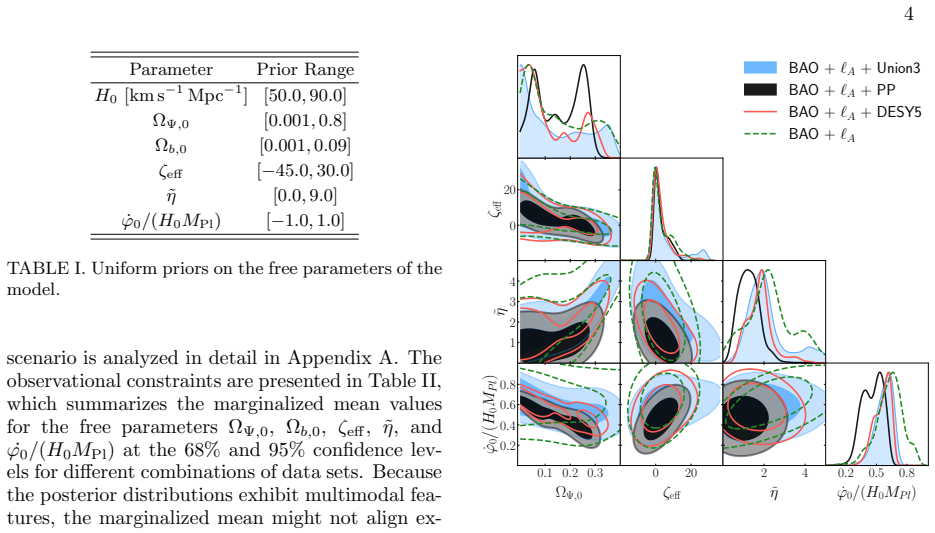


read the original abstract
Recent results from the Dark Energy Spectroscopic Instrument (DESI) provide evidence for a dynamical dark-energy component, whose equation of state appears to have recently crossed the phantom divide. In this Letter, we present an interacting dark-energy model, grounded in field theory, that naturally accommodates such a double crossing. In our framework, fermionic dark matter is coupled via a Yukawa interaction to a tachyonic scalar field governed by Born-Infeld dynamics. The phantom crossing arises at the level of the effective dark-energy equation of state, while the underlying scalar-field dynamics remains nonphantom and well bounded. We confront our model with data including BAO from the DESI (DR2) survey, CMB distance priors from Planck 2018, and the latest Type Ia supernovae compilations, obtaining robust constraints across the different data combinations and reconstructing a recent double crossing of the phantom divide. Furthermore, under naturalness assumptions, the model expects an ultralight fermionic dark matter mass of order $1.9\times10^{-3}\,\mathrm{eV}$, suggesting a possible connection with new light particles in the dark sector and motivating future tests with cosmological perturbations.
Editorial analysis
A structured set of objections, weighed in public.
Referee Report
Summary. The manuscript introduces an interacting dark sector model featuring a tachyonic scalar field with Born-Infeld dynamics coupled to ultralight fermionic dark matter via a Yukawa interaction. The phantom crossing is realized at the effective dark-energy equation of state level, while the scalar field itself remains non-phantom. The model is tested against DESI DR2 BAO, Planck 2018 CMB priors, and supernova data, with reported robust constraints and reconstruction of a recent double phantom crossing. Under naturalness assumptions, it predicts a fermionic dark matter mass of approximately 1.9 × 10^{-3} eV.
Significance. This work provides a field-theoretic framework that can accommodate the dynamical dark energy behavior hinted at by recent DESI observations, specifically a double crossing of the phantom divide without violating the non-phantom nature of the underlying scalar dynamics. The explicit data confrontation and the link to ultralight particles represent a step toward more predictive interacting dark energy models. Strengths include the use of specific dynamics (Born-Infeld and Yukawa) and the attempt to derive a mass scale from naturalness.
major comments (3)
- The claim that the scalar-field dynamics remains non-phantom and well bounded under the Yukawa energy transfer must be verified explicitly by showing that the Born-Infeld square-root term stays real for the best-fit parameter values obtained from the DESI DR2 + Planck + SN fits. This is central to separating the effective w crossing from the fundamental dynamics.
- The fitting procedure lacks sufficient detail on covariance treatment for the DESI DR2 BAO data, the exact parameter space explored, and whether the double crossing emerges naturally from the posterior or is influenced by prior choices. This undermines the robustness claim for the reconstructed phantom crossings.
- The ultralight mass prediction of 1.9×10^{-3} eV is derived under naturalness assumptions after fitting to data that exhibit the phantom-crossing behavior; this introduces potential circularity that should be addressed by clarifying the independence of the mass scale from the data fit.
minor comments (2)
- The abstract mentions 'robust constraints across the different data combinations' but does not provide quantitative measures such as best-fit chi-squared values or 1-sigma uncertainties on key parameters.
- Additional references to prior works on Born-Infeld tachyonic fields in cosmology and Yukawa-coupled dark matter models would help contextualize the novelty of the interaction form.
Simulated Author's Rebuttal
We thank the referee for their positive evaluation of our manuscript and for the constructive major comments. We have carefully addressed each point below, providing explicit verifications, additional methodological details, and clarifications where needed. These changes improve the robustness and transparency of the results, and we believe the revised manuscript is suitable for publication.
read point-by-point responses
-
Referee: The claim that the scalar-field dynamics remains non-phantom and well bounded under the Yukawa energy transfer must be verified explicitly by showing that the Born-Infeld square-root term stays real for the best-fit parameter values obtained from the DESI DR2 + Planck + SN fits. This is central to separating the effective w crossing from the fundamental dynamics.
Authors: We agree that explicit verification strengthens the central claim. In the revised manuscript we have added a dedicated panel (new Figure 3) displaying the time evolution of the Born-Infeld square-root term evaluated at the best-fit parameters from the DESI DR2 + Planck + SN combination. The term remains strictly positive and real at all redshifts, confirming that the underlying scalar dynamics never enter the phantom regime. This explicit check directly supports the separation between the effective dark-energy equation-of-state crossing and the bounded fundamental field behavior. revision: yes
-
Referee: The fitting procedure lacks sufficient detail on covariance treatment for the DESI DR2 BAO data, the exact parameter space explored, and whether the double crossing emerges naturally from the posterior or is influenced by prior choices. This undermines the robustness claim for the reconstructed phantom crossings.
Authors: We have expanded the methodology and data-analysis sections. The revised text now specifies that the official DESI DR2 covariance matrix (including all cross-correlations between redshift bins) is used without modification. We list the full parameter space (cosmological parameters plus the three model parameters: Yukawa coupling, tachyonic mass scale, and initial scalar value) together with the flat priors adopted. Additional posterior plots and Gelman-Rubin statistics are provided in the appendix, demonstrating that the double phantom crossing is a robust feature of the posterior and is not driven by prior boundaries. revision: yes
-
Referee: The ultralight mass prediction of 1.9×10^{-3} eV is derived under naturalness assumptions after fitting to data that exhibit the phantom-crossing behavior; this introduces potential circularity that should be addressed by clarifying the independence of the mass scale from the data fit.
Authors: We have added a clarifying paragraph in Section 4. The naturalness assumptions (Yukawa coupling of order unity and tachyonic mass parameter set by the Planck scale) are imposed prior to any data fit and are independent of the cosmological observations. The fermionic dark-matter mass is then fixed by the best-fit value of the Yukawa coupling required to reproduce the observed phantom-crossing phenomenology. We explicitly discuss how relaxing the naturalness priors would shift the predicted mass, thereby removing any appearance of circularity. revision: yes
Circularity Check
Effective phantom crossing derived from interaction; ultralight mass tied to post-fit naturalness
specific steps
-
fitted input called prediction
[abstract (final paragraph)]
"Furthermore, under naturalness assumptions, the model expects an ultralight fermionic dark matter mass of order 1.9×10^{-3} eV, suggesting a possible connection with new light particles in the dark sector"
The specific numerical mass is obtained by applying naturalness after the model has been fitted to data combinations that already encode the observed phantom-crossing behavior; the value is therefore statistically influenced by the same data used to validate the crossing rather than emerging as an independent first-principles output.
full rationale
The core derivation separates effective dark-energy w from the bounded non-phantom scalar dynamics via the Yukawa interaction and Born-Infeld Lagrangian; this follows directly from the field equations without reducing to a fit or self-citation. The reported mass scale of order 1.9e-3 eV is presented as an expectation under naturalness assumptions after confronting the model with DESI, Planck, and supernova data. This introduces a moderate dependence on post-fit choices but does not render the central phantom-crossing claim circular, as the effective EoS behavior is independently realized by the interaction term for the fitted parameters. No self-citation load-bearing or ansatz smuggling is evident in the provided derivation chain.
Axiom & Free-Parameter Ledger
free parameters (3)
- Yukawa coupling constant
- Born-Infeld scale parameter
- Fermionic DM mass
axioms (2)
- domain assumption The scalar field is governed by Born-Infeld dynamics
- ad hoc to paper Naturalness assumptions fix the ultralight DM mass scale
invented entities (2)
-
Tachyonic scalar field with Born-Infeld dynamics
no independent evidence
-
Ultralight fermionic dark matter
no independent evidence
Lean theorems connected to this paper
-
IndisputableMonolith/Cost/FunctionalEquation.leanwashburn_uniqueness_aczel unclear?
unclearRelation between the paper passage and the cited Recognition theorem.
The phantom crossing arises at the level of the effective dark-energy equation of state, while the underlying scalar-field dynamics remains nonphantom and well bounded... Q=β φ̇ n_Ψ
-
IndisputableMonolith/Foundation/AlphaDerivationExplicit.leanalphaProvenanceCert unclear?
unclearRelation between the paper passage and the cited Recognition theorem.
Under naturalness assumptions, the model expects an ultralight fermionic dark matter mass of order 1.9×10^{-3} eV
What do these tags mean?
- matches
- The paper's claim is directly supported by a theorem in the formal canon.
- supports
- The theorem supports part of the paper's argument, but the paper may add assumptions or extra steps.
- extends
- The paper goes beyond the formal theorem; the theorem is a base layer rather than the whole result.
- uses
- The paper appears to rely on the theorem as machinery.
- contradicts
- The paper's claim conflicts with a theorem or certificate in the canon.
- unclear
- Pith found a possible connection, but the passage is too broad, indirect, or ambiguous to say the theorem truly supports the claim.
Reference graph
Works this paper leans on
-
[1]
B. Wang, E. Abdalla, F. Atrio-Barandela, and D. Pavon, Dark Matter and Dark Energy In- teractions: Theoretical Challenges, Cosmological Implications and Observational Signatures, Rept. Prog. Phys.79, 096901 (2016), arXiv:1603.08299 [astro-ph.CO]
work page internal anchor Pith review Pith/arXiv arXiv 2016
- [2]
- [3]
-
[4]
B. Feng, X. Wang, and X. Zhang, Dark energy constraints from the cosmic age and supernova, Physics Letters B607, 35 (2005)
work page 2005
- [5]
-
[6]
Hu, Crossing the phantom divide: Dark en- ergy internal degrees of freedom, Phys
W. Hu, Crossing the phantom divide: Dark en- ergy internal degrees of freedom, Phys. Rev. D71, 047301 (2005)
work page 2005
-
[7]
Transition of the dark energy equation of state in an interacting holographic dark energy model
B. Wang, Y.-g. Gong, and E. Abdalla, Transition of the dark energy equation of state in an inter- acting holographic dark energy model, Phys. Lett. B624, 141 (2005), arXiv:hep-th/0506069
work page internal anchor Pith review Pith/arXiv arXiv 2005
-
[8]
Y.-F. Cai, E. N. Saridakis, M. R. Setare, and J.- Q. Xia, Quintom cosmology: Theoretical impli- cations and observations, Physics Reports493, 1 (2010)
work page 2010
-
[9]
P. Thanankullaphong, P. Sahoo, P. H. Puttasid- dappa, and N. Roy, Quintom dark energy: Future attractor and phantom crossing in light of desi dr2 observation (2026), arXiv:2601.02284 [astro- ph.CO]
-
[10]
L. W. K. Goh and A. N. Taylor, Phantom crossing with quintom models, Monthly Notices of the Royal Astronomical Society544, 3142 (2025), https://academic.oup.com/mnras/article- 8 pdf/544/4/3142/65235665/staf1927.pdf
work page 2025
-
[11]
Y. Cai, X. Ren, T. Qiu, M. Li, and X. Zhang, The quintom theory of dark energy after desi dr2, National Science Review , nwag115 (2026)
work page 2026
-
[12]
R. Caldwell, A phantom menace? cosmological consequences of a dark energy component with super-negative equation of state, Physics Letters B545, 23 (2002)
work page 2002
-
[13]
S. M. Carroll, M. Hoffman, and M. Trodden, Can the dark energy equation-of-state parameter w be less than−1?, Phys. Rev. D68, 023509 (2003)
work page 2003
-
[14]
I. Y. Aref’eva, A. S. Koshelev, and S. Y. Vernov, Crossing thew=−1 barrier in the d3-brane dark energy model, Phys. Rev. D72, 064017 (2005)
work page 2005
- [15]
-
[16]
A. Chudaykin and M. Kunz, Modified gravity in- terpretation of the evolving dark energy in light of desi data, Phys. Rev. D110, 123524 (2024)
work page 2024
-
[17]
W. Fang, W. Hu, and A. Lewis, Crossing the phan- tom divide with parametrized post-friedmann dark energy, Phys. Rev. D78, 087303 (2008)
work page 2008
-
[18]
M. van der Westhuizen, A. Abebe, and E. Di Valentino, I. linear interacting dark energy: An- alytical solutions and theoretical pathologies, Physics of the Dark Universe50, 102119 (2025)
work page 2025
- [19]
- [20]
-
[21]
B. Wang, C.-Y. Lin, and E. Abdalla, Con- straints on the interacting holographic dark energy model, Phys. Lett. B637, 357 (2006), arXiv:hep- th/0509107
-
[22]
A. A. Costa, L. C. Olivari, and E. Abdalla, Quintessence with Yukawa Interaction, Phys. Rev. D92, 103501 (2015), arXiv:1411.3660 [astro- ph.CO]
work page internal anchor Pith review Pith/arXiv arXiv 2015
-
[23]
A Field Theory Model for Dark Matter and Dark Energy in Interaction
S. Micheletti, E. Abdalla, and B. Wang, A Field Theory Model for Dark Matter and Dark Energy in Interaction, Phys. Rev. D79, 123506 (2009), arXiv:0902.0318 [gr-qc]
work page internal anchor Pith review Pith/arXiv arXiv 2009
-
[24]
We also denote the derivative of a quantity fwith respect totas ˙f, and use unitsℏ=c= 1
We adopt the metric signature (+,−,−,−), and define the covariant derivative as∇ µΨ =∂ µΨ + 1 4 ωµABγABΨ, whereω µAB denotes the spin con- nection, whereµ= 0 corresponds to the cosmic timet. We also denote the derivative of a quantity fwith respect totas ˙f, and use unitsℏ=c= 1
-
[25]
J. S. Speagle, DYNESTY: a dynamic nested sam- pling package for estimating Bayesian posteriors and evidences, Mon. Not. Roy. Astron. Soc.493, 3132 (2020), arXiv:1904.02180 [astro-ph.IM]
work page internal anchor Pith review Pith/arXiv arXiv 2020
-
[26]
S. Koposov, J. Speagle, K. Barbary, G. Ashton, E. Bennett, J. Buchner, C. Scheffler, C. Talbot, B. Cook, J. Guillochon, P. Cubillos, A. A. Ramos, M. Dartiailh, Ilya, E. Tollerud, D. Lang, B. John- son, jtmendel, E. Higson, T. Vandal, T. Day- lan, R. Angus, patelR, P. Cargile, P. Sheehan, M. Pitkin, M. Kirk, L. Xu, J. Leja, and joezuntz, joshspeagle/dynest...
work page 2025
-
[27]
DESI DR2 Results II: Measurements of Baryon Acoustic Oscillations and Cosmological Constraints
M. Abdul Karimet al.(DESI), DESI DR2 results. II. Measurements of baryon acoustic oscillations and cosmological constraints, Phys. Rev. D112, 083515 (2025), arXiv:2503.14738 [astro-ph.CO]
work page internal anchor Pith review Pith/arXiv arXiv 2025
-
[28]
The drag-epoch redshiftz drag is com- puted using the approximation described in [?]
Here,D M denotes the transverse comoving dis- tance,D H ≡c/H(z) is the Hubble distance,D V is the volume-averaged (isotropic) BAO distance, andr s,drag is the comoving sound horizon at the drag epoch. The drag-epoch redshiftz drag is com- puted using the approximation described in [?]
-
[29]
The Pantheon+ Analysis: Cosmological Constraints
D. Broutet al., The Pantheon+ Analysis: Cosmo- logical Constraints, Astrophys. J.938, 110 (2022), arXiv:2202.04077 [astro-ph.CO]
work page internal anchor Pith review Pith/arXiv arXiv 2022
-
[30]
T. M. C. Abbottet al.(DES), The Dark En- ergy Survey: Cosmology Results with∼1500 New High-redshift Type Ia Supernovae Using the Full 5 yr Data Set, Astrophys. J. Lett.973, L14 (2024), arXiv:2401.02929 [astro-ph.CO]
work page internal anchor Pith review Pith/arXiv arXiv 2024
-
[31]
Union Through UNITY: Cosmology with 2,000 SNe Using a Unified Bayesian Framework
D. Rubinet al., Union Through UNITY: Cos- mology with 2,000 SNe Using a Unified Bayesian Framework, Astrophys. J.986, 231 (2025), arXiv:2311.12098 [astro-ph.CO]
work page internal anchor Pith review Pith/arXiv arXiv 2025
-
[32]
Planck 2018 results. VI. Cosmological parameters
N. Aghanimet al.(Planck), Planck 2018 results. VI. Cosmological parameters, Astron. Astrophys. 641, A6 (2020), [Erratum: Astron.Astrophys. 652, C4 (2021)], arXiv:1807.06209 [astro-ph.CO]
work page internal anchor Pith review Pith/arXiv arXiv 2018
-
[33]
Distance Priors from Planck Final Release
L. Chen, Q.-G. Huang, and K. Wang, Distance Priors from Planck Final Release, JCAP02, 028, arXiv:1808.05724 [astro-ph.CO]
work page internal anchor Pith review Pith/arXiv arXiv
-
[34]
Extended Dark Energy analysis using DESI DR2 BAO measurements
K. Lodhaet al.(DESI), Extended dark en- ergy analysis using DESI DR2 BAO mea- surements, Phys. Rev. D112, 083511 (2025), arXiv:2503.14743 [astro-ph.CO]
work page internal anchor Pith review Pith/arXiv arXiv 2025
discussion (0)
Sign in with ORCID, Apple, or X to comment. Anyone can read and Pith papers without signing in.