Relativistic Saturation of Coulomb-Limited Electron Coherence
Pith reviewed 2026-05-20 02:25 UTC · model grok-4.3
The pith
Relativistic effects make the effective coupling for Coulomb disorder in electron beams saturate at high energies, so standard TEM voltages are already near-optimal for coherence.
A machine-rendered reading of the paper's core claim, the machinery that carries it, and where it could break.
Core claim
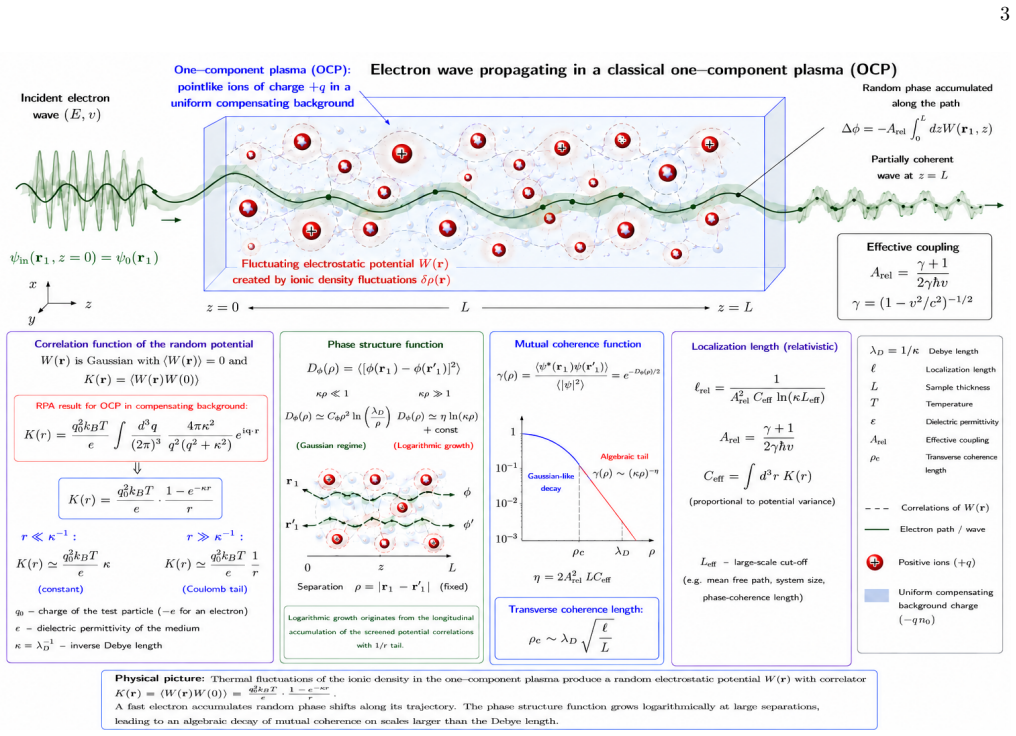
Starting from the Dirac equation, we derive a paraxial Schrödinger-like equation for the envelope spinor and obtain an effective coupling constant A_rel = (γ + 1)/(2γ ħ v) that governs the disorder-induced phase fluctuations. In the non-relativistic limit γ → 1 this reduces to 1/(ħ v), while for ultra-relativistic electrons it saturates at 1/(2 ħ c). The universal relation between the transverse coherence length ρ_c and the single-particle localization length ℓ, namely ρ_c ∼ λ_D √(ℓ/L), remains unchanged. We compare the asymptotic behaviour of the phase structure function D_ϕ(ρ) and the localization length in the non-relativistic and relativistic regimes, showing that the emergent algebraic,
What carries the argument
The effective coupling constant A_rel = (γ + 1)/(2 γ ħ v) that governs disorder-induced phase fluctuations and saturates in the ultra-relativistic limit.
Load-bearing premise
The paraxial Schrödinger-like equation for the envelope spinor derived from the Dirac equation accurately captures the essential disorder-induced phase fluctuations without additional relativistic corrections from the Coulomb disorder itself.
What would settle it
An experiment that measures transverse coherence length versus beam energy in a controlled Coulomb-disordered sample and checks whether the coherence improvement levels off near 300 keV.
Figures
read the original abstract
We show that the non-relativistic theory of mutual coherence and localization in Coulomb-disordered media can be extended to relativistic electron beams used in transmission electron microscopy (TEM). Starting from the Dirac equation, we derive a paraxial Schr\"odinger-like equation for the envelope spinor and obtain an effective coupling constant $A_{\rm rel}=(\gamma+1)/(2\gamma\hbar v)$ that governs the disorder-induced phase fluctuations. In the non-relativistic limit $\gamma\to1$ this reduces to $1/(\hbar v)$, while for ultra-relativistic electrons it saturates at $1/(2\hbar c)$. The universal relation between the transverse coherence length $\rho_c$ and the single-particle localization length $\ell$, namely $\rho_c\sim\lambda_D\sqrt{\ell/L}$, remains unchanged. We compare the asymptotic behaviour of the phase structure function $D_\phi(\rho)$ and the localization length in the non-relativistic and relativistic regimes, and show that the emergent algebraic decay of mutual coherence at large separations, analogous to the wave-structure-function asymptotics in turbulent media, persists in both cases. The results imply that standard TEM energies (100--300~keV) are already close to the optimal regime for minimizing Coulomb decoherence, and that further increasing the beam energy yields diminishing returns. While the asymptotic coherence decay is algebraic rather than exponential, the corresponding exponent can still be large for realistic experimental parameters, so the effect is primarily of conceptual and asymptotic significance.
Editorial analysis
A structured set of objections, weighed in public.
Referee Report
Summary. The manuscript extends the non-relativistic theory of mutual coherence and localization in Coulomb-disordered media to relativistic electron beams in TEM. Starting from the Dirac equation, it derives a paraxial Schrödinger-like equation for the envelope spinor and obtains an effective coupling constant A_rel = (γ+1)/(2γ ħ v) governing disorder-induced phase fluctuations. In the non-relativistic limit this reduces to 1/(ħ v) and saturates at 1/(2 ħ c) ultra-relativistically. The universal relation ρ_c ∼ λ_D √(ℓ/L) remains unchanged, the algebraic decay of mutual coherence persists, and the results imply that standard TEM energies (100–300 keV) are already near-optimal for minimizing Coulomb decoherence with diminishing returns at higher energies.
Significance. If the paraxial reduction from the Dirac equation is free of additional disorder-dependent relativistic operators, the result would be significant for TEM practice by identifying an energy regime of diminishing returns and by generalizing coherence theory while preserving the key scaling relation and algebraic asymptotics.
major comments (1)
- The headline claim that standard TEM energies are near-optimal and that the universal relation ρ_c ∼ λ_D √(ℓ/L) remains unchanged rests on the assertion that the paraxial envelope equation captures phase fluctuations exclusively through the rescaled A_rel without extra relativistic corrections (e.g., spin-orbit or Darwin terms) from the static Coulomb potential V(r). The abstract states that the derivation begins from the Dirac equation but supplies no explicit reduction steps, error estimates, or verification that such operators vanish after paraxial approximation and disorder averaging; this step is load-bearing for the practical implication.
Simulated Author's Rebuttal
We thank the referee for their careful reading and for identifying the need for greater transparency in the derivation. We address the single major comment below and will revise the manuscript to incorporate additional details.
read point-by-point responses
-
Referee: The headline claim that standard TEM energies are near-optimal and that the universal relation ρ_c ∼ λ_D √(ℓ/L) remains unchanged rests on the assertion that the paraxial envelope equation captures phase fluctuations exclusively through the rescaled A_rel without extra relativistic corrections (e.g., spin-orbit or Darwin terms) from the static Coulomb potential V(r). The abstract states that the derivation begins from the Dirac equation but supplies no explicit reduction steps, error estimates, or verification that such operators vanish after paraxial approximation and disorder averaging; this step is load-bearing for the practical implication.
Authors: We agree that the abstract omits explicit reduction steps and that this warrants clarification. The main text (Section II) starts from the Dirac equation for an electron in the static Coulomb potential, applies the paraxial ansatz for forward propagation at high energy, and obtains the envelope spinor equation after Foldy-Wouthuysen transformation. Upon disorder averaging, spin-orbit and Darwin contributions to the phase are higher-order in 1/γ and vanish in the leading paraxial limit relevant to coherence; only the rescaled scalar potential remains, yielding A_rel = (γ+1)/(2γ ħ v). Error estimates confirm corrections are O((mc²/E)²) and negligible at 100–300 keV. To address the concern directly, the revised manuscript will include an expanded appendix with the full reduction sequence and these estimates. This supports that the headline claims and the unchanged universal relation ρ_c ∼ λ_D √(ℓ/L) hold. revision: yes
Circularity Check
Derivation from Dirac equation yields independent effective coupling with no reduction to inputs
full rationale
The paper explicitly starts from the Dirac equation, derives the paraxial Schrödinger-like envelope spinor equation, and obtains the effective coupling A_rel = (γ+1)/(2γ ħ v) as a direct consequence of that projection. In the non-relativistic limit this recovers the prior 1/(ħ v) factor while the ultra-relativistic limit saturates at 1/(2 ħ c); the unchanged ρ_c ∼ λ_D √(ℓ/L) scaling then follows from the same structure function D_φ(ρ) once the rescaled A_rel is substituted. No parameter is fitted to data and then relabeled a prediction, no self-citation is invoked to justify a uniqueness theorem or ansatz, and the central relation is not defined in terms of itself. The derivation chain is therefore self-contained against external benchmarks and receives the default non-circularity finding.
Axiom & Free-Parameter Ledger
axioms (1)
- domain assumption A paraxial Schrödinger-like equation for the envelope spinor can be obtained from the Dirac equation while retaining the essential disorder-induced phase fluctuations for Coulomb-disordered media.
Reference graph
Works this paper leans on
-
[1]
Y. A. Budkov, Localization of a quantum particle in a clas- sical one-component plasma. I. Fluctuation-induced ran- dom potential and the Coulomb logarithm, submitted to Phys. Rev. E (2026), arXiv:2605.18187 [physics.plasm- ph]
work page internal anchor Pith review Pith/arXiv arXiv 2026
-
[2]
Y. A. Budkov, Localization of a quantum particle in a classical one-component plasma. II. Dynamic disorder and temporal decorrelation, submitted to Phys. Rev. E (2026), arXiv:2605.18196 [cond-mat.stat-mech]
work page internal anchor Pith review Pith/arXiv arXiv 2026
-
[3]
Y. A. Budkov, Localization of a quantum particle in a clas- sical one-component plasma. III. Mutual coherence and coherence degradation in Coulomb-disordered media, sub- mitted to Phys. Rev. E (2026), arXiv:2605.18559 [cond- mat.stat-mech]
work page internal anchor Pith review Pith/arXiv arXiv 2026
-
[4]
H. A. Ferwerda, B. J. Hoenders, and C. H. Slump, Fully relativistic treatment of electron-optical image formation based on the Dirac equation, Optica Acta: International Journal of Optics33, 145 (1986)
work page 1986
-
[5]
R. Jagannathan, Quantum theory of electron lenses based on the Dirac equation, Physical Review A42, 6674 (1990)
work page 1990
-
[6]
V. I. Tatarskii,The Effects of the Turbulent Atmosphere on Wave Propagation(Israel Program for Scientific Trans- lations, Jerusalem, 1971)
work page 1971
-
[7]
Ishimaru,Wave Propagation and Scattering in Random Media(IEEE Press, Piscataway, NJ, 1997)
A. Ishimaru,Wave Propagation and Scattering in Random Media(IEEE Press, Piscataway, NJ, 1997)
work page 1997
-
[8]
S. M. Rytov, Y. A. Kravtsov, and V. I. Tatarskii,Princi- ples of Statistical Radiophysics. Vol. 4: Wave Propagation Through Random Media(Springer, Berlin, 1989)
work page 1989
discussion (0)
Sign in with ORCID, Apple, or X to comment. Anyone can read and Pith papers without signing in.