Programmable Participatory Governance -- A Formal Framework for Transparent, Accountable, and Citizen-Responsive Democratic Systems: From Deliberative Theory to Decentralised Architecture
Pith reviewed 2026-05-21 07:53 UTC · model grok-4.3
The pith
A new framework called Programmable Participatory Governance combines democratic theory with distributed computing to create transparent, verifiable systems for civic decision-making.
A machine-rendered reading of the paper's core claim, the machinery that carries it, and where it could break.
Core claim
PPG defines a programmable architecture for civic coordination that integrates insights from deliberative and participatory democracy, collective action theory, direct democratic governance, and distributed computation to support transparent, verifiable, and scalable decision-making while preserving auditability and institutional resilience.
What carries the argument
The PPG framework, a synthesis of democratic principles and cryptographically verifiable distributed systems that enables programmable mechanisms for participatory governance.
If this is right
- Governance mechanisms can expand citizen participation in complex policy decisions through programmable interfaces.
- Transparency and accountability increase because processes become verifiable and auditable via distributed systems.
- Institutional resilience is maintained under large-scale coordination by design choices that embed procedural safeguards.
- Existing democratic institutions can be augmented rather than replaced in contexts where they face structural limits.
Where Pith is reading between the lines
- Small-scale community trials could surface usability issues before any larger rollout.
- Links to current digital government platforms might provide a practical path for testing the architecture.
- The emphasis on cryptographic verification suggests potential overlaps with secure voting or budgeting tools already in use.
Load-bearing premise
Computationally mediated governance structures can augment or improve contemporary democratic processes while preserving procedural integrity, auditability, and institutional resilience.
What would settle it
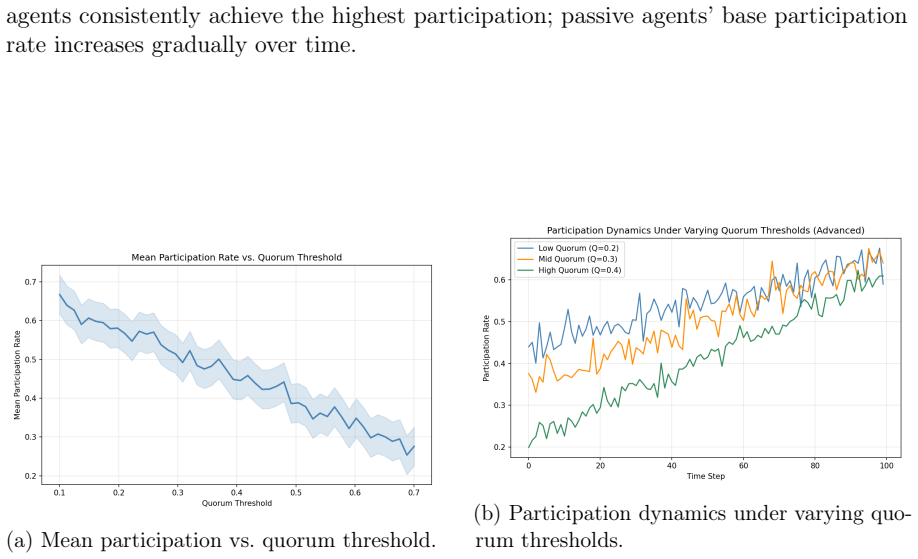
A simulation or pilot deployment of the PPG architecture that shows no improvement in participation rates, decision quality, or public trust metrics relative to conventional governance structures.
Figures




read the original abstract
Public confidence in democratic institutions has declined across many OECD countries over recent decades, while political participation and policy influence remain unevenly distributed across socioeconomic groups. Concurrently, democratic backsliding, declining electoral participation, and persistent concerns regarding institutional transparency and accountability have raised questions about whether existing governance structures are capable of sustaining broad-based legitimacy in complex modern societies. These developments motivate a central institutional design question: can governance systems be restructured to expand participation, improve transparency, and strengthen accountability without undermining stability or decision quality? This thesis proposes Programmable Participatory Governance (PPG), a formal governance framework designed to address these institutional deficits through the integration of democratic theory, institutional economics, and cryptographically verifiable distributed systems. PPG synthesises insights from deliberative and participatory democracy, collective action theory, direct democratic governance, and distributed computation to define a programmable architecture for transparent, verifiable, and scalable civic coordination. The framework is formally specified and evaluated through simulation and systems-oriented architectural analysis. The thesis examines how programmable governance mechanisms can support participatory decision-making while preserving procedural integrity, auditability, and institutional resilience under conditions of large-scale coordination. The objective is not to replace existing democratic institutions outright, but to explore how computationally mediated governance structures may augment or improve contemporary democratic processes in contexts where conventional institutions exhibit persistent structural limitations.
Editorial analysis
A structured set of objections, weighed in public.
Referee Report
Summary. The manuscript proposes Programmable Participatory Governance (PPG), a formal framework that synthesizes insights from deliberative and participatory democracy, collective action theory, direct democratic governance, and distributed computation to define a programmable architecture for transparent, verifiable, and scalable civic coordination. The framework is formally specified and evaluated through simulation and systems-oriented architectural analysis to explore augmentation of contemporary democratic processes while preserving procedural integrity, auditability, and institutional resilience.
Significance. If the formal specification and simulations rigorously establish that the integrated mechanisms preserve verifiability, scalability, and resilience without circular reliance on the architecture's own definitions, the work could offer a substantive contribution to bridging democratic theory with decentralized systems, providing a structured model for addressing institutional limitations in large-scale coordination.
major comments (2)
- [Abstract and framework definition] Abstract and framework definition: The central claim that PPG constitutes a verifiable and resilient architecture for civic coordination rests on the formal specification, yet the manuscript provides no machine-checked proofs or detailed derivations demonstrating how deliberative processes combined with decentralized computation preserve procedural integrity and institutional resilience under large-scale conditions.
- [Simulation and evaluation section] Simulation and evaluation section: The evaluation reduces to testing the constructed PPG system against its own assumptions rather than independent benchmarks or falsifiable predictions, which undermines verification of the claimed benefits of transparency and scalability.
minor comments (3)
- [Architectural analysis] The notation and definitions for programmable mechanisms in the architectural analysis could be expanded with explicit mappings to standard distributed systems primitives for improved clarity.
- [Introduction] Additional references to foundational works in institutional economics and cryptographically verifiable systems would strengthen the synthesis claims.
- [Conclusion] The conclusion would benefit from an explicit discussion of scope limitations and potential failure modes when scaling beyond the simulated conditions.
Simulated Author's Rebuttal
We thank the referee for their insightful comments and recommendation for major revision. We address each major comment below, outlining our responses and planned changes to the manuscript.
read point-by-point responses
-
Referee: [Abstract and framework definition] Abstract and framework definition: The central claim that PPG constitutes a verifiable and resilient architecture for civic coordination rests on the formal specification, yet the manuscript provides no machine-checked proofs or detailed derivations demonstrating how deliberative processes combined with decentralized computation preserve procedural integrity and institutional resilience under large-scale conditions.
Authors: We agree that the manuscript does not include machine-checked proofs. The formal specification relies on mathematical definitions and logical arguments drawn from the integration of deliberative theory and distributed systems. In the revised version, we will expand this section with additional step-by-step derivations that explicitly connect the deliberative processes to the preservation of procedural integrity and resilience properties under scaled conditions. This will strengthen the presentation of the claims while remaining within the scope of a theoretical framework. revision: partial
-
Referee: [Simulation and evaluation section] Simulation and evaluation section: The evaluation reduces to testing the constructed PPG system against its own assumptions rather than independent benchmarks or falsifiable predictions, which undermines verification of the claimed benefits of transparency and scalability.
Authors: The simulations are constructed to evaluate the framework's behavior against the formal model under varying conditions of scale and participation. We acknowledge the limitation regarding independent benchmarks. In the revision, we will augment the evaluation section by relating simulation outcomes to established metrics from collective action theory and by articulating specific falsifiable predictions regarding transparency and scalability that can be tested against external data or alternative systems. revision: yes
Circularity Check
No significant circularity in PPG synthesis proposal
full rationale
The paper proposes PPG as a synthesis of existing theories from deliberative democracy, participatory democracy, collective action theory, direct democratic governance, and distributed computation to define a new programmable architecture. No derivation chain, equations, or first-principles results are exhibited in the provided text that reduce a claimed prediction or property back to the inputs by construction. The formal specification and simulation evaluation are described at a high level as analysis of the proposed system itself, which is standard for architectural design papers and does not match any of the enumerated circularity patterns such as self-definitional loops, fitted inputs renamed as predictions, or load-bearing self-citations. The central claim remains an integrative proposal rather than a tautological reduction.
Axiom & Free-Parameter Ledger
axioms (1)
- domain assumption Insights from deliberative and participatory democracy, collective action theory, and distributed computation can be synthesised into a single programmable governance architecture.
invented entities (1)
-
Programmable Participatory Governance (PPG)
no independent evidence
Lean theorems connected to this paper
-
IndisputableMonolith/Foundation/RealityFromDistinction.leanreality_from_one_distinction unclear?
unclearRelation between the paper passage and the cited Recognition theorem.
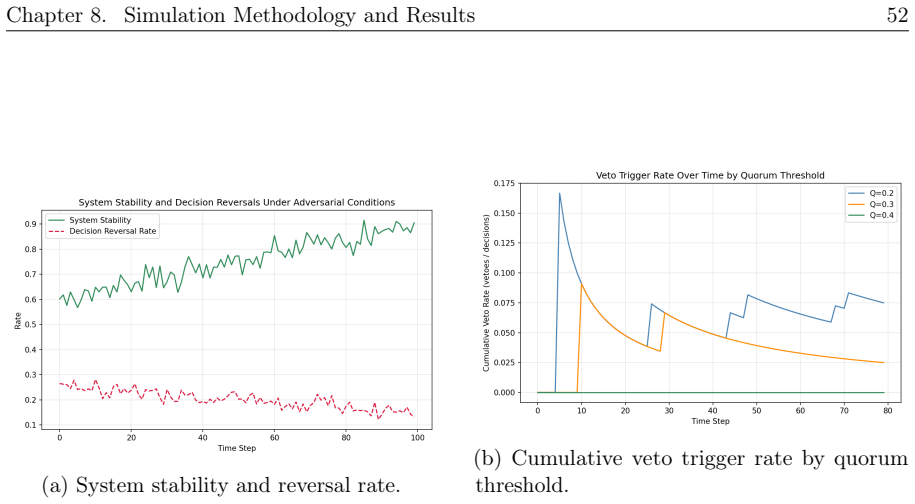
The framework is formalised as a state machine G = (S, s0, Σ, δ, F), with all transitions being deterministic and auditable. A key design contribution is the dynamic quorum mechanism: Q(i) = Qbase + α·σ(i)
-
IndisputableMonolith/Cost/FunctionalEquation.leanwashburn_uniqueness_aczel unclear?
unclearRelation between the paper passage and the cited Recognition theorem.
PPG structures governance as a sequential six-stage pipeline: proposal submission, structured deliberation, constitutional validation, verifiable voting, execution, and citizen-triggered veto.
What do these tags mean?
- matches
- The paper's claim is directly supported by a theorem in the formal canon.
- supports
- The theorem supports part of the paper's argument, but the paper may add assumptions or extra steps.
- extends
- The paper goes beyond the formal theorem; the theorem is a base layer rather than the whole result.
- uses
- The paper appears to rely on the theorem as machinery.
- contradicts
- The paper's claim conflicts with a theorem or certificate in the canon.
- unclear
- Pith found a possible connection, but the passage is too broad, indirect, or ambiguous to say the theorem truly supports the claim.
Reference graph
Works this paper leans on
- [1]
-
[2]
Between Facts and Norms: Contributions to a Discourse Theory of Law and Democracy , author =. 1996 , publisher =
work page 1996
-
[3]
Governing the Commons: The Evolution of Institutions for Collective Action , author =. 1990 , publisher =
work page 1990
- [4]
-
[5]
Social Choice and Individual Values , author =. 1951 , publisher =
work page 1951
-
[6]
Democracy and Deliberation: New Directions for Democratic Reform , author =. 1991 , publisher =
work page 1991
- [7]
- [8]
- [9]
- [10]
-
[11]
Proceedings of the 2020 ACM SIGCOMM Workshop , year =
Identity and Personhood in Digital Democracy , author =. Proceedings of the 2020 ACM SIGCOMM Workshop , year =
work page 2020
-
[12]
Social Physics: How Good Ideas Spread , author =. 2014 , publisher =
work page 2014
- [13]
- [14]
- [15]
- [16]
-
[17]
Participation and Democratic Theory , author =. 1970 , publisher =
work page 1970
-
[18]
Strong Democracy: Participatory Politics for a New Age , author =. 1984 , publisher =
work page 1984
-
[19]
Swiss Democracy: Possible Solutions to Conflict in Multicultural Societies , author =. 2010 , edition =
work page 2010
- [20]
- [21]
-
[22]
Counter-Democracy: Politics in an Age of Distrust , author =. 2008 , publisher =
work page 2008
-
[23]
Public Administration Review , volume =
Varieties of Participation in Complex Governance , author =. Public Administration Review , volume =. 2006 , note =
work page 2006
-
[24]
Ethereum: A Next-Generation Smart Contract and Decentralised Application Platform , author =. 2014 , note =
work page 2014
-
[25]
Blockchain and the Law: The Rule of Code , author =. 2018 , publisher =
work page 2018
-
[26]
Internet Policy Review , volume =
Decentralized Autonomous Organization , author =. Internet Policy Review , volume =. 2021 , doi =
work page 2021
-
[27]
Bitcoin: A Peer-to-Peer Electronic Cash System , author =. 2008 , note =
work page 2008
-
[28]
Open Government: The Global Context and the Way Forward , author =. 2020 , publisher =
work page 2020
-
[29]
Democratic Deficit: Critical Citizens Revisited , author =. 2011 , publisher =
work page 2011
-
[30]
Democratic Challenges, Democratic Choices: The Erosion of Political Support in Advanced Industrial Democracies , author =. 2004 , publisher =
work page 2004
-
[31]
The Unheavenly Chorus: Unequal Political Voice and the Broken Promise of American Democracy , author =. 2012 , publisher =
work page 2012
-
[32]
Perspectives on Politics , volume =
Testing Theories of American Politics: Elites, Interest Groups, and Average Citizens , author =. Perspectives on Politics , volume =. 2014 , publisher =
work page 2014
-
[33]
The Global State of Democracy 2021: Building Resilience in a Pandemic Era , author =. 2021 , institution =
work page 2021
-
[34]
Deliberative Polling: Toward a Better-Informed Democracy , author =. 2018 , institution =
work page 2018
-
[35]
Journal of Information Technology & Politics , volume =
Electronic Democracy: Old Tensions and New Developments , author =. Journal of Information Technology & Politics , volume =. 2012 , pages =
work page 2012
-
[36]
American Economic Review , volume =
Direct Democracy: Politico-Economic Lessons from Swiss Experience , author =. American Economic Review , volume =
-
[37]
Journal of Happiness Studies , volume =
Happiness Prospers in Democracy , author =. Journal of Happiness Studies , volume =
-
[38]
Journal of Democracy , volume =
Digital Technologies and Democratic Governance , author =. Journal of Democracy , volume =
-
[39]
Political Communication , volume =
The Character of Deliberation: Equality, Argument, and the Formation of Public Opinion in Discussion Groups , author =. Political Communication , volume =
-
[40]
The Promise and Practice of Democratic Deliberation , author =. 2010 , publisher =
work page 2010
-
[41]
American Political Science Review , year =
Lijphart, Arend , title =. American Political Science Review , year =
- [42]
- [43]
-
[44]
Herman, Edward S. and Chomsky, Noam , title =. 1988 , publisher =
work page 1988
- [45]
- [46]
-
[47]
Rauch, James E. and Evans, Peter B. , title =. Journal of Public Economics , year =
-
[48]
Open Contracting Data Standard Documentation , year =
-
[49]
Cornell Law Review Online , volume =
A Primer on DAOs , author =. Cornell Law Review Online , volume =. 2022 , pages =
work page 2022
-
[50]
Now the Code Runs Itself: On-Chain and Off-Chain Governance of Blockchain Technologies , author =. Topoi , volume =. 2021 , publisher =
work page 2021
-
[51]
The Decentralized Autonomous Organization and Governance Issues , author =. SSRN Working Paper , year =
-
[52]
Apolitical Foundation , year =
Digital Democracy and Open Government in Taiwan , author =. Apolitical Foundation , year =
-
[53]
Better Reykjavik: An Overview of Digital Participatory Democracy in Iceland , author =. 2016 , institution =
work page 2016
-
[54]
Universitat Oberta de Catalunya , year =
Decidim: Political and Technopolitical Networks for Participatory Democracy , author =. Universitat Oberta de Catalunya , year =
-
[55]
American Economic Review , volume =
The Design of Mechanisms for Resource Allocation , author =. American Economic Review , volume =
-
[56]
American Economic Review , volume =
Mechanism Design: How to Implement Social Goals , author =. American Economic Review , volume =
-
[57]
The Folk Theorem in Repeated Games with Discounting or with Incomplete Information , author =. Econometrica , volume =
-
[58]
Economics and Politics , volume =
Interest Groups, Voting, and Campaigns , author =. Economics and Politics , volume =
-
[59]
Remaking Democracy: How Citizens Are Changing Politics , author =. 2019 , publisher =
work page 2019
- [60]
discussion (0)
Sign in with ORCID, Apple, or X to comment. Anyone can read and Pith papers without signing in.