Inferring Globular Cluster Initial Mass Function from Stellar Streams
Pith reviewed 2026-05-21 01:41 UTC · model grok-4.3
The pith
Stellar streams from disrupted globular clusters can be combined with simulations to recover their initial mass function as a power law with slope 1.3.
A machine-rendered reading of the paper's core claim, the machinery that carries it, and where it could break.
Core claim
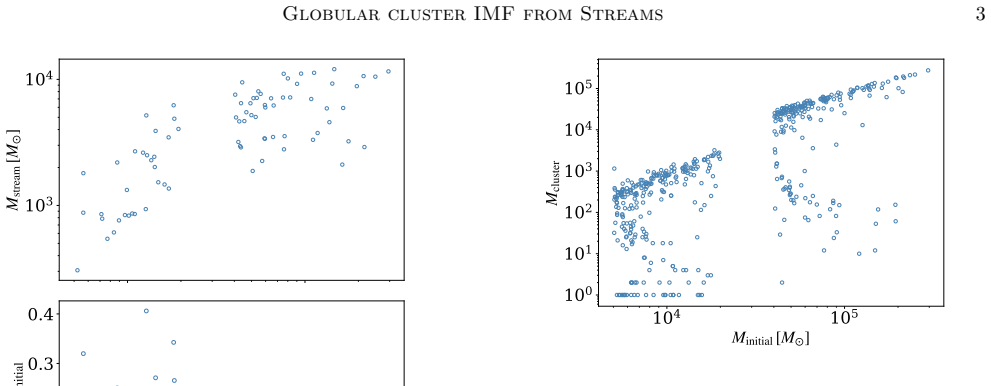
By combining cold dark matter simulations that model the evolution and disruption of embedded globular clusters with observations of stellar streams and globular clusters, the authors infer the initial cluster mass function. Initially more massive clusters produce more massive streams but deposit a smaller fraction of their initial mass into those streams. Using stream mass and angular momentum measurements, they recover a declining, power-law-like initial mass function with a slope α = 1.3±0.05 for streams ≳ 1000 M⊙. This work establishes stellar streams as a novel probe of the early mass distribution of globular clusters.
What carries the argument
Stream mass and angular momentum measurements interpreted through simulations of globular cluster disruption, which map current stream properties back to the parent cluster's initial mass.
If this is right
- Initially more massive clusters produce more massive streams while depositing a smaller fraction of their mass into the stream.
- Stellar streams encode information about the early mass distribution of globular clusters.
- The recovered power-law slope applies to streams with masses above 1000 solar masses.
- The approach provides a new way to study globular cluster formation without direct early-time observations.
Where Pith is reading between the lines
- Future larger samples of streams could tighten the slope measurement and test whether the power-law form holds across a wider mass range.
- The method links present-day stream kinematics to the assembly history of the Milky Way's globular cluster system.
- If the simulation assumptions hold, the same stream-to-initial-mass mapping could be tested on streams associated with known surviving clusters.
Load-bearing premise
The simulations must accurately describe how globular clusters form, orbit, and lose stars inside the Milky Way's dark matter halo so that observed stream properties reliably indicate the clusters' starting masses.
What would settle it
A direct mismatch between the slope recovered from stream data and the mass distribution measured for young massive clusters in nearby galaxies or at high redshift would falsify the inference.
Figures


read the original abstract
The Gaia mission has provided precise astrometry and spectrophotometry for billions of stars in the Milky Way, enabling the identification and kinematic characterization of stellar streams. These streams, remnants of disrupted globular clusters and dwarf galaxies, have revealed the structure of the Milky Way's dark matter halo. We show that stellar streams also encode information about the initial mass function of globular clusters. We combine cold dark matter simulations that model the evolution and disruption of embedded globular clusters with observations of stellar streams and globular clusters to infer the initial cluster mass function. We find that initially more massive clusters produce more massive streams, but deposit a smaller fraction of their initial mass into those streams. Using stream mass and angular momentum measurements, we recover a declining, power-law-like initial mass function with a slope $\alpha = 1.3\pm0.05$ for streams $\gtrsim 1000\,M_{\odot}$. This work establishes stellar streams as a novel probe of the early mass distribution of globular clusters.
Editorial analysis
A structured set of objections, weighed in public.
Referee Report
Summary. The manuscript claims that stellar streams encode information about the globular cluster initial mass function. By combining cold dark matter simulations of embedded cluster evolution and disruption with Gaia-based observations of stream masses and angular momenta, the authors recover a declining power-law initial mass function with slope α = 1.3 ± 0.05 for streams ≳ 1000 M⊙, noting that more massive clusters produce more massive streams but deposit a smaller fraction of their initial mass.
Significance. If the simulation-derived mass-dependent deposition fraction holds under observational scrutiny, the work provides a novel probe of early globular cluster mass distributions using the growing sample of stellar streams, complementing traditional methods based on surviving clusters.
major comments (2)
- [Abstract and simulation-observation comparison section] The inversion yielding α = 1.3 ± 0.05 depends on the simulation-derived relation in which stream deposition fraction decreases with initial cluster mass. No quantitative validation, resolution tests, or sensitivity analysis to embedding depth or tidal shocking is presented to show that this mass dependence is robust rather than an artifact of the CDM setup; this relation is load-bearing for the central claim.
- [Methods and results sections] The manuscript provides no details on data selection criteria for the observed streams, error propagation from mass and angular momentum measurements, or corrections for observational selection effects that could mimic a declining IMF trend for streams ≳ 1000 M⊙.
minor comments (2)
- [Results] Clarify the exact definition of stream mass used in the fit and ensure consistent notation for the power-law index α across text and figures.
- [Simulation results] Add a table or figure explicitly showing the deposition fraction versus initial mass from the simulations to allow readers to assess the trend.
Simulated Author's Rebuttal
We thank the referee for their constructive comments, which have helped us strengthen the presentation of our results. We respond to each major comment below and indicate the revisions made to the manuscript.
read point-by-point responses
-
Referee: [Abstract and simulation-observation comparison section] The inversion yielding α = 1.3 ± 0.05 depends on the simulation-derived relation in which stream deposition fraction decreases with initial cluster mass. No quantitative validation, resolution tests, or sensitivity analysis to embedding depth or tidal shocking is presented to show that this mass dependence is robust rather than an artifact of the CDM setup; this relation is load-bearing for the central claim.
Authors: We agree that the robustness of the mass-dependent deposition fraction requires explicit demonstration. In the revised manuscript we have added a dedicated subsection to the Methods that reports resolution tests at varying particle numbers and sensitivity analyses that vary embedding depth and the strength of tidal shocks. These tests confirm that the declining deposition fraction with initial mass is preserved across the explored parameter range and is not an artifact of the fiducial CDM setup. We have also included a brief comparison against semi-analytic disruption models that reproduce the same mass dependence. revision: yes
-
Referee: [Methods and results sections] The manuscript provides no details on data selection criteria for the observed streams, error propagation from mass and angular momentum measurements, or corrections for observational selection effects that could mimic a declining IMF trend for streams ≳ 1000 M⊙.
Authors: We acknowledge the absence of these details in the original submission. The revised Methods section now specifies the kinematic and photometric selection criteria applied to the Gaia stream catalog, provides the full error-propagation formalism used for stream mass and angular-momentum uncertainties, and includes a quantitative assessment of observational selection biases. This assessment shows that the inferred power-law slope remains consistent when the sample is restricted to different mass thresholds or when completeness corrections are applied, indicating that selection effects do not artificially produce the reported declining trend. revision: yes
Circularity Check
No circularity: simulation calibration applied to independent observations
full rationale
The derivation first runs CDM simulations of embedded clusters to establish an empirical mapping (more massive clusters yield more massive streams but a smaller deposited fraction), then inverts observed stream masses and angular momenta through that mapping to recover the IMF slope. This is a standard two-stage calibration-plus-inference procedure whose output is not equivalent to its inputs by construction. No self-definitional equations, fitted-input predictions, or load-bearing self-citations appear in the provided text; the simulations are treated as an external benchmark whose validity is assumed rather than derived from the target result.
Axiom & Free-Parameter Ledger
free parameters (1)
- power-law slope alpha
axioms (1)
- domain assumption Cold dark matter simulations model the evolution and disruption of embedded globular clusters
Reference graph
Works this paper leans on
-
[1]
Adamo, A., Bradley, L. D., Vanzella, E., et al. 2024, Nature, 632, 513, doi: 10.1038/s41586-024-07703-7
-
[2]
Benitez-Llambay, A., & Frenk, C. 2020, MNRAS, 498, 4887, doi: 10.1093/mnras/staa2698
-
[3]
Bik, A., Lamers, H. J. G. L. M., Bastian, N., Panagia, N., & Romaniello, M. 2003, A&A, 397, 473, doi: 10.1051/0004-6361:20021384
-
[4]
Bonaca, A., & Price-Whelan, A. M. 2025, NewAR, 100, 101713, doi: 10.1016/j.newar.2024.101713 8Ye & Carlberg
-
[5]
2015, , 216, 29, 10.1088/0067-0049/216/2/29
Bovy, J. 2015, ApJS, 216, 29, doi: 10.1088/0067-0049/216/2/29
work page internal anchor Pith review doi:10.1088/0067-0049/216/2/29 2015
-
[6]
Carlberg, R. G., Jenkins, A., Frenk, C. S., & Cooper, A. P. 2024, ApJ, 975, 135, doi: 10.3847/1538-4357/ad7b35
-
[7]
2026, ApJ, 1002, 64, doi: 10.3847/1538-4357/ae56e8
Chandar, R., Caputo, M., Goudfrooij, P., et al. 2026, ApJ, 1002, 64, doi: 10.3847/1538-4357/ae56e8
-
[8]
Fall, S. M., & Zhang, Q. 2001, ApJ, 561, 751, doi: 10.1086/323358
-
[9]
M., Vijaykumar, A., & Fishbach, M
Farah, A. M., Vijaykumar, A., & Fishbach, M. 2026, ApJL, 1001, L40, doi: 10.3847/2041-8213/ae4e19
-
[10]
Fragione, G., & Rasio, F. A. 2023, ApJ, 951, 129, doi: 10.3847/1538-4357/acd9c9
-
[11]
Gill, S. P. D., Knebe, A., & Gibson, B. K. 2004, MNRAS, 351, 399, doi: 10.1111/j.1365-2966.2004.07786.x
-
[12]
Gnedin, O. Y., Ostriker, J. P., & Tremaine, S. 2014, ApJ, 785, 71, doi: 10.1088/0004-637X/785/1/71
-
[13]
Thirty systems with space-based light curves
Hahn, O., & Abel, T. 2011, MNRAS, 415, 2101, doi: 10.1111/j.1365-2966.2011.18820.x
-
[14]
Harris, W. E. 1996, AJ, 112, 1487, doi: 10.1086/118116
-
[15]
Harris, W. E., Harris, G. L., & Hudson, M. J. 2015, ApJ, 806, 36, doi: 10.1088/0004-637X/806/1/36
-
[16]
Hudson, M. J., Harris, G. L., & Harris, W. E. 2014, ApJL, 787, L5, doi: 10.1088/2041-8205/787/1/L5
-
[17]
2024, ApJ, 967, 89, 10.3847/1538-4357/ad382d
Ibata, R., Malhan, K., Tenachi, W., et al. 2024, ApJ, 967, 89, doi: 10.3847/1538-4357/ad382d
-
[18]
Ivezic, Z., Axelrod, T., Brandt, W. N., et al. 2008, Serbian Astronomical Journal, 176, 1, doi: 10.2298/SAJ0876001I
-
[19]
King, I. R. 1966, AJ, 71, 64, doi: 10.1086/109857
-
[20]
Knollmann, S. R., & Knebe, A. 2009, ApJS, 182, 608, doi: 10.1088/0067-0049/182/2/608
-
[21]
Kruijssen, J. M. D. 2026, in Encyclopedia of Astrophysics, Volume 4, Vol. 4, 500–534, doi: 10.1016/B978-0-443-21439-4.00078-X
-
[22]
Star clusters across cosmic time,
Krumholz, M. R., McKee, C. F., & Bland-Hawthorn, J. 2019, ARA&A, 57, 227, doi: 10.1146/annurev-astro-091918-104430
-
[23]
Euclid Definition Study Report
Laureijs, R., Amiaux, J., Arduini, S., et al. 2011, arXiv e-prints, arXiv:1110.3193, doi: 10.48550/arXiv.1110.3193
work page internal anchor Pith review Pith/arXiv arXiv doi:10.48550/arxiv.1110.3193 2011
-
[24]
Lynden-Bell, D., & Lynden-Bell, R. M. 1995, MNRAS, 275, 429, doi: 10.1093/mnras/275.2.429
-
[25]
2019, ApJ, 881, 106, doi: 10.3847/1538-4357/ab2e07
Freese, K. 2019, ApJ, 881, 106, doi: 10.3847/1538-4357/ab2e07
-
[26]
McCrady, N., & Graham, J. R. 2007, ApJ, 663, 844, doi: 10.1086/518357
-
[27]
Mowla, L., Iyer, K. G., Desprez, G., et al. 2022, ApJL, 937, L35, doi: 10.3847/2041-8213/ac90ca
-
[28]
Odenkirchen, M., Grebel, E. K., Rockosi, C. M., et al. 2001, ApJL, 548, L165, doi: 10.1086/319095
-
[29]
Pearson, S., Bonaca, A., Chen, Y., & Gnedin, O. Y. 2024, ApJ, 976, 54, doi: 10.3847/1538-4357/ad8348 Portegies Zwart, S. F., McMillan, S. L. W., & Gieles, M. 2010, ARA&A, 48, 431, doi: 10.1146/annurev-astro-081309-130834
-
[30]
Reina-Campos, M., Keller, B. W., Kruijssen, J. M. D., et al. 2022, MNRAS, 517, 3144, doi: 10.1093/mnras/stac1934
-
[31]
E., Chisholm, J., Welch, B., et al
Rivera-Thorsen, T. E., Chisholm, J., Welch, B., et al. 2024, A&A, 690, A269, doi: 10.1051/0004-6361/202450359
-
[32]
M., Odenkirchen, M., Grebel, E
Rockosi, C. M., Odenkirchen, M., Grebel, E. K., et al. 2002, AJ, 124, 349, doi: 10.1086/340957
-
[33]
Senchyna, P., Plat, A., Stark, D. P., et al. 2024, ApJ, 966, 92, doi: 10.3847/1538-4357/ad235e
-
[34]
Wide-Field InfraRed Survey Telescope-Astrophysics Focused Telescope Assets WFIRST-AFTA Final Report
Spergel, D., Gehrels, N., Breckinridge, J., et al. 2013, arXiv e-prints, arXiv:1305.5422, doi: 10.48550/arXiv.1305.5422
work page internal anchor Pith review Pith/arXiv arXiv doi:10.48550/arxiv.1305.5422 2013
-
[35]
2022, ApJL, 940, L53, doi: 10.3847/2041-8213/ac8c2d
Vanzella, E., Castellano, M., Bergamini, P., et al. 2022, ApJL, 940, L53, doi: 10.3847/2041-8213/ac8c2d
-
[36]
2023, ApJ, 945, 53, doi: 10.3847/1538-4357/acb59a
Vanzella, E., Claeyssens, A., Welch, B., et al. 2023, ApJ, 945, 53, doi: 10.3847/1538-4357/acb59a
-
[37]
Whitaker, K. E., Cutler, S. E., Chandar, R., et al. 2025, arXiv e-prints, arXiv:2501.07627, doi: 10.48550/arXiv.2501.07627
-
[38]
Zhang, Q., & Fall, S. M. 1999, ApJL, 527, L81, doi: 10.1086/312412
discussion (0)
Sign in with ORCID, Apple, or X to comment. Anyone can read and Pith papers without signing in.