On the correlation between globular clusters and the distribution of dark matter in galaxy clusters: the case of Abell 2744
Pith reviewed 2026-05-21 07:29 UTC · model grok-4.3
The pith
Bright globular clusters trace the mass distribution in Abell 2744 more closely than other galactic components.
A machine-rendered reading of the paper's core claim, the machinery that carries it, and where it could break.
Core claim
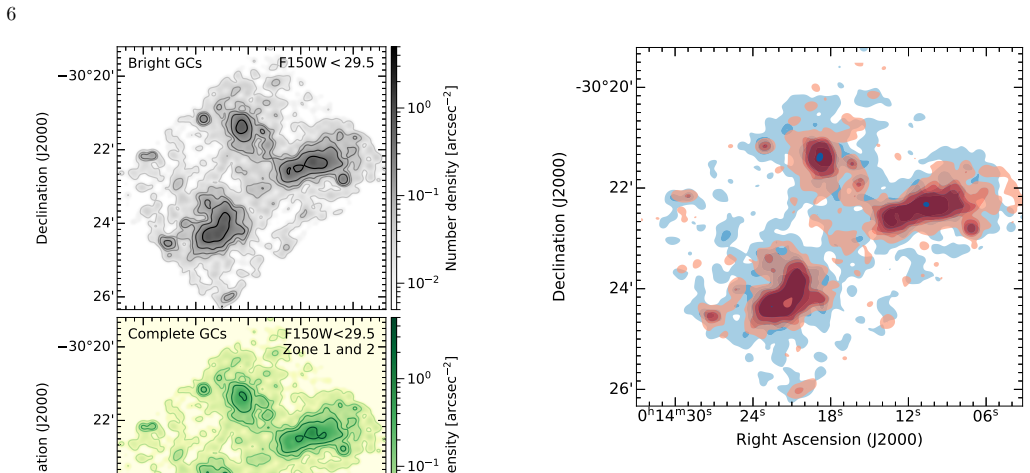
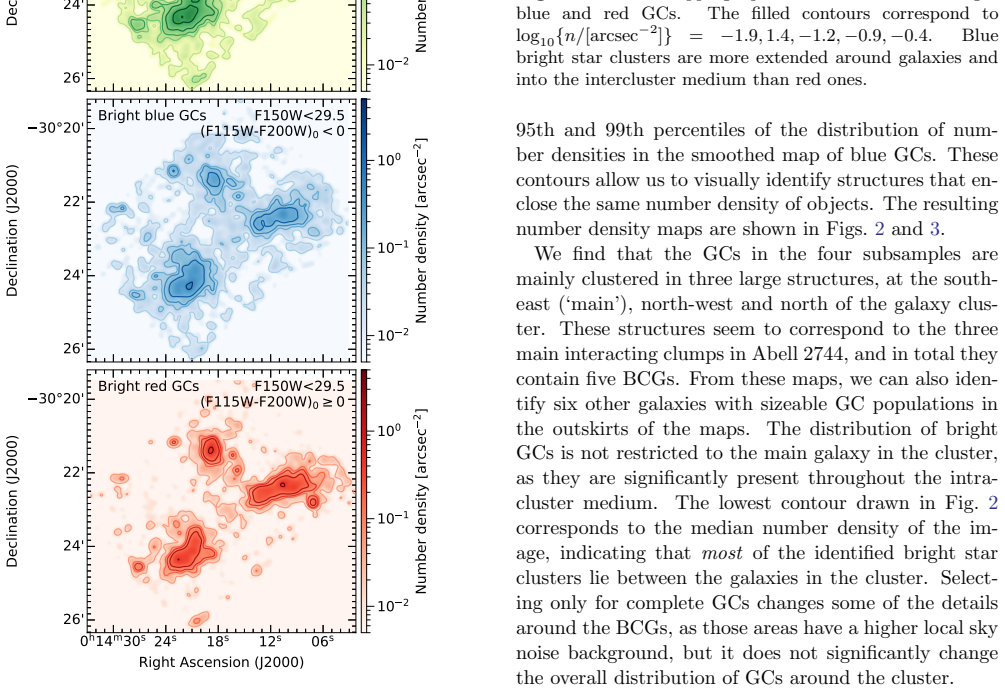
The spatial distribution of bright globular clusters roughly traces the three main interacting clumps in Abell 2744 alongside galaxies with large globular cluster populations. The globular cluster populations correlate more closely with the predicted mass maps than any other galactic component, with Spearman rank coefficients exceeding 0.7. Bright blue globular clusters prove compatible with the mass map derived solely from weak lensing, indicating they supply complementary and independent information on the mass distribution at a level of detail comparable to weak lensing.
What carries the argument
inhomogeneous spatial Poisson point process model for globular cluster locations, used to identify the closest-matching mass map
If this is right
- Globular clusters can provide complementary information on mass distribution in galaxy clusters with detail similar to weak lensing.
- The method distinguishes which mass map the globular cluster distribution agrees with most closely.
- Catalogs of globular clusters at different cosmic epochs can be combined with this approach to study mass distributions independently.
Where Pith is reading between the lines
- If the correlation holds in other clusters, globular cluster catalogs could map dark matter where weak lensing coverage is incomplete.
- Testing the same method on non-merging clusters would show whether bright blue globular clusters consistently trace weak lensing maps across environments.
- The approach might be applied to other potential tracers such as intracluster light to check for similar correlations.
Load-bearing premise
Globular cluster locations around a galaxy cluster follow an inhomogeneous spatial Poisson point process that lets the method distinguish which mass map they agree with most closely.
What would settle it
Repeating the analysis on Abell 2744 or a similar cluster and finding Spearman rank coefficients below 0.7 for globular clusters versus the mass maps, or finding that bright blue globular clusters no longer match the weak lensing mass map.
Figures



read the original abstract
Globular clusters (GCs) lie scattered around the inner $40\%$ of the virial radius of galaxy clusters, potentially being excellent tracers of the underlying mass distribution. In this paper, we present a statistical method based on assuming that the location of GCs around a galaxy cluster follows an inhomogenous spatial Poisson point process, and we use this method to assess to which galactic component GCs are better tracers of. We apply the method to the galaxy cluster Abell 2744, and we find that the spatial distribution of bright GCs roughly traces the three main interacting clumps in the galaxy cluster, alongside other galaxies with sizeable GC populations. The GC populations are more closely correlated to the predicted mass maps than any other galactic component (Spearman rank coefficients $>0.7$). A perk of this statistical method is that it allows us to distinguish to which map the agreement is closest to. In particular, we find that the Bright Blue GCs are compatible with the mass map solely derived from weak lensing, suggesting that they can provide complementary and independent information on the mass distribution in galaxy clusters with a similar level of detail to that of weak lensing. This statistical method is available in a public repository, and combined with catalogs of GCs in galaxy clusters at different cosmic epochs, it provides an independent method for investigating the mass distribution in these galactic environments.
Editorial analysis
A structured set of objections, weighed in public.
Referee Report
Summary. The paper introduces a statistical method that models the positions of globular clusters (GCs) around galaxy clusters as an inhomogeneous spatial Poisson point process. Applied to Abell 2744, the method is used to compare the spatial distribution of bright GCs (and subsets such as bright blue GCs) against mass maps derived from different galactic components and weak-lensing data. The central claims are that bright GCs trace the three main interacting clumps similarly to other GC-rich galaxies, that GC populations show Spearman rank correlations >0.7 with the predicted mass maps (higher than other components), and that bright blue GCs are compatible with the weak-lensing-only mass map, providing complementary information on the cluster mass distribution.
Significance. If the quantitative results hold after addressing the modeling assumptions, the work provides a new, publicly available statistical tool for using GCs as mass tracers in clusters at various redshifts, independent of weak lensing. The finding that GCs correlate more strongly with mass maps than other galactic components, together with the specific compatibility of blue GCs with the lensing map, could offer an additional probe of dark-matter distribution in merging systems.
major comments (2)
- [Statistical method (abstract and methods description)] The core method assumes GC locations follow an inhomogeneous spatial Poisson point process whose intensity is proportional to a chosen mass map. In Abell 2744, however, GCs are physically tied to member galaxies that themselves trace the three merging clumps; this induces positive spatial correlations on galaxy scales that violate the independence assumption of the Poisson process. If the likelihood or Spearman comparison is performed under this misspecification, the reported preference for the weak-lensing map may be an artifact of how galaxy positions align with that map rather than a genuine tracer property of the GCs themselves.
- [Abstract and results] The abstract states Spearman rank coefficients above 0.7 and compatibility of bright blue GCs with the weak-lensing map, yet provides no details on GC sample selection criteria, error estimation on the coefficients, or the explicit construction of the Poisson intensity function from each mass map. These omissions make the central quantitative claims difficult to evaluate or reproduce.
minor comments (2)
- [Data and sample] Clarify the exact definition of 'bright' and 'blue' GCs (magnitude and color cuts) and state how many objects fall into each category for Abell 2744.
- [Abstract] The public repository is mentioned; include a direct link or DOI in the manuscript for immediate access.
Simulated Author's Rebuttal
We thank the referee for the constructive and detailed comments on our manuscript. We have addressed each major point below, proposing revisions to improve clarity and acknowledge modeling assumptions where appropriate.
read point-by-point responses
-
Referee: [Statistical method (abstract and methods description)] The core method assumes GC locations follow an inhomogeneous spatial Poisson point process whose intensity is proportional to a chosen mass map. In Abell 2744, however, GCs are physically tied to member galaxies that themselves trace the three merging clumps; this induces positive spatial correlations on galaxy scales that violate the independence assumption of the Poisson process. If the likelihood or Spearman comparison is performed under this misspecification, the reported preference for the weak-lensing map may be an artifact of how galaxy positions align with that map rather than a genuine tracer property of the GCs themselves.
Authors: We agree that GCs are hosted within galaxies and that this introduces spatial correlations at galaxy scales, which formally violates the strict independence assumption of the Poisson point process. Our model uses the inhomogeneous Poisson process as an approximation focused on cluster-scale intensity variations driven by the mass maps. The Spearman rank correlations are calculated directly between the binned GC counts and the mass maps and do not rely on the Poisson likelihood. We will add a dedicated paragraph in the Methods section discussing this approximation, its limitations, and why the large-scale tracing results remain informative despite small-scale galaxy clustering. revision: partial
-
Referee: [Abstract and results] The abstract states Spearman rank coefficients above 0.7 and compatibility of bright blue GCs with the weak-lensing map, yet provides no details on GC sample selection criteria, error estimation on the coefficients, or the explicit construction of the Poisson intensity function from each mass map. These omissions make the central quantitative claims difficult to evaluate or reproduce.
Authors: The abstract is kept concise by design, but the Methods section details the GC sample (bright GCs selected by magnitude and color cuts), the construction of the Poisson intensity (normalized mass map values used as the intensity function), and error estimation on the Spearman coefficients (via resampling). We will revise the abstract to include a short reference to the sample selection and direct readers to the Methods for the model construction and statistical details, improving reproducibility without lengthening the abstract excessively. revision: yes
Circularity Check
No significant circularity: GC positions tested against independent lensing mass maps via Poisson model
full rationale
The paper's core method assumes GC locations follow an inhomogeneous spatial Poisson point process whose intensity is taken proportional to a chosen mass map, then computes Spearman rank correlations and compatibility metrics to identify which map (including a weak-lensing-only map) the observed bright blue GCs best trace. The mass maps are derived independently from weak lensing and other data; GC positions are observed catalog data. No parameter is fitted to the final claim, no self-citation supplies a load-bearing uniqueness theorem, and the output (GCs trace the lensing map at Spearman >0.7) is not equivalent to the input by construction. The Poisson assumption is a modeling choice whose validity can be checked externally, but it does not create definitional circularity within the derivation chain.
Axiom & Free-Parameter Ledger
axioms (1)
- domain assumption The locations of globular clusters follow an inhomogeneous spatial Poisson point process
Lean theorems connected to this paper
-
IndisputableMonolith/Cost/FunctionalEquation.leanwashburn_uniqueness_aczel unclear?
unclearRelation between the paper passage and the cited Recognition theorem.
we assume that the location of GCs around a galaxy cluster follows an inhomogenous spatial Poisson point process
What do these tags mean?
- matches
- The paper's claim is directly supported by a theorem in the formal canon.
- supports
- The theorem supports part of the paper's argument, but the paper may add assumptions or extra steps.
- extends
- The paper goes beyond the formal theorem; the theorem is a base layer rather than the whole result.
- uses
- The paper appears to rely on the theorem as machinery.
- contradicts
- The paper's claim conflicts with a theorem or certificate in the canon.
- unclear
- Pith found a possible connection, but the passage is too broad, indirect, or ambiguous to say the theorem truly supports the claim.
Reference graph
Works this paper leans on
-
[1]
2023, https://github.com/marimo-team/marimo Alamo-Mart´ ınez, K
Agrawal, A., & Scolnick, M. 2023, https://github.com/marimo-team/marimo Alamo-Mart´ ınez, K. A., Blakeslee, J. P., Jee, M. J., et al. 2013, ApJ, 775, 20, doi: 10.1088/0004-637X/775/1/20
-
[2]
Allen, S. W. 1998, MNRAS, 296, 392, doi: 10.1046/j.1365-8711.1998.01358.x
-
[3]
Allingham, J. F. V., Zitrin, A., Kokorev, V., et al. 2026, arXiv e-prints, arXiv:2602.14074, doi: 10.48550/arXiv.2602.14074
-
[4]
2021, MNRAS, 500, 5249, doi: 10.1093/mnras/staa3441 Astropy Collaboration, Robitaille, T
Asencio, E., Banik, I., & Kroupa, P. 2021, MNRAS, 500, 5249, doi: 10.1093/mnras/staa3441 Astropy Collaboration, Robitaille, T. P., Tollerud, E. J., et al. 2013, A&A, 558, A33, doi: 10.1051/0004-6361/201322068 Astropy Collaboration, Price-Whelan, A. M., Sip˝ ocz, B. M., et al. 2018, AJ, 156, 123, doi: 10.3847/1538-3881/aabc4f Astropy Collaboration, Price-W...
-
[5]
2020, JCAP, 2020, 024, doi: 10.1088/1475-7516/2020/02/024
Banerjee, A., Adhikari, S., Dalal, N., More, S., & Kravtsov, A. 2020, JCAP, 2020, 024, doi: 10.1088/1475-7516/2020/02/024
-
[6]
Berek, S. C., Eadie, G. M., Speagle, J. S., & Wang, S. Y. 2024, ApJ, 972, 104, doi: 10.3847/1538-4357/ad6147
-
[7]
2023, ApJ, 952, 84, doi: 10.3847/1538-4357/acd643
Bergamini, P., Acebron, A., Grillo, C., et al. 2023, ApJ, 952, 84, doi: 10.3847/1538-4357/acd643
-
[8]
Berkheimer, J. M., Windhorst, R. A., Harris, W. E., et al. 2026, AJ, 171, 48, doi: 10.3847/1538-3881/ae209a
-
[9]
Bezanson, R., Labbe, I., Whitaker, K. E., et al. 2024, ApJ, 974, 92, doi: 10.3847/1538-4357/ad66cf
-
[10]
2026, ApJ, 1001, 60, doi: 10.3847/1538-4357/ae41b0
Cerny, C., Mahler, G., Sharon, K., et al. 2026, ApJ, 1001, 60, doi: 10.3847/1538-4357/ae41b0
-
[11]
Cha, S., Cho, B. Y., Joo, H., et al. 2025, ApJL, 987, L15, doi: 10.3847/2041-8213/add2f0
-
[12]
Cha, S., HyeongHan, K., Scofield, Z. P., Joo, H., & Jee, M. J. 2024, ApJ, 961, 186, doi: 10.3847/1538-4357/ad0cbf
-
[13]
Cho, B. Y., Jee, M. J., Joo, H., Cha, S., & HyeongHan, K. 2025, arXiv e-prints, arXiv:2512.03150, doi: 10.48550/arXiv.2512.03150
-
[14]
2004, ApJ, 604, 596, doi: 10.1086/381970
Clowe, D., Gonzalez, A., & Markevitch, M. 2004, ApJ, 604, 596, doi: 10.1086/381970
-
[15]
Diego, J. M. 2026, arXiv e-prints, arXiv:2602.15940, doi: 10.48550/arXiv.2602.15940
-
[16]
M., Broadhurst, T., Wong, J., et al
Diego, J. M., Broadhurst, T., Wong, J., et al. 2016, MNRAS, 459, 3447, doi: 10.1093/mnras/stw865 15
-
[17]
Diego, J. M., Goolsby, C., Conselice, C. J., & Palencia, J. M. 2026, arXiv e-prints, arXiv:2602.12332, doi: 10.48550/arXiv.2602.12332
-
[18]
M., Pascale, M., Frye, B., et al
Diego, J. M., Pascale, M., Frye, B., et al. 2023a, A&A, 679, A159, doi: 10.1051/0004-6361/202345868
-
[19]
Diego, J. M., Meena, A. K., Adams, N. J., et al. 2023b, A&A, 672, A3, doi: 10.1051/0004-6361/202245238
-
[20]
Diego, J. M., Adams, N. J., Willner, S. P., et al. 2024, A&A, 690, A114, doi: 10.1051/0004-6361/202349119
-
[21]
Diego, J. M., Sun, F., Palencia, J. M., et al. 2025, A&A, 703, A207, doi: 10.1051/0004-6361/202556062
-
[22]
1998, ApJ, 502, 141, doi: 10.1086/305901
Dubinski, J. 1998, ApJ, 502, 141, doi: 10.1086/305901
-
[23]
Ebeling, H., Edge, A. C., Mantz, A., et al. 2010, MNRAS, 407, 83, doi: 10.1111/j.1365-2966.2010.16920.x
-
[24]
Faisst, A. L., Chary, R. R., Brammer, G., & Toft, S. 2022, ApJL, 941, L11, doi: 10.3847/2041-8213/aca1bf
-
[25]
Furtak, L. J., Zitrin, A., Weaver, J. R., et al. 2023, MNRAS, 523, 4568, doi: 10.1093/mnras/stad1627
-
[26]
2024, ApJ, 973, 77, doi: 10.3847/1538-4357/ad684a
Gledhill, R., Strait, V., Desprez, G., et al. 2024, ApJ, 973, 77, doi: 10.3847/1538-4357/ad684a
-
[27]
Grillo, C., Suyu, S. H., Rosati, P., et al. 2015, ApJ, 800, 38, doi: 10.1088/0004-637X/800/1/38
-
[28]
Harris, C. R., Millman, K. J., van der Walt, S. J., et al. 2020, Nature, 585, 357, doi: 10.1038/s41586-020-2649-2
-
[29]
Harris, W. E., & Reina-Campos, M. 2023, MNRAS, 526, 2696, doi: 10.1093/mnras/stad2903
-
[30]
Harris, W. E., & Reina-Campos, M. 2024, ApJ, 971, 155, doi: 10.3847/1538-4357/ad583c
-
[31]
Harris, W. E., & Speagle, J. S. 2024, AJ, 168, 38, doi: 10.3847/1538-3881/ad4a76
-
[32]
Harris, W. E., Brown, R. A., Durrell, P. R., et al. 2020, ApJ, 890, 105, doi: 10.3847/1538-4357/ab6992
-
[33]
E., Reina-Campos, M., Keatley, K
Harris, W. E., Reina-Campos, M., Keatley, K. E., et al. 2025, ApJ, 993, 210, doi: 10.3847/1538-4357/ae073f
-
[34]
Hinrichs, T. R., Kamieneski, P. S., Windhorst, R. A., et al. 2026, ApJ, 1001, 91, doi: 10.3847/1538-4357/ae50ee
-
[35]
2013, SSRv, 177, 75, doi: 10.1007/s11214-013-9978-5
Hoekstra, H., Bartelmann, M., Dahle, H., et al. 2013, SSRv, 177, 75, doi: 10.1007/s11214-013-9978-5
-
[36]
Hunter, J. D. 2007, Computing in Science and Engineering, 9, 90, doi: 10.1109/MCSE.2007.55
-
[37]
2015, MNRAS, 452, 1437, doi: 10.1093/mnras/stv1402
Jauzac, M., Richard, J., Jullo, E., et al. 2015, MNRAS, 452, 1437, doi: 10.1093/mnras/stv1402
-
[38]
Jones, E., Oliphant, T., Peterson, P., et al. 2001, http://www.scipy.org/
work page 2001
-
[39]
2016, ApJ, 819, 114, doi: 10.3847/0004-637X/819/2/114
Ouchi, M. 2016, ApJ, 819, 114, doi: 10.3847/0004-637X/819/2/114
-
[40]
Keatley, K. E., & Harris, W. E. 2025, ApJ, 990, 67, doi: 10.3847/1538-4357/adf5c4
-
[41]
Kluge, M., Hatch, N. A., Montes, M., et al. 2025, A&A, 697, A13, doi: 10.1051/0004-6361/202450772
-
[42]
2011, A&A Rv, 19, 47, doi: 10.1007/s00159-011-0047-3
Kneib, J.-P., & Natarajan, P. 2011, A&A Rv, 19, 47, doi: 10.1007/s00159-011-0047-3
-
[43]
Lee, M. G., Bae, J. H., & Jang, I. S. 2022, ApJL, 940, L19, doi: 10.3847/2041-8213/ac990b
-
[44]
Lee, M. G., & Jang, I. S. 2016, ApJ, 831, 108, doi: 10.3847/0004-637X/831/1/108
-
[45]
Li, D. D., Eadie, G. M., Brown, P. E., et al. 2025, ApJ, 984, 147, doi: 10.3847/1538-4357/adc71f
-
[46]
Markevitch, M., Gonzalez, A. H., Clowe, D., et al. 2004, ApJ, 606, 819, doi: 10.1086/383178
-
[47]
Martis, N. S., Sarrouh, G. T. E., Willott, C. J., et al. 2024, ApJ, 975, 76, doi: 10.3847/1538-4357/ad7735
-
[48]
2016, ApJ, 817, 24, doi: 10.3847/0004-637X/817/1/24
Medezinski, E., Umetsu, K., Okabe, N., et al. 2016, ApJ, 817, 24, doi: 10.3847/0004-637X/817/1/24
-
[49]
Thirty systems with space-based light curves
Merten, J., Coe, D., Dupke, R., et al. 2011, MNRAS, 417, 333, doi: 10.1111/j.1365-2966.2011.19266.x
-
[50]
Mihos, J. C. 2016, in IAU Symposium, Vol. 317, The General Assembly of Galaxy Halos: Structure, Origin and Evolution, ed. A. Bragaglia, M. Arnaboldi, M. Rejkuba, & D. Romano, 27–34, doi: 10.1017/S1743921315006857
-
[51]
2022, Nature Astronomy, 6, 308, doi: 10.1038/s41550-022-01616-z
Montes, M. 2022, Nature Astronomy, 6, 308, doi: 10.1038/s41550-022-01616-z
-
[52]
2014, ApJ, 794, 137, doi: 10.1088/0004-637X/794/2/137
Montes, M., & Trujillo, I. 2014, ApJ, 794, 137, doi: 10.1088/0004-637X/794/2/137
-
[53]
2019, MNRAS, 482, 2838, doi: 10.1093/mnras/sty2858
Montes, M., & Trujillo, I. 2019, MNRAS, 482, 2838, doi: 10.1093/mnras/sty2858
-
[54]
2022, ApJL, 940, L51, doi: 10.3847/2041-8213/ac98c5
Montes, M., & Trujillo, I. 2022, ApJL, 940, L51, doi: 10.3847/2041-8213/ac98c5
-
[55]
Owers, M. S., Randall, S. W., Nulsen, P. E. J., et al. 2011, ApJ, 728, 27, doi: 10.1088/0004-637X/728/1/27 Planck Collaboration, Aghanim, N., Akrami, Y., et al. 2020, A&A, 641, A6, doi: 10.1051/0004-6361/201833910
-
[56]
H., Bezanson, R., Labbe, I., et al
Price, S. H., Bezanson, R., Labbe, I., et al. 2025, ApJ, 982, 51, doi: 10.3847/1538-4357/adaec1
-
[57]
Rajpurohit, K., Vazza, F., van Weeren, R. J., et al. 2021, A&A, 654, A41, doi: 10.1051/0004-6361/202141060
-
[58]
2020, doi: 10.5281/zenodo.3509134
Reback, J., McKinney, W., jbrockmendel, et al. 2020, doi: 10.5281/zenodo.3509134
-
[59]
Reina-Campos, M., & Harris, W. E. 2024, MNRAS, 531, 4099, doi: 10.1093/mnras/stae1414
-
[60]
Reina-Campos, M., Trujillo-Gomez, S., Deason, A. J., et al. 2022, MNRAS, 513, 3925, doi: 10.1093/mnras/stac1126
-
[61]
Reina-Campos, M., Trujillo-Gomez, S., Pfeffer, J. L., et al. 2023, MNRAS, 521, 6368, doi: 10.1093/mnras/stad920
-
[62]
2014, MNRAS, 444, 268, doi: 10.1093/mnras/stu1395
Richard, J., Jauzac, M., Limousin, M., et al. 2014, MNRAS, 444, 268, doi: 10.1093/mnras/stu1395 Rihtarˇ siˇ c, G., Bradaˇ c, M., Desprez, G., et al. 2025, A&A, 696, A15, doi: 10.1051/0004-6361/202451117 16
-
[63]
V., Lange-Vagle, D., Marchesini, D., et al
Shipley, H. V., Lange-Vagle, D., Marchesini, D., et al. 2018, The Astrophysical Journal Supplement Series, 235, 14, doi: 10.3847/1538-4365/aaacce
-
[64]
L., Jauzac, M., Acebron, A., et al
Steinhardt, C. L., Jauzac, M., Acebron, A., et al. 2020, ApJS, 247, 64, doi: 10.3847/1538-4365/ab75ed
-
[65]
Suess, K. A., Weaver, J. R., Price, S. H., et al. 2024, ApJ, 976, 101, doi: 10.3847/1538-4357/ad75fe
-
[66]
2010, ARA&A, 48, 87, doi: 10.1146/annurev-astro-081309-130924
Treu, T. 2010, ARA&A, 48, 87, doi: 10.1146/annurev-astro-081309-130924
-
[67]
2015, ApJ, 811, 29, doi: 10.1088/0004-637X/811/1/29
Wang, X., Hoag, A., Huang, K.-H., et al. 2015, ApJ, 811, 29, doi: 10.1088/0004-637X/811/1/29
-
[68]
Waskom, M. L. 2021, Journal of Open Source Software, 6, 3021, doi: 10.21105/joss.03021
-
[69]
Weaver, J. R., Cutler, S. E., Pan, R., et al. 2024, ApJS, 270, 7, doi: 10.3847/1538-4365/ad07e0
-
[70]
2015, ApJ, 801, 44, doi: 10.1088/0004-637X/801/1/44
Zitrin, A., Fabris, A., Merten, J., et al. 2015, ApJ, 801, 44, doi: 10.1088/0004-637X/801/1/44
discussion (0)
Sign in with ORCID, Apple, or X to comment. Anyone can read and Pith papers without signing in.