Investigating the impact of Solar Fusion III reaction rates on helioseismic constraints and solar neutrino fluxes
Pith reviewed 2026-05-21 06:58 UTC · model grok-4.3
The pith
Solar Fusion III reaction rates slightly improve helioseismic agreement in solar models but lower predicted beryllium, boron, and CNO neutrino fluxes.
A machine-rendered reading of the paper's core claim, the machinery that carries it, and where it could break.
Core claim
Using the Solar Fusion III reaction rates significantly impacts the agreement of solar models with both helioseismic constraints and neutrino flux measurements. For helioseismic constraints there is a slight improvement, but the rates lower the beryllium, boron and CNO neutrino fluxes. Changes to key reaction rates within their quoted uncertainties prove insufficient to reconcile the models with observations.
What carries the argument
Solar Fusion III reaction rates as the updated set of nuclear cross-sections governing energy generation and neutrino production in the solar core.
If this is right
- Solar models built with Solar Fusion III rates achieve closer agreement with helioseismic inversion results.
- Predicted fluxes for beryllium, boron, and CNO neutrinos decrease relative to models using earlier rate compilations.
- Adjustments to individual reaction rates within their uncertainties do not eliminate the mismatch with measured neutrino fluxes.
- Additional mechanisms such as those linked to planetary formation may be required to bring models into full consistency with observations.
Where Pith is reading between the lines
- If the lowered neutrino fluxes prove accurate, upcoming detectors could record signals below previous theoretical expectations.
- Similar rate updates could shift predicted neutrino outputs in models of other main-sequence stars.
- Further tests could examine whether the new rates interact differently with opacity or initial abundance changes.
Load-bearing premise
Non-standard solar models can reproduce observed lithium and beryllium depletion by varying abundances, nuclear reaction rates, and opacities and still serve as valid tests of the new rates against helioseismic and neutrino data.
What would settle it
A precise measurement of the solar boron neutrino flux lying well outside the lowered range predicted by Solar Fusion III models would show that rate uncertainties alone cannot account for the discrepancy.
Figures



read the original abstract
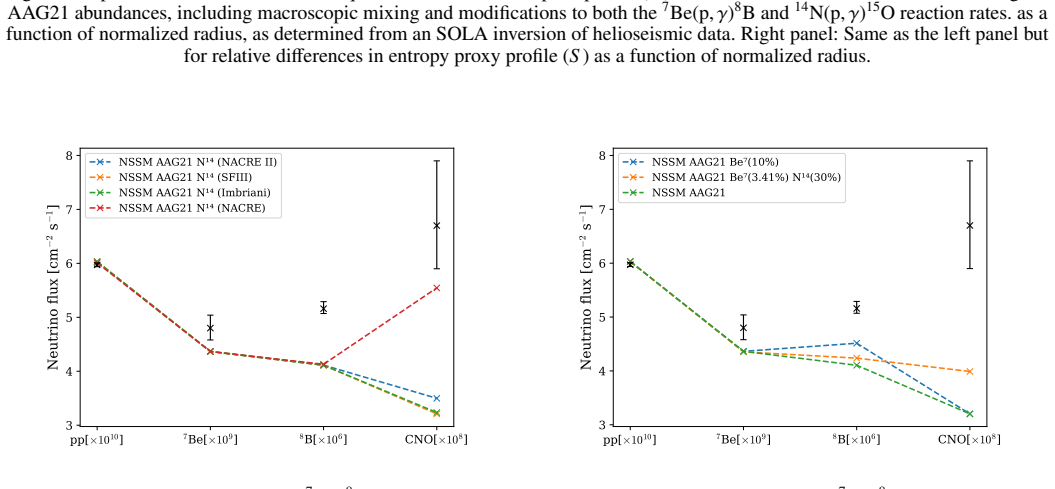
Nuclear reaction rates are crucial ingredients of solar and stellar models, they directly impact the duration of the life of stars and the energy they produce. In the solar case, the tight observational constraints put on models (Mass, Radius, Luminosity and chemical composition) coupled to our capabilities to probe the solar interior thanks to helioseismology and solar neutrinos provide an exquisite testbed for such physical ingredients. With the recent publication of the Solar Fusion III reaction rates, a new generation of solar models may be computed and put to the test. We aim to investigate the impact of the new Solar Fusion III reaction rates on solar models, both standard and non-standard, as well as the impact of the current uncertainties on some key solar reactions on the predicted neutrino fluxes for boron and the so-called CNO cycle. We compute various theoretical standard solar models as well as non-standard models reproducing the depletion of lithium and beryllium for various abundances, nuclear reaction rates and opacities. We focus on the impact of the solar fusion III reaction rates on both helioseismic inversion results and neutrino fluxes. We find that using the Solar Fusion III reaction rates significantly impact the agreement of solar models both with helioseismic constraints and neutrino flux measurements. While for helioseismic constraints it seems that there is a slight improvement, for neutrino fluxes, the use of the SFIII reaction rates induces a lowering of the beryllium, boron and CNO neutrino fluxes. When investigating the impact of changes on the rates of key reactions within their quoted uncertainties, we find that these changes are far from sufficient to reconcile models and observations, potentially hinting at other processes (e.g. planetary formation as found in other studies).
Editorial analysis
A structured set of objections, weighed in public.
Referee Report
Summary. The paper computes standard and non-standard solar models incorporating the Solar Fusion III (SFIII) nuclear reaction rates and compares the resulting helioseismic inversions and neutrino flux predictions (7Be, 8B, and CNO) against observations. It reports a modest improvement in helioseismic agreement but a systematic lowering of the neutrino fluxes when SFIII rates are adopted; variations of key rates within their quoted 1-sigma uncertainties are stated to be insufficient to restore agreement with measured fluxes, suggesting possible additional physics such as planetary formation effects.
Significance. If the quantitative mapping from rate changes to core temperature, composition profiles, and fluxes is robustly demonstrated, the work would provide a timely test of the SFIII compilation against the tightest available solar constraints. It would strengthen the case that nuclear-rate updates alone cannot resolve current neutrino-flux discrepancies and would motivate further exploration of non-standard solar physics.
major comments (3)
- [Abstract / methods summary paragraph] Abstract and methods summary: the central claim that SFIII-induced lowering of 7Be, 8B and CNO fluxes lies outside the range reachable by rate variations within quoted uncertainties is not supported by any explicit tabulation or figure showing the magnitude of the central-temperature shift or the 3He/4He profile adjustment after recalibration to fixed luminosity, radius and surface Z/X. Without this mapping the statement that the changes are “far from sufficient” cannot be verified.
- [Non-standard models] Non-standard models section: the assumption that models tuned to reproduce observed lithium and beryllium depletion (by varying abundances, rates and opacities) remain valid benchmarks for testing SFIII rates against helioseismic and neutrino data requires explicit demonstration that the same models still satisfy the helioseismic inversion constraints used elsewhere in the paper.
- [Neutrino flux predictions] Neutrino-flux results: no covariance matrix or sensitivity table is provided that quantifies how the flux changes induced by the SFIII rates correlate with the simultaneous adjustments to opacity tables and initial abundances that are also varied in the non-standard runs.
minor comments (2)
- [Throughout] Notation for the key reactions (e.g., 3He(3He,2p)4He and 7Be(p,γ)8B) should be standardized throughout the text and tables.
- [Figures] Figure captions should explicitly state whether error bars include only rate uncertainties or also the propagated uncertainties from abundance and opacity variations.
Simulated Author's Rebuttal
We thank the referee for the thorough and constructive report. The comments highlight areas where additional clarity and supporting material would strengthen the presentation. We address each major comment below and indicate the revisions planned for the manuscript.
read point-by-point responses
-
Referee: [Abstract / methods summary paragraph] Abstract and methods summary: the central claim that SFIII-induced lowering of 7Be, 8B and CNO fluxes lies outside the range reachable by rate variations within quoted uncertainties is not supported by any explicit tabulation or figure showing the magnitude of the central-temperature shift or the 3He/4He profile adjustment after recalibration to fixed luminosity, radius and surface Z/X. Without this mapping the statement that the changes are “far from sufficient” cannot be verified.
Authors: We agree that an explicit tabulation or figure quantifying the central-temperature shift and 3He/4He adjustment after recalibration would make the argument more verifiable. In the revised manuscript we will add a table (or supplementary figure) reporting these structural changes for the SFIII models relative to the prior rate compilation, together with the resulting neutrino-flux shifts. This will directly support the statement that variations within the quoted 1-sigma uncertainties remain insufficient. revision: yes
-
Referee: [Non-standard models] Non-standard models section: the assumption that models tuned to reproduce observed lithium and beryllium depletion (by varying abundances, rates and opacities) remain valid benchmarks for testing SFIII rates against helioseismic and neutrino data requires explicit demonstration that the same models still satisfy the helioseismic inversion constraints used elsewhere in the paper.
Authors: The non-standard models were constructed to simultaneously match the observed Li and Be depletions while remaining as close as possible to the helioseismic inversions. To make this explicit, we will add a short paragraph and a supplementary table in the revised version that compares the sound-speed and density inversion residuals for the non-standard SFIII models against the standard solar model and against the observational uncertainties, confirming that the helioseismic agreement is preserved at the level reported in the abstract. revision: yes
-
Referee: [Neutrino flux predictions] Neutrino-flux results: no covariance matrix or sensitivity table is provided that quantifies how the flux changes induced by the SFIII rates correlate with the simultaneous adjustments to opacity tables and initial abundances that are also varied in the non-standard runs.
Authors: A full covariance matrix would require a dedicated Monte-Carlo ensemble that lies outside the scope of the present study. However, we can supply a sensitivity table that isolates the flux response to individual changes in opacity and initial abundances for the SFIII-based models. We will include this table in the revision to quantify the dominant correlations to the extent permitted by the existing model grid. revision: partial
Circularity Check
No significant circularity; results derive from external rates and independent observations
full rationale
The paper imports the Solar Fusion III reaction rates from an external compilation and computes standard and non-standard solar models whose outputs are compared directly to independent helioseismic inversions and measured neutrino fluxes. The reported lowering of 7Be, 8B and CNO fluxes, as well as the conclusion that rate variations within quoted uncertainties remain insufficient, follow from numerical solution of the stellar-structure equations after the rate substitution; no equation or parameter in the study is defined in terms of the target fluxes or helioseismic quantities themselves. Non-standard models that reproduce Li and Be depletion are constructed by varying abundances, rates and opacities and then tested against the same external constraints, without any self-definitional loop or fitted-input-called-prediction pattern. No load-bearing self-citation, uniqueness theorem, or ansatz smuggling is present in the provided text.
Axiom & Free-Parameter Ledger
free parameters (2)
- initial abundances
- opacity tables
axioms (1)
- domain assumption Standard solar model boundary conditions (mass, radius, luminosity, surface composition) are correctly imposed
Lean theorems connected to this paper
-
IndisputableMonolith/Cost/FunctionalEquation.leanwashburn_uniqueness_aczel unclear?
unclearRelation between the paper passage and the cited Recognition theorem.
We compute various theoretical standard solar models as well as non-standard models reproducing the depletion of lithium and beryllium for various abundances, nuclear reaction rates and opacities.
-
IndisputableMonolith/Foundation/Constants.leanreality_from_one_distinction unclear?
unclearRelation between the paper passage and the cited Recognition theorem.
Using the Solar Fusion III reaction rates significantly impact the agreement of solar models both with helioseismic constraints and neutrino flux measurements.
What do these tags mean?
- matches
- The paper's claim is directly supported by a theorem in the formal canon.
- supports
- The theorem supports part of the paper's argument, but the paper may add assumptions or extra steps.
- extends
- The paper goes beyond the formal theorem; the theorem is a base layer rather than the whole result.
- uses
- The paper appears to rely on the theorem as machinery.
- contradicts
- The paper's claim conflicts with a theorem or certificate in the canon.
- unclear
- Pith found a possible connection, but the passage is too broad, indirect, or ambiguous to say the theorem truly supports the claim.
Reference graph
Works this paper leans on
- [1]
-
[2]
Adelberger, E. G., García, A., Robertson, R. G. H., et al. 2011, Reviews of Mod- ern Physics, 83, 195
work page 2011
-
[3]
M., Ogneva, D., Buldgen, G., et al
Amarsi, A. M., Ogneva, D., Buldgen, G., et al. 2024, A&A, 690, A128
work page 2024
- [4]
- [5]
-
[6]
Bahcall, J. N. 1989, Neutrino Astrophysics
work page 1989
-
[7]
Bahcall, J. N., Huebner, W. F., Lubow, S. H., Parker, P . D., & Ulrich, R. K. 1982, Reviews of Modern Physics, 54, 767
work page 1982
-
[8]
Bahcall, J. N. & Shaviv, G. 1968, ApJ, 153, 113
work page 1968
-
[9]
Bahcall, J. N. & Ulrich, R. K. 1988, Reviews of Modern Physics, 60, 297
work page 1988
-
[10]
Basilico, D., Bellini, G., Benziger, J., et al. 2023, Phys. Rev. D, 108, 102005
work page 2023
- [11]
-
[12]
J., Elsworth, Y ., New, R., & Serenelli, A
Basu, S., Chaplin, W. J., Elsworth, Y ., New, R., & Serenelli, A. M. 2009, ApJ, 699, 1403 Borexino Collaboration, Agostini, M., Altenmüller, K., et al. 2018, Nature, 562, 505 Borexino Collaboration, Agostini, M., Altenmüller, K., Appel, S., et al. 2020, Nature, 587, 577
work page 2009
-
[13]
2010, Annual Review of Nuclear and Particle Science, 60, 53
Broggini, C., Bemmerer, D., Guglielmetti, A., & Menegazzo, R. 2010, Annual Review of Nuclear and Particle Science, 60, 53
work page 2010
-
[14]
Buldgen, G., Eggenberger, P ., Noels, A., et al. 2023, A&A, 669, L9
work page 2023
-
[15]
Buldgen, G., Salmon, S. J. A. J., Noels, A., et al. 2019, A&A, 621, A33
work page 2019
-
[16]
Chen, X., Su, J., Shen, Y . P ., et al. 2025, Phys. Rev. Lett., 135, 232701
work page 2025
-
[17]
2021, Living Reviews in Solar Physics, 18, 2
Christensen-Dalsgaard, J. 2021, Living Reviews in Solar Physics, 18, 2
work page 2021
-
[18]
Christensen-Dalsgaard, J., Dappen, W., Ajukov, S. V ., et al. 1996, Science, 272, 1286
work page 1996
-
[19]
Christensen-Dalsgaard, J., Gough, D. O., & Thompson, M. J. 1991, ApJ, 378, 413
work page 1991
-
[20]
Colgan, J., Kilcrease, D. P ., Magee, N. H., et al. 2016, ApJ, 817, 116
work page 2016
-
[21]
Cox, J. P . & Giuli, R. T. 1968, Principles of stellar structure (Gordon and Breach) Däppen, W. 2024, Sol. Phys., 299, 128
work page 1968
-
[22]
Davies, G. R., Broomhall, A. M., Chaplin, W. J., Elsworth, Y ., & Hale, S. J. 2014, MNRAS, 439, 2025
work page 2014
- [23]
-
[24]
Dziembowski, W. A., Pamiatnykh, A. A., & Sienkiewicz, R. . 1991, MNRAS, 249, 602
work page 1991
-
[25]
2004, Physics Letters B, 591, 61
Formicola, A., Imbriani, G., Costantini, H., et al. 2004, Physics Letters B, 591, 61
work page 2004
-
[26]
Frentz, B., Aprahamian, A., Boeltzig, A., et al. 2022, Phys. Rev. C, 106, 065803
work page 2022
-
[27]
Guzik, J. A. & Mussack, K. 2010, ApJ, 713, 1108
work page 2010
-
[28]
Haxton, W. C., Hamish Robertson, R. G., & Serenelli, A. M. 2013, ARA&A, 51, 21
work page 2013
-
[29]
Iglesias, C. A. & Rogers, F. J. 1996, ApJ, 464, 943 Article number, page 7 of 8 A&A proofs: manuscript no. aa60005-26 Fig. 8: Arguments of the integrals described in Eqs. 3,4,5 and 6 for the NSSM model using the AAG21 abundances and either the SFIII or the combination of NACRE II and SFII reaction rates used in our previous publications. Upper left panel:...
work page 1996
-
[30]
2005, European Physical Jour- nal A, 25, 455
Imbriani, G., Costantini, H., Formicola, A., et al. 2005, European Physical Jour- nal A, 25, 455
work page 2005
-
[31]
Kosovichev, A. G. & Fedorova, A. V . 1991, Soviet Ast., 35, 507
work page 1991
- [32]
- [33]
-
[34]
2022, A&A, 667, L2 Le Pennec, M., Turck-Chièze, S., Salmon, S., et al
Kunitomo, M., Guillot, T., & Buldgen, G. 2022, A&A, 667, L2 Le Pennec, M., Turck-Chièze, S., Salmon, S., et al. 2015, ApJ, 813, L42
work page 2022
-
[35]
Magg, E., Bergemann, M., Serenelli, A., et al. 2022, A&A, 661, A140
work page 2022
-
[36]
Mamajek, E. E., Prsa, A., Torres, G., et al. 2015, arXiv e-prints, arXiv:1510.07674
work page internal anchor Pith review Pith/arXiv arXiv 2015
- [37]
-
[38]
Marta, M., Formicola, A., Bemmerer, D., et al. 2011, Phys. Rev. C, 83, 045804
work page 2011
-
[39]
Marta, M., Formicola, A., Gyürky, G., et al. 2008, Phys. Rev. C, 78, 022802
work page 2008
-
[40]
Mondet, G., Blancard, C., Cossé, P ., & Faussurier, G. 2015, ApJs, 220, 2
work page 2015
- [41]
-
[42]
Mussack, K. & Däppen, W. 2011, ApJ, 729, 96 Orebi Gann, G. D., Zuber, K., Bemmerer, D., & Serenelli, A. 2021, Annual Re- view of Nuclear and Particle Science, 71, 491
work page 2011
-
[43]
Paquette, C., Pelletier, C., Fontaine, G., & Michaud, G. 1986, ApJS, 61, 177
work page 1986
-
[44]
Pijpers, F. P . & Thompson, M. J. 1994, A&A, 281, 231 Proffitt, C. R. & Michaud, G. 1991, ApJ, 380, 238
work page 1994
-
[45]
C., Basu, S., & Christensen-Dalsgaard, J
Rabello-Soares, M. C., Basu, S., & Christensen-Dalsgaard, J. 1999, MNRAS, 309, 35
work page 1999
-
[46]
2025, Experimental Astronomy, 59, 26
Rauer, H., Aerts, C., Cabrera, J., et al. 2025, Experimental Astronomy, 59, 26
work page 2025
-
[47]
A., Sienkiewicz, R., & Goode, P
Richard, O., Dziembowski, W. A., Sienkiewicz, R., & Goode, P . R. 1998, A&A, 338, 756 Scuflaire, R., Théado, S., Montalbán, J., et al. 2008, ApSS, 316, 83
work page 1998
-
[48]
Shaviv, N. J. & Shaviv, G. 2001, ApJ, 558, 925
work page 2001
-
[49]
Thoul, A. A., Bahcall, J. N., & Loeb, A. 1994, ApJ, 421, 828 V ernazza, J. E., Avrett, E. H., & Loeser, R. 1981, ApJS, 45, 635
work page 1994
-
[50]
Villante, F. L. & Serenelli, A. 2021, Frontiers in Astronomy and Space Sciences, 7, 112 V orontsov, S. V ., Baturin, V . A., & Pamiatnykh, A. A. 1991, Nature, 349, 49
work page 2021
-
[51]
Wagner, L., Akhmadaliev, S., Anders, M., et al. 2018, Phys. Rev. C, 97, 015801
work page 2018
-
[52]
X., Nordlander, T., Asplund, M., et al
Wang, E. X., Nordlander, T., Asplund, M., et al. 2021, MNRAS, 500, 2159
work page 2021
- [53]
-
[54]
2019, ApJ, 881, 103 Article number, page 8 of 8
Zhang, Q.-S., Li, Y ., & Christensen-Dalsgaard, J. 2019, ApJ, 881, 103 Article number, page 8 of 8
work page 2019
discussion (0)
Sign in with ORCID, Apple, or X to comment. Anyone can read and Pith papers without signing in.