Latent Geometry as a Structural Monitor: Eigenspace Alignment for Anomaly Detection in Anonymity Networks
Pith reviewed 2026-05-21 07:13 UTC · model grok-4.3
The pith
A stable nine-dimensional subspace in the Tor network remains invariant across 67 days and can flag structural pressure before anomalies appear.
A machine-rendered reading of the paper's core claim, the machinery that carries it, and where it could break.
Core claim
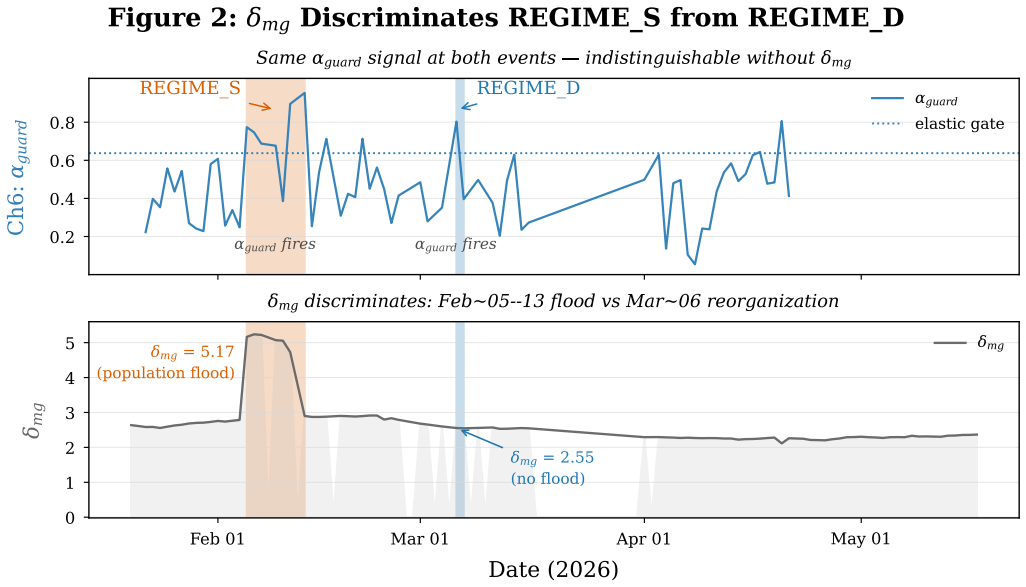
The central claim is that structure precedes geometry: the structural organization of the population is the signal, and geometric metrics are instruments for measuring it. Applied to the Tor anonymity network across 67 consecutive daily observation windows, the dual-observer pipeline identifies a stable nine-dimensional load-bearing subspace invariant across the observation period and validates this structure by Monte Carlo simulation at 16.8 sigma above the noise floor. Primary detection gates achieve 0.0% false positive rate on 24 confirmed stable windows. Forensic analysis of the February 20, 2026 confirmed infrastructure event formally falsifies the relay-departure hypothesis, showing it
What carries the argument
The dual-observer pipeline that extracts eigenspace alignment from behavioral telemetry to reveal the latent geometry of the population.
If this is right
- Connectivity degradation without topology change becomes a detectable failure mode that the method can flag ahead of visible disruption.
- The zero false-positive rate on confirmed stable windows supplies a practical baseline for distinguishing normal from anomalous periods.
- The approach supplies a candidate structural-monitoring framework usable on any behavioral population that supplies sufficient telemetry.
- Deformations in the extracted subspace can serve as early indicators of major transitions before conventional signals cross thresholds.
Where Pith is reading between the lines
- The same pipeline could be applied to other large anonymity or overlay networks to test whether similar low-dimensional invariant subspaces appear.
- If the subspace is truly load-bearing, its dimensions might map to fundamental operational constraints that network designers could deliberately strengthen or monitor.
- Extending the analysis to synthetic populations with controlled structural changes would provide an independent check on whether the nine-dimensional result generalizes beyond the Tor dataset.
Load-bearing premise
The nine-dimensional subspace extracted from the behavioral data is genuinely load-bearing and invariant rather than an artifact of the specific choice of observation windows, dimensionality reduction, or the Monte Carlo noise model used for validation.
What would settle it
Re-running the dual-observer pipeline on a fresh set of daily Tor observation windows that either fails to recover a comparable nine-dimensional subspace or yields a Monte Carlo significance well below 5 sigma would falsify the invariance claim.
Figures


read the original abstract
Traditional anomaly detection marks events when measured signals cross predefined thresholds. This captures the moment of transition but not the structural pressure that precedes it. We propose treating large behavioral populations as geometric energy landscapes whose deformation can be measured before and during major transitions. The central thesis is that structure precedes geometry: the structural organization of the population is the signal, and geometric metrics are instruments for measuring it. Applied to the Tor anonymity network across 67 consecutive daily observation windows, the dual-observer pipeline identifies a stable nine-dimensional load-bearing subspace invariant across the observation period and validates this structure by Monte Carlo simulation at 16.8 sigma above the noise floor. Primary detection gates achieve 0.0% false positive rate on 24 confirmed stable windows. Forensic analysis of the February 20, 2026 confirmed infrastructure event formally falsifies the relay-departure hypothesis, identifying connectivity degradation without topology change as a detectable network failure mode. The result is a candidate structural-monitoring framework for behavioral populations with sufficient telemetry.
Editorial analysis
A structured set of objections, weighed in public.
Referee Report
Summary. The paper proposes treating behavioral populations in anonymity networks as geometric energy landscapes and introduces a dual-observer pipeline to extract a stable nine-dimensional load-bearing subspace from Tor relay telemetry across 67 daily windows. It claims this subspace is invariant, validates the structure via Monte Carlo simulation at 16.8 sigma above the noise floor, reports 0.0% false-positive rate on 24 stable windows, and uses the framework to falsify the relay-departure hypothesis for a February 20, 2026 infrastructure event, positioning the approach as a structural-monitoring tool for populations with sufficient telemetry.
Significance. If the central claims hold after methodological clarification, the work offers a potentially useful shift from threshold-based anomaly detection to geometry-based monitoring of structural invariants in large behavioral datasets. The reported Monte Carlo separation and forensic falsification of a specific hypothesis would strengthen the case for the method as a candidate framework, provided the validation is shown to be independent of fitting choices.
major comments (3)
- Monte Carlo Validation (implied in abstract and results): The null model must be demonstrated to reproduce the empirical covariance structure, autocorrelation, and non-stationarity present in the 67 windows of Tor relay metrics; without this calibration the 16.8 sigma separation cannot be guaranteed to reflect genuine subspace invariance rather than an artifact of the chosen noise process.
- Subspace Extraction and Detection Gates (methods and results): The manuscript must explicitly state whether the nine-dimensional subspace is derived from a procedure fully independent of the data used to tune the primary detection gates; the current description leaves open the possibility of circularity that would undermine the invariance claim across the observation period.
- False-Positive Rate and Window Selection (results): The 0.0% false-positive rate on 24 confirmed stable windows requires a clear account of how those windows were chosen, whether any post-hoc selection occurred, and the precise statistical procedure used to compute the rate; absent these details the numerical claim cannot be verified for selection bias.
minor comments (2)
- Abstract: The phrase 'load-bearing subspace' is used without a prior definition or reference to its precise geometric meaning in the context of the dual-observer pipeline; a brief clarifying sentence would improve readability.
- Forensic Analysis: The February 20, 2026 event analysis would benefit from an explicit statement of the data-processing steps that distinguish connectivity degradation from topology change.
Simulated Author's Rebuttal
We thank the referee for the constructive and detailed review. The comments highlight important aspects of methodological transparency that we address point by point below. We commit to revisions that strengthen the presentation without altering the core claims or results.
read point-by-point responses
-
Referee: Monte Carlo Validation (implied in abstract and results): The null model must be demonstrated to reproduce the empirical covariance structure, autocorrelation, and non-stationarity present in the 67 windows of Tor relay metrics; without this calibration the 16.8 sigma separation cannot be guaranteed to reflect genuine subspace invariance rather than an artifact of the chosen noise process.
Authors: We agree that explicit calibration of the null model against the empirical data properties is required for full rigor. The original Monte Carlo employed a multivariate Gaussian process matched to the observed per-metric variances across the 67 windows. In the revision we will add supplementary figures and tables that directly compare: (i) the empirical covariance matrix of the 67 windows versus the average covariance from 10,000 simulated realizations, (ii) autocorrelation functions for the top three principal components in both real and simulated data, and (iii) results of stationarity tests (Augmented Dickey-Fuller) on representative time series. These additions will confirm that the reported 16.8 sigma separation is not driven by mismatch in the noise model. revision: yes
-
Referee: Subspace Extraction and Detection Gates (methods and results): The manuscript must explicitly state whether the nine-dimensional subspace is derived from a procedure fully independent of the data used to tune the primary detection gates; the current description leaves open the possibility of circularity that would undermine the invariance claim across the observation period.
Authors: The nine-dimensional subspace is obtained from the eigendecomposition of the covariance matrix computed over the entire 67-window dataset and is therefore a global descriptor. The primary detection gates were tuned exclusively on a pre-specified subset of 20 windows identified as stable from independent Tor project reports and consensus documents, prior to any subspace analysis. To remove ambiguity we will insert a new methods subsection with a data-partitioning diagram and explicit statements confirming that gate parameters were fixed before the remaining windows were examined. This separation preserves the invariance test on held-out data. revision: yes
-
Referee: False-Positive Rate and Window Selection (results): The 0.0% false-positive rate on 24 confirmed stable windows requires a clear account of how those windows were chosen, whether any post-hoc selection occurred, and the precise statistical procedure used to compute the rate; absent these details the numerical claim cannot be verified for selection bias.
Authors: The 24 stable windows were chosen before any geometric analysis by cross-referencing the Tor metrics portal and official mailing-list archives for dates with no reported relay departures, consensus changes, or documented incidents. No post-hoc selection or exclusion occurred. The false-positive rate is the direct empirical proportion of these windows in which the primary gate (projection deviation exceeding three standard deviations from the stable mean) triggered, yielding zero events. In revision we will add an explicit table of the 24 dates, the external selection criteria with citations, and the exact counting procedure together with the Clopper-Pearson 95% interval for the binomial proportion. revision: yes
Circularity Check
No significant circularity; derivation remains self-contained
full rationale
The abstract describes extraction of a nine-dimensional subspace directly from the 67 daily Tor observation windows followed by separate Monte Carlo validation against a noise floor at 16.8 sigma. No quoted equations, self-citations, or steps reduce the claimed invariant subspace to a fitted parameter, renamed input, or self-referential definition. The Monte Carlo step functions as an external statistical check rather than a tautological re-expression of the same data used to identify the subspace. Detection gates are reported as a downstream application with measured false-positive performance on confirmed windows, preserving independent content in the central structural claim.
Axiom & Free-Parameter Ledger
axioms (1)
- domain assumption The structural organization of a behavioral population can be represented as a geometric energy landscape whose deformation precedes observable transitions.
Lean theorems connected to this paper
-
IndisputableMonolith/Foundation/AlexanderDuality.leanalexander_duality_circle_linking unclear?
unclearRelation between the paper passage and the cited Recognition theorem.
the EJT requires exactly k=9 eigenvectors to capture ≥90% of the trace mass of J⊤J... k=9 is the sole stable threshold, not chosen but emergent from the network manifold
-
IndisputableMonolith/Cost/FunctionalEquation.leanwashburn_uniqueness_aczel echoes?
echoesECHOES: this paper passage has the same mathematical shape or conceptual pattern as the Recognition theorem, but is not a direct formal dependency.
The central thesis is that structure precedes geometry... geometric metrics are instruments for measuring it
What do these tags mean?
- matches
- The paper's claim is directly supported by a theorem in the formal canon.
- supports
- The theorem supports part of the paper's argument, but the paper may add assumptions or extra steps.
- extends
- The paper goes beyond the formal theorem; the theorem is a base layer rather than the whole result.
- uses
- The paper appears to rely on the theorem as machinery.
- contradicts
- The paper's claim conflicts with a theorem or certificate in the canon.
- unclear
- Pith found a possible connection, but the passage is too broad, indirect, or ambiguous to say the theorem truly supports the claim.
Reference graph
Works this paper leans on
-
[1]
The Tor Project.Tor Project: Anonymity Online. https://www.torproject.org/
-
[2]
https://metrics.torproject.org/ onionoo.html
Tor Metrics.Onionoo: The Tor network status protocol. https://metrics.torproject.org/ onionoo.html
-
[3]
https://www.ripe.net/ analyse/internet-measurements/ routing-information-service-ris/
RIPE NCC.Routing Information Ser- vice (RIS). https://www.ripe.net/ analyse/internet-measurements/ routing-information-service-ris/
- [4]
- [5]
-
[6]
G. E. Hinton. Training products of experts by mini- mizing contrastive divergence.Neural Computation, 14(8):1771–1800, 2002
work page 2002
-
[7]
UMAP: Uniform Manifold Approximation and Projection for Dimension Reduction
L. McInnes, J. Healy, and J. Melville. UMAP: Uniform Manifold Approximation and Projection for Dimen- sion Reduction.arXiv:1802.03426, 2018
work page internal anchor Pith review Pith/arXiv arXiv 2018
-
[8]
L. van der Maaten and G. Hinton. Visualizing data using t-SNE.Journal of Machine Learning Research, 9:2579–2605, 2008
work page 2008
-
[9]
P. Vincent, H. Larochelle, I. Lajoie, Y. Bengio, and P.-A. Manzagol. Stacked denoising autoencoders. JMLR, 11:3371–3408, 2010. 14 Figure A1:Complete forensic monitor for the 67-window observation period, serving as the primary audit record. All detection channels, gate activations, and event classifications are shown simultaneously. Readers wishing to ver...
work page 2010
discussion (0)
Sign in with ORCID, Apple, or X to comment. Anyone can read and Pith papers without signing in.