Efficient and simple fourth-order compact finite difference methods for convection-diffusion-reaction equations on arbitrary curved domains
Pith reviewed 2026-05-21 02:28 UTC · model grok-4.3
The pith
A fourth-order compact finite difference method achieves stable convergence for convection-diffusion-reaction equations on arbitrary curved domains using only interior points of a Cartesian mesh.
A machine-rendered reading of the paper's core claim, the machinery that carries it, and where it could break.
Core claim
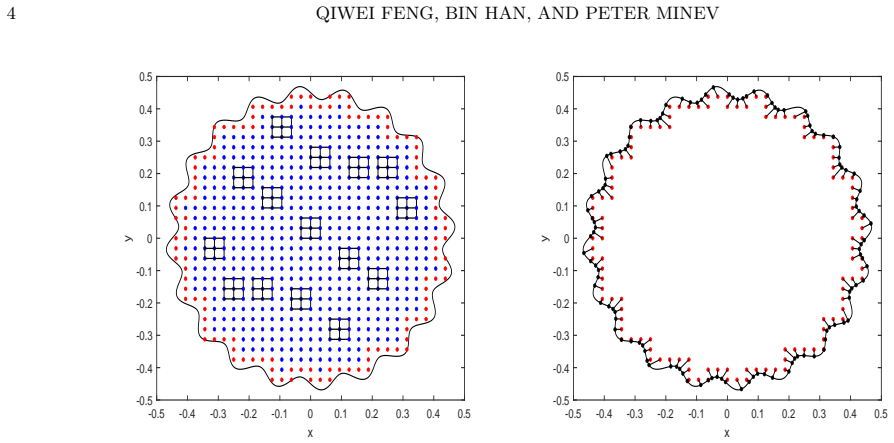
By combining the classical fourth-order compact nine-point discretization at interior points with a set of ten specially constructed compact stencils at irregular boundary-adjacent points, the method achieves a uniform fourth-order truncation error throughout the domain. Each irregular stencil is obtained by a sequence of vertical and horizontal grid-aligned transformations whose coefficients satisfy a linear system of size at most six by twenty-four; the right-hand side remains an explicit combination of the source term and its first derivatives. The construction uses only grid points that lie inside the computational domain and incorporates up to third-order derivatives of the boundary and
What carries the argument
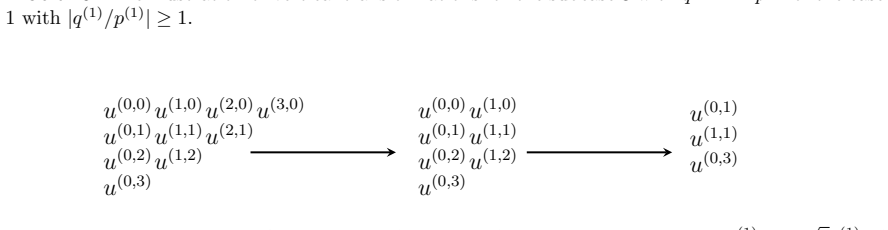
The central mechanism is the derivation of ten families of fourth-order compact stencils for irregular centers via vertical and horizontal transformations, each obtained by solving an at most 6x24 linear system to match Taylor expansion terms up to order four while using only interior grid points.
If this is right
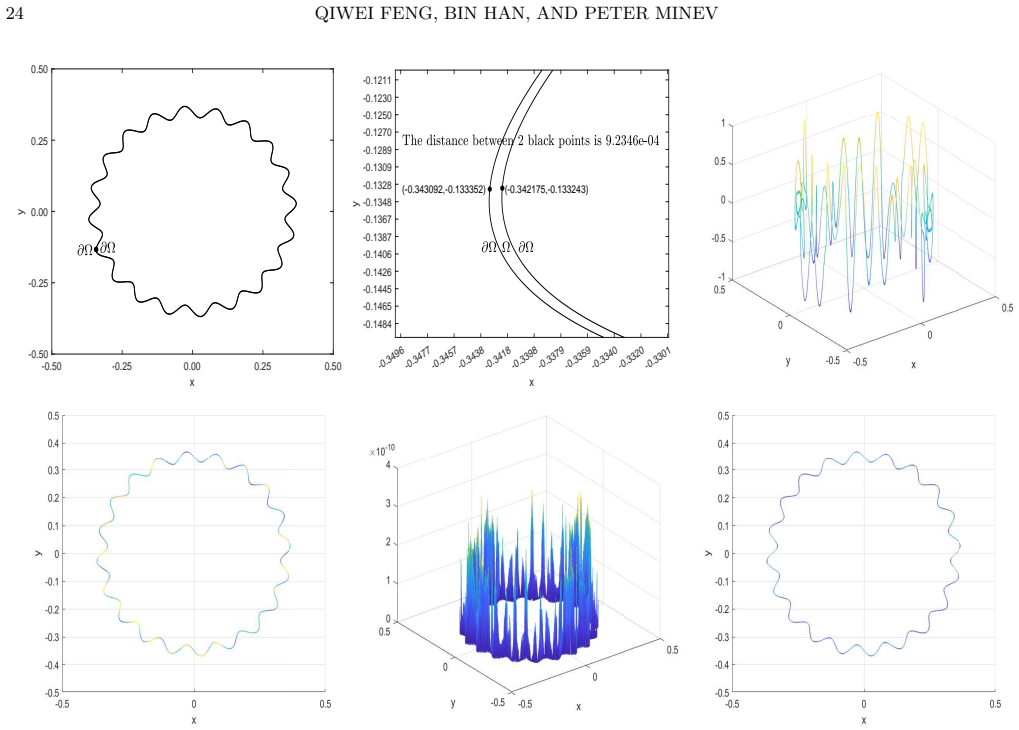
- The method maintains fourth-order accuracy and stability on domains with 100-leaf high-curvature boundaries.
- Only first-order partial derivatives of the PDE coefficients are required at irregular stencils.
- All stencils retain a simple nine-point structure by discarding any exterior points.
- The left-hand side coefficients come from a small explicitly solvable linear system while the right-hand side is given by an explicit formula.
Where Pith is reading between the lines
- The same vertical and horizontal transformation technique could be adapted to three-dimensional problems or to other classes of elliptic operators.
- Because every stencil uses only interior points the approach may integrate directly with moving-boundary or adaptive-refinement algorithms.
- The modest derivative requirements at the boundary suggest the method could be modified for problems with reduced regularity if the Taylor-matching conditions are relaxed accordingly.
Load-bearing premise
The boundary admits a parametric representation with derivatives up to third order that are sufficiently smooth, and the PDE coefficients are smooth enough for the Taylor expansions in the stencil derivations to hold at the required orders.
What would settle it
Running the scheme on a domain whose boundary parametrization has only C^2 smoothness and measuring whether the observed convergence rate in the l2 or l-infinity norm falls below four would directly test the necessity of the smoothness assumption.
Figures





read the original abstract
In this paper, we discuss the 2D convection-diffusion-reaction equation with variable smooth coefficients and the Dirichlet boundary condition on a complicated, thin, and curved domain. We propose the fourth-order compact FDM at every grid point with the uniform Cartesian mesh. For the regular stencil center, we utilize the fourth-order compact 9-point FDM to approximate the solution. According to the preliminary analysis, we use vertical and horizontal transformations to derive fourth-order compact FDMs in 10 cases for all irregular stencil centers. To obtain the left-hand side of the stencil of the fourth-order FDM in each case, we only need to solve an at most $6 \times 24$ linear system which is presented with the explicit formula. The right-hand side of the FDM is constructed in explicit expression for any irregular stencil centers too. To achieve the fourth-order consistency, up to second-order partial derivatives of convection, diffusion, reaction, and source terms are used for the FDM at the regular stencil center, and the FDM at an irregular stencil center only requires first-order partial derivatives of convection, diffusion, reaction, and source terms, and up to third-order derivatives of the Dirichlet boundary function and the parametric expression of the boundary curve. We test challenging domains with 100-leaf, high-curvature, high-frequency, sharply varying, and nearly overlapping boundary curves, the proposed FDM produces the high accuracy and the stable fourth-order convergence rate in $l_2$ and $l_{\infty}$ norms. All stencils of our FDMs have a simple desired structure by only keeping grid points inside $\Omega$ in the standard compact 9-point stencil for both regular stencils and boundary stencils, but without assuming any information outside the domain $\Omega$.
Editorial analysis
A structured set of objections, weighed in public.
Referee Report
Summary. The manuscript develops fourth-order compact finite difference methods for the 2D convection-diffusion-reaction equation with variable smooth coefficients and Dirichlet boundary conditions on arbitrary curved domains. It employs a uniform Cartesian mesh with a standard 9-point stencil at regular interior points and derives specialized fourth-order compact stencils for irregular boundary points via vertical/horizontal transformations, solving at most 6×24 linear systems whose rows encode Taylor matching conditions that incorporate up to third-order derivatives of the boundary parametrization. Explicit formulas are given for both the left- and right-hand sides of the irregular stencils, which use only interior grid points. Numerical tests on domains featuring 100-leaf, high-curvature, high-frequency, and nearly overlapping boundaries report high accuracy together with stable fourth-order convergence in both the ℓ₂ and ℓ∞ norms.
Significance. If the claimed fourth-order consistency and observed convergence rates hold under the stated smoothness assumptions, the work supplies a practical, mesh-generation-free route to high-order accuracy on highly irregular geometries while preserving a compact stencil structure. The explicit construction of the irregular-stencil coefficients and the reduced derivative requirements (only first-order PDE coefficients for irregular points) are concrete strengths that lower implementation cost relative to schemes needing higher-order coefficient derivatives everywhere. The successful application to the most demanding test cases (100-leaf high-curvature boundaries) provides direct evidence of robustness that is valuable for applications in fluid mechanics and reaction-diffusion modeling on complex domains.
major comments (2)
- [irregular stencil centers] § on irregular stencil centers: the fourth-order consistency claim rests on the solution of the at most 6×24 linear system obtained from Taylor matching that includes up to third-order boundary-curve derivatives. The manuscript does not supply an explicit truncation-error expansion demonstrating that the solved coefficients cancel all terms through O(h³) (including the contributions arising from the boundary parametrization), leaving the order of consistency verified only by the numerical rates rather than by direct analysis. This is load-bearing for the central claim.
- [numerical experiments] Numerical experiments on high-curvature domains: although stable fourth-order convergence is reported for the 100-leaf test cases, no data or bounds are given on the condition numbers of the 6×24 matrices or on the magnitude of the resulting stencil coefficients when third derivatives of the parametrization become large. Severe ill-conditioning could amplify round-off and destroy the O(h⁴) truncation error that the derivation asserts; the absence of this check leaves open the possibility that the observed rates are limited by other factors rather than confirming the scheme’s theoretical order.
minor comments (2)
- A concise table or diagram summarizing the ten distinct irregular-stencil configurations and the corresponding transformation choices would improve readability and reproducibility.
- The explicit right-hand-side expressions for the irregular stencils should be collected in a single numbered display or appendix to facilitate direct implementation.
Simulated Author's Rebuttal
We thank the referee for the thorough review and constructive feedback on our manuscript. We address each major comment below and have revised the manuscript accordingly to strengthen the presentation of the theoretical aspects and numerical robustness.
read point-by-point responses
-
Referee: § on irregular stencil centers: the fourth-order consistency claim rests on the solution of the at most 6×24 linear system obtained from Taylor matching that includes up to third-order boundary-curve derivatives. The manuscript does not supply an explicit truncation-error expansion demonstrating that the solved coefficients cancel all terms through O(h³) (including the contributions arising from the boundary parametrization), leaving the order of consistency verified only by the numerical rates rather than by direct analysis. This is load-bearing for the central claim.
Authors: We agree that an explicit truncation error analysis would strengthen the manuscript. The linear system is constructed precisely so that the discrete operator matches the continuous PDE and boundary conditions through terms of order h^3 in the Taylor expansions at the irregular point, incorporating the derivatives of the boundary parametrization. By solving for the coefficients to satisfy these matching conditions, the local truncation error is O(h^4) by construction. However, to address the referee's concern directly, we will add a section or appendix in the revised version that derives the explicit truncation error expansion for the irregular stencils, confirming the cancellation of lower-order terms. revision: yes
-
Referee: Numerical experiments on high-curvature domains: although stable fourth-order convergence is reported for the 100-leaf test cases, no data or bounds are given on the condition numbers of the 6×24 matrices or on the magnitude of the resulting stencil coefficients when third derivatives of the parametrization become large. Severe ill-conditioning could amplify round-off and destroy the O(h⁴) truncation error that the derivation asserts; the absence of this check leaves open the possibility that the observed rates are limited by other factors rather than confirming the scheme’s theoretical order.
Authors: This is a valid point regarding the practical implementation and stability. In the revised manuscript, we will include additional numerical results reporting the condition numbers of the 6×24 systems for the high-curvature and 100-leaf boundary cases. We will also provide bounds or observations on the magnitude of the stencil coefficients and discuss their impact on round-off errors. Preliminary checks indicate that the matrices remain well-conditioned under the smoothness assumptions, but we will document this explicitly to support the observed convergence rates. revision: yes
Circularity Check
No significant circularity; derivation is self-contained via Taylor matching
full rationale
The paper derives its fourth-order compact FDM stencils explicitly from Taylor series expansions around regular and irregular grid points, solving at most 6x24 linear systems to match terms up to the required order for O(h^4) consistency. This process uses the assumed smoothness of coefficients and boundary parametrization (up to third derivatives) as inputs to construct the scheme, without fitting parameters to solution data or renaming fitted quantities as predictions. No load-bearing self-citations, uniqueness theorems, or ansatzes from prior author work are invoked in the provided derivation chain; the convergence claims are verified numerically on test domains rather than enforced by construction. The method remains independent of the target solution values.
Axiom & Free-Parameter Ledger
axioms (2)
- domain assumption The solution and coefficients admit Taylor expansions of sufficient order at every grid point inside or near the boundary.
- domain assumption The boundary curve is parametrized by a sufficiently smooth function whose derivatives up to order three can be evaluated.
Reference graph
Works this paper leans on
- [1]
-
[2]
M. B-Artzi, I. Chorev, J-P. Croisille, and D. Fishelov, A compact difference scheme for the biharmonic equation in planar irregular domains.SIAM J. Numer. Anal.47(2009), 3087-3108
work page 2009
- [3]
-
[4]
G. Berikelashvili, M. M. Gupta, and M. Mirianashvili, Convergence of fourth order compact difference schemes for three-dimensional convection-diffusion equations.SIAM J. Numer. Anal.45(2007), 443-455
work page 2007
-
[5]
M. Chai, K. Luo, H. Wang, S. Zheng, and J. Fan, Imposing mixed Dirichlet-Neumann-Robin boundary conditions on irregular domains in a level set/ghost fluid based finite difference framework.Comput. Fluids.214(2021), 104772
work page 2021
-
[6]
G. Chen, Z. Li, and P. Lin, A fast finite difference method for biharmonic equations on irregular domains and its application to an incompressible Stokes flow.Adv. Comput. Math.29(2008), 113-133. 25
work page 2008
-
[7]
H. Chen, C. Min, and F. Gibou, A supra-convergent finite difference scheme for the Poisson and heat equations on irregular domains and non-graded adaptive Cartesian grids.J. Sci. Comput.31(2007), 19-60
work page 2007
- [8]
- [9]
-
[10]
H. Ding, C. Shu, and Q. D. Cai, Applications of stencil-adaptive finite difference method to incompressible viscous flows with curved boundary.Comput. Fluids.36(2007), 786-793
work page 2007
-
[11]
A. Ditkowski, and Y. Harness, High-order embedded finite difference schemes for initial boundary value problems on time dependent irregular domains.J. Sci. Comput.39(2009), 394-440
work page 2009
-
[12]
Q. Feng, B. Han, and M. Michelle, Sixth order compact finite difference method for 2D Helmholtz equations with singular sources and reduced pollution effect.Commun. Comput. Phys.34(2023), 672-712
work page 2023
-
[13]
Q. Feng, B. Han, and P. Minev, Sixth order compact finite difference schemes for Poisson interface problems with singular sources.Comp. Math. Appl.99(2021), 2-25
work page 2021
-
[14]
Q. Feng, B. Han, and M. Neilan, A high-order, pressure-robust, and decoupled finite difference method for the Stokes problem.Math. Comput. Simul.241(2026), 634-649
work page 2026
-
[15]
Q. Feng and C. Trenchea, Fourth-order compact finite difference methods for nonlinear convection-diffusion equa- tions.J. Comput. Phys.555(2026), 114783
work page 2026
-
[16]
Q. Feng, Fourth-order compact finite difference methods for 2D and 3D nonlinear convection-diffusion-reaction equations. Preprint, 2026. https://arxiv.org/abs/2603.16226
-
[17]
J. F-Fidalgo, S. Clain, L. Ram´ ırez, I. Colominas, and X. Nogueira, Very high-order method on immersed curved domains for finite difference schemes with regular Cartesian grids.Comput. Methods Appl. Mech. Engrg.360 (2020), 112782
work page 2020
-
[18]
F. Gibou and R. Fedkiw, A fourth order accurate discretization for the Laplace and heat equations on arbitrary domains, with applications to the Stefan problem.J. Comput. Phys.202(2005), 577-601
work page 2005
- [19]
- [20]
-
[21]
´A. Helgad´ ottir and F. Gibou, A Poisson-Boltzmann solver on irregular domains with Neumann or Robin boundary conditions on non-graded adaptive grid.J. Comput. Phys.230(2011), 3830-3848
work page 2011
-
[22]
K. Ito, Z. Li, and Y. Kyei, Higher-order, Cartesian grid based finite difference schemes for elliptic equations on irregular domains.SIAM J. Sci. Comput.27(2005), 346-367
work page 2005
-
[23]
Z. Jomaa and C. Macaskill, The embedded finite difference method for the Poisson equation in a domain with an irregular boundary and Dirichlet boundary conditions.J. Comput. Phys.202(2005), 488-506
work page 2005
-
[24]
M. Lakner and I. Plazl, The finite differences method for solving systems on irregular shapes.Comput. Chem. Eng.32(2008), 2891-2896
work page 2008
- [25]
-
[26]
C. Li, Y. Ren, G. Long, E. Boerman, and S. Zhao, A fast sine transform accelerated high-order finite difference method for parabolic problems over irregular domains.J. Sci. Comput.95(2023), 49, 1-38
work page 2023
-
[27]
C. Li, S. Zhao, B. Pentecost, Y. Ren, and Z. Guan, A spatially fourth-order Cartesian grid method for fast solutions of elliptic and parabolic problems on irregular domains with sharply curved boundaries.J. Sci. Comput. 103(2025), 94, 1-35
work page 2025
-
[28]
T. Liszka and J. Orkisz, The finite difference method at arbitrary irregular grids and its application in applied mechanics.Comput. Struct.11(1980), 83-95
work page 1980
-
[29]
Y. T. Ng, H. Chen, C. Min, and F. Gibou, Guidelines for Poisson solvers on irregular domains with Dirichlet boundary conditions using the ghost fluid method.J. Sci. Comput.41(2009), 300-320
work page 2009
-
[30]
Olsson, High order finite differences methods on non-smooth domains.Comput
P. Olsson, High order finite differences methods on non-smooth domains.Comput. Methods Appl. Mech. Engrg. 116(1994), 265-272
work page 1994
-
[31]
K. Pan, D. He, and Z. Li, A high order compact FD framework for elliptic BVPs involving singular sources, interfaces, and irregular domains.J. Sci. Comput.88(2021), 67, 1-25
work page 2021
-
[32]
Y. Ren, H. Feng, and S. Zhao, A FFT accelerated high order finite difference method for elliptic boundary value problems over irregular domains.J. Comput. Phys.448(2022), 110762
work page 2022
-
[33]
Y. Shi, S. Xie, D. Liang, and K. Fu, High order compact block-centered finite difference schemes for elliptic and parabolic problems.J. Sci. Comput.87(2021), 86, 1-26
work page 2021
-
[34]
M. Theillard, L. F. Djodom, J-L. Vi´ e, and F. Gibou, A second-order sharp numerical method for solving the linear elasticity equations on irregular domains and adaptive grids–application to shape optimization.J. Comput. Phys.233(2013), 430-448. 26 QIWEI FENG, BIN HAN, AND PETER MINEV
work page 2013
-
[35]
G. Yoon and C. Min, Analyses on the finite difference method by Gibou et al. for Poisson equation.J. Comput. Phys.280(2015), 184-194
work page 2015
-
[36]
S. M. Zhang and Z. Li, An augmented IIM for Helmholtz/Poisson equations on irregular domains in complex space.Int. J. Numer. Anal. Model.13(2016), 166-178. Mathematics Department, King F ahd University of Petroleum and Minerals, Dhahran, 31261, Saudi Arabia. Email address:qiwei.feng@kfupm.edu.sa,qfeng@ualberta.ca Department of Mathematical and Statistical...
work page 2016
discussion (0)
Sign in with ORCID, Apple, or X to comment. Anyone can read and Pith papers without signing in.