The extra slow Tamari lattice
Pith reviewed 2026-05-21 04:11 UTC · model grok-4.3
The pith
Extra slow Tamari lattices on faithfully balanced tableaux extend the Tamari lattice and satisfy semidistributivity, trimness, and congruence uniformity.
A machine-rendered reading of the paper's core claim, the machinery that carries it, and where it could break.
Core claim
We introduce the extra slow Tamari lattices defined on faithfully balanced tableaux arising naturally from type A quiver representation theory. We explicitly describe meets and joins to prove they form lattices that are semidistributive, trim, polygonal, and congruence uniform. The join-irreducible elements are described via a three-color analogue of positive roots of type A, yielding descriptions of spines and congruence lattices along with several enumerative results, and new results for the slow Tamari lattices.
What carries the argument
The order on faithfully balanced tableaux that defines the extra slow Tamari lattice, with its explicit meet and join operations based on the three-color root analogue.
Load-bearing premise
The order defined on faithfully balanced tableaux from type A quivers allows for meet and join operations that satisfy the lattice axioms and the additional properties listed.
What would settle it
A computation for small n where the number of elements or the join-irreducibles do not match the described three-color roots, or where the proposed meet fails to be the greatest lower bound.
Figures



read the original abstract
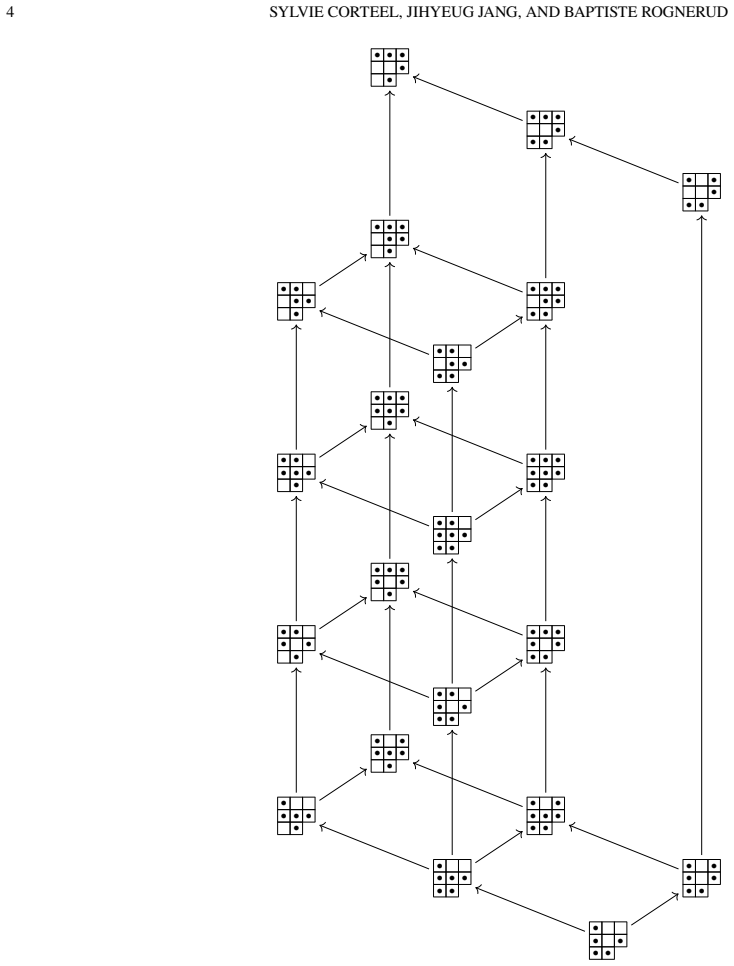
We introduce the extra slow Tamari lattices, a new family of lattices defined on faithfully balanced tableaux. These tableaux arise naturally from the representation theory of type \( A \) quivers, and our construction extends the classical Tamari lattice and the slow Tamari lattice. We explicitly describe meets and joins in the extra slow Tamari lattices, and then prove that they are lattices. We then show that they are semidistributive, trim, polygonal, and congruence uniform. Their join-irreducible elements are described in terms of a three-color analogue of the positive roots of type \( A \), which leads to descriptions of their spines and congruence lattices. We also obtain several enumerative results for the extra slow Tamari lattices and their associated structures. Finally, we derive new structural and enumerative results for the slow Tamari lattices.
Editorial analysis
A structured set of objections, weighed in public.
Referee Report
Summary. The manuscript introduces the extra slow Tamari lattices as a new family of lattices defined on faithfully balanced tableaux arising from the representation theory of type A quivers. It extends the classical Tamari lattice and the slow Tamari lattice by explicitly describing meets and joins on these tableaux, proving that the resulting structure is a lattice, and then establishing that the lattices are semidistributive, trim, polygonal, and congruence uniform. Join-irreducible elements are described via a three-color analogue of the positive roots of type A, yielding descriptions of spines and congruence lattices; the paper also derives enumerative results for the new lattices and new structural/enumerative results for the slow Tamari lattices.
Significance. If the explicit descriptions and verifications hold, the work provides a natural combinatorial extension of the Tamari family with a parameter-free construction and direct proofs of multiple lattice-theoretic properties. The three-color root-system description of join-irreducibles and the new results obtained for the slow Tamari lattices are particular strengths, as is the explicit, machine-checkable style of the combinatorial arguments.
major comments (1)
- [§4] §4 (proof that the described meet and join turn the poset of faithfully balanced tableaux into a lattice): the verification proceeds by case analysis on the tableaux; it is not immediately clear whether the cases are exhaustive or whether a key identity (e.g., the absorption laws) is proved uniformly rather than by exhaustive checking. A short lemma isolating the essential combinatorial identity would make the argument more transparent.
minor comments (3)
- [§6] The three-color analogue of positive roots is introduced in §6 without a self-contained definition or small example; adding a one-paragraph reminder of the classical type-A roots and how the three-color version modifies them would improve readability.
- [Table 1] Table 1 (enumeration of extra slow Tamari lattices): the column headings use an abbreviation that is defined only later in the text; moving the definition to the table caption or an earlier section would help.
- [§2 and §7] The notation for the order relation on tableaux is introduced in §2 but occasionally reused with a different symbol in §7; consistent use throughout would eliminate a minor source of confusion.
Simulated Author's Rebuttal
We thank the referee for their careful reading of the manuscript, their positive assessment, and the recommendation for minor revision. We address the single major comment below.
read point-by-point responses
-
Referee: [§4] §4 (proof that the described meet and join turn the poset of faithfully balanced tableaux into a lattice): the verification proceeds by case analysis on the tableaux; it is not immediately clear whether the cases are exhaustive or whether a key identity (e.g., the absorption laws) is proved uniformly rather than by exhaustive checking. A short lemma isolating the essential combinatorial identity would make the argument more transparent.
Authors: We agree with the referee that the case analysis in Section 4 would benefit from greater transparency. In the revised manuscript we will insert a short lemma that isolates the essential combinatorial identity underlying the verification of the meet and join operations (including the absorption laws). The lemma will make explicit that the cases are exhaustive and that the argument proceeds from a uniform combinatorial principle rather than from exhaustive checking alone. revision: yes
Circularity Check
No significant circularity; direct combinatorial verification
full rationale
The paper defines the extra slow Tamari lattice via an independent order on faithfully balanced tableaux arising from type-A quiver representations, then supplies explicit meet and join formulas followed by direct proofs that the structure satisfies the lattice axioms and the listed properties (semidistributivity, trimness, etc.). Join-irreducibles are described via a three-color root-system analogue that is constructed within the paper rather than presupposed. Although the work extends classical and slow Tamari lattices and obtains new results for the latter, these extensions rest on fresh definitions and verifications rather than any reduction of the central claims to self-citations, fitted parameters, or ansatzes imported from prior author work. The derivation chain is therefore self-contained and parameter-free.
Axiom & Free-Parameter Ledger
axioms (1)
- standard math Basic axioms of partially ordered sets and lattices
Lean theorems connected to this paper
-
IndisputableMonolith/Foundation/AlexanderDuality.leanalexander_duality_circle_linking unclear?
unclearRelation between the paper passage and the cited Recognition theorem.
We explicitly describe meets and joins in the extra slow Tamari lattices... Their join-irreducible elements are described in terms of a three-color analogue of the positive roots of type A
-
IndisputableMonolith/Cost/FunctionalEquation.leanwashburn_uniqueness_aczel unclear?
unclearRelation between the paper passage and the cited Recognition theorem.
the poset of faithfully balanced tableaux under the given order admits explicitly described meet and join operations
What do these tags mean?
- matches
- The paper's claim is directly supported by a theorem in the formal canon.
- supports
- The theorem supports part of the paper's argument, but the paper may add assumptions or extra steps.
- extends
- The paper goes beyond the formal theorem; the theorem is a base layer rather than the whole result.
- uses
- The paper appears to rely on the theorem as machinery.
- contradicts
- The paper's claim conflicts with a theorem or certificate in the canon.
- unclear
- Pith found a possible connection, but the passage is too broad, indirect, or ambiguous to say the theorem truly supports the claim.
Reference graph
Works this paper leans on
-
[1]
Aval, Jean-Christophe and Boussicault, Adrien and Nadeau, Philippe , TITLE =. Electron. J. Combin. , FJOURNAL =. 2013 , NUMBER =. doi:10.37236/3440 , URL =
-
[2]
Geyer, Winfried , title =. Discrete Math. , issn =. 1994 , language =. doi:10.1016/0012-365X(94)90019-1 , keywords =
-
[3]
Demonet, Laurent and Iyama, Osamu and Reading, Nathan and Reiten, Idun and Thomas, Hugh , title =. Trans. Am. Math. Soc., Ser. B , issn =. 2023 , language =. doi:10.1090/btran/100 , keywords =
-
[4]
Lattice theory: special topics and applications
Reading, Nathan , title =. Lattice theory: special topics and applications. Volume 2 , isbn =. 2016 , publisher =. doi:10.1007/978-3-319-44236-5_9 , keywords =
-
[7]
Elizalde, Sergi and Winkler, Peter , TITLE =. Proceedings of the. 2009 , MRCLASS =
work page 2009
-
[8]
Corteel, Sylvie and Kim, Jang Soo , TITLE =. European J. Combin. , FJOURNAL =. 2011 , NUMBER =. doi:10.1016/j.ejc.2011.01.003 , URL =
-
[9]
Williams, Lauren K. , TITLE =. Adv. Math. , FJOURNAL =. 2005 , NUMBER =. doi:10.1016/j.aim.2004.01.003 , URL =
-
[10]
Corteel, Sylvie and Nadeau, Philippe , TITLE =. European J. Combin. , FJOURNAL =. 2009 , NUMBER =. doi:10.1016/j.ejc.2007.12.007 , URL =
-
[11]
Riedtmann, Christine and Schofield, Aidan , title =. Comment. Math. Helv. , issn =. 1991 , language =. doi:10.1007/BF02566636 , keywords =
-
[12]
Happel, Dieter and Unger, Luise , title =. Algebr. Represent. Theory , issn =. 2005 , language =. doi:10.1007/s10468-005-3595-2 , keywords =
- [13]
-
[14]
Crawley-Boevey, William and Ma, Biao and Rognerud, Baptiste and Sauter, Julia , TITLE =. J. Combin. Theory Ser. A , FJOURNAL =. 2021 , PAGES =. doi:10.1016/j.jcta.2021.105472 , URL =
-
[15]
Mandelshtam, Olya and Viennot, Xavier , TITLE =. European J. Combin. , FJOURNAL =. 2018 , PAGES =. doi:10.1016/j.ejc.2018.05.002 , URL =
-
[16]
Mandelshtam, Olya and Viennot, Xavier , TITLE =. J. Combin. Theory Ser. A , FJOURNAL =. 2018 , PAGES =. doi:10.1016/j.jcta.2018.05.006 , URL =
-
[18]
Ceballos, Cesar and Pons, Viviane , TITLE =. S\'. 2020 , PAGES =
work page 2020
-
[19]
von Bell, Matias and Gonz\'. A unifying framework for the. Combinatorica , FJOURNAL =. 2023 , NUMBER =. doi:10.1007/s00493-023-00022-x , URL =
-
[20]
von Bell, Matias and Yip, Martha , TITLE =. European J. Combin. , FJOURNAL =. 2021 , PAGES =. doi:10.1016/j.ejc.2021.103415 , URL =
-
[21]
Ceballos, Cesar and Padrol, Arnau and Sarmiento, Camilo , TITLE =. Trans. Amer. Math. Soc. , FJOURNAL =. 2019 , NUMBER =. doi:10.1090/tran/7405 , URL =
-
[22]
Ceballos, Cesar and Padrol, Arnau and Sarmiento, Camilo , TITLE =. Electron. J. Combin. , FJOURNAL =. 2020 , NUMBER =. doi:10.37236/8000 , URL =
-
[23]
The enumeration of generalized
Pr. The enumeration of generalized. Trans. Am. Math. Soc. , issn =. 2017 , language =. doi:10.1090/tran/7004 , keywords =
-
[24]
Huang, Samuel and Tamari, Dov , title =. J. Comb. Theory, Ser. A , issn =. 1972 , language =. doi:10.1016/0097-3165(72)90003-9 , keywords =
-
[25]
Day, Alan , title =. Can. J. Math. , issn =. 1979 , language =. doi:10.4153/CJM-1979-008-x , keywords =
-
[26]
Reading, Nathan and Speyer, David E. and Thomas, Hugh , Title =. Sel. Math., New Ser. , ISSN =. 2021 , Language =. doi:10.1007/s00029-021-00656-z , Keywords =
-
[27]
Rafael S. González D'León, Alejandro H. Morales, Eva Philippe, Daniel Tamayo Jiménez, Martha Yip , TITLE=. 2023 , JOURNAL=
work page 2023
-
[28]
Thomas, H. and Williams, N. , TITLE =. Proc. Lond. Math. Soc. (3) , FJOURNAL =. 2019 , NUMBER =. doi:10.1112/plms.12251 , URL =
-
[29]
Partially ordered sets and lattices , JOURNAL =
Caicedo, Jhon Bladimir and Gonz\'. Partially ordered sets and lattices , JOURNAL =. 2019 , NUMBER =
work page 2019
-
[30]
Wachs, Michelle L. , TITLE =. Geometric combinatorics , SERIES =. 2007 , ISBN =. doi:10.1090/pcms/013/09 , URL =
-
[31]
The on-line encyclopedia of integer sequences , author=. Towards Mechanized Mathematical Assistants: 14th Symposium, Calculemus 2007, 6th International Conference, MKM 2007, Hagenberg, Austria, June 27-30, 2007. Proceedings , pages=. 2007 , organization=
work page 2007
-
[32]
Statistical Mechanics and Quantum-Field Theory Methods in Combinatorial Enumeration
Alternative tableaux, permutations and partially asymmetric exclusion process , author=. Worshop “Statistical Mechanics and Quantum-Field Theory Methods in Combinatorial Enumeration”, Isaac Newton Institiute for Mathematical Science , pages=
-
[33]
Corteel, Sylvie and Williams, Lauren K. , TITLE =. Duke Math. J. , FJOURNAL =. 2011 , NUMBER =. doi:10.1215/00127094-1433385 , URL =
-
[34]
Corteel, Sylvie and Mandelshtam, Olya and Williams, Lauren , TITLE =. Adv. Math. , FJOURNAL =. 2017 , PAGES =. doi:10.1016/j.aim.2017.09.034 , URL =
-
[35]
González D'León,Rafael S. and Morales, Alejandro H. and Philippe, Eva and Jiménez, Daniel Tamayo and Yip, Martha , title=. 2023 , journal=
work page 2023
- [36]
- [37]
-
[38]
Buan, Aslak Bakke and Krause, Henning , title =. J. Pure Appl. Algebra , issn =. 2004 , language =. doi:10.1016/j.jpaa.2003.11.004 , keywords =
-
[39]
Lie algebras and related topics
Hille, Lutz , title =. Lie algebras and related topics. Workshop on Lie algebras, in honor of Helmut Strade's 70th birthday, Universit\`a degli Studi di Milano-Bicocca, Milano, Italy, May 22--24, 2013. Proceedings , isbn =. 2015 , publisher =. doi:10.1090/conm/652/12982 , keywords =
-
[40]
Adachi, Takahide and Iyama, Osamu and Reiten, Idun , title =. Compos. Math. , issn =. 2014 , language =. doi:10.1112/S0010437X13007422 , keywords =
-
[41]
Associahedra, Tamari lattices and related structures
Thomas, Hugh , title =. Associahedra, Tamari lattices and related structures. Tamari memorial Festschrift , isbn =. 2012 , publisher =. doi:10.1007/978-3-0348-0405-9_14 , keywords =
-
[42]
Caspard, Nathalie and Le Conte de Poly-Barbut, Claude and Morvan, Michel , title =. Adv. Appl. Math. , issn =. 2004 , language =. doi:10.1016/j.aam.2003.09.002 , keywords =
-
[43]
Adaricheva, K. V. and Gorbunov, V. A. and Tumanov, V. I. , TITLE =. Adv. Math. , FJOURNAL =. 2003 , NUMBER =. doi:10.1016/S0001-8708(02)00011-7 , URL =
-
[44]
Balchin, Scott and Barnes, David and Roitzheim, Constanze , title =. Pac. J. Math. , issn =. 2021 , language =. doi:10.2140/pjm.2021.315.285 , keywords =
-
[45]
Reading, Nathan , title =. Adv. Math. , issn =. 2006 , language =. doi:10.1016/j.aim.2005.07.010 , keywords =
-
[46]
Ceballos, Cesar and Pons, Viviane , title =. SIAM J. Discrete Math. , issn =. 2024 , language =. doi:10.1137/23M1605818 , keywords =
-
[47]
Luo, Yongle and Rognerud, Baptiste , title =. J. Algebra , issn =. 2026 , language =. doi:10.1016/j.jalgebra.2026.01.017 , keywords =
-
[48]
von Bell, Matias and Ceballos, Cesar , title =. 2025 , howpublished =
work page 2025
- [49]
-
[50]
Ma, Biao and Sauter, Julia , title =. J. Algebra , issn =. 2020 , language =. doi:10.1016/j.jalgebra.2020.03.026 , keywords =
-
[51]
Thomas, Hugh , TITLE =. Order , FJOURNAL =. 2006 , NUMBER =. doi:10.1007/s11083-006-9046-9 , URL =
-
[52]
Markowsky, George , TITLE =. Order , FJOURNAL =. 1992 , NUMBER =. doi:10.1007/BF00383950 , URL =
discussion (0)
Sign in with ORCID, Apple, or X to comment. Anyone can read and Pith papers without signing in.