Type-III solar radio bursts with spike-like toppings
Pith reviewed 2026-05-21 02:22 UTC · model grok-4.3
The pith
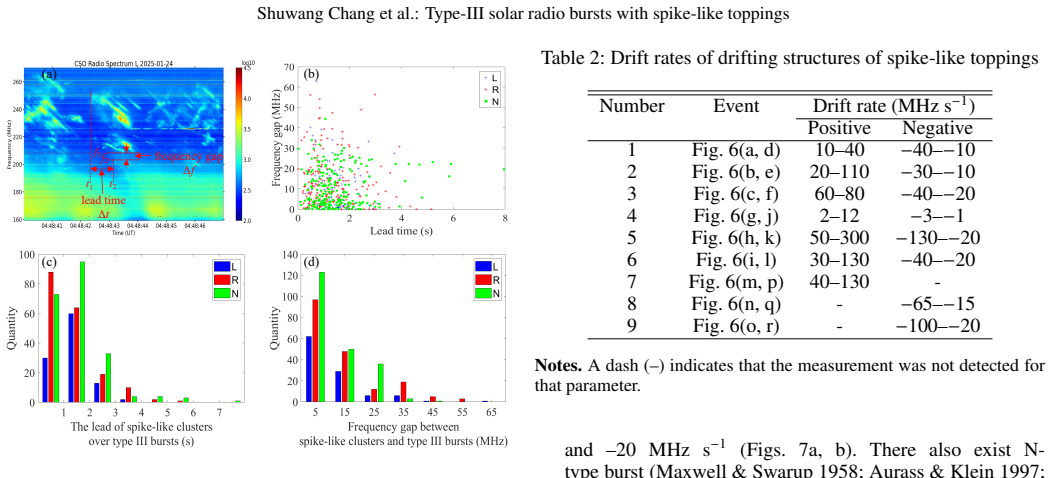
Spike clusters atop type III solar radio bursts precede the main emission by 0.5-3 seconds and 3-30 MHz while showing much stronger circular polarization, indicating a separate multiscale electron-acceleration region.
A machine-rendered reading of the paper's core claim, the machinery that carries it, and where it could break.
Core claim
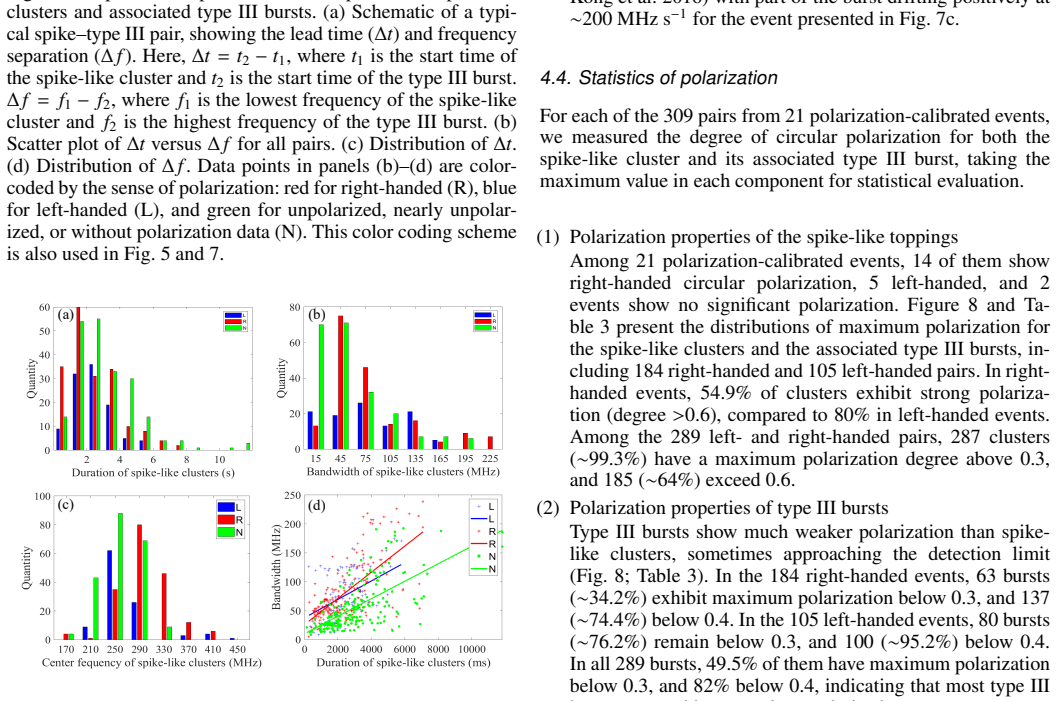
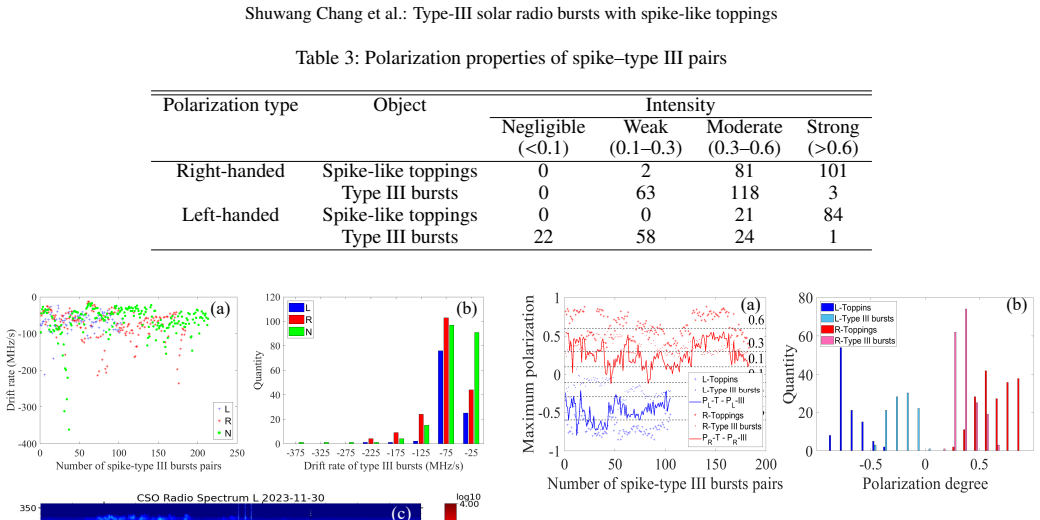
Spike-type III burst pairs show spike clusters that precede the type III emission by 0.5-3 s in time for 87 percent of cases and by 3-30 MHz in frequency for 80 percent, with the spikes exhibiting diverse morphologies, bidirectional drifts of 20-100 MHz s^{-1}, and maximum circular polarization above 0.6 in more than 64 percent of clusters, in contrast to the weak polarization of the type III bursts; these properties indicate that the spike radiation originates in a multiscale, inhomogeneous, and highly dynamic electron-acceleration region.
What carries the argument
Statistical comparison of temporal offsets, frequency offsets, and polarization degrees between spike clusters and associated type III bursts across 502 events.
If this is right
- Spike radiation must be generated under different plasma conditions than the main type III emission.
- Electron-acceleration sites in solar flares contain substructures operating on multiple spatial and temporal scales.
- Coherent radio-burst theory must incorporate separate mechanisms or source regions to explain the observed offsets and polarization contrast.
- Type III burst models need to include a preceding spike phase driven by the same overall electron population but in a more dynamic environment.
Where Pith is reading between the lines
- High-resolution imaging combined with these spectral data could map the spatial separation between spike and type III sources.
- Similar offset and polarization patterns may appear in other classes of coherent solar radio emission and could be searched for in existing archives.
- The dynamic nature of the acceleration region implied here suggests that time-dependent particle injection models may need revision to match the short precursor timescales.
Load-bearing premise
The measured time and frequency offsets together with the polarization contrast arise from a distinct multiscale acceleration region rather than from differences in radio-wave propagation or source geometry.
What would settle it
A set of spike-type III pairs that lack the reported 0.5-3 s and 3-30 MHz offsets or that show comparable polarization levels between spikes and type III emission would undermine the claim of a separate multiscale region.
Figures




read the original abstract
Spike-type III burst pairs represent a distinct class of solar radio emissions in which clusters of spike-like bursts appear atop the highfrequency onset of type III bursts. Using high time-frequency resolution data from the Chashan Broadband Solar radio spectrometer at meter wavelengths (CBSm), we present the largest statistical study to date of such events, comprising 502 spike-type III pairs from 35 events recorded between November 2023 and October 2025. We find that spike-like clusters systematically precede their associated type III bursts by 0.5-3 s in time (~87% of pairs) and by 3-30 MHz in frequency (~80%), a temporal and spectral offset that differs from earlier reports. The spike-like clusters exhibit diverse morphologies, including point-like, blob-like, drifting, and diffuse structures, with durations of ~0.5-5 s and bandwidths of 15-150 MHz. Bi-directional drifting structures with rates of ~20-100 MHz s-1 are observed, consistent with source motion both toward and away from the Sun. Furthermore, spike emission is predominantly strongly circularly polarized, with more than 64% of clusters showing maximum polarization exceeding 0.6, in stark contrast to the generally weak polarization of type III bursts. These findings point to an origin of the spike radiation in a multiscale, inhomogeneous, and highly dynamic electron-acceleration region, providing novel observational constraints on the mechanisms underlying coherent solar radio bursts.
Editorial analysis
A structured set of objections, weighed in public.
Referee Report
Summary. The manuscript presents the largest statistical study to date of 502 spike-type III burst pairs observed with the Chashan Broadband Solar radio spectrometer (CBSm) at meter wavelengths from November 2023 to October 2025. It reports that spike-like clusters systematically precede associated type III bursts by 0.5-3 s (~87% of pairs) and 3-30 MHz (~80%), exhibit diverse morphologies (point-like, blob-like, drifting, diffuse) with durations ~0.5-5 s and bandwidths 15-150 MHz, show bi-directional drifts at 20-100 MHz s^{-1}, and are strongly circularly polarized (>0.6 in >64% of clusters) in contrast to the weak polarization of type III bursts. The authors interpret these features as originating in a multiscale, inhomogeneous, and highly dynamic electron-acceleration region.
Significance. The large event sample and high-resolution observations provide useful new statistics on a relatively rare subclass of solar radio bursts. If the interpretive link to a distinct multiscale acceleration region can be substantiated against alternatives, the work would supply novel observational constraints on coherent emission mechanisms. The current significance is tempered by the absence of quantitative tests distinguishing the proposed origin from propagation or geometric effects.
major comments (1)
- [Abstract] Abstract (final sentence) and implied Discussion: The central claim attributes the observed temporal/spectral offsets, bi-directional drifts, and polarization contrast (>0.6 in >64% of clusters) directly to a multiscale, inhomogeneous electron-acceleration region. This inference is load-bearing for the paper's conclusions, yet the manuscript provides no quantitative propagation modeling, ray-tracing simulations, or explicit comparison to rule out refraction/scattering in the inhomogeneous corona or differences in source geometry. A dedicated analysis section addressing these alternatives is required to support the attribution.
minor comments (2)
- [Abstract] The abstract refers to differences from 'earlier reports' without specific citations; these should be added with quantitative comparison of the reported offsets.
- [Methods] Clarify the exact definition of 'clusters' and the selection criteria used to identify the 502 pairs from the 35 events to allow reproducibility.
Simulated Author's Rebuttal
We thank the referee for their constructive review and for recognizing the value of our large statistical sample of 502 spike-type III burst pairs. We have carefully considered the major comment regarding the need to address alternative explanations for the observed features and have revised the manuscript accordingly by adding a dedicated discussion of propagation and geometric effects.
read point-by-point responses
-
Referee: [Abstract] Abstract (final sentence) and implied Discussion: The central claim attributes the observed temporal/spectral offsets, bi-directional drifts, and polarization contrast (>0.6 in >64% of clusters) directly to a multiscale, inhomogeneous electron-acceleration region. This inference is load-bearing for the paper's conclusions, yet the manuscript provides no quantitative propagation modeling, ray-tracing simulations, or explicit comparison to rule out refraction/scattering in the inhomogeneous corona or differences in source geometry. A dedicated analysis section addressing these alternatives is required to support the attribution.
Authors: We agree that an explicit discussion of alternatives strengthens the interpretation. Our study is observational and does not include new quantitative propagation modeling or ray-tracing simulations, which would require additional assumptions about coronal density profiles and dedicated computational work beyond the current scope. In the revised manuscript we have added a new subsection in the Discussion that qualitatively compares the observations to known propagation effects. We note that the systematic temporal precedence of spikes, the frequency offsets, and especially the strong circular polarization contrast (spikes >0.6 while type III bursts remain weakly polarized) are difficult to reconcile with refraction or scattering alone, since scattering tends to reduce rather than enhance polarization. The bi-directional drifts are also more naturally explained by source motion than by propagation geometry. We have clarified that these arguments support but do not definitively prove the multiscale acceleration region interpretation and have flagged full numerical modeling as valuable future work. revision: yes
Circularity Check
Observational statistical study with interpretive conclusion; no derivations or self-referential reductions
full rationale
The manuscript reports a statistical analysis of 502 observed spike-type III burst pairs from CBSm data, documenting temporal offsets (0.5-3 s in ~87% of pairs), spectral offsets (3-30 MHz in ~80%), diverse morphologies, bi-directional drifts (20-100 MHz s^{-1}), and polarization contrasts (>0.6 in >64% of clusters). The final interpretive sentence attributes these features to a multiscale inhomogeneous dynamic electron-acceleration region. This is a direct inference from the reported observations rather than any derivation, equation, fitted parameter renamed as prediction, or self-citation chain that reduces the result to its own inputs by construction. No load-bearing steps match the enumerated circularity patterns; the paper is self-contained as an empirical catalog with an interpretive close.
Axiom & Free-Parameter Ledger
axioms (1)
- domain assumption Standard assumptions about plasma emission and wave propagation in the solar corona apply to both spike and type III components.
Reference graph
Works this paper leans on
-
[1]
Aurass, H., & Klein, K. L. 1997, A&AS, 123, 279
work page 1997
-
[2]
Benz, A. O., Zlobec, P., & Jaeggi, M. 1982, A&A, 109, 305
work page 1982
-
[3]
O., Csillaghy, A., & Aschwanden, M
Benz, A. O., Csillaghy, A., & Aschwanden, M. J. 1996, A&A, 309, 291
work page 1996
-
[4]
Benz, A. O. 2017, Liv. Rev. Sol. Phys., 14, 2
work page 2017
-
[5]
2024, ApJS, 272, 21 Article number, page 9 A&A proofs:manuscript no
Chang, S., Wang, B., Lu, G., et al. 2024, ApJS, 272, 21 Article number, page 9 A&A proofs:manuscript no. SpikeTIIIP_Revised_clean
work page 2024
-
[6]
2023, ApJ, 953, 171 Karlický, M., Jelínek, P., & Mészárosová, H
Deng, Y . 2023, ApJ, 953, 171 Karlický, M., Jelínek, P., & Mészárosová, H. 2011, A&A, 529, A96
work page 2023
- [7]
- [8]
-
[9]
Luo, Y ., Chen, B., Yu, S., Bastian, T. S., & Krucker, S. 2021, ApJ, 911, 4
work page 2021
- [10]
-
[11]
Melrose, D. B. 1980, Plasma Astrophysics: Nonthermal Processes in Diffuse Magnetized Plasmas (Gordon and Breach, New York)
work page 1980
-
[12]
P., Glesener, L., Vilmer, N., & amini, A
Musset, S., Kontar, E. P., Glesener, L., Vilmer, N., & amini, A. 2021, A&A, 656, A34
work page 2021
-
[13]
Paesold, G., Benz, A. O., Klein, K.-L., & Vilmer, N. 2001, A&A, 371, 333
work page 2001
- [14]
- [15]
-
[16]
Yan, J., Wu, J., Wu, L., Yang, Y ., Wu, J., Yan, Y ., & Wang, C. 2023, NatAs, 7, 640
work page 2023
-
[17]
2025, ApJ, 985, 257 Article number, page 10
Yang, Y ., Ning, Z., Song, Y ., Han, Y ., Tang, X., Gao, M., Liu, H., Yan, J., Wang, B., & Chang, S. 2025, ApJ, 985, 257 Article number, page 10
work page 2025
discussion (0)
Sign in with ORCID, Apple, or X to comment. Anyone can read and Pith papers without signing in.