Origin of Persistent Boundary Motion in Confined Active Matter
Pith reviewed 2026-05-21 02:24 UTC · model grok-4.3
The pith
Confinement couples active particle positions directly to orientational fluctuations via two preferred tangential states and stochastic flips.
A machine-rendered reading of the paper's core claim, the machinery that carries it, and where it could break.
Core claim
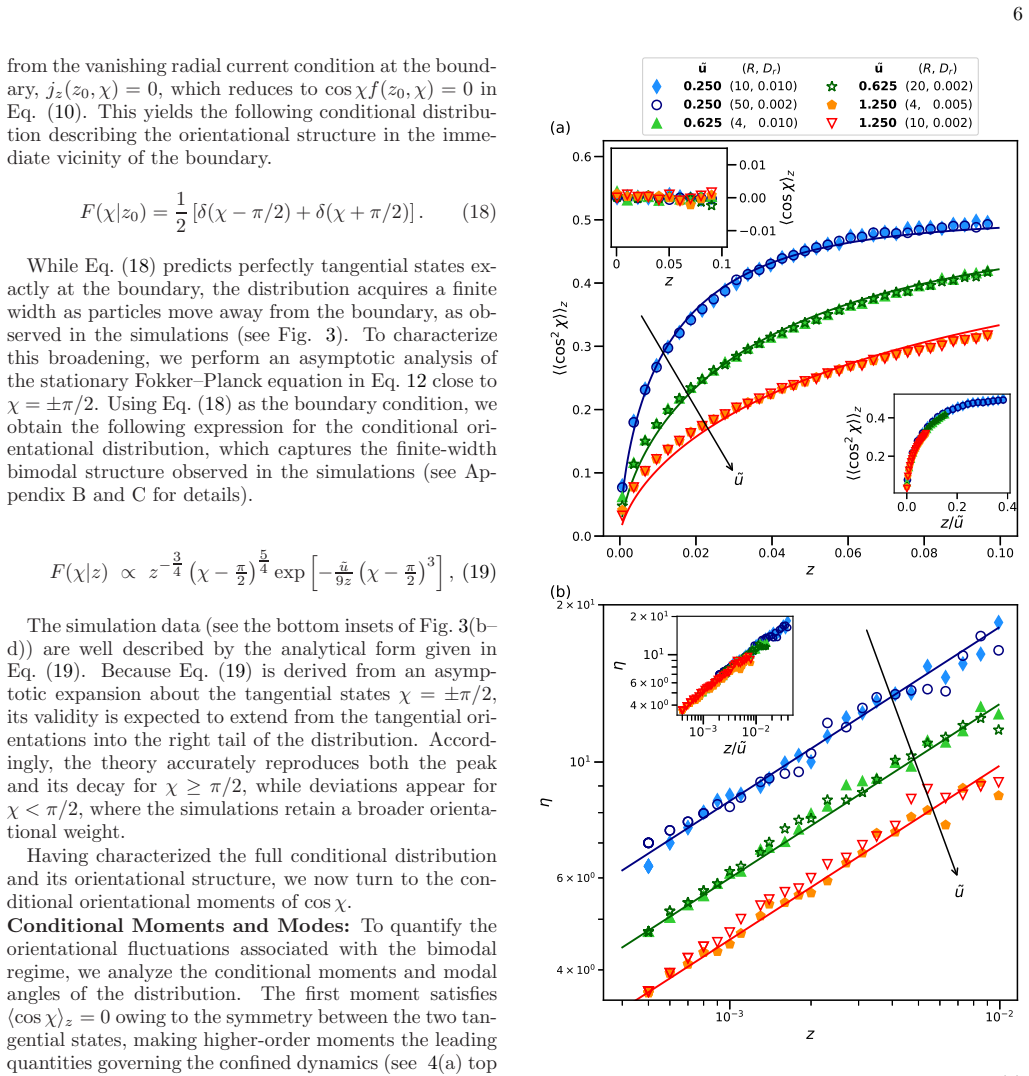
The positional distribution of the particle is directly coupled to orientational fluctuations, as characterized by the conditional orientational distribution. Confinement generates two preferred tangential orientational states connected by stochastic flipping pathways: rapid boundary-localized switching and slower bulk-mediated excursions. The positional distribution exhibits a nontrivial power-law decay with distance from the boundary that is closely linked to curvature-induced bistable orientational states and the variance of the associated conditional distribution. The mean waiting time between flips exhibits power-law dependence on the confinement strength.
What carries the argument
The conditional orientational distribution that connects position to curvature-induced bistable tangential orientations and enables stochastic flipping pathways.
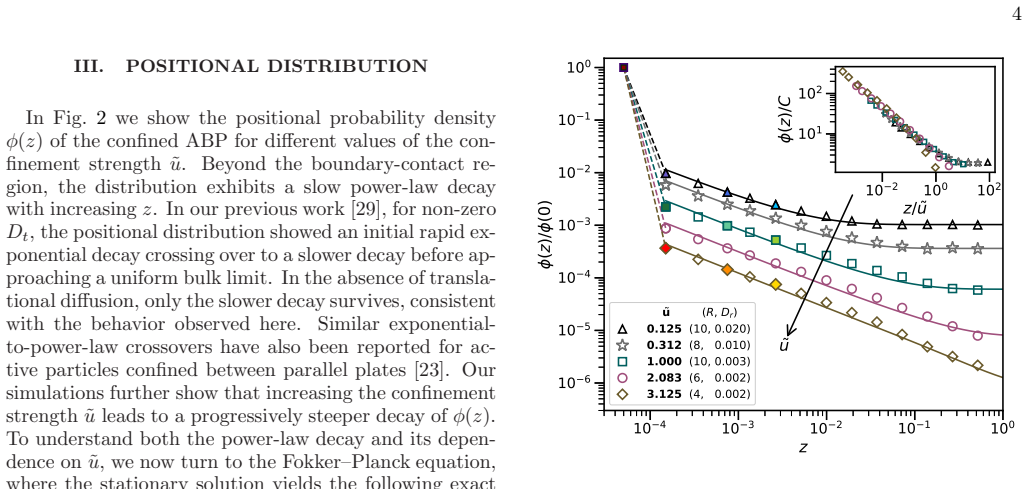
Load-bearing premise
The hard circular boundary and the active Brownian particle model with constant speed and rotational diffusion are sufficient to produce the bistability and power-law behaviors without soft boundaries or extra interactions.
What would settle it
Measuring the conditional probability of orientation at fixed distances from the boundary would reveal two distinct peaks at tangential angles if the coupling holds; removing the hard wall or softening the boundary and finding the power-law decay and flip-time scaling disappear would falsify the claim.
Figures




read the original abstract
Active matter systems under confinement display persistent surface motion and a strong boundary affinity. However, despite extensive studies of their positional dynamics, much less attention has been given to the corresponding orientational behavior. Here, using molecular simulations of an active Brownian particle confined within a hard circular boundary and the Fokker-Planck equation, we show that the positional distribution of the particle is directly coupled to orientational fluctuations, as characterized by the conditional orientational distribution. Confinement generates two preferred tangential orientational states connected by stochastic flipping pathways: rapid boundary-localized switching and slower bulk-mediated excursions. Further, the positional distribution exhibits a nontrivial power-law decay with distance from the boundary that is closely linked to curvature-induced bistable orientational states and the variance of the associated conditional distribution. The mean waiting time between flips exhibits power-law dependence on the confinement strength. Our results establish that the interplay between orientational fluctuations, bistability, positional accumulation, and stochastic switching governs the observed dynamics of active particles under confinement, providing a framework for understanding transport, exploration, and escape processes in confined active systems.
Editorial analysis
A structured set of objections, weighed in public.
Referee Report
Summary. The manuscript uses molecular simulations of an active Brownian particle (constant speed, rotational diffusion) inside a hard circular boundary together with the Fokker-Planck equation to argue that positional accumulation is directly coupled to orientational fluctuations. The central results are the conditional distribution P(θ|r) exhibiting two preferred tangential states, stochastic flipping pathways (boundary-localized rapid switches and slower bulk-mediated excursions), a power-law decay of the positional distribution whose exponent is linked to curvature-induced bistability and conditional variance, and a power-law dependence of the mean flip waiting time on confinement strength.
Significance. If the reported coupling and power-law relations survive scrutiny, the work supplies a concrete mechanistic link between orientational bistability and boundary persistence that could inform models of transport, exploration, and escape in confined active systems. The combination of direct simulation and Fokker-Planck analysis is a positive feature.
major comments (2)
- [Model section and Fokker-Planck derivation] The hard-wall no-flux boundary condition used in both the simulations and the Fokker-Planck operator is load-bearing for the reported bistability of P(θ|r) and the quantitative power-law relations. Any finite boundary stiffness or near-wall hydrodynamic lubrication would smooth the effective potential for θ near the wall and could merge the two tangential peaks or change the relative weight of boundary-localized versus bulk-mediated flip pathways, thereby altering the waiting-time scaling and the positional exponent even if qualitative accumulation persists.
- [Results on positional distribution and waiting times] The abstract and results sections state that the positional power-law decay is 'closely linked' to the bistable orientational states and that the waiting time exhibits power-law dependence on confinement strength, yet no quantitative checks (error bars, fit ranges, direct simulation-Fokker-Planck comparison, or sensitivity to rotational diffusion coefficient) are supplied. This prevents assessment of how strongly the data support the claimed coupling.
minor comments (2)
- [Methods] Clarify whether 'molecular simulations' refers to overdamped Brownian dynamics or includes inertial terms; the model description should explicitly state the integration scheme and time-step convergence.
- [Figures] Figure captions and axis labels for the conditional distributions P(θ|r) should include the precise definition of the radial binning and the normalization used.
Simulated Author's Rebuttal
We thank the referee for the careful reading of our manuscript and the constructive comments. We address each major point below and have revised the manuscript to strengthen the quantitative support and clarify the scope of the hard-wall model.
read point-by-point responses
-
Referee: [Model section and Fokker-Planck derivation] The hard-wall no-flux boundary condition used in both the simulations and the Fokker-Planck operator is load-bearing for the reported bistability of P(θ|r) and the quantitative power-law relations. Any finite boundary stiffness or near-wall hydrodynamic lubrication would smooth the effective potential for θ near the wall and could merge the two tangential peaks or change the relative weight of boundary-localized versus bulk-mediated flip pathways, thereby altering the waiting-time scaling and the positional exponent even if qualitative accumulation persists.
Authors: We agree that the ideal hard-wall boundary condition is central to the reported bistability and power-law scalings. In the revised manuscript we have added an explicit discussion of this modeling choice in the Model section, noting that softer boundaries or lubrication forces could quantitatively modify the orientational potential and flip pathways. To test robustness we performed additional simulations with a stiff harmonic wall potential; the bistable tangential states and power-law positional decay persist for wall stiffnesses comparable to the particle propulsion force. We have included these results in the supplementary information and updated the main text to state the limitation clearly while emphasizing that the hard-wall case provides the cleanest link to the Fokker-Planck analysis. revision: partial
-
Referee: [Results on positional distribution and waiting times] The abstract and results sections state that the positional power-law decay is 'closely linked' to the bistable orientational states and that the waiting time exhibits power-law dependence on confinement strength, yet no quantitative checks (error bars, fit ranges, direct simulation-Fokker-Planck comparison, or sensitivity to rotational diffusion coefficient) are supplied. This prevents assessment of how strongly the data support the claimed coupling.
Authors: We thank the referee for highlighting the need for stronger quantitative validation. In the revised manuscript we now report error bars on the positional distributions and waiting-time data, obtained from at least ten independent runs. The fitting ranges for the power-law exponents are specified in the figure captions and methods. We have added a direct side-by-side comparison of the simulation histograms with the numerical solution of the Fokker-Planck equation for both P(r) and the mean flip waiting time. Finally, we include a brief sensitivity analysis to the rotational diffusion coefficient D_r in the main text, with supporting plots in the supplementary information. These additions provide a clearer assessment of the coupling strength. revision: yes
Circularity Check
No significant circularity; results emerge from independent simulations and Fokker-Planck solution
full rationale
The paper derives its central claims—the coupling of positional distribution to conditional orientational distribution P(θ|r), the emergence of two curvature-induced tangential bistable states, the power-law decay of positional density, and the power-law scaling of mean flip waiting times—directly from molecular dynamics simulations of the standard active Brownian particle model plus the corresponding Fokker-Planck operator with hard-wall boundary conditions. These quantities are computed outputs rather than inputs; the bistability and scalings are not presupposed by any fitted parameter or self-referential definition. No load-bearing self-citations, ansatz smuggling, or renaming of known results appear in the derivation chain. The analysis remains self-contained against the stated model assumptions.
Axiom & Free-Parameter Ledger
Reference graph
Works this paper leans on
-
[1]
For most of the results of this work, we fo- cus on the stationary state and therefore set ∂Π/∂t = 0
re- spectively represent translational diffusion, effective ro- tational diffusion, curvature-induced angular drift, and the radial propulsion current modified by the boundary reaction force. For most of the results of this work, we fo- cus on the stationary state and therefore set ∂Π/∂t = 0. 3 r φ θ χ = φ − θ z = 1 − r / R R FIG. 1. Schematic illustration of...
-
[2]
reduces to ∂ 2f ∂χ 2 + ˜u ∂ ∂χ (sinχf (0,χ )) = 0, (15) with solution F (χ |0) ∝ e˜u cos χ, (16) Equation ( 16) therefore predicts a unimodal F (χ |z) at the boundary-contact region, which is also corroborated by the numerical simulations (see Fig. 3 (b-d), top inset). Such a behavior corresponds to preferential outward ra- dial alignment at the boundary....
-
[3]
main panel). For z > z0 and n(z,χ ) = 0, the vanishing radial probability current suppresses the outward propulsion component, and the dynamics is dominated by motion parallel to the bound- ary (see Appendix A for further details). Next, we present our results for the positional distribu- tion φ(z) at varying ˜u before discussing the conditional orientati...
-
[4]
for three representative confinement strengths ˜u = 0 . 125, 1 . 0, and 3 . 125. For a fixed ˜ u, the condi- tional distribution exhibits a pronounced bimodal struc- ture peaked around χ = ±π/ 2. Moving away from the boundary, the peaks shift away from the purely tangential directions and the distribution progressively broadens, indicating a gradual weakeni...
-
[5]
with the asymptotic positional distribution close to the boundary, φ(z) ∝ 0.00 0.02 0.04 0.06 0.08 0.10 z 0.0 0.1 0.2 0.3 0.4 0.5 0.6 /uni27E8/uni27E8cos 2 χ /uni27E9/uni27E9 z (a) ⟨u ̃̃̃̃̃̃̃̃̃ ⟨u ̃̃̃̃̃̃̃̃̃( R ,̃ D r )̃̃̃̃̃̃̃̃̃̃̃̃̃̃̃̃̃̃̃̃̃̃̃̃ ⟨u ̃̃̃̃̃̃̃̃̃( R ,̃ D r ) ̃̃ 0. 250 ̃̃(10,̃0.010) ̃̃ 0. 250 ̃̃(50,̃0.002) ̃̃ 0.625 ̃̃(4,̃̃̃0.010) ̃̃ 0.625 ̃̃(20,̃0...
-
[6]
(23) The growth of η reflects the progressive weakening of confinement-induced orientational order
captures the data well and yields the scaling η ∝ z1/ 3. (23) The growth of η reflects the progressive weakening of confinement-induced orientational order. Near the boundary, strong confinement favors nearly tangential trajectories, while farther away enhanced orientational fluctuations allow particles to explore broader angular configurations. Similar to the...
-
[7]
III, which predicts the coupling between the positional distribution and orienta- tional fluctuations
discussed in Sec. III, which predicts the coupling between the positional distribution and orienta- tional fluctuations. Substituting the conditional variance ⟨⟨cos2χ ⟩⟩z from Eq. (
-
[8]
( 17) yields a closed analytical form for the positional boundary layer
into Eq. ( 17) yields a closed analytical form for the positional boundary layer. Intro- ducing the transformed variable τ = − ln(1 − z), which maps the radial distance from the wall onto an effective evolution parameter, Eq. (
-
[9]
becomes φ(z) ∝ 1 1 − exp ( − [ τ ˜u ]2/ 3) exp { − 3˜uγ ( 3 2, [τ ˜u ]2/ 3)} , (24) where γ(a,x ) is the lower incomplete Gamma function. In the near-boundary regime z ≪ 1, where τ ≃ z, this reduces to φ(z) ∝ ( z ˜u ) − 2/ 3 , (25) recovering the asymptotic scaling of the positional boundary layer (see Appendices A and C for details). A stringent test of ...
-
[10]
is in good agreement with the simulation data shown in Fig. 5(c), where the same power-law scaling is observed over the large-˜u regime (see Appendix D for details). 9 VII. CONCLUSIONS In this work, we have investigated the dynamics of an active Brownian particle confined within a hard cir- cular boundary using molecular simulations and the Fokker–Planck e...
-
[11]
36 is well-approximated by λ(x) = 1 − exp(−x 2 3 ), which leads to the expression in Eq
indicate that the scaling function in Eq. 36 is well-approximated by λ(x) = 1 − exp(−x 2 3 ), which leads to the expression in Eq. 21 for τ ≪ 1. APPENDIX B The symmetry χ → − χ in the distribution implies that it is sufficient to focus on χ ≥ 0: also, the boundary condition in Eq. ( 18) suggests that, close to τ = 0, it is convenient to define the angular de...
-
[12]
Also, for ˜ u ≥ 1, we may also ignore the r.h.s in this regime, whence Eq. 41 reduces to the standard homogeneous Airy equation [49], the solution for which is Ψ(s,η ′) = Γ(s)Ai(η′) (42) where the prefactor Γ( s) is, in general, an undetermined function of the Laplace frequency s. The Airy function shows decaying behaviour for η′> 0 and damped oscil- lato...
-
[13]
S. Ramaswamy, Active matter, Journal of Statistical Me- chanics: Theory and Experiment 2017, 054002 (2017)
work page 2017
- [14]
-
[15]
M. C. Marchetti, J.-F. Joanny, S. Ramaswamy, T. B. Liverpool, J. Prost, M. Rao, and R. A. Simha, Hydrody- namics of soft active matter, Reviews of modern physics 85, 1143 (2013)
work page 2013
-
[16]
Ramaswamy, The mechanics and statistics of active matter, Annu
S. Ramaswamy, The mechanics and statistics of active matter, Annu. Rev. Condens. Matter Phys. 1, 323 (2010)
work page 2010
-
[17]
C. Bechinger, R. Di Leonardo, H. L¨ owen, C. Reichhardt, G. Volpe, and G. Volpe, Active particles in complex and crowded environments, Reviews of Modern Physics 88, 045006 (2016)
work page 2016
-
[18]
T. Vicsek and A. Zafeiris, Collective motion, Physics re- ports 517, 71 (2012)
work page 2012
-
[19]
A. Mart ´ ınez-Calvo, C. Trenado-Yuste, and S. S. Datta, Active Transport in Complex Environments, in Out-of- equilibrium Soft Matter (The Royal Society of Chemistry, 2023)
work page 2023
-
[20]
A. Czir´ ok and T. Vicsek, Collective behavior of inter- acting self-propelled particles, Physica A: Statistical M e- chanics and its Applications 281, 17 (2000)
work page 2000
-
[21]
M. E. Cates and J. Tailleur, Motility-induced phase sepa- ration, Annu. Rev. Condens. Matter Phys. 6, 219 (2015)
work page 2015
-
[22]
T. Bhattacharjee and S. S. Datta, Bacterial hopping and trapping in porous media, Nature communications 10, 2075 (2019)
work page 2075
-
[23]
B. J. Toley and N. S. Forbes, Motility is critical for effec- tive distribution and accumulation of bacteria in tumor tissue, Integrative Biology 4, 165 (2012)
work page 2012
-
[24]
F. A. Overberg, G. Gompper, and D. A. Fedosov, Mo- tion of microswimmers in cylindrical microchannels, Soft Matter 20, 3007 (2024)
work page 2024
-
[25]
R. Ni, M. A. C. Stuart, and M. Dijkstra, Pushing the glass transition towards random close packing using self- propelled hard spheres, Nature communications 4, 2704 (2013)
work page 2013
-
[26]
F. K¨ ummel, P. Shabestari, C. Lozano, G. Volpe, and C. Bechinger, Formation, compression and surface melt- ing of colloidal clusters by active particles, Soft matter 11, 6187 (2015)
work page 2015
-
[27]
R. Sharma and S. Karmakar, Activity-induced anneal- ing leads to a ductile-to-brittle transition in amorphous solids, Nature Physics 21, 253 (2025)
work page 2025
-
[28]
A. P. Berke, L. Turner, H. C. Berg, and E. Lauga, Hy- drodynamic attraction of swimming microorganisms by surfaces, Physical Review Letters 101, 038102 (2008)
work page 2008
-
[29]
P. Denissenko, V. Kantsler, D. J. Smith, and J. Kirkman- Brown, Human spermatozoa migration in microchan- nels reveals boundary-following navigation, Proceedings of the National Academy of Sciences 109, 8007 (2012)
work page 2012
-
[30]
S. Das, A. Garg, A. I. Campbell, J. Howse, A. Sen, D. Velegol, R. Golestanian, and S. J. Ebbens, Boundaries can steer active janus spheres, Nature communications 6, 8999 (2015)
work page 2015
- [31]
-
[32]
H. H. Tuson and D. B. Weibel, Bacteria–surface interac- tions, Soft matter 9, 4368 (2013)
work page 2013
-
[33]
K. Drescher, J. Dunkel, L. H. Cisneros, S. Ganguly, and R. E. Goldstein, Fluid dynamics and noise in bacterial cell–cell and cell–surface scattering, Proceedings of the National Academy of Sciences 108, 10940 (2011)
work page 2011
-
[34]
J. Elgeti and G. Gompper, Self-propelled rods near sur- faces, Europhysics Letters 85, 38002 (2009)
work page 2009
-
[35]
J. Elgeti and G. Gompper, Wall accumulation of self-propelled spheres, Europhysics Letters 101, 48003 (2013)
work page 2013
- [36]
-
[37]
S. C. Takatori, R. De Dier, J. Vermant, and J. F. Brady, Acoustic trapping of active matter, Nature communica- tions 7, 10694 (2016)
work page 2016
-
[38]
O. Dauchot and V. D´ emery, Dynamics of a self-propelled particle in a harmonic trap, Physical review letters 122, 068002 (2019)
work page 2019
-
[39]
F. Schmidt, H. ˇS ´ ıpov´ a-Jungov´ a, M. K¨ all, A. W¨ urger, and G. Volpe, Non-equilibrium properties of an active nanoparticle in a harmonic potential, Nature communi- 13 cations 12, 1902 (2021)
work page 1902
-
[40]
I. Buttinoni, L. Caprini, L. Alvarez, F. J. Schwarzen- dahl, and H. L¨ owen, Active colloids in harmonic optical potentials (a), Europhysics Letters 140, 27001 (2022)
work page 2022
-
[41]
O. Vincent, A. Sreekumari, M. Gopalakrishnan, V. V. Vasisht, and B. R. Sarangi, Curvature-dependent dynam- ics of a bacterium confined in a giant unilamellar vesicle, Physical Review E 112, 024408 (2025)
work page 2025
-
[42]
A. Duzgun and J. V. Selinger, Active brownian particles near straight or curved walls: Pressure and boundary layers, Physical Review E 97, 032606 (2018)
work page 2018
-
[43]
K. Malakar, A. Das, A. Kundu, K. V. Kumar, and A. Dhar, Steady state of an active brownian particle in a two-dimensional harmonic trap, Physical Review E 101, 022610 (2020)
work page 2020
-
[44]
U. Nakul and M. Gopalakrishnan, Stationary states of an active brownian particle in a harmonic trap, Physical Review E 108, 024121 (2023)
work page 2023
-
[45]
A. Samui and M. Gopalakrishnan, Active particles in power-law potentials: steady state distributions and shape transitions, arXiv preprint arXiv:2507.18862 (2025)
-
[46]
N. A. Ara´ ujo, L. M. Janssen, T. Barois, G. Boffetta, I. Cohen, A. Corbetta, O. Dauchot, M. Dijkstra, W. M. Durham, A. Dussutour, et al. , Steering self-organisation through confinement, Soft Matter 19, 1695 (2023)
work page 2023
-
[47]
H. A. Kramers, Brownian motion in a field of force and the diffusion model of chemical reactions, physica 7, 284 (1940)
work page 1940
-
[48]
J. A. Drocco, C. Olson Reichhardt, and C. Reichhardt, Bidirectional sorting of flocking particles in the presence of asymmetric barriers, Physical Review E—Statistical, Nonlinear, and Soft Matter Physics 85, 056102 (2012)
work page 2012
- [49]
-
[50]
S. S. Rogers and collaborators, Sorting and filtering of ac- tive swimmers in tesla valve geometries, Physical Review E 107, 024607 (2023)
work page 2023
-
[51]
A. Militaru, M. Innerbichler, M. Frimmer, F. Tebbenjo- hanns, L. Novotny, and C. Dellago, Escape dynamics of active particles in multistable potentials, Nature Com- munications 12, 2446 (2021)
work page 2021
-
[52]
I. S. Aranson and A. Pikovsky, Confinement and col- lective escape of active particles, Physical review letter s 128, 108001 (2022)
work page 2022
-
[53]
P. Kumar and R. Chakrabarti, Escape kinetics of an ac- tive brownian particle from a circular cavity through a narrow opening, The Journal of Chemical Physics 151, 064902 (2019)
work page 2019
-
[54]
Y. Fily, A. Baskaran, and M. F. Hagan, Active parti- cles on curved surfaces, arXiv preprint arXiv:1601.00324 (2016)
work page internal anchor Pith review Pith/arXiv arXiv 2016
- [55]
-
[56]
A. Morin and D. Bartolo, Flowing active liquids in a pipe: Hysteretic response of polar flocks to external fields, Physical Review X 8, 021037 (2018)
work page 2018
-
[57]
T. Brotto, J.-B. Caussin, E. Lauga, and D. Bartolo, Hy- drodynamics of confined active fluids, Physical Review Letters 110, 038101 (2013)
work page 2013
-
[58]
L. Caprini and U. M. B. Marconi, Active particles un- der confinement and effective force generation among sur- faces, Soft Matter 15, 2627 (2019)
work page 2019
-
[59]
Y. Fily, A. Baskaran, and M. F. Hagan, Dynamics of self- propelled particles under strong confinement, Soft matter 10, 5609 (2014)
work page 2014
-
[60]
R. Priya and S. Karmakar, Inverse bauschinger effect in active ultrastable glasses, Physical Review E 112, 035414 (2025)
work page 2025
-
[61]
M. Abramowitz and I. A. Stegun, Handbook of mathe- matical functions with formulas, graphs, and mathemati- cal tables, Vol. 55 (US Government printing office, 1948)
work page 1948
-
[62]
N. G. van Kampen, Stochastic Processes in Physics and Chemistry, 1st ed., North-Holland Personal Library (El- sevier, Amsterdam, 1992)
work page 1992
discussion (0)
Sign in with ORCID, Apple, or X to comment. Anyone can read and Pith papers without signing in.