Toward 6G-enabled Brain Computer Interfaces: Technical Requirements, Use Cases, Challenges, and Future Trends
Pith reviewed 2026-05-21 04:00 UTC · model grok-4.3
The pith
6G wireless networks can improve real-time brain-device communication and enable new applications in brain-computer interfaces.
A machine-rendered reading of the paper's core claim, the machinery that carries it, and where it could break.
Core claim
Integrating 6G into BCI systems enhances the performance of brain-device communication and creates new opportunities for innovative applications. The paper traces the progression from early BCI and 6G developments to their convergence through cognitive communication and advanced neural interfaces. It highlights the need for 6G technologies such as intelligent edge and zero-touch networks to support BCI use cases including digital twins, immersive communication, and the internet of minds, while identifying key technical challenges and future research directions.
What carries the argument
The 6G-enabled BCI paradigm, which builds effective brain-device communication on top of 6G wireless networks by leveraging high data rates, security, automation, intelligent edge, and zero-touch capabilities.
If this is right
- Real-time translation of neural signals improves because 6G supplies higher data rates and lower latency than prior generations.
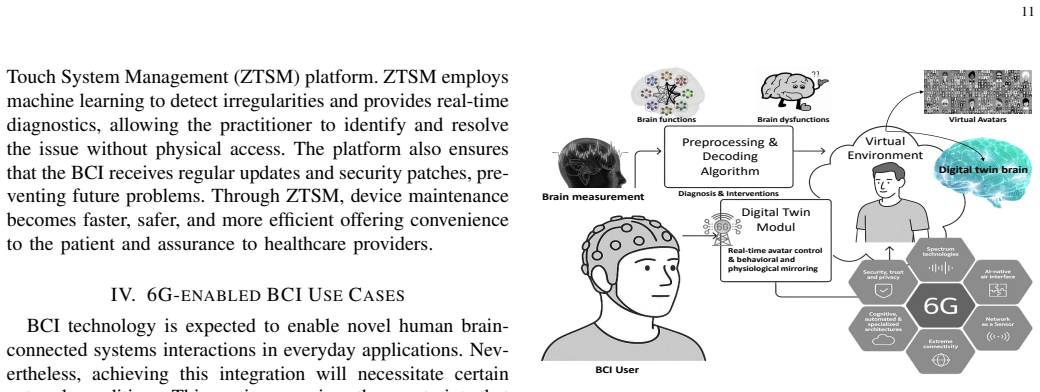
- New applications become feasible, including digital twins of brain activity and direct brain-to-brain or brain-to-device networks.
- Automation in 6G networks supports zero-touch management of BCI connections without manual intervention.
- Security features in 6G address privacy needs when transmitting sensitive neural data.
Where Pith is reading between the lines
- Widespread adoption could shift medical rehabilitation toward wireless thought-controlled prosthetics that operate without tethered connections.
- Ethical questions around continuous brain data streaming over public networks may require new regulatory frameworks beyond what the paper examines.
- Integration with existing sensor networks could allow BCIs to interact with smart environments in ways that current systems cannot sustain.
Load-bearing premise
The assumption that upcoming 6G systems will deliver the expected high data rates, data security, and automation capabilities needed for effective real-time neural communication.
What would settle it
A practical test showing that a deployed 6G network fails to provide the low latency or high bandwidth required to translate brain signals into device actions faster or more reliably than current wireless systems.
Figures



read the original abstract
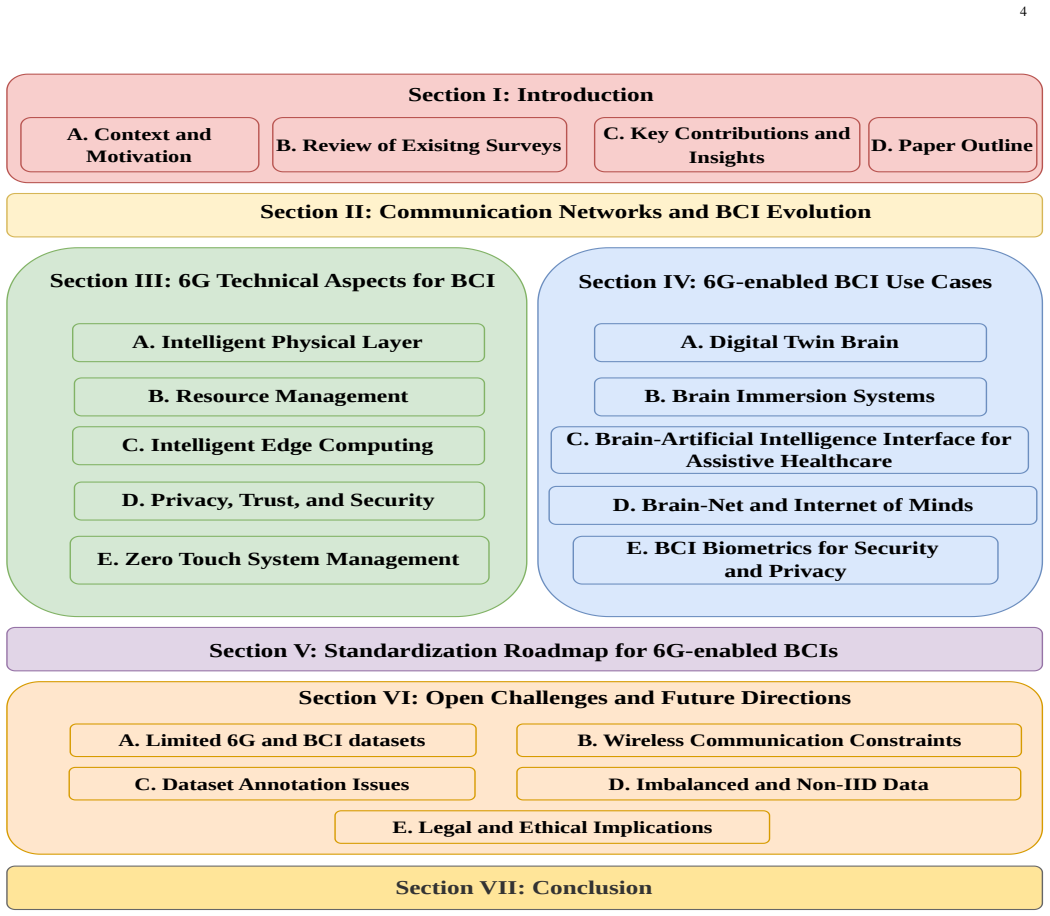
Brain computer interface (BCI) enables the brain to directly control an external device by converting neural signals into actionable outputs. However, effective real-time translation of brain activity strongly depends on the quality of neural communication between the brain and the external device. 6G is the next generation of wireless communication, expected to provide unprecedented levels of data rates, data security, and automation capabilities. In this context, integrating 6G into BCI systems would not only enhance the performance of brain-device communication, but would also create new opportunities for innovative applications. This work provides a comprehensive study on how BCI technology can be built effectively on top of 6G wireless networks by introducing several technical aspects and use cases. We first provide an overview of BCI and 6G, following their progression from early development to convergence through cognitive communication and advanced neural interfaces. We then highlight the need for the upcoming 6G systems toward BCI technology in every aspect, including 6G technologies such as intelligent edge and zero-touch networks, and 6G use cases such as digital twin, immersive communication, and internet of minds. Furthermore, we identify key technical challenges, open issues, and future research directions related to the 6G-enabled BCI paradigm.
Editorial analysis
A structured set of objections, weighed in public.
Referee Report
Summary. The paper surveys the integration of 6G wireless networks with Brain-Computer Interfaces (BCIs). It provides an overview of BCI and 6G technologies and their progression toward convergence via cognitive communication and advanced neural interfaces, highlights the technical requirements and need for 6G features such as intelligent edge computing and zero-touch networks to support BCI, presents use cases including digital twins, immersive communication, and the internet of minds, and catalogs key technical challenges, open issues, and future research directions. The central claim is that 6G integration would enhance brain-device communication performance and enable new innovative applications, conditional on 6G delivering high data rates, security, and automation.
Significance. If the literature synthesis accurately captures the state of both fields and the identified challenges are well-supported, this survey could serve as a useful roadmap for interdisciplinary research at the intersection of wireless networks and neural interfaces. By explicitly mapping anticipated 6G capabilities to BCI limitations and listing open issues, it provides a structured foundation for future work on real-time neural communication and applications such as the internet of minds.
major comments (1)
- [Abstract and technical requirements discussion] Abstract and section on the need for 6G toward BCI: the central claim that integration 'would not only enhance the performance of brain-device communication' rests on the assumption that 6G will deliver unprecedented data rates, security, and automation for real-time neural signals, yet the manuscript remains at a descriptive level without quantitative benchmarks, required latency/bandwidth figures drawn from BCI literature, or error analysis for neural communication.
minor comments (3)
- [Overview section] In the overview of BCI and 6G progression, a summary table of key milestones or a timeline would improve clarity and help readers track the convergence path.
- [Use cases section] The 'internet of minds' use case is introduced but lacks a concise definition or concrete example distinguishing it from conventional BCI applications.
- [Challenges and future directions] Ensure references in the challenges and future directions sections include the most recent publications (2023 onward) on 6G security and edge intelligence for BCIs.
Simulated Author's Rebuttal
We thank the referee for the constructive feedback and positive overall assessment of our survey. We agree that strengthening the quantitative grounding of our claims will improve the manuscript and have revised accordingly.
read point-by-point responses
-
Referee: [Abstract and technical requirements discussion] Abstract and section on the need for 6G toward BCI: the central claim that integration 'would not only enhance the performance of brain-device communication' rests on the assumption that 6G will deliver unprecedented data rates, security, and automation for real-time neural signals, yet the manuscript remains at a descriptive level without quantitative benchmarks, required latency/bandwidth figures drawn from BCI literature, or error analysis for neural communication.
Authors: We appreciate this observation. While the manuscript is a survey whose primary goal is to map the intersection of the two fields and identify open directions, we acknowledge that explicit quantitative anchors would better substantiate the performance-enhancement claim. In the revised version we have added a dedicated paragraph (and supporting citations) in the technical-requirements section that extracts concrete figures from the BCI literature: typical per-channel EEG data rates of 1–10 kbps (up to several Mbps for high-density arrays), end-to-end latency targets below 10 ms for closed-loop control, and reported packet-error rates of 10^-3 to 10^-5 in current wireless neural links. We then explicitly link these numbers to 6G features (URLLC, THz bands, intelligent edge) and note how they could reduce the observed error floors. The abstract has been lightly edited to reflect the added grounding. These changes remain within the survey style but now provide the requested benchmarks and error discussion. revision: yes
Circularity Check
No significant circularity: survey paper with external synthesis only
full rationale
The paper is a forward-looking literature synthesis and survey. It overviews BCI and 6G progression, maps anticipated 6G features (edge intelligence, digital twins, immersive comms) onto BCI requirements, catalogues challenges, and lists open research directions. No equations, derivations, fitted parameters, or quantitative predictions appear. All technical claims reference external sources or stated prospective assumptions about 6G targets; the central claim remains conditional ('would enhance... if 6G meets its targets'). No self-citation forms a load-bearing premise, no ansatz is smuggled, and no result reduces to its own inputs by construction. This is the standard non-circular outcome for descriptive survey work.
Axiom & Free-Parameter Ledger
Reference graph
Works this paper leans on
-
[1]
M. Aldayel, N. Alsedairy, A. Al-Nafjan, and S. Alsenan, “Systematic review of brain-computer interface-based user authentication system: Trends, challenges, and directions,”IEEE Access, vol. 12, pp. 96 848– 96 861, 2024
work page 2024
-
[2]
A survey on brain-computer interface-inspired communications: Opportunities and challenges,
H. Hu, Z. Wang, X. Zhao, R. Li, A. Li, Y . Si, J. Wang, T. Zhou, and T. Xu, “A survey on brain-computer interface-inspired communications: Opportunities and challenges,”IEEE Communications Surveys and Tutorials, pp. 1–1, 2024
work page 2024
-
[3]
A survey of brain computer interfaces and their applications,
T. C. Major and J. M. Conrad, “A survey of brain computer interfaces and their applications,” inIEEE SOUTHEASTCON 2014, 2014, pp. 1–8
work page 2014
-
[4]
Brain computer interfaces for improving the quality of life of older adults and elderly patients,
A. N. Belkacem, N. Jamil, J. A. Palmer, S. Ouhbi, and C. Chen, “Brain computer interfaces for improving the quality of life of older adults and elderly patients,”Frontiers in Neuroscience, vol. 14, p. 692, 2020
work page 2020
-
[5]
A. N. Belkacem, N. Jamil, S. Khalid, and F. Alnajjar, “On closed-loop brain stimulation systems for improving the quality of life of patients with neurological disorders,”Frontiers in human neuroscience, vol. 17, p. 1085173, 2023
work page 2023
-
[6]
Pediatric brain–computer interfaces: An unmet need,
E. Kinney-Lang, E. D. Floreani, N. Hashemi, D. Kelly, S. S. Bradley, C. Horner, B. Irvine, Z. Jadavji, D. Rowley, I. Sadybekovet al., “Pediatric brain–computer interfaces: An unmet need,”Handbook of Human-Machine Systems, pp. 35–48, 2023
work page 2023
-
[7]
N. Shi, Y . Miao, C. Huang, X. Li, Y . Song, X. Chen, Y . Wang, and X. Gao, “Estimating and approaching the maximum information rate of noninvasive visual brain-computer interface,”NeuroImage, vol. 289, p. 120548, 2024. [Online]. Available: https://www.sciencedirect. com/science/article/pii/S1053811924000430
work page 2024
-
[8]
Chapter 28 - invasive brain-computer interfaces and neural recordings from humans,
C. Klaes, “Chapter 28 - invasive brain-computer interfaces and neural recordings from humans,” inHandbook of in Vivo Neural Plasticity Techniques, ser. Handbook of Behavioral Neuroscience, D. Manahan-Vaughan, Ed. Elsevier, 2018, vol. 28, pp. 527–539. [Online]. Available: https://www.sciencedirect.com/science/article/pii/ B9780128120286000288
work page 2018
-
[9]
On the road to 6g: Visions, requirements, key technologies, and testbeds,
C.-X. Wang, X. You, X. Gao, X. Zhu, Z. Li, C. Zhang, H. Wang, Y . Huang, Y . Chen, H. Haas, J. S. Thompson, E. G. Larsson, M. D. Renzo, W. Tong, P. Zhu, X. Shen, H. V . Poor, and L. Hanzo, “On the road to 6g: Visions, requirements, key technologies, and testbeds,” IEEE Communications Surveys and Tutorials, vol. 25, no. 2, pp. 905– 974, 2023
work page 2023
-
[10]
A survey of beam management for mmwave and thz communications towards 6g,
Q. Xue, C. Ji, S. Ma, J. Guo, Y . Xu, Q. Chen, and W. Zhang, “A survey of beam management for mmwave and thz communications towards 6g,”IEEE Communications Surveys and Tutorials, vol. 26, no. 3, pp. 1520–1559, 2024
work page 2024
-
[11]
Security and privacy on 6g network edge: A survey,
B. Mao, J. Liu, Y . Wu, and N. Kato, “Security and privacy on 6g network edge: A survey,”Commun. Surveys Tuts., vol. 25, no. 2, p. 1095–1127, Apr. 2023. [Online]. Available: https: //doi.org/10.1109/COMST.2023.3244674
-
[12]
e. a. Ganesan, Saravana Kumar,Wireless Brain-Computer Interface (WBCI) and 6G Technology Security Issues, Safety Mechanisms.A.M. Viswa Bharathy and Basim Alhadidi, IGI Global, Hershey PA, 2022, pp. 204–219., 2022
work page 2022
-
[13]
Survey on brain-computer interface: An emerging computational intelligence paradigm,
A. Bablani, D. R. Edla, D. Tripathi, and R. Cheruku, “Survey on brain-computer interface: An emerging computational intelligence paradigm,”ACM Comput. Surv., vol. 52, no. 1, Feb. 2019. [Online]. Available: https://doi.org/10.1145/3297713
-
[14]
Brain–computer interface: trend, challenges, and threats,
B. Maiseli, A. T. Abdalla, L. V . Massawe, M. Mbise, K. Mkocha, N. A. Nassor, M. Ismail, J. Michael, and S. Kimambo, “Brain–computer interface: trend, challenges, and threats,”Brain Informatics, Springer., vol. 10, no. 20, aug 2023. [Online]. Available: https://doi.org/10.1186/ s40708-023-00199-3
work page 2023
-
[15]
K. Pai, R. Kallimani, S. Iyer, B. Uma Maheswari, R. Khanai, and D. Torse,A Survey on Brain-Computer Interface and Related Applications. BENTHAM SCIENCE PUBLISHERS, may 2023, p. 210–228. [Online]. Available: http://dx.doi.org/10.2174/9789815080445123020016
-
[16]
Brain-computer interfaces for communication: Preferences of individuals with locked- in syndrome,
M. P. Branco, E. G. M. Pels, R. H. Sars, E. J. Aarnoutse, N. F. Ramsey, M. J. Vansteensel, and F. Nijboer, “Brain-computer interfaces for communication: Preferences of individuals with locked- in syndrome,”Neurorehabilitation and Neural Repair, vol. 35, no. 3, pp. 267–279, 2021, pMID: 33530868. [Online]. Available: https://doi.org/10.1177/1545968321989331
-
[17]
Guest editorial: Brain-computer- interface inspired communications,
H. Hu, X. Chen, and T. Jiang, “Guest editorial: Brain-computer- interface inspired communications,”China Communications, vol. 19, no. 2, pp. iii–v, 2022. 21
work page 2022
-
[18]
Survey on brain- computer interface: An emerging computational intelligence paradigm,
A. Bablani, D. R. Edla, D. Tripathi, and R. Cheruku, “Survey on brain- computer interface: An emerging computational intelligence paradigm,” ACM computing surveys (CSUR), vol. 52, no. 1, pp. 1–32, 2019
work page 2019
-
[19]
Brain-computer interface: Advancement and chal- lenges,
M. F. Mridha, S. C. Das, M. M. Kabir, A. A. Lima, M. R. Islam, and Y . Watanobe, “Brain-computer interface: Advancement and chal- lenges,”Sensors, vol. 21, no. 17, p. 5746, 2021
work page 2021
-
[20]
The road towards 6g: A comprehensive survey,
W. Jiang, B. Han, M. A. Habibi, and H. D. Schotten, “The road towards 6g: A comprehensive survey,”IEEE Open Journal of the Communications Society, vol. 2, pp. 334–366, 2021
work page 2021
-
[21]
A. Shahraki, M. Abbasi, M. J. Piran, and A. Taherkordi, “A compre- hensive survey on 6g networks: Applications, core services, enabling technologies, and future challenges,”arXiv preprint arXiv:2101.12475, 2021
-
[22]
Toward direct brain-computer communication,
J. J. Vidal, “Toward direct brain-computer communication,”Annual review of Biophysics and Bioengineering, vol. 2, no. 1, pp. 157–180, 1973
work page 1973
-
[23]
Article: Generations of mobile wireless technology: A survey,
A. V . Bhalla and M. R. Bhalla, “Article: Generations of mobile wireless technology: A survey,”International Journal of Computer Applications, vol. 5, no. 4, pp. 26–32, August 2010, published By Foundation of Computer Science
work page 2010
-
[24]
Evolution of mobile wireless communication networks: 1g to 4g,
A. Kumar, Y . fei Liu, and J. Sengupta, “Evolution of mobile wireless communication networks: 1g to 4g,” 2010
work page 2010
-
[25]
L. A. Farwell and E. Donchin, “Talking off the top of your head: toward a mental prosthesis utilizing event-related brain potentials,” Electroencephalography and clinical Neurophysiology, vol. 70, no. 6, pp. 510–523, 1988
work page 1988
-
[26]
Article: Evolution of networks (2g-5g),
J. R. Churi, T. S. Surendran, S. A. Tigdi, and S. Yewale, “Article: Evolution of networks (2g-5g),”IJCA Proceedings on International Conference on Advances in Communication and Computing Technolo- gies 2012, vol. ICACACT, no. 3, pp. 8–13, August 2012, full text available
work page 2012
-
[27]
Three decades of 3gpp target cell search through 3g, 4g, and 5g,
S. Won and S. W. Choi, “Three decades of 3gpp target cell search through 3g, 4g, and 5g,”IEEE Access, vol. 8, pp. 116 914–116 960, 2020
work page 2020
-
[28]
Exploration and comparison of different 4g technologies implementations: A survey,
P. Datta and S. Kaushal, “Exploration and comparison of different 4g technologies implementations: A survey,” in2014 Recent Advances in Engineering and Computational Sciences (RAECS), 2014, pp. 1–6
work page 2014
-
[29]
A bci-controlled robotic assistant for quadriplegic people in domestic and professional life,
S. M. Grigorescu, T. L ¨uth, C. Fragkopoulos, M. Cyriacks, and A. Gr¨aser, “A bci-controlled robotic assistant for quadriplegic people in domestic and professional life,”Robotica, vol. 30, no. 3, pp. 419–431, 2012
work page 2012
-
[30]
A direct brain-to-brain interface in humans,
R. P. Rao, A. Stocco, M. Bryan, D. Sarma, T. M. Youngquist, J. Wu, and C. S. Prat, “A direct brain-to-brain interface in humans,”PloS one, vol. 9, no. 11, p. e111332, 2014
work page 2014
-
[31]
Recent advances in neural dust: towards a neural interface platform,
R. M. Neely, D. K. Piech, S. R. Santacruz, M. M. Maharbiz, and J. M. Carmena, “Recent advances in neural dust: towards a neural interface platform,”Current opinion in neurobiology, vol. 50, pp. 64–71, 2018
work page 2018
-
[32]
High-resolution image reconstruction with latent diffusion models from human brain activity,
Y . Takagi and S. Nishimoto, “High-resolution image reconstruction with latent diffusion models from human brain activity,” inProceedings of the IEEE/CVF conference on computer vision and pattern recogni- tion, 2023, pp. 14 453–14 463
work page 2023
-
[33]
Inner speech in motor cortex and implications for speech neuroprostheses,
E. M. Kunz, B. A. Krasa, F. Kamdar, D. T. Avansino, N. Hahn, S. Yoon, A. Singh, S. R. Nason-Tomaszewski, N. S. Card, J. J. Judeet al., “Inner speech in motor cortex and implications for speech neuroprostheses,” Cell, vol. 188, no. 17, pp. 4658–4673, 2025
work page 2025
-
[34]
5g wireless network slicing for embb, urllc, and mmtc: A communication- theoretic view,
P. Popovski, K. F. Trillingsgaard, O. Simeone, and G. Durisi, “5g wireless network slicing for embb, urllc, and mmtc: A communication- theoretic view,”IEEE Access, vol. 6, pp. 55 765–55 779, 2018
work page 2018
-
[35]
An edge-based social distancing detection service to mitigate covid-19 propagation,
A. Ksentini and B. Brik, “An edge-based social distancing detection service to mitigate covid-19 propagation,”IEEE Internet of Things Magazine, vol. 3, no. 3, pp. 35–39, 2020
work page 2020
-
[36]
Millimeter- wave and terahertz spectrum for 6g wireless,
S. Tripathi, N. V . Sabu, A. K. Gupta, and H. S. Dhillon, “Millimeter- wave and terahertz spectrum for 6g wireless,” in6G Mobile Wireless Networks. Springer, 2021, pp. 83–121
work page 2021
-
[37]
T. S. Rappaport, Y . Xing, O. Kanhere, S. Ju, A. Madanayake, S. Man- dal, A. Alkhateeb, and G. C. Trichopoulos, “Wireless communications and applications above 100 ghz: Opportunities and challenges for 6g and beyond,”IEEE access, vol. 7, pp. 78 729–78 757, 2019
work page 2019
-
[38]
Exploring reconfigurable intelligent surfaces for 6g: State-of-the-art and the road ahead,
S. Basharat, M. Khan, M. Iqbal, U. S. Hashmi, S. A. R. Zaidi, and I. Robertson, “Exploring reconfigurable intelligent surfaces for 6g: State-of-the-art and the road ahead,”IET Communications, vol. 16, no. 13, pp. 1458–1474, 2022
work page 2022
-
[39]
Ray tracing meets terahertz: Challenges and opportunities,
H. Yi, D. He, P. T. Mathiopoulos, B. Ai, J. M. Garcia-Loygorri, J. Dou, and Z. Zhong, “Ray tracing meets terahertz: Challenges and opportunities,”IEEE Communications Magazine, 2022
work page 2022
-
[40]
Performance analysis of deep learning based on recurrent neural networks for channel coding,
R. Sattiraju, A. Weinand, and H. D. Schotten, “Performance analysis of deep learning based on recurrent neural networks for channel coding,” in2018 IEEE International Conference on Advanced Networks and Telecommunications Systems (ANTS). IEEE, 2018, pp. 1–6
work page 2018
-
[41]
Deep learning at the physical layer for adaptive terahertz communications,
J. Hall, J. M. Jornet, N. Thawdar, T. Melodia, and F. Restuccia, “Deep learning at the physical layer for adaptive terahertz communications,” IEEE Transactions on Terahertz Science and Technology, vol. 13, no. 2, pp. 102–112, 2023
work page 2023
-
[42]
Redefining wireless communication for 6g: Signal processing meets deep learning with deep unfolding,
A. Jagannath, J. Jagannath, and T. Melodia, “Redefining wireless communication for 6g: Signal processing meets deep learning with deep unfolding,”IEEE Transactions on Artificial Intelligence, vol. 2, no. 6, pp. 528–536, 2021
work page 2021
-
[43]
Signal processing and machine learning techniques for terahertz sensing: An overview,
S. Helal, H. Sarieddeen, H. Dahrouj, T. Y . Al-Naffouri, and M.- S. Alouini, “Signal processing and machine learning techniques for terahertz sensing: An overview,”IEEE Signal Processing Magazine, vol. 39, no. 5, pp. 42–62, 2022
work page 2022
-
[44]
H. Sharma and N. Kumar, “Deep learning based physical layer security for terrestrial communications in 5g and beyond networks: A survey,” Physical Communication, p. 102002, 2023
work page 2023
-
[45]
Ai-driven collaborative resource allocation for task execution in 6g-enabled massive iot,
K. Lin, Y . Li, Q. Zhang, and G. Fortino, “Ai-driven collaborative resource allocation for task execution in 6g-enabled massive iot,”IEEE Internet of Things Journal, vol. 8, no. 7, pp. 5264–5273, 2021
work page 2021
-
[46]
Spectrum sensing for cognitive radio: Recent advances and future challenge,
A. Nasser, H. Al Haj Hassan, J. Abou Chaaya, A. Mansour, and K.- C. Yao, “Spectrum sensing for cognitive radio: Recent advances and future challenge,”Sensors, vol. 21, no. 7, p. 2408, 2021
work page 2021
-
[47]
Terahertz communications: Challenges in the next decade,
H.-J. Song and N. Lee, “Terahertz communications: Challenges in the next decade,”IEEE Transactions on Terahertz Science and Technology, vol. 12, no. 2, pp. 105–117, 2021
work page 2021
-
[48]
Ai-driven proactive content caching for 6g,
G. Cheng, C. Jiang, B. Yue, R. Wang, B. Alzahrani, and Y . Zhang, “Ai-driven proactive content caching for 6g,”IEEE Wireless Commu- nications, vol. 30, no. 3, pp. 180–188, 2023
work page 2023
-
[49]
Key challenges, drivers and solutions for mobility management in 5g networks: A survey,
I. Shayea, M. Ergen, M. Hadri Azmi, S. Aldirmaz C ¸ olak, R. Nordin, and Y . I. Daradkeh, “Key challenges, drivers and solutions for mobility management in 5g networks: A survey,”IEEE Access, vol. 8, pp. 172 534–172 552, 2020
work page 2020
-
[50]
A survey of machine learning applications to handover management in 5g and beyond,
M. S. Mollel, A. I. Abubakar, M. Ozturk, S. F. Kaijage, M. Kisangiri, S. Hussain, M. A. Imran, and Q. H. Abbasi, “A survey of machine learning applications to handover management in 5g and beyond,”IEEE Access, vol. 9, pp. 45 770–45 802, 2021
work page 2021
-
[51]
Network slicing-aware nfv orchestration for 5g service platforms,
H. Khalili, A. Papageorgiou, S. Siddiqui, C. Colman-Meixner, G. Car- rozzo, R. Nejabati, and D. Simeonidou, “Network slicing-aware nfv orchestration for 5g service platforms,” in2019 European Conference on Networks and Communications (EuCNC). IEEE, 2019, pp. 25–30
work page 2019
-
[52]
Practically deploying multiple vertical services into 5g networks with network slicing,
M. Xie, A. J. Gonzalez, P. Grønsund, H. Lønsethagen, P. Waldemar, C. Tranoris, S. Denazis, and A. Elmokashfi, “Practically deploying multiple vertical services into 5g networks with network slicing,”IEEE Network, vol. 36, no. 1, pp. 32–39, 2022
work page 2022
-
[53]
A survey on slice admission control strategies and optimization schemes in 5G network,
M. O. Ojijo and O. E. Falowo, “A survey on slice admission control strategies and optimization schemes in 5G network,”IEEE Access, vol. 8, pp. 14 977–14 990, 2020
work page 2020
-
[54]
On the specialization of FDRL agents for scalable and distributed 6g RAN slicing orchestration,
F. Rezazadeh, L. Zanzi, F. Devoti, H. Chergui, X. Costa-P ´erez, and C. V . Verikoukis, “On the specialization of FDRL agents for scalable and distributed 6g RAN slicing orchestration,”IEEE Trans. Veh. Technol., vol. 72, no. 3, pp. 3473–3487, 2023. [Online]. Available: https://doi.org/10.1109/TVT.2022.3218158
-
[55]
M. Setayesh, S. Bahrami, and V . W. S. Wong, “Resource slicing for eMBB and URLLC services in radio access network using hierarchical deep learning,”IEEE Trans. Wirel. Commun., vol. 21, no. 11, pp. 8950– 8966, 2022
work page 2022
-
[56]
Ai-assisted network-slicing based next-generation wireless networks,
X. Shen, J. Gao, W. Wu, K. Lyu, M. Li, W. Zhuang, X. Li, and J. Rao, “Ai-assisted network-slicing based next-generation wireless networks,” IEEE Open Journal of Vehicular Technology, vol. 1, pp. 45–66, 2020
work page 2020
-
[57]
Network slicing meets artificial intelligence: An AI- based framework for slice management,
D. Bega, M. Gramaglia, A. Garcia-Saavedra, M. Fiore, A. Banchs, and X. Costa-P ´erez, “Network slicing meets artificial intelligence: An AI- based framework for slice management,”IEEE Commun. Mag., vol. 58, no. 6, pp. 32–38, 2020
work page 2020
-
[58]
Multi-agent deep reinforcement learning for dynamic power allocation in wireless networks,
Y . S. Nasir and D. Guo, “Multi-agent deep reinforcement learning for dynamic power allocation in wireless networks,”IEEE Journal on Selected Areas in Communications, vol. 37, no. 10, pp. 2239–2250, 2019
work page 2019
-
[59]
Real-time eeg classification via coresets for bci applications,
E. Netzer, A. Frid, and D. Feldman, “Real-time eeg classification via coresets for bci applications,”Engineering applications of artificial intelligence, vol. 89, p. 103455, 2020
work page 2020
-
[60]
Quantum-enabled 6g wireless networks: Opportunities and challenges,
C. Wang and A. Rahman, “Quantum-enabled 6g wireless networks: Opportunities and challenges,”IEEE Wireless Communications, vol. 29, no. 1, pp. 58–69, 2022
work page 2022
-
[61]
Security concerns for 5g/6g mobile network technology and quantum communication,
F. Muheidat, K. Dajani, and A. T. Lo’ai, “Security concerns for 5g/6g mobile network technology and quantum communication,”Procedia Computer Science, vol. 203, pp. 32–40, 2022. 22
work page 2022
-
[62]
J. Biamonte, P. Wittek, N. Pancotti, P. Rebentrost, N. Wiebe, and S. Lloyd, “Quantum machine learning,”Nature, vol. 549, no. 7671, pp. 195–202, 2017
work page 2017
- [63]
-
[64]
A survey on federated learning,
C. Zhang, Y . Xie, H. Bai, B. Yu, W. Li, and Y . Gao, “A survey on federated learning,”Knowledge-Based Systems, vol. 216, p. 106775, 2021
work page 2021
-
[65]
Split federated learning for 6g enabled-networks: Requirements, challenges and future directions,
H. Hafi, B. Brik, P. A. Frangoudis, A. Ksentini, and M. Bagaa, “Split federated learning for 6g enabled-networks: Requirements, challenges and future directions,”IEEE Access, 2024
work page 2024
-
[66]
Classification and recognition of encrypted eeg data based on neural network,
Y . Liu, H. Huang, F. Xiao, R. Malekian, and W. Wang, “Classification and recognition of encrypted eeg data based on neural network,” Journal of Information Security and Applications, vol. 54, p. 102567, 2020
work page 2020
-
[67]
Neurocrypt: Machine learning over encrypted distributed neu- roimaging data,
N. Senanayake, R. Podschwadt, D. Takabi, V . D. Calhoun, and S. M. Plis, “Neurocrypt: Machine learning over encrypted distributed neu- roimaging data,”Neuroinformatics, vol. 20, no. 1, pp. 91–108, 2022
work page 2022
-
[68]
Intel software guard extensions (intel sgx),
I. Anati, F. McKeen, S. Gueron, H. Huang, S. Johnson, R. Leslie-Hurd, H. Patil, C. Rozas, and H. Shafi, “Intel software guard extensions (intel sgx),” inTutorial at International Symposium on Computer Architecture (ISCA), 2015
work page 2015
-
[69]
Efficient perturbation techniques for preserving privacy of multivariate sensitive data,
M. Rahman, M. K. Paul, and A. S. Sattar, “Efficient perturbation techniques for preserving privacy of multivariate sensitive data,”Array, p. 100324, 2023
work page 2023
-
[70]
Dimension reduction techniques in a brain–computer interface application,
F. Cozza, P. Galdi, A. Serra, G. Pasqua, L. Pavone, and R. Taglia- ferri, “Dimension reduction techniques in a brain–computer interface application,”Neural Approaches to Dynamics of Signal Exchanges, pp. 107–118, 2020
work page 2020
-
[71]
Analysis of dimensionality reduction techniques on big data,
G. T. Reddy, M. P. K. Reddy, K. Lakshmanna, R. Kaluri, D. S. Rajput, G. Srivastava, and T. Baker, “Analysis of dimensionality reduction techniques on big data,”Ieee Access, vol. 8, pp. 54 776–54 788, 2020
work page 2020
-
[72]
A privacy-preserving generative adversarial network method for securing eeg brain signals,
E. Debie, N. Moustafa, and M. T. Whitty, “A privacy-preserving generative adversarial network method for securing eeg brain signals,” in2020 International Joint Conference on Neural Networks (IJCNN). IEEE, 2020, pp. 1–8
work page 2020
-
[73]
Epilepsygan: Synthetic epileptic brain activities with privacy preservation,
D. Pascual, A. Amirshahi, A. Aminifar, D. Atienza, P. Ryvlin, and R. Wattenhofer, “Epilepsygan: Synthetic epileptic brain activities with privacy preservation,”IEEE Transactions on Biomedical Engineering, vol. 68, no. 8, pp. 2435–2446, 2020
work page 2020
-
[74]
A survey on deep learning based brain computer interface: Recent advances and new frontiers,
X. Zhang, L. Yao, X. Wang, J. Monaghan, D. Mcalpine, and Y . Zhang, “A survey on deep learning based brain computer interface: Recent advances and new frontiers,”arXiv preprint arXiv:1905.04149, vol. 66, 2019
-
[75]
Exploiting federated learning for eeg-based brain-computer interface system,
M. Ghader, B. Farahani, Z. Rezvani, M. Shahsavari, and M. Fazlali, “Exploiting federated learning for eeg-based brain-computer interface system,” in2023 IEEE International Conference on Omni-layer Intel- ligent Systems (COINS). IEEE, 2023, pp. 1–6
work page 2023
-
[76]
Splitfed: When federated learning meets split learning,
C. Thapa, P. C. M. Arachchige, S. Camtepe, and L. Sun, “Splitfed: When federated learning meets split learning,” inProceedings of the AAAI Conference on Artificial Intelligence, vol. 36, no. 8, 2022, pp. 8485–8493
work page 2022
-
[77]
A. A. Khan, A. A. Laghari, A. A. Shaikh, M. A. Dootio, V . V . Estrela, and R. T. Lopes, “A blockchain security module for brain- computer interface (bci) with multimedia life cycle framework (mlcf),” Neuroscience Informatics, vol. 2, no. 1, p. 100030, 2022
work page 2022
-
[78]
A survey of blockchain consensus algorithms performance evaluation criteria,
S. M. H. Bamakan, A. Motavali, and A. B. Bondarti, “A survey of blockchain consensus algorithms performance evaluation criteria,” Expert Systems with Applications, vol. 154, p. 113385, 2020
work page 2020
-
[79]
A systematic review of blockchain scalability: Issues, solutions, analysis and future research,
A. I. Sanka and R. C. Cheung, “A systematic review of blockchain scalability: Issues, solutions, analysis and future research,”Journal of Network and Computer Applications, vol. 195, p. 103232, 2021
work page 2021
-
[80]
Zero-touch network and service management (zsm); refer- ence architecture,
G. ETSI, “Zero-touch network and service management (zsm); refer- ence architecture,”Group Specification (GS) ETSI GS ZSM, vol. 2, 2019
work page 2019
discussion (0)
Sign in with ORCID, Apple, or X to comment. Anyone can read and Pith papers without signing in.