From Numbers to Perception, Energy Decay Curves Prediction
Pith reviewed 2026-05-21 02:14 UTC · model grok-4.3
The pith
A neural network predicts multi-band energy decay curves directly from room geometry and material properties.
A machine-rendered reading of the paper's core claim, the machinery that carries it, and where it could break.
Core claim
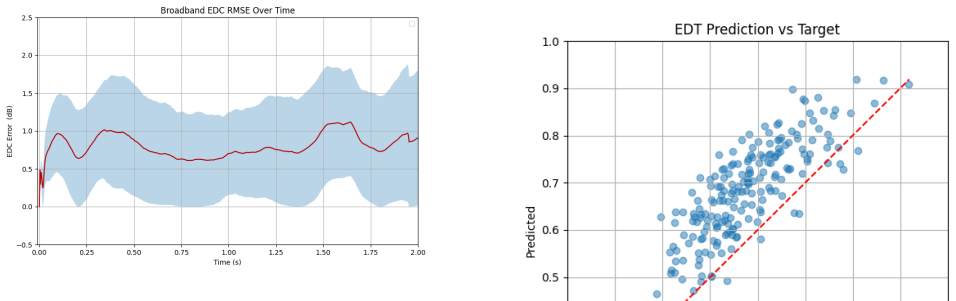
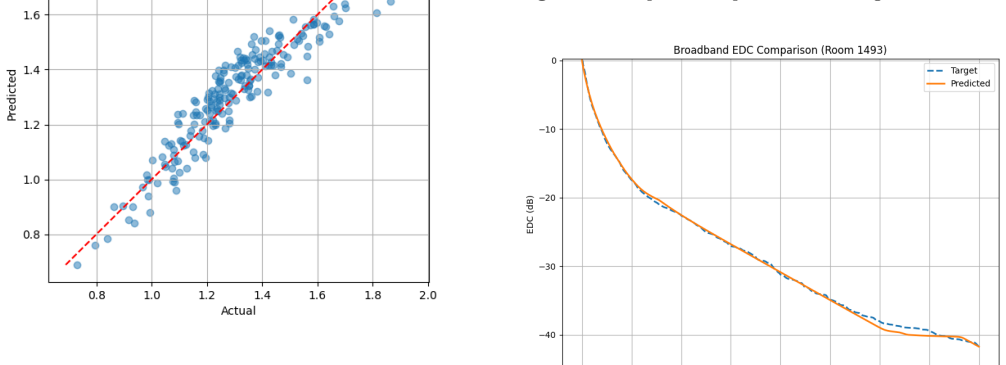
The neural network framework successfully approximates ground-truth acoustics with minimal error in T30 and clarity indices by predicting multi-band Energy Decay Curves directly from room geometry and material properties using a custom composite loss function.
What carries the argument
Custom composite loss function that jointly optimizes energy levels and decay slopes in the log-domain.
If this is right
- The predicted curves can be inverted to synthesize room impulse responses for audio rendering.
- The approach reduces computation time relative to full acoustic simulation methods.
- It supports interactive virtual environments where room acoustics must update quickly.
- Sensitivity to early reflections and reverberation time is preserved in the output curves.
Where Pith is reading between the lines
- Real-time updates to room geometry during a simulation session could allow live acoustic feedback.
- The same input representation might be tested on non-rectangular or furnished rooms to check generalization.
- Integration with visual rendering pipelines could produce synchronized audio-visual changes in VR.
Load-bearing premise
Optimizing the custom composite loss for energy levels and decay slopes in the log-domain is sufficient to guarantee that the predicted curves adhere to physical decay principles and remain sensitive to reverberation time and early reflections.
What would settle it
Compare the model's predicted T30 and clarity values against measurements from a real room whose exact geometry and surface materials are known; large systematic deviations would falsify the approximation claim.
Figures



read the original abstract
Predicting Room Impulse Responses (RIRs) remains a challenge due to the high dimensionality of audio signals and the need for perceptual accuracy. This paper introduces a neural network framework that predicts multi-band Energy Decay Curves (EDCs) directly from room geometry and material properties. Unlike standard models, our framework employs a custom composite loss function that optimizes for both energy levels and decay slopes in the log-domain. This ensures the predicted curves adhere to physical decay principles while maintaining high sensitivity to reverberation time and early reflections. Results demonstrate that the model successfully approximates ground-truth acoustics with minimal error in T30 and clarity indices. The approach offers a computationally efficient alternative to traditional simulations, facilitating realistic audio rendering for interactive virtual environments.
Editorial analysis
A structured set of objections, weighed in public.
Referee Report
Summary. The paper introduces a neural network framework that predicts multi-band Energy Decay Curves (EDCs) directly from room geometry and material properties. It employs a custom composite loss function optimizing both energy levels and decay slopes in the log-domain to ensure adherence to physical decay principles and sensitivity to reverberation time and early reflections. The central claim is that this yields minimal error in derived T30 and clarity indices, providing a computationally efficient alternative to traditional RIR simulations for virtual environments.
Significance. If the quantitative results and physical consistency hold, the work could offer a practical advance for real-time acoustic rendering in interactive applications by bypassing expensive wave-based or geometric simulations. The emphasis on a composite loss targeting log-domain slopes is a reasonable direction for perceptual accuracy, but the absence of reported error metrics or validation protocols in the abstract prevents a full assessment of its contribution relative to prior ML-based acoustics models.
major comments (2)
- [Abstract] Abstract: The assertion that 'results demonstrate that the model successfully approximates ground-truth acoustics with minimal error in T30 and clarity indices' supplies no numerical error values, standard deviations, validation-set details, or comparison baselines. This is load-bearing because the paper's success claim and the utility of the custom loss rest entirely on this unquantified statement.
- [Abstract] Abstract (custom composite loss description): The loss is stated to optimize 'energy levels and decay slopes in the log-domain' to enforce physical decay principles, yet no explicit constraints (monotonicity penalties, ReLU on slopes, non-negativity enforcement, or post-training physical checks) are mentioned. If the loss permits non-monotonic segments or negative energies while still minimizing the composite terms, the derived T30 and clarity indices could be unreliable even if reported errors appear small.
minor comments (1)
- [Title] The title contains an awkward comma and could be rephrased for clarity (e.g., 'Predicting Energy Decay Curves from Room Geometry and Materials').
Simulated Author's Rebuttal
We thank the referee for the constructive feedback on our manuscript. The comments highlight opportunities to strengthen the abstract and clarify the loss function. We address each major comment below and will make the indicated revisions in the next version.
read point-by-point responses
-
Referee: [Abstract] The assertion that 'results demonstrate that the model successfully approximates ground-truth acoustics with minimal error in T30 and clarity indices' supplies no numerical error values, standard deviations, validation-set details, or comparison baselines. This is load-bearing because the paper's success claim and the utility of the custom loss rest entirely on this unquantified statement.
Authors: We agree that the abstract would be improved by including specific quantitative results to support the claims. The experimental section of the manuscript already reports mean errors, standard deviations, validation-set sizes, and baseline comparisons for T30 and clarity indices. In the revised version we will incorporate representative numerical values and validation details into the abstract so that the success claim is quantified rather than qualitative. revision: yes
-
Referee: [Abstract] The loss is stated to optimize 'energy levels and decay slopes in the log-domain' to enforce physical decay principles, yet no explicit constraints (monotonicity penalties, ReLU on slopes, non-negativity enforcement, or post-training physical checks) are mentioned. If the loss permits non-monotonic segments or negative energies while still minimizing the composite terms, the derived T30 and clarity indices could be unreliable even if reported errors appear small.
Authors: The referee correctly notes that the abstract and current methods description do not explicitly list additional constraints or post-training checks. Our composite loss penalizes deviations in log-energy levels and in the computed slopes, which empirically produces monotonic positive decays in all reported experiments. To address the concern, we will expand the methods section with the precise loss formulation, describe how the slope term discourages non-monotonicity, and add a short report of post-training monotonicity and non-negativity statistics on the validation set. We will also consider a small explicit monotonicity regularizer if it further improves robustness. revision: yes
Circularity Check
T30 and clarity errors partly forced by composite loss optimizing decay slopes
specific steps
-
fitted input called prediction
[Abstract]
"our framework employs a custom composite loss function that optimizes for both energy levels and decay slopes in the log-domain. This ensures the predicted curves adhere to physical decay principles while maintaining high sensitivity to reverberation time and early reflections. Results demonstrate that the model successfully approximates ground-truth acoustics with minimal error in T30 and clarity indices."
The loss explicitly optimizes decay slopes (log-domain), which directly determine T30 via the standard 30 dB drop calculation on the EDC. Reporting 'minimal error in T30' after slope optimization makes the T30 metric a near-direct consequence of the fitted loss term rather than an independent validation of the geometry-to-EDC mapping.
full rationale
The paper trains a neural network to output multi-band EDCs and evaluates derived quantities (T30, clarity) that are direct functions of the optimized terms in the custom loss. This matches the fitted-input-called-prediction pattern: the loss includes decay slopes in the log domain, from which T30 is computed, so reported low T30 error is not an independent test of the model's predictive power. No self-citations or self-definitional equations are present, but the central performance claim reduces to the training objective by construction. The derivation chain is otherwise a standard supervised regression and receives a moderate circularity score.
Axiom & Free-Parameter Ledger
Lean theorems connected to this paper
-
IndisputableMonolith/Cost/FunctionalEquation.leanwashburn_uniqueness_aczel unclear?
unclearRelation between the paper passage and the cited Recognition theorem.
custom composite loss function that optimizes for both energy levels and decay slopes in the log-domain... Slope Penalty... finite difference with a stride of 50 samples... suppress the 'staircase' artifacts... monotonic energy decay
-
IndisputableMonolith/Foundation/RealityFromDistinction.leanreality_from_one_distinction unclear?
unclearRelation between the paper passage and the cited Recognition theorem.
1D-Convolutional Neural Network (CNN) decoder... 90% reduction in model complexity... 9 million parameters
What do these tags mean?
- matches
- The paper's claim is directly supported by a theorem in the formal canon.
- supports
- The theorem supports part of the paper's argument, but the paper may add assumptions or extra steps.
- extends
- The paper goes beyond the formal theorem; the theorem is a base layer rather than the whole result.
- uses
- The paper appears to rely on the theorem as machinery.
- contradicts
- The paper's claim conflicts with a theorem or certificate in the canon.
- unclear
- Pith found a possible connection, but the passage is too broad, indirect, or ambiguous to say the theorem truly supports the claim.
Reference graph
Works this paper leans on
- [1]
-
[2]
Available: https://doi.org/10.1201/ 9781482266450
[Online]. Available: https://doi.org/10.1201/ 9781482266450
-
[3]
M. Vorl¨ ander,Auralization: Fundamentals of Acoustics, Modelling, Simulation, Algorithms and Acoustic Virtual Reality, 2nd ed. Cham: Springer,
-
[4]
Available: https://link.springer
[Online]. Available: https://link.springer. com/book/10.1007/978-3-030-51202-6
-
[5]
Py- roomacoustics: A python package for audio room simulation and array processing algorithms,
R. Scheibler, E. Bezzam, and I. Dokmani´ c, “Py- roomacoustics: A python package for audio room simulation and array processing algorithms,” in 2018 IEEE International Conference on Acoustics, Speech and Signal Processing (ICASSP), 2018, pp. 351–355
work page 2018
-
[6]
Gsound: Interactive sound propagation for games,
C. Schissler and D. Manocha, “Gsound: Interactive sound propagation for games,” inAudio Engineering Society Conference: 41st International Conference: Audio for Games. Audio Engineering Society, 2011
work page 2011
-
[7]
V. Acoustics, “Itageometricalacoustics,” 2025. [On- line]. Available: https://www.virtualacoustics.org/ GA/
work page 2025
-
[8]
Ac- celerated beam tracing algorithm,
S. Laine, S. Siltanen, T. Lokki, and L. Savioja, “Ac- celerated beam tracing algorithm,”Applied Acous- tics, vol. 70, no. 1, pp. 172–181, 2009
work page 2009
-
[9]
Mean ab- sorption estimation from room impulse responses using virtually supervised learning,
C. Foy, A. Deleforge, and D. Di Carlo, “Mean ab- sorption estimation from room impulse responses using virtually supervised learning,” inInterna- tional Workshop on Acoustic Signal Enhancement (IWAENC), 2021
work page 2021
-
[10]
Predicting room acoustic parameters from room geometry us- ing deep learning,
C. Meng, N. Shabtai, and B. Rafaely, “Predicting room acoustic parameters from room geometry us- ing deep learning,”The Journal of the Acoustical Society of America, vol. 154, no. 4, pp. 2452–2461, 2023
work page 2023
-
[11]
Deep room impulse response completion,
J. Lin, G. G¨ otz, and S. J. Schlecht, “Deep room impulse response completion,”EURASIP Journal on Audio, Speech, and Music Processing, vol. 2025, no. 20, 2025. [Online]. Available: https://doi.org/10.1186/s13636-024-00383-1
-
[12]
Room impulse re- sponse reconstruction with physics-informed deep learning,
X. Karakonstantis and et al., “Room impulse re- sponse reconstruction with physics-informed deep learning,”Journal of the Acoustical Society of Amer- ica, 2024
work page 2024
-
[13]
Generative adversarial neu- ral network for room impulse response synthesis,
J. Kim and Y. E. Yang, “Generative adversarial neu- ral network for room impulse response synthesis,” arXiv preprint arXiv:2311.02581, 2023
-
[14]
Storir: Stochastic room impulse response generation for audio data augmentation,
P. Masztalski, M. Matuszewski, K. Piaskowski, and M. Romaniuk, “Storir: Stochastic room impulse response generation for audio data augmentation,”
-
[15]
Available: https://arxiv.org/abs/ 2008.07231
[Online]. Available: https://arxiv.org/abs/ 2008.07231
-
[16]
Deep learning- based prediction of energy decay curves from room geometry and material properties,
M. Imran and S. Gerald, “Deep learning- based prediction of energy decay curves from room geometry and material properties,” in https://arxiv.org/abs/2509.24769, 2026
-
[17]
M. Imran and G. Schuller, “Room impulse re- sponse prediction with neural networks: from en- ergy decay curves to perceptual validation,” in https://arxiv.org/abs/2509.24834, 2026
discussion (0)
Sign in with ORCID, Apple, or X to comment. Anyone can read and Pith papers without signing in.