Equilibrium and dynamics of a three-state opinion model on a network of networks
Pith reviewed 2026-05-21 02:09 UTC · model grok-4.3
The pith
The internal organization of beliefs within each agent determines how much social agitation is needed to destabilize a polarized group consensus.
A machine-rendered reading of the paper's core claim, the machinery that carries it, and where it could break.
Core claim
Each agent holds an internal belief graph where beliefs take polarized or neutral values, with a neutrality parameter controlling neutral conviction and temperature accounting for external agitation and internal dissonance. On a fully connected external social graph with internal topologies of one-dimensional chains, cliques, and star-like structures featuring a central core belief, the polarized consensus destabilizes at a critical temperature that increases with added beliefs for star-like agents but saturates for ring- and clique-like topologies. In equal-proportion binary mixtures of different topologies, the dominant influence on collective behavior depends on the neutrality parameter.
What carries the argument
The network-of-networks structure, where a fully connected external social graph links agents each carrying an internal belief topology (one-dimensional chains, cliques, or stars with central core), with temperature controlling both inter-agent interactions and intra-agent consistency.
If this is right
- Polarized consensus becomes more stable against rising temperature when agents have star-like internal belief structures with more beliefs attached.
- For ring and clique internal topologies the critical temperature saturates and stops increasing once a certain number of beliefs is reached.
- In equal mixtures of agents with different internal topologies, which type dominates the collective outcome depends on the value of the neutrality parameter.
- The model predicts regime-dependent interplay between agents of differing internal organizations.
Where Pith is reading between the lines
- Real populations containing many individuals with core beliefs linked to multiple peripherals may sustain consensus under higher levels of social noise than populations with densely connected belief sets.
- The observed saturation effect implies there may be an effective limit on how much internal complexity improves stability for chain or clique topologies.
- Extending the external graph to include community structure or sparse connections could show whether the topology-specific temperature shifts survive outside the complete-graph case.
Load-bearing premise
The external social graph is fully connected and internal belief structures are restricted to simple topologies like one-dimensional chains, cliques, and stars with a central core belief.
What would settle it
A Monte Carlo run on the same model but with a non-fully-connected external graph in which the critical temperature fails to rise with added beliefs for star-like agents would falsify the reported dependence.
Figures






read the original abstract
Opinion formation models typically represent each individual as a single variable. However, in practice each individual holds interconnected beliefs whose internal organization may influence collective outcomes. To explore this dependence, we study a three-state opinion model on a network of networks in which each agent has an internal belief graph and interacts with other agents through an external social graph. Each belief can take two opposite polarized states or a neutral one and a neutrality parameter tunes the relative conviction of the neutral stance. We incorporate temperature into the model to account for external social agitation and for the tolerance of internal cognitive dissonance. We explore the stationary state and dynamics of the model using analytical approaches and Monte Carlo simulations on a fully connected external social graph, with internal belief topologies given by one-dimensional chains, cliques, and star-like structures, where there is a central core belief to which all other beliefs are connected. We find that the critical temperature at which the polarized consensus destabilizes increases with the addition of more beliefs to star-like agents but saturates in the case of ring- and clique-like internal topologies. We also consider binary mixtures of agents with different internal topologies in equal proportions, showing that the interplay between agents is regime-dependent, with the dominant topology depending on the value of the neutrality parameter.
Editorial analysis
A structured set of objections, weighed in public.
Referee Report
Summary. The manuscript introduces a three-state opinion model on a network of networks in which each agent is equipped with an internal belief graph. Each belief takes one of two polarized states or a neutral state, with a neutrality parameter controlling the weight of the neutral stance. Agents interact through a fully connected external social graph, and temperature is introduced to model social agitation and tolerance to internal dissonance. Analytical methods and Monte Carlo simulations are used to examine stationary states and dynamics for internal topologies consisting of one-dimensional chains, cliques, and star-like structures (with a central core belief). The central result is that the critical temperature at which polarized consensus destabilizes increases with the number of beliefs for star-like agents but saturates for ring- and clique-like internal topologies. Binary mixtures of agents with different internal topologies are also studied, revealing regime-dependent dominance governed by the neutrality parameter.
Significance. If the reported topology dependence survives normalization checks, the work provides a useful extension of opinion dynamics models by showing how the internal organization of an agent's beliefs can modulate collective stability against temperature. The combination of analytical treatment and Monte Carlo simulations on concrete topologies, together with the analysis of mixed populations, constitutes a clear strength and opens avenues for studying cognitive structure effects in sociophysics.
major comments (1)
- [§2] §2 (model definition): The internal Hamiltonian is written as a direct sum of interactions over the edges of the belief graph with no rescaling by the number of beliefs or the number of edges. Consequently, clique and ring topologies accumulate interaction energy quadratically or linearly with added beliefs, while star topologies accumulate it linearly; this difference in total coupling strength at fixed temperature could produce the reported saturation versus monotonic increase without any topological mechanism. The central claim comparing critical temperatures across topologies therefore requires either an explicit normalization (e.g., division by edge count) or a supplementary check that the qualitative behavior is invariant under such rescaling.
minor comments (2)
- [Abstract] The abstract refers to 'ring- and clique-like internal topologies' while the model section specifies 'one-dimensional chains, cliques, and star-like structures'; a brief clarification of whether rings are distinct from chains would improve consistency.
- [Figures] Figure captions and legends should explicitly state the number of Monte Carlo realizations and whether error bars represent standard deviations or standard errors, especially for the critical-temperature curves.
Simulated Author's Rebuttal
We thank the referee for their detailed and constructive report. The concern regarding the normalization of the internal Hamiltonian is well taken, and we address it directly below by clarifying the modeling choice and reporting an explicit check that preserves the central claims.
read point-by-point responses
-
Referee: [§2] §2 (model definition): The internal Hamiltonian is written as a direct sum of interactions over the edges of the belief graph with no rescaling by the number of beliefs or the number of edges. Consequently, clique and ring topologies accumulate interaction energy quadratically or linearly with added beliefs, while star topologies accumulate it linearly; this difference in total coupling strength at fixed temperature could produce the reported saturation versus monotonic increase without any topological mechanism. The central claim comparing critical temperatures across topologies therefore requires either an explicit normalization (e.g., division by edge count) or a supplementary check that the qualitative behavior is invariant under such rescaling.
Authors: We agree that the unnormalized sum over edges leads to different total internal coupling strengths across topologies when the number of beliefs increases. Our modeling choice treats each belief–belief interaction as an independent unit-strength constraint, so that adding beliefs naturally augments the total internal field experienced by the agent; this is intentional and reflects the interpretation that more beliefs impose more cognitive constraints. Nevertheless, to isolate topological effects from the overall energy scale, we have repeated the Monte Carlo simulations after rescaling the internal Hamiltonian by the number of edges in each belief graph. The qualitative results remain unchanged: the critical temperature at which polarized consensus destabilizes continues to rise monotonically with the number of beliefs for star-like agents, while it saturates for both ring and clique topologies. We will add a brief discussion of this normalization check together with the corresponding supplementary figure in the revised §2 and results sections. revision: yes
Circularity Check
No significant circularity; results follow from explicit model definitions and simulations
full rationale
The paper defines a three-state opinion model on a network of networks with explicit internal belief topologies (chains, cliques, stars) and an external fully connected social graph, plus parameters for neutrality and temperature. Stationary states and critical temperatures are obtained from analytical mean-field approaches and Monte Carlo simulations on these fixed structures. No derivation step reduces a claimed result to an input by construction, no fitted quantity is relabeled as a prediction, and no load-bearing premise rests on self-citation chains or imported uniqueness theorems. The reported saturation versus monotonic increase in critical temperature with added beliefs is an output of the simulation protocol rather than a tautological re-expression of the model equations.
Axiom & Free-Parameter Ledger
free parameters (2)
- neutrality parameter
- temperature
axioms (2)
- domain assumption Each belief can take one of two opposite polarized states or a neutral state.
- domain assumption The external social graph is fully connected.
Lean theorems connected to this paper
-
IndisputableMonolith/Cost/FunctionalEquation.leanwashburn_uniqueness_aczel unclear?
unclearRelation between the paper passage and the cited Recognition theorem.
H = −J/z_ext ∑_μ ∑_<i,j>_ext s̄^μ_i · s̄^μ_j − J/z_int ∑_i ∑_<μ,ν>_int s̄^μ_i · s̄^ν_i (Eq. 2); order parameters m, n0; MFA free energy L(m,n,β) (Eq. 6)
-
IndisputableMonolith/Foundation/AlexanderDuality.leanalexander_duality_circle_linking unclear?
unclearRelation between the paper passage and the cited Recognition theorem.
internal topologies (clique, ring, star) and critical temperature vs. number of beliefs c
What do these tags mean?
- matches
- The paper's claim is directly supported by a theorem in the formal canon.
- supports
- The theorem supports part of the paper's argument, but the paper may add assumptions or extra steps.
- extends
- The paper goes beyond the formal theorem; the theorem is a base layer rather than the whole result.
- uses
- The paper appears to rely on the theorem as machinery.
- contradicts
- The paper's claim conflicts with a theorem or certificate in the canon.
- unclear
- Pith found a possible connection, but the passage is too broad, indirect, or ambiguous to say the theorem truly supports the claim.
Reference graph
Works this paper leans on
-
[1]
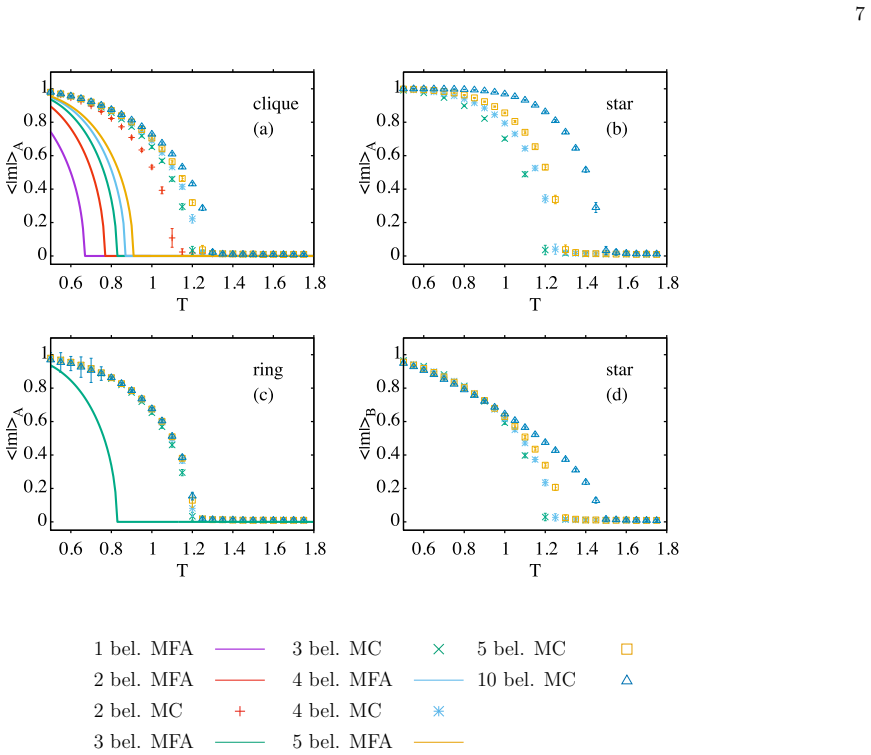
We choose two values for the neutrality parameter: α= 0, for which we expect a second-order phase transi- tion, andα= 0.85, which lies in the first-order transition regime for the fully connected internal graph. Our aim is to understand how the critical and tricritical points vary with system parameters and with the beliefs’ topol- ogy. Since, for both th...
-
[2]
Results for α= 0 When α= 0 , all topologies exhibit a second-order phase transition for the number of internal beliefs stud- ied. As observed for ER graphs [32], the MFA under- estimates the critical temperature value, yet it qualita- tively captures the influence of additional beliefs on it for the clique and ring internal topologies, as shown in Fig. 4(...
-
[3]
Results for α= 0.85 When all nodes have the same degreeki = z, which holds true for both ring and clique agents, all beliefs share the same magnetization such thatmµ= m and the fraction of neutral beliefs nµ 0 = n0 for all µ∈ {A,B,C,...}. Consequently, the mean-field free-energy functionL(m,n,β)≡(HMF−β−1SMF)/N simplifies to: L(m,n,β) =−z 2 ( m2 +α2n2) +zα...
work page 2000
-
[4]
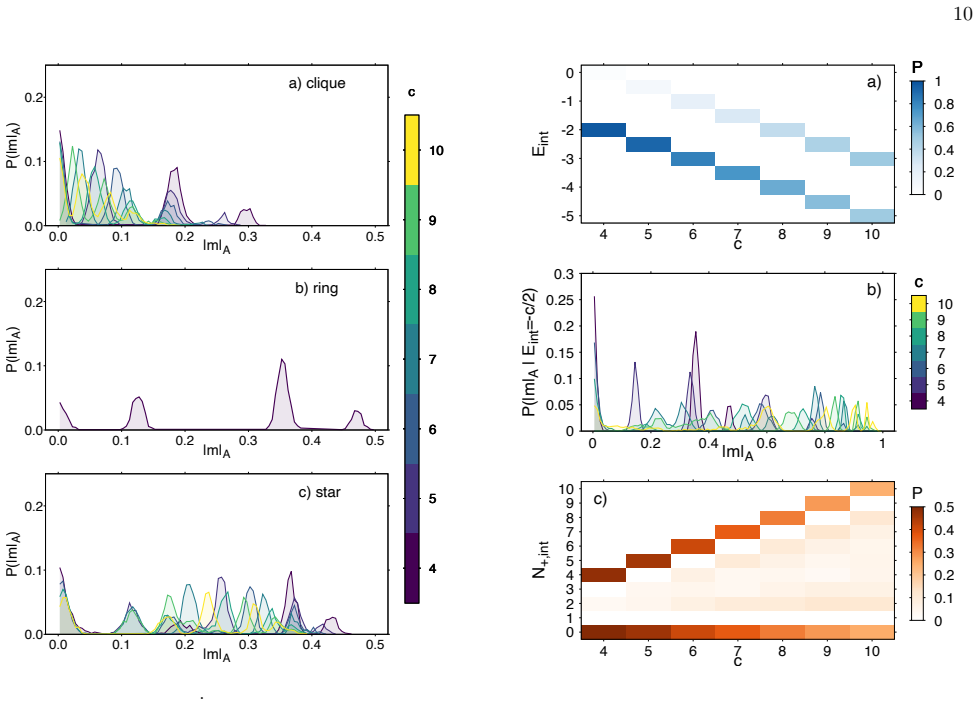
The values for N0,int are no longer merely thermal fluctuations, but complementMint, meaning that when Mint = 0, it is not due to an equal number of opposite be- liefs, but because there is neutral internal agreement. In this scenario, rings, rather than stars, are the dominant structure. When cliques are alone, they display an almost flat distribution fo...
- [5]
-
[6]
F. Baumann, P. Lorenz-Spreen, I. M. Sokolov, and M. Starnini, Phys. Rev. X11, 011012 (2021)
work page 2021
-
[7]
T. M. Pham, J. Korbel, R. Hanel, and S. Thurner, Proc. Natl. Acad. Sci. U.S.A. 119, 10.1073/pnas.2121103119 (2022)
- [8]
-
[9]
R. P. Abelson and M. J. Rosenberg, Behav. Sci. 3, 1 (1958)
work page 1958
-
[10]
Crystal time-reversal symmetry breaking and spontaneous hall effect in collinear anti- ferromagnets,
J. Dalege and T. van der Does, Sci. Adv.8, 10.1126/sci- adv.abm0137 (2022)
-
[11]
M. Vlasceanu, A. M. Dyckovsky, and A. Coman, Per- spect. Psychol. Sci.19, 444–453 (2023)
work page 2023
- [12]
- [13]
-
[14]
A. P. Davison and S. Appukuttan, eLife 11, e84463 (2022)
work page 2022
- [15]
-
[16]
H. Kim, O. K. Pineda, and C. Gershenson, Complexity 2019, 1–11 (2019)
work page 2019
-
[17]
L. A. Escobar, H. Kim, and C. Gershenson, Complexity 2019, 1–14 (2019)
work page 2019
-
[18]
M. S. Granovetter, Am. J. Sociol.78, 1360 (1973)
work page 1973
-
[19]
N. E. Friedkin, A. V. Proskurnikov, R. Tempo, and S. E. Parsegov, Science 354, 321 (2016)
work page 2016
-
[20]
H. L. J. van der Maas, J. Dalege, and L. Waldorp, J. Complex Netw. 8, 10.1093/comnet/cnaa010 (2020)
- [21]
- [22]
-
[23]
A. Bizyaeva, A. Franci, and N. E. Leonard, IEEE Trans. Autom. Control 70, 5082–5097 (2025)
work page 2025
-
[24]
C. Castellano, S. Fortunato, and V. Loreto, Rev. Mod. Phys. 81, 591–646 (2009)
work page 2009
-
[25]
Abelson, in Contributions to mathematical psychol- ogy, edited by N
R. Abelson, in Contributions to mathematical psychol- ogy, edited by N. Fredericksen and H. Gullicksen (Holt, Rinehart & Winston, New York, 1964)
work page 1964
-
[26]
G. Deffuant, D. Neau, F. Amblard, and G. Weisbuch, Adv. in Compl. Syst.3, 87 (2000)
work page 2000
-
[27]
G. Deffuant, F. Amblard, G. Weisbuch, and T. Faure, J. Artif. Soc. Soc. Simul.5 (2002)
work page 2002
-
[28]
R. A. Holley and T. M. Liggett, Ann. Probab.3, 643 (1975)
work page 1975
-
[29]
Ising, Zeitschrift für Physik31, 253 (1925)
E. Ising, Zeitschrift für Physik31, 253 (1925)
work page 1925
- [30]
-
[31]
K. Sznajd-Weron and J. Sznajd, Int. J. Mod. Phys. C11, 1157–1165 (2000)
work page 2000
- [32]
-
[33]
Y.-H. Yang, Physics Procedia3, 1839 (2010), the Inter- national Conference on Complexity and Interdisciplinary Sciences.The3rdChina-EuropeSummerSchoolonCom- plexity Sciences
work page 2010
-
[34]
T. C. Schelling, J. Math. Sociol.1, 143 (1971)
work page 1971
-
[35]
L. Gauvin, J.-P. Nadal, and J. Vannimenus, Phys. Rev. E 81, 066120 (2010)
work page 2010
- [36]
-
[37]
I. Ferri, C. Pérez-Vicente, M. Palassini, and A. Díaz- Guilera, Entropy 24, 10.3390/e24111627 (2022)
- [38]
-
[39]
L.Festinger, A Theory of Cognitive Dissonance (Stanford University Press, Stanford, CA, 1957)
work page 1957
-
[40]
Harmon-Jones,Cognitive Dissonance: Reexamining a Pivotal Theory in Psychology , 2nd ed
E. Harmon-Jones,Cognitive Dissonance: Reexamining a Pivotal Theory in Psychology , 2nd ed. (American Psy- chological Association, 2019)
work page 2019
-
[41]
M. McPherson, L. Smith-Lovin, and J. M. Cook, Annu. Rev. Sociol. 27, 415–444 (2001)
work page 2001
- [42]
-
[43]
Hoffer,The True Believer: Thoughts on the Nature of Mass Movements (Harper and Row, 1951)
E. Hoffer,The True Believer: Thoughts on the Nature of Mass Movements (Harper and Row, 1951)
work page 1951
-
[44]
Z. Kovács, G. Palla, and A. Zafeiris, Sci. Rep. 16, 10.1038/s41598-025-31643-5 (2025)
-
[45]
J. R. Zaller, The Nature and Origins of Mass Opinion (Cambridge University Press, Cambridge, 1992)
work page 1992
- [46]
- [47]
-
[48]
D. Borsboom, M. K. Deserno, M. Rhemtulla, S. Ep- skamp, E. I. Fried, R. J. McNally, D. J. Robinaugh, M. Perugini, J. Dalege, G. Costantini, A.-M. Isvoranu, A. C. Wysocki, C. D. van Borkulo, R. van Bork, and L. J. Waldorp, Nat. Rev. Methods Primers1, 58 (2021)
work page 2021
-
[49]
J. Gómez-Gardeñes, M. de Domenico, G. Gutiérrez, A. Arenas, and S. Gómez, Philos. Trans. R. Soc. A373, 20150117 (2015)
work page 2015
-
[50]
S. Jang, J. S. Lee, S. Hwang, and B. Kahng, Phys. Rev. E 92, 022110 (2015)
work page 2015
- [51]
- [52]
- [53]
- [54]
-
[55]
M. Sales-Pardo, R. Guimerà, A. A. Moreira, and L. A. N. Amaral, Proc. Natl. Acad. Sci. U.S.A.104, 15224 (2007)
work page 2007
discussion (0)
Sign in with ORCID, Apple, or X to comment. Anyone can read and Pith papers without signing in.