A Fixed-Grid Affine-Constrained Multiwavelet Coefficient Method for Buckley--Leverett Shock Capturing
Pith reviewed 2026-05-21 01:57 UTC · model grok-4.3
The pith
Affine-constrained multiwavelet coefficients enable exact inflow enforcement in conservative shock-capturing simulations of saturation transport.
A machine-rendered reading of the paper's core claim, the machinery that carries it, and where it could break.
Core claim
The central discovery is that an affine constraint can be applied to the multiwavelet coefficient vector to enforce a prescribed inflow trace exactly while the conservative weak-form update with monotone fluxes and a modal limiter produces saturation profiles and breakthrough curves that match reference solutions for the Buckley-Leverett problem, with saturation bounds controlled by mean-preserving rescaling and accumulated mass-balance defects remaining small.
What carries the argument
Affine lifting of the coefficient vector to satisfy the linear trace constraint on the inflow cell, applied in the detail subspace so that the mean mode remains unchanged.
If this is right
- The method preserves the imposed inflow trace to roundoff accuracy regardless of mesh size.
- The saturation bounds are controlled without violating conservation through detail rescaling.
- Piecewise-linear local representations (p=2) give the optimal accuracy-cost trade-off among tested modal orders.
- Global mass balance defects accumulate slowly and remain small on refined meshes.
Where Pith is reading between the lines
- This boundary enforcement technique might extend to other hyperbolic conservation laws with prescribed inflow on fixed grids.
- Combining the mean-detail separation with adaptive detail thresholding could further reduce computational cost for problems with localized shocks.
- The approach suggests a path toward high-order methods that avoid the usual conflict between conservation and boundary accuracy in discontinuous solutions.
Load-bearing premise
The validation of the method's accuracy rests on the independent reference solution correctly solving the same physical problem with identical parameters and fractional-flow model.
What would settle it
Running the method on a problem with a known exact solution, such as a Riemann problem for the Buckley-Leverett equation, and checking if the computed shock position and height match the analytic values would test the central accuracy claim.
Figures

read the original abstract
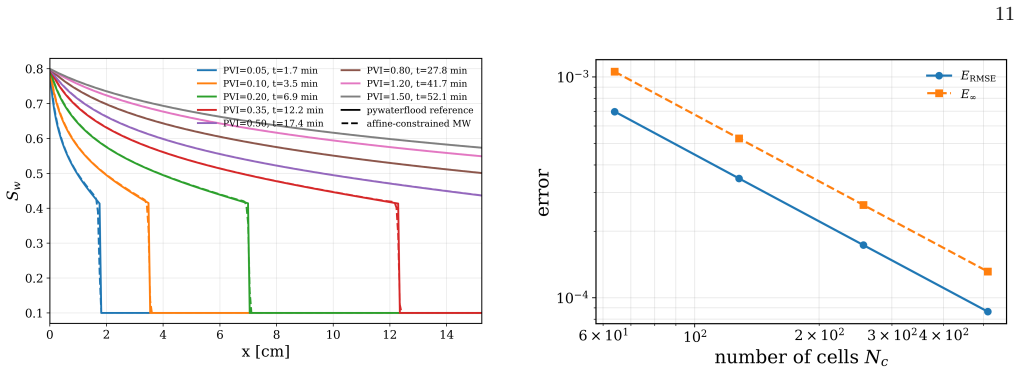
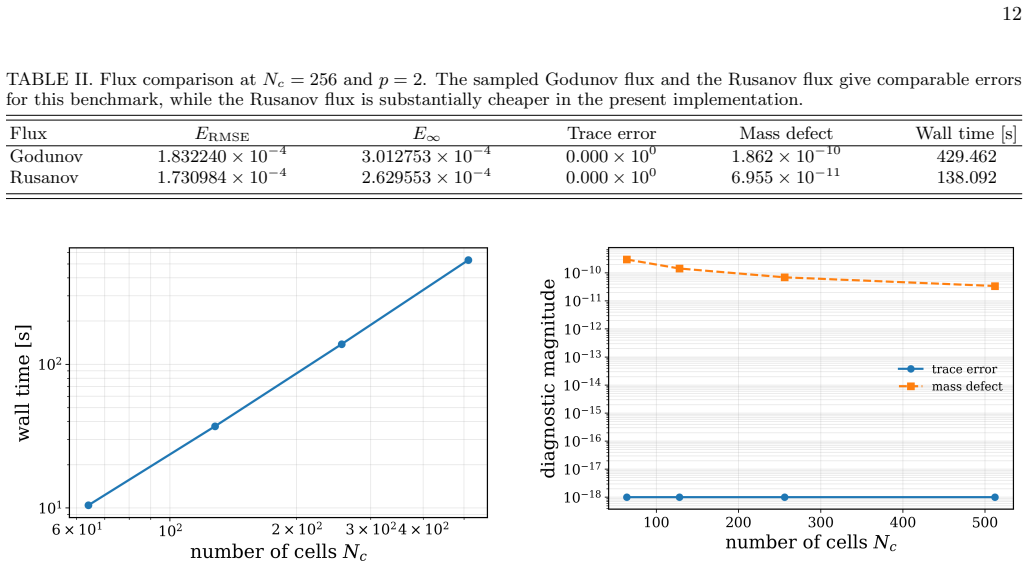
We present a fixed-grid conservative affine-constrained modal/multiwavelet coefficient method for one-dimensional Buckley--Leverett saturation transport. The saturation is evolved directly in a local orthonormal coefficient basis with a mean/detail structure: the first mode carries the conservative cell average, whereas higher modes carry zero-mean local details. The hyperbolic inflow condition is imposed as a linear trace constraint on the coefficient vector and enforced by affine lifting. For $(p>1)$, the boundary reprojection is applied in the detail subspace of the inflow cell, so that the prescribed trace is restored without modifying the conservative cell-average update. The transport operator is discretized in conservative weak form with monotone numerical fluxes, and shock-induced oscillations are controlled by a troubled-cell limiter acting on modal details. The method is validated on a Berea-core waterflood benchmark against an independent \texttt{pywaterflood} reference solution using the same Corey fractional-flow closure, physical parameters, and pore-volume-injected scaling. The affine-constrained coefficient solver reproduces the reference breakthrough curve and saturation profiles, preserves the imposed inflow trace to roundoff accuracy, controls saturation bounds through mean-preserving detail rescaling, and gives small accumulated global mass-balance defects. Mesh-refinement, flux-comparison, and modal-order studies show that $(p=2)$, corresponding to a piecewise-linear local representation, provides the most favorable accuracy--cost compromise among the tested orders for this shock-dominated benchmark.
Editorial analysis
A structured set of objections, weighed in public.
Referee Report
Summary. The manuscript presents a fixed-grid conservative affine-constrained modal/multiwavelet coefficient method for one-dimensional Buckley-Leverett saturation transport. Saturation is evolved in a local orthonormal coefficient basis separating the conservative cell average (first mode) from zero-mean details (higher modes). The hyperbolic inflow condition is imposed as a linear trace constraint enforced by affine lifting, with boundary reprojection applied in the detail subspace for p>1 to restore the trace without altering the cell-average update. The transport operator uses conservative weak form with monotone numerical fluxes, and oscillations are controlled by a troubled-cell limiter on modal details. Validation on a Berea-core waterflood benchmark against an independent pywaterflood reference (same Corey closure, parameters, and PVI scaling) shows reproduction of breakthrough curves and saturation profiles, roundoff-accurate inflow trace preservation, saturation bound control via mean-preserving detail rescaling, and small accumulated global mass-balance defects, with p=2 identified as the optimal accuracy-cost compromise.
Significance. If the reported properties hold under more rigorous scrutiny, the method offers a promising conservative, bound-preserving discretization for hyperbolic conservation laws that directly incorporates boundary trace constraints via affine lifting in a multiwavelet basis. This could be useful for reservoir simulation and two-phase porous-media flow where strict mass conservation and bound control are essential. The approach avoids parameter fitting and demonstrates practical performance on a standard shock-dominated benchmark. However, the current evidence base is moderate, limiting the immediate impact until quantitative error analysis and reference-independent verification are added.
major comments (3)
- Abstract and validation section: The central claims of reproducing the reference breakthrough curve, preserving the inflow trace to roundoff accuracy, controlling saturation bounds, and achieving small mass-balance defects rest entirely on agreement with the pywaterflood reference. No quantitative error norms (e.g., L1 or L2 errors on saturation profiles), convergence rates under mesh refinement, or sensitivity tests to the reference's discretization of the nonlinear fractional-flow function are reported, so the support for the method's conservation and enforcement properties remains moderate rather than conclusive.
- Method description (affine lifting and boundary reprojection): The procedure for imposing the trace constraint via affine lifting and performing reprojection in the detail subspace for p>1 is described at a conceptual level, but the explicit form of the lifting operator, the projection matrix onto the detail subspace, or the algebraic steps that guarantee roundoff-accurate trace restoration without modifying the conservative update are not provided. This makes independent verification of the claimed roundoff accuracy difficult.
- Validation and mesh-refinement studies: The statement that p=2 provides the most favorable accuracy-cost compromise is based on mesh-refinement, flux-comparison, and modal-order studies, yet no tabulated error metrics, CPU timings, or direct comparison of mass defects across orders p=1,2,3 are supplied. Without these data, the optimality claim for p=2 cannot be assessed quantitatively.
minor comments (2)
- Ensure that all figures showing saturation profiles and breakthrough curves include the corresponding pywaterflood reference data overlaid for direct visual comparison, and that axis labels and legends clearly distinguish the new method from the reference.
- The abstract mentions 'small accumulated global mass-balance defects'; provide the exact definition of the global mass defect (e.g., integrated over all cells and time steps) and report its magnitude relative to machine epsilon or total injected mass.
Simulated Author's Rebuttal
We thank the referee for the constructive and detailed review. We address each major comment below and indicate the revisions planned for the next version of the manuscript.
read point-by-point responses
-
Referee: Abstract and validation section: The central claims of reproducing the reference breakthrough curve, preserving the inflow trace to roundoff accuracy, controlling saturation bounds, and achieving small mass-balance defects rest entirely on agreement with the pywaterflood reference. No quantitative error norms (e.g., L1 or L2 errors on saturation profiles), convergence rates under mesh refinement, or sensitivity tests to the reference's discretization of the nonlinear fractional-flow function are reported, so the support for the method's conservation and enforcement properties remains moderate rather than conclusive.
Authors: We agree that quantitative error norms and convergence data would strengthen the validation. In the revised manuscript we will add L1 and L2 error norms on saturation profiles at selected times, observed convergence rates under mesh refinement, and a short sensitivity study to the reference solution's discretization of the fractional-flow function. These results will be reported in the validation section. revision: yes
-
Referee: Method description (affine lifting and boundary reprojection): The procedure for imposing the trace constraint via affine lifting and performing reprojection in the detail subspace for p>1 is described at a conceptual level, but the explicit form of the lifting operator, the projection matrix onto the detail subspace, or the algebraic steps that guarantee roundoff-accurate trace restoration without modifying the conservative update are not provided. This makes independent verification of the claimed roundoff accuracy difficult.
Authors: We acknowledge that the absence of explicit algebraic expressions limits independent verification. The revised manuscript will include the explicit form of the affine lifting operator, the orthogonal projection matrix onto the detail subspace, and the algebraic steps of the boundary reprojection procedure, together with a brief argument showing that the conservative cell-average update is unaffected. revision: yes
-
Referee: Validation and mesh-refinement studies: The statement that p=2 provides the most favorable accuracy-cost compromise is based on mesh-refinement, flux-comparison, and modal-order studies, yet no tabulated error metrics, CPU timings, or direct comparison of mass defects across orders p=1,2,3 are supplied. Without these data, the optimality claim for p=2 cannot be assessed quantitatively.
Authors: We accept that tabulated quantitative metrics are required to support the optimality statement. The revised version will contain a table reporting L1 errors, CPU time per time step, and accumulated mass defects for p=1, 2, and 3 across the mesh-refinement study, allowing direct quantitative assessment of the accuracy-cost trade-off. revision: yes
Circularity Check
No circularity: method derivation and validation rest on independent external reference
full rationale
The paper introduces a fixed-grid affine-constrained multiwavelet method for the Buckley-Leverett problem, with the saturation evolved in a local orthonormal coefficient basis, hyperbolic inflow imposed via affine lifting on the trace constraint, and transport discretized in conservative weak form with monotone fluxes and a troubled-cell limiter. All load-bearing claims about reproduction of breakthrough curves, trace preservation to roundoff, bound control via mean-preserving rescaling, and small mass-balance defects are supported by direct numerical comparison to the independent pywaterflood reference solution using identical Corey closure, parameters, and PVI scaling. No step reduces by construction to a fitted quantity defined inside the paper, no self-citation chain carries the central premise, and the uniqueness or ansatz choices are not imported from prior author work as an external theorem. The derivation is therefore self-contained against external benchmarks.
Axiom & Free-Parameter Ledger
axioms (1)
- domain assumption The Buckley-Leverett saturation transport is governed by a hyperbolic conservation law with a nonlinear fractional flow function.
Reference graph
Works this paper leans on
-
[1]
S. E. Buckley and M. C. Leverett,Mechanism of fluid displacement in sands, Transactions of the AIME146, 107–116 (1942)
work page 1942
-
[2]
S. E. Buckley and M. C. Leverett,Mechanism of fluid displacements in sands, Transactions of the AIME146, 107–116 (1952), classical work on immiscible two-phase 14 displacement theory using fractional flow analysis
work page 1952
-
[3]
L. Belazreg, S. M. Mahmood, and A. Aulia,Novel ap- proach for predicting water alternating gas injection re- covery factor, Journal of Petroleum Exploration and Pro- duction Technology9, 2893–2910 (2019), forecasting per- formance of immiscible WAG floods using analytical pre- diction tools
work page 2019
-
[4]
L. P. Dake,Fundamentals of Reservoir Engineering, De- velopments in Petroleum Science, Vol. 8 (Elsevier, Ams- terdam, 1978)
work page 1978
-
[5]
R. Helmig,Multiphase Flow and Transport Processes in the Subsurface: A Contribution to the Modeling of Hy- drosystems(Springer, Berlin Heidelberg, 1997)
work page 1997
-
[6]
Z. Chen, G. Huan, and Y. Ma,Computational Methods for Multiphase Flows in Porous Media(SIAM, Philadel- phia, 2006)
work page 2006
-
[7]
E. F. Kaasschieter,Solving the buckley–leverett equation with gravity in a heterogeneous porous medium, Compu- tational Geosciences3, 23–48 (1999), hyperbolic limit and capillary regularisation discussion
work page 1999
-
[8]
K. R. Spayd,The buckley–leverett equation with dynamic capillary pressure, SIAM Journal on Applied Mathe- matics71, 1275–1300 (2011), shows how the Buck- ley–Leverett model becomes pseudo-parabolic when a dy- namic capillary term is included, and reduces to a hyper- bolic conservation law in the capillarity-free limit
work page 2011
-
[9]
C. J. van Duijn, X. Cao, and I. S. Pop,Two-phase flow in porous media: Dynamic capillarity and heterogeneous media, Transport in Porous Media109, 333–357 (2015), analyzes two-phase flow with dynamic capillary effects in heterogeneous media, highlighting the transition between hyperbolic and regularised regimes
work page 2015
-
[10]
X. Cao, I. S. Pop,et al.,Degenerate two-phase porous media flow model with dynamic capillarity, Journal of Differential Equations260, 2418–2456 (2016), provides mathematical analysis of a degenerate elliptic–parabolic (pseudo-parabolic) two-phase flow model including dy- namic capillary pressure, with existence/uniqueness re- sults
work page 2016
-
[11]
C.-W. Shu,High order weno and dg methods for time- dependent convection-dominated problems, Journal of Computational Physics316, 598–658 (2016), survey of high-order finite volume/WENO and discontinuous Galerkin methods for hyperbolic conservation laws rel- evant to saturation transport
work page 2016
-
[12]
G.-S. Jiang and C.-W. Shu,Weighted essentially non- oscillatory (weno) methods, Journal of Computational Physics126, 202–228 (1996), foundational work on high- resolution WENO reconstruction for hyperbolic PDEs
work page 1996
-
[13]
N. Gerhardet al.,Multiwavelet-based grid adaptation with discontinuous galerkin schemes, Journal of Compu- tational Physics301, 265–288 (2015), adaptive multires- olution strategies using multiwavelets integrated into DG frameworks for hyperbolic conservation laws
work page 2015
-
[14]
G. Kesserwaniet al.,(multi)wavelets increase both ac- curacy and efficiency of standard godunov-type hydrody- namic models, Advances in Water Resources144, 103693 (2020), multiwavelet adaptivity combined with FV and DG solvers to enhance adaptivity and efficiency
work page 2020
-
[15]
O. P. L. Maˆ ıtre and O. M. Knio (Springer, 2017) Chap. 18, pp. 637–672
work page 2017
-
[16]
S. H. Fouladi, M. Hajiramezanali, H. Amindavar, J. A. Ritcey, and P. Arabshahi,Denoising based on multivari- ate stochastic volatility modeling of multiwavelet coeffi- cients, IEEE Transactions on Signal Processing61, 5578– 5589 (2013)
work page 2013
-
[17]
J. Sembiring, A. S. Sabzevary, and K. Akizuki,Stochastic process on multiwavelet, IFAC Proceedings Volumes35, 211–215 (2002), 15th IFAC World Congress
work page 2002
-
[18]
A. Harten,Adaptive multiresolution schemes for shock computations, Journal of Computational Physics115, 319–338 (1994)
work page 1994
-
[19]
N. Hovhannisyan, S. M¨ uller, and R. Sch¨ afer,Adaptive multiresolution discontinuous galerkin schemes for con- servation laws, Mathematics of Computation83, 113– 151 (2014)
work page 2014
-
[20]
D. Caviedes-Voulli` emeet al.,Multiwavelet-based mesh adaptivity with discontinuous galerkin methods, Applied Mathematical Modelling (2020), please verify full biblio- graphic metadata from your database before submission
work page 2020
-
[21]
N. Gerhard,A wavelet-free approach for multiresolution- based grid adaptation for conservation laws, Journal of Scientific Computing (2022), please verify full biblio- graphic metadata from your database before submission
work page 2022
-
[22]
J. Huang and Y. Cheng,An adaptive multiresolution dis- continuous galerkin method for scalar hyperbolic conser- vation laws in multidimensions, SIAM Journal on Sci- entific Computing (2020), please verify volume, issue, pages, and DOI before submission
work page 2020
-
[23]
F. Male,Pywaterflood: Well connectivity analysis through capacitance-resistance modeling, Journal of Open Source Software9, 6191 (2024)
work page 2024
-
[24]
G. Chavent and J. Jaffr´ e,Mathematical Models and Fi- nite Elements for Reservoir Simulation: Single Phase, Multiphase and Multicomponent Flows through Porous Media, Studies in Mathematics and its Applications, Vol. 17 (North-Holland, Amsterdam, 1986)
work page 1986
-
[25]
B. Alpert,A class of bases inl 2 for the sparse representation of integral operators, SIAM Jour- nal on Mathematical Analysis24, 246–262 (1993), https://doi.org/10.1137/0524016
-
[26]
B. Cockburn and C.-W. Shu,Runge–kutta discontinu- ous galerkin methods for convection-dominated problems, Journal of Scientific Computing16, 173–261 (2001)
work page 2001
-
[27]
J. S. Hesthaven and T. Warburton,Nodal Discontinuous Galerkin Methods: Algorithms, Analysis, and Applica- tions(Springer, New York, 2008)
work page 2008
-
[28]
B. Cockburn and C.-W. Shu,Tvb runge–kutta local pro- jection discontinuous galerkin finite element method for conservation laws. iii. one-dimensional systems, Journal of Computational Physics84, 90–113 (1989)
work page 1989
-
[29]
V. V. Rusanov,Calculation of interaction of non-steady shock waves with obstacles, USSR Computational Math- ematics and Mathematical Physics1, 304–320 (1961)
work page 1961
-
[30]
S. K. Godunov,A difference scheme for numerical solu- tion of discontinuous solution of hydrodynamic equations, Matematicheskii Sbornik47, 271–306 (1959)
work page 1959
-
[31]
X. Zhang and C.-W. Shu,On maximum-principle- satisfying high order schemes for scalar conservation laws, Journal of Computational Physics229, 3091–3120 (2010)
work page 2010
-
[32]
S. Gottlieb, C.-W. Shu, and E. Tadmor,Strong stability- preserving high-order time discretization methods, SIAM Review43, 89–112 (2001)
work page 2001
-
[33]
R. Courant, K. Friedrichs, and H. Lewy,On the partial difference equations of mathematical physics, IBM Jour- nal of Research and Development11, 215–234 (1967)
work page 1967
discussion (0)
Sign in with ORCID, Apple, or X to comment. Anyone can read and Pith papers without signing in.