Large-space and Large-time Asymptotics for the Focusing Nonlinear Schr\"{o}dinger Soliton Gas
Pith reviewed 2026-05-21 01:33 UTC · model grok-4.3
The pith
For the focusing nonlinear Schrödinger soliton gas, large negative space yields a constant finite-gap elliptic solution while large positive time divides into exponentially decaying, modulated elliptic-wave, and unmodulated elliptic-wave ξ=
A machine-rendered reading of the paper's core claim, the machinery that carries it, and where it could break.
Core claim
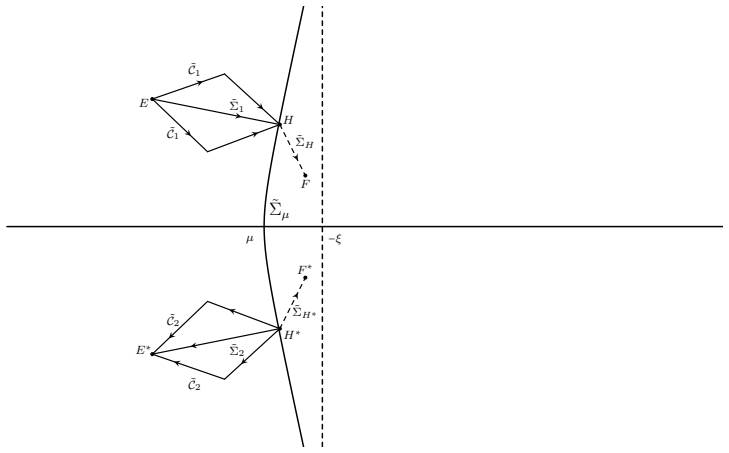
By taking the continuum limit of pure N-soliton solutions with spectrum confined to two segments Σ1 and Σ2, the soliton gas satisfies a Riemann–Hilbert problem whose large-space and large-time behavior is extracted via the nonlinear steepest descent method together with a suitable g-function. As x→−∞ the solution is asymptotically a finite-gap elliptic solution with constant coefficients. Under the assumption that F=H(ξ̂) for ξ̂∈(−E1−√2E2,−E1), the large-time solution exhibits an exponentially decaying region for ξ∈(−E1,+∞), a modulated elliptic-wave region for ξ∈(ξ̂,−E1), and an unmodulated elliptic-wave region for ξ∈(−∞,ξ̂).
What carries the argument
Nonlinear steepest descent analysis of the Riemann–Hilbert problem for the soliton gas, equipped with a g-function that deforms the contour and produces the three asymptotic regions.
If this is right
- Large negative space forces the soliton gas onto a stationary finite-gap elliptic background whose coefficients are independent of x.
- Large positive time produces an exponentially decaying tail for velocities ξ greater than −E1.
- Between ξ̂ and −E1 the solution oscillates as a modulated elliptic wave whose modulation parameters vary with ξ.
- For velocities less than ξ̂ the solution settles into an unmodulated elliptic wave whose parameters are fixed.
Where Pith is reading between the lines
- The same contour-deformation technique may apply to soliton gases in other integrable equations whose spectral data occupy multiple arcs.
- Relaxing the endpoint trajectory assumption would require a different g-function or higher-genus Riemann surface to capture transitional regimes.
- The explicit asymptotic formulas supply initial data for numerical tests of soliton-gas statistics in physical models such as optical fibers.
Load-bearing premise
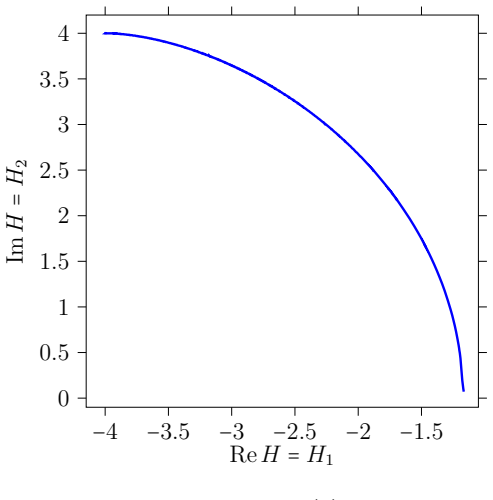
The division of large-time behavior into three distinct regions requires that the endpoint F lies on the trajectory of H(ξ) for some ξ̂ inside the interval (−E1−√2E2,−E1).
What would settle it
Numerical evolution of a large-N soliton solution whose spectrum fills two segments, checking whether the field for large negative x matches a constant-coefficient finite-gap elliptic function and whether the three ξ-regions appear for large t precisely when the endpoint assumption holds.
Figures

read the original abstract
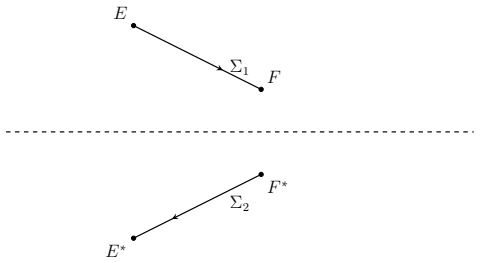
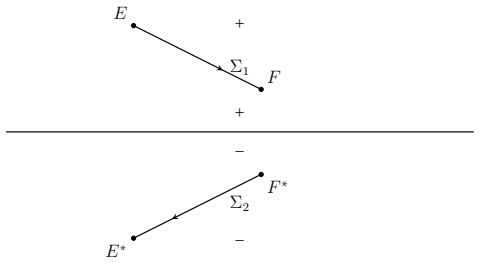
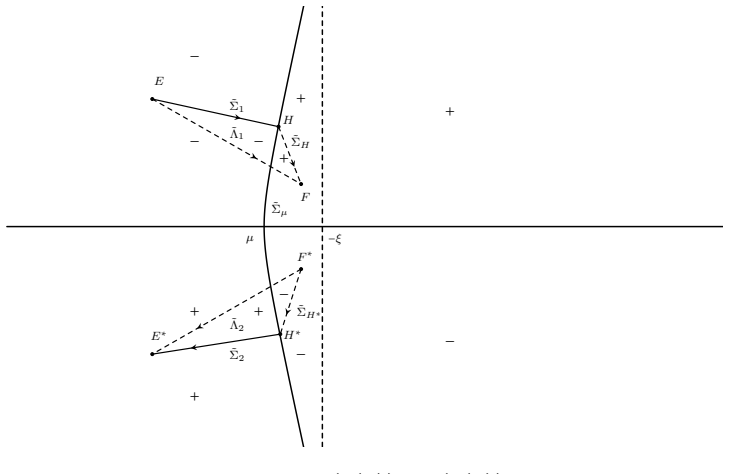
We investigate the large-space and large-time asymptotic behavior of a soliton gas for the focusing nonlinear Schr\"odinger equation. The soliton gas is constructed as the continuum limit of pure $N$-soliton solutions as $N\to\infty$, with the discrete spectrum confined to two segments $\Sigma_1$ and $\Sigma_2$. In particular, our framework does not require the discrete spectrum to be confined to the imaginary axis. By combining the nonlinear steepest descent method with an appropriate $g$-function mechanism, we show that, as $x\to-\infty$, the soliton gas is asymptotically described by a finite-gap elliptic solution with constant coefficients. In the large-time regime $t\to+\infty$, we assume that the endpoint $F$ lies on the trajectory of $H(\xi)$ with $\xi=\frac{x}{2t}\in(-E_1-\sqrt{2}E_2,-E_1)$, namely, $F=H(\hat{\xi})$, $\hat{\xi}\in (-E_1-\sqrt{2}E_2,-E_1)$. Under this assumption, we prove that the solution exhibits distinct asymptotic behaviors in different regions of the variable $\xi=\frac{x}{2t}$. More precisely, there exist an exponentially decaying region $\xi\in(-E_1,+\infty)$, a modulated elliptic-wave region $\xi\in(\hat{\xi},-E_1)$, and an unmodulated elliptic-wave region $\xi\in(-\infty,\hat{\xi})$.
Editorial analysis
A structured set of objections, weighed in public.
Referee Report
Summary. The paper studies large-space and large-time asymptotics of the focusing NLS soliton gas obtained as the continuum limit of N-soliton solutions whose discrete spectrum lies on two segments Σ1 ∪ Σ2 (not necessarily on the imaginary axis). Using the nonlinear steepest descent method together with a g-function, it claims that as x → −∞ the solution is asymptotically a finite-gap elliptic solution with constant coefficients. For t → +∞, under the explicit assumption that the endpoint F lies on the trajectory of H(ξ) for ξ = x/(2t) ∈ (−E1 − √2 E2, −E1), i.e., F = H(ξ̂) for some ξ̂ in that interval, the solution is shown to exhibit three distinct regimes: an exponentially decaying region for ξ ∈ (−E1, +∞), a modulated elliptic-wave region for ξ ∈ (ξ̂, −E1), and an unmodulated elliptic-wave region for ξ ∈ (−∞, ξ̂).
Significance. If the assumption on the location of F is justified and the steepest-descent analysis is complete, the result would extend existing soliton-gas asymptotics to spectra off the imaginary axis and furnish a concrete three-region large-time description that could be relevant to integrable turbulence. The work is technically ambitious and the conditional statement is clearly flagged in the abstract.
major comments (1)
- [Abstract / large-time section] Abstract and the large-time analysis (presumably §4 or §5): the partition into exponentially decaying, modulated elliptic-wave, and unmodulated elliptic-wave regions is derived only after imposing that the continuum-limit endpoint F equals H(ξ̂) for some ξ̂ ∈ (−E1 − √2 E2, −E1). The manuscript states the assumption but supplies no verification that the endpoint arising from the discrete spectrum on Σ1 ∪ Σ2 actually lies on the image of H over this interval. Without such a check or an explicit condition guaranteeing it, the claimed separation of regions and the associated stationary-point analysis do not necessarily hold.
minor comments (2)
- [Introduction / preliminaries] The functions H(ξ), the endpoints E1, E2, and the precise definition of the spectral segments Σ1, Σ2 should be introduced with explicit formulas in a preliminary section before the asymptotic statements are given.
- Notation for the g-function and the contour deformations should be cross-referenced consistently between the large-space and large-time analyses to avoid ambiguity for readers.
Simulated Author's Rebuttal
We thank the referee for their careful reading of the manuscript and for the constructive comment. We address the major point below.
read point-by-point responses
-
Referee: [Abstract / large-time section] Abstract and the large-time analysis (presumably §4 or §5): the partition into exponentially decaying, modulated elliptic-wave, and unmodulated elliptic-wave regions is derived only after imposing that the continuum-limit endpoint F equals H(ξ̂) for some ξ̂ ∈ (−E1 − √2 E2, −E1). The manuscript states the assumption but supplies no verification that the endpoint arising from the discrete spectrum on Σ1 ∪ Σ2 actually lies on the image of H over this interval. Without such a check or an explicit condition guaranteeing it, the claimed separation of regions and the associated stationary-point analysis do not necessarily hold.
Authors: We agree that the separation into the three regions relies on the assumption that F = H(ξ̂) for ξ̂ in (−E1 − √2 E2, −E1). This assumption is explicitly stated in the abstract and is used throughout the large-time analysis because the location of the endpoint F is fixed by the particular choice of the measures in the continuum limit of the discrete spectrum on Σ1 ∪ Σ2. For arbitrary measures the endpoint need not lie on the required trajectory of H(ξ). The result is therefore conditional on this relation between the spectral data and the function H, which is already flagged in the manuscript. To address the referee’s concern we will add a short clarifying paragraph (in the introduction and/or the opening of the large-time section) explaining that the assumption selects a class of admissible spectral measures for which the stationary-point analysis yields the three distinct regimes, and that the condition can be verified directly for any concrete choice of measures on Σ1 ∪ Σ2. We believe this makes the scope of the theorem fully transparent without changing its conditional character. revision: partial
Circularity Check
No significant circularity; asymptotics derived under explicit assumption using external analytic methods
full rationale
The paper explicitly states the assumption that the endpoint F lies on the trajectory of H(ξ) for ξ in the given interval and derives the three-region large-time asymptotics conditionally on this assumption via the nonlinear steepest descent method combined with a g-function mechanism. No step reduces a claimed prediction or result to a fitted parameter or self-defined quantity by the paper's own equations. The large-space finite-gap elliptic solution is likewise obtained from the continuum limit construction without self-referential fitting. The derivation chain is self-contained against the stated analytic techniques and does not rely on load-bearing self-citations or ansatzes smuggled from prior work by the same authors.
Axiom & Free-Parameter Ledger
free parameters (1)
- endpoints E1, E2 of the spectral segments
axioms (1)
- standard math Existence and uniqueness theory for the Riemann-Hilbert problem associated with the focusing NLS
Reference graph
Works this paper leans on
-
[1]
Soliton shielding of the focusing nonlinear Schr¨ odinger equation
Bertola, M., T. Grava, and G. Orsatti. “Soliton shielding of the focusing nonlinear Schr¨ odinger equation.” Phys. Rev. Lett. 130 (2023): 127201
work page 2023
-
[2]
∂-problem for the focusing nonlinear Schr¨ odinger equation and soliton shielding
Bertola, M., T. Grava, and G. Orsatti. “ ∂-problem for the focusing nonlinear Schr¨ odinger equation and soliton shielding.” Proc. R. Soc. A 481, no. 2310 (2025): 20240764
work page 2025
-
[3]
A robust inverse scattering transform for the focusing nonlinear Schr¨ odinger equation
Bilman, D., and P. D. Miller. “A robust inverse scattering transform for the focusing nonlinear Schr¨ odinger equation.” Comm. Pure Appl. Math. 72, no. 8 (2019): 1722–805
work page 2019
-
[4]
Biondini, G., S. T. Li, and D. Mantzavinos. “Long-time asymptotics for the focusing nonlinear Schr¨ odinger equation with nonzero boundary conditions in the presence of a discrete spectrum.” Comm. Math. Phys. 382 (2021): 1495–577. 31
work page 2021
-
[5]
Biondini, G., and D. Mantzavinos. “Long-time asymptotics for the focusing nonlinear Schr¨ odinger equation with nonzero boundary conditions at infinity and asymptotic stage of modulational instability.” Comm. Pure Appl. Math. 70, no. 12 (2017): 2300–65
work page 2017
-
[6]
Long time asymptotic behavior of the focusing nonlinear Schr¨ odinger equation
Borghese, M., R. Jenkins, and K. T.-R. McLaughlin. “Long time asymptotic behavior of the focusing nonlinear Schr¨ odinger equation.” Ann. Inst. H. Poincar´ e C Anal. Non Lin´ eaire 35, no. 4 (2018): 887–920
work page 2018
-
[7]
Boutet de Monvel, A., A. Its, and V. Kotlyarov. “Long-time asymptotics for the focusing NLS equation with time-periodic boundary condition on the half-line.” Comm. Math. Phys. 290 (2009): 479–522
work page 2009
-
[8]
Focusing NLS equation: long- time dynamics of step-like initial data
Boutet de Monvel, A., V. Kotlyarov, and D. Shepelsky. “Focusing NLS equation: long- time dynamics of step-like initial data.” Int. Math. Res. Not. IMRN 2011, no. 7 (2011): 1613–53
work page 2011
-
[9]
The focusing NLS equation with step-like oscillating background: scenarios of long-time asymptotics
Boutet de Monvel, A., J. Lenells, and D. Shepelsky. “The focusing NLS equation with step-like oscillating background: scenarios of long-time asymptotics.” Comm. Math. Phys. 383, no. 2 (2021): 893–952
work page 2021
-
[10]
The focusing NLS equation with step- like oscillating background: the genus 3 sector
Boutet de Monvel, A., J. Lenells, and D. Shepelsky. “The focusing NLS equation with step- like oscillating background: the genus 3 sector.” Comm. Math. Phys. 390, no. 3 (2022): 1081–148
work page 2022
-
[11]
The focusing NLS equation with step- like oscillating background: asymptotics in a transition zone
Boutet de Monvel, A., J. Lenells, and D. Shepelsky. “The focusing NLS equation with step- like oscillating background: asymptotics in a transition zone.” J. Differential Equations 429 (2025): 747–801
work page 2025
-
[12]
Long-time asymptotics of the nonlinear Schr¨ odinger equation shock problem
Buckingham, R., and S. Venakides. “Long-time asymptotics of the nonlinear Schr¨ odinger equation shock problem.” Comm. Pure Appl. Math. 60, no. 9 (2007): 1349–414
work page 2007
-
[13]
A dense focusing Ablowitz–Ladik soliton gas and its asymptotics
Chen, M. S., E. G. Fan, Z. Y. Wang, Y. L. Yang, and L. Zhang. “A dense focusing Ablowitz–Ladik soliton gas and its asymptotics.” arXiv:2603.16696 [math-ph], 2026
-
[14]
Deift, P., A. Its, and X. Zhou. “A Riemann–Hilbert approach to asymptotic problems aris- ing in the theory of random matrix models, and also in the theory of integrable statistical mechanics.” Ann. of Math. 146 (1997): 149–235
work page 1997
-
[15]
The collisionless shock region for the long-time behavior of solutions of the KdV equation
Deift, P., S. Venakides, and X. Zhou. “The collisionless shock region for the long-time behavior of solutions of the KdV equation.” Comm. Pure Appl. Math. 47, no. 2 (1994): 199–206. 32
work page 1994
-
[16]
Deift, P., S. Venakides, and X. Zhou. “New results in small dispersion KdV by an extension of the steepest descent method for Riemann–Hilbert problems.” Int. Math. Res. Not. IMRN 1997, no. 6 (1997): 286–99
work page 1997
-
[17]
Deift, P., and X. Zhou. “A steepest descent method for oscillatory Riemann–Hilbert prob- lems. Asymptotics for the MKdV equation.” Ann. of Math. 137, no. 2 (1993): 295–368
work page 1993
-
[18]
Primitive potentials and bounded solutions of the KdV equation
Dyachenko, S., D. Zakharov, and V. Zakharov. “Primitive potentials and bounded solutions of the KdV equation.” Phys. D 333 (2016): 148–56
work page 2016
-
[19]
Spectral theory of soliton and breather gases for the focusing nonlinear Schr¨ odinger equation
El, G. A., and A. Tovbis. “Spectral theory of soliton and breather gases for the focusing nonlinear Schr¨ odinger equation.” Phys. Rev. E 101 (2020): 052207
work page 2020
-
[20]
Shielding of breathers for the focusing nonlinear Schr¨ odinger equation
Falqui, G., T. Grava, and C. Puntini. “Shielding of breathers for the focusing nonlinear Schr¨ odinger equation.” Phys. D 481 (2025): 134744
work page 2025
-
[21]
Method for solving the Korteweg–de Vries equation
Gardner, C. S., J. M. Greene, M. D. Kruskal, and R. M. Miura. “Method for solving the Korteweg–de Vries equation.” Phys. Rev. Lett. 19 (1967): 1095–97
work page 1967
-
[22]
Large-space and large-time asymptotics of the Camassa–Holm soliton gas
Geng, X. G., D. D. Yan, and M. X. Jia. “Large-space and large-time asymptotics of the Camassa–Holm soliton gas.” J. Differential Equations 444 (2025): 113581
work page 2025
-
[23]
Long-time asymptotics for the spin-1 Gross– Pitaevskii equation
Geng, X. G., K. D. Wang, and M. M. Chen. “Long-time asymptotics for the spin-1 Gross– Pitaevskii equation.” Comm. Math. Phys. 382, no. 1 (2021): 585–611
work page 2021
-
[24]
Geng, X., and H. Liu. “The nonlinear steepest descent method to long-time asymptotics of the coupled nonlinear Schr¨ odinger equation.” J. Nonlinear Sci. 28 (2018): 739–63
work page 2018
-
[25]
Rigorous asymptotics of a KdV soliton gas
Girotti, M., T. Grava, R. Jenkins, and K. T.-R. McLaughlin. “Rigorous asymptotics of a KdV soliton gas.” Comm. Math. Phys. 384 (2021): 733–84
work page 2021
-
[26]
Girotti, M., T. Grava, R. Jenkins, K. T.-R. McLaughlin, and A. Minakov. “Soliton versus the gas: Fredholm determinants, analysis, and the rapid oscillations behind the kinetic equation.” Comm. Pure Appl. Math. 76 (2023): 3233–99
work page 2023
-
[27]
The formation of a soliton gas condensate for the focusing nonlinear Schr¨ odinger equation
Gkogkou, A., G. Mazzuca, and K. T.-R. McLaughlin. “The formation of a soliton gas condensate for the focusing nonlinear Schr¨ odinger equation.” J. Nonlinear Waves 1 (2025): e14
work page 2025
-
[28]
Largexasymptotics of the soliton gas for the nonlinear Schr¨ odinger equation
Han, X. F., X. E. Zhang, and H. H. Dong. “Largexasymptotics of the soliton gas for the nonlinear Schr¨ odinger equation.” Stud. Appl. Math. 154, no. 2 (2025): e70027
work page 2025
-
[29]
Tovbis, A., and S. Venakides. “Nonlinear steepest descent asymptotics for semiclassical limit of integrable systems: continuation in the parameter space.” Comm. Math. Phys. 295 (2010): 139–60. 33
work page 2010
-
[30]
On semiclassical (zero dispersion limit) solutions of the focusing nonlinear Schr¨ odinger equation
Tovbis, A., S. Venakides, and X. Zhou. “On semiclassical (zero dispersion limit) solutions of the focusing nonlinear Schr¨ odinger equation.” Comm. Pure Appl. Math. 57, no. 7 (2004): 877–985
work page 2004
-
[31]
Tovbis, A., S. Venakides, and X. Zhou. “On the long-time limit of semiclassical (zero dispersion limit) solutions of the focusing nonlinear Schr¨ odinger equation: pure radiation case.” Comm. Pure Appl. Math. 59, no. 10 (2006): 1379–432
work page 2006
-
[32]
Tovbis, A., and F. D. Wang. “Recent developments in spectral theory of the focusing NLS soliton and breather gases: the thermodynamic limit of average densities, fluxes and certain meromorphic differentials; periodic gases.” J. Phys. A 55 (2022): 424006
work page 2022
-
[33]
Genus two KdV soliton gases and their long-time asymptotics
Wang, D. S., D. H. Zhu, and X. D. Zhu. “Genus two KdV soliton gases and their long-time asymptotics.” Forum Math. Sigma 14 (2026): e57
work page 2026
-
[34]
Weng, W. F., and Z. Y. Yan. “Large-space and long-time asymptotic behaviors ofN ∞- soliton solutions (soliton gas) for the focusing Hirota equation.” arXiv:2401.08924 [nlin.SI], 2024
-
[35]
Zakharov, V. E. “Kinetic equation for solitons.” Sov. Phys. JETP 33 (1971): 538–41
work page 1971
-
[36]
A modified Korteweg–de Vries equation soliton gas on a nonzero background
Zhang, X. E., and L. M. Ling. “A modified Korteweg–de Vries equation soliton gas on a nonzero background.” Phys. D 482 (2025): 134890
work page 2025
-
[37]
The Riemann–Hilbert problem and inverse scattering
Zhou, X. “The Riemann–Hilbert problem and inverse scattering.” SIAM J. Math. Anal. 20, no. 4 (1989): 966–86. 34
work page 1989
discussion (0)
Sign in with ORCID, Apple, or X to comment. Anyone can read and Pith papers without signing in.