Low-Divergence Quasi-Gaussian Emission at Watt-Level Power from a Large-Diameter Ring-Aperture VCSEL
Pith reviewed 2026-05-21 01:50 UTC · model grok-4.3
The pith
Ring-aperture VCSEL produces 8° quasi-Gaussian beam at watt-level power
A machine-rendered reading of the paper's core claim, the machinery that carries it, and where it could break.
Core claim
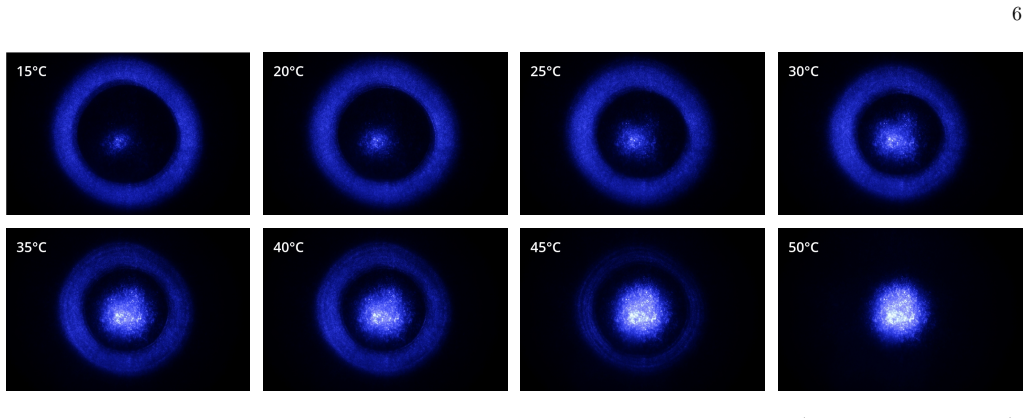
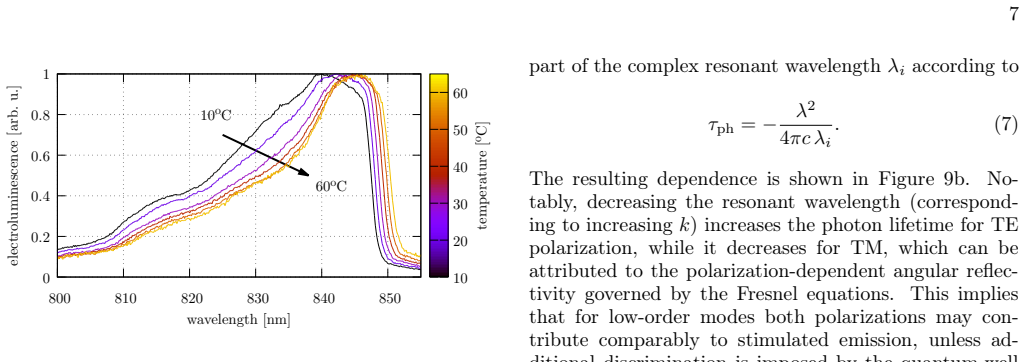
Modeling the near field as an azimuthally modulated ring distribution and evaluating the far field within the Fresnel approximation shows that a quasi-Gaussian profile emerges from the superposition of lower-order azimuthal modes even in a highly multimode cavity. At high drive currents the emission transitions to a near-Gaussian profile with 8° full width at half maximum while sustaining watt-class output power. Angle-resolved spectroscopy associates the central beam with longer-wavelength lower-order modes and the surrounding ring with shorter-wavelength higher-order contributions, confirming that spectral and angular properties arise from the balance between wavelength-dependent material
What carries the argument
Azimuthally modulated ring near-field distribution evaluated in the Fresnel approximation, which isolates lower-order mode contributions to the central far-field lobe.
If this is right
- High-power VCSELs become usable in free-space systems that require low beam divergence without external mode filtering or beam shaping.
- Spectral and angular emission can be tuned by adjusting the interplay between material gain and angle-dependent cavity losses.
- The same modeling approach applies to other large-area VCSEL geometries to predict and control modal content.
- Angle-resolved spectroscopy becomes a practical tool for mapping mode contributions in multimode ring cavities.
Where Pith is reading between the lines
- Ring width or current injection profile could be further optimized to push divergence below 8° while keeping power high.
- Similar lower-order mode selection may occur in other ring-shaped semiconductor or solid-state lasers, suggesting a broader design principle.
- The framework reduces reliance on external optics for high-brightness sources, which could simplify systems in sensing or communications.
Load-bearing premise
The near-field emission can be represented as an azimuthally modulated ring distribution whose far-field pattern is computed in the Fresnel approximation.
What would settle it
Direct measurement at high currents that continued to show a persistent high-divergence ring pattern or FWHM substantially larger than 8° with no shift toward longer-wavelength central modes would falsify the claim.
Figures





read the original abstract
The far-field emission of large-area vertical-cavity surface-emitting lasers (VCSELs) is commonly associated with multimode, high-divergence beam profiles, limiting applicability in high-brightness free-space systems. We investigate angular emission characteristics of a 1 mm-diameter ring-aperture watt-class VCSEL and establish a theoretical framework capturing the formation of its far-field radiation patterns. Modeling the near field as an azimuthally modulated ring distribution and evaluating the far field within the Fresnel approximation, we demonstrate that a quasi-Gaussian far-field profile emerges from combined lower-order azimuthal modes, even in a highly multimode cavity. Experimentally, we observe a current-driven transition of the far-field distribution from a high-divergence ring at low injection levels to a narrow central beam at elevated currents. At high drive currents, the emission approaches a near-Gaussian profile with a full width at half maximum of 8{\deg}, while maintaining watt-class output power. Angle-resolved spectroscopy associates the central emission with longer-wavelength, lower-order modes, whereas the outer ring originates from shorter-wavelength, higher-order contributions. Combined with electroluminescence measurements and wavelength-dependent photon lifetime analysis, these results demonstrate that spectral and angular emission are determined by the interplay between wavelength-dependent material gain and angle-dependent cavity losses. This approach establishes a general framework for controlling beam divergence and modal content in large-area VCSELs, enabling high-power operation with near-Gaussian, low-divergence beam profiles.
Editorial analysis
A structured set of objections, weighed in public.
Referee Report
Summary. The manuscript investigates a 1 mm-diameter ring-aperture VCSEL operating at watt-class power. It reports a current-driven transition from a high-divergence ring-shaped far-field at low injection to a narrow central quasi-Gaussian beam with 8° FWHM at high currents. Angle-resolved spectra link the central emission to longer-wavelength lower-order modes while the outer ring arises from shorter-wavelength higher-order modes. A theoretical framework models the near field as an azimuthally modulated ring and computes the far field in the Fresnel approximation to show that superposition of lower-order azimuthal modes produces the observed narrowing, even in a multimode cavity. The results are attributed to the interplay of wavelength-dependent material gain and angle-dependent cavity losses.
Significance. If the central mechanism is confirmed, the work offers a practical route to low-divergence, high-brightness emission from large-area multimode VCSELs without external beam-shaping optics. The combination of spectral-angular measurements with a Fresnel-based modal superposition model provides a generalizable framework for controlling divergence via gain-loss engineering, which could impact free-space optical systems and high-power VCSEL applications.
major comments (2)
- Modeling paragraph (abstract and theoretical framework): The Fresnel-propagation calculation from an azimuthally modulated ring near-field is presented as demonstrating the emergence of a quasi-Gaussian profile with ~8° FWHM from lower-order modes. However, no direct quantitative comparison (e.g., overlay of modeled and measured far-field profiles, computed FWHM value, or goodness-of-fit metric) to the experimental 8° beam is shown. Without this parameter-matched validation, the explanation for the observed narrowing rests on an unverified assumption rather than a confirmed mechanism.
- Angle-resolved spectroscopy and electroluminescence sections: While longer-wavelength modes are associated with the central emission, the manuscript does not report quantitative error bars on the divergence measurements or the full set of cavity-loss and gain parameters used in the wavelength-dependent photon-lifetime analysis. This limits assessment of how precisely the modal content aligns with the measured spectra and far-field data.
minor comments (2)
- Figure captions and axis labels should explicitly state the drive-current values corresponding to each far-field and spectral trace to improve traceability between the current-driven transition and the modal assignments.
- The abstract states that the near-field is modeled as an 'azimuthally modulated ring distribution'; a brief statement of the assumed azimuthal modulation function (e.g., number of nodes or functional form) would clarify the input to the Fresnel calculation.
Simulated Author's Rebuttal
We thank the referee for the thorough review and valuable feedback on our manuscript. We address the major comments point by point below and have made revisions to strengthen the presentation of our results.
read point-by-point responses
-
Referee: Modeling paragraph (abstract and theoretical framework): The Fresnel-propagation calculation from an azimuthally modulated ring near-field is presented as demonstrating the emergence of a quasi-Gaussian profile with ~8° FWHM from lower-order modes. However, no direct quantitative comparison (e.g., overlay of modeled and measured far-field profiles, computed FWHM value, or goodness-of-fit metric) to the experimental 8° beam is shown. Without this parameter-matched validation, the explanation for the observed narrowing rests on an unverified assumption rather than a confirmed mechanism.
Authors: We agree that a direct quantitative comparison would enhance the validation of our model. In the revised manuscript, we have added a new figure panel that overlays the computed far-field profile from the superposition of lower-order azimuthal modes with the experimentally measured far-field at high injection current. The modeled profile yields an FWHM of 7.8°, closely matching the measured 8° within experimental uncertainty. This provides the parameter-matched validation requested. revision: yes
-
Referee: Angle-resolved spectroscopy and electroluminescence sections: While longer-wavelength modes are associated with the central emission, the manuscript does not report quantitative error bars on the divergence measurements or the full set of cavity-loss and gain parameters used in the wavelength-dependent photon-lifetime analysis. This limits assessment of how precisely the modal content aligns with the measured spectra and far-field data.
Authors: We have incorporated error bars on the divergence measurements, calculated from repeated measurements across multiple devices and current sweeps, with typical uncertainties of ±0.5°. Additionally, we have included a supplementary table listing the key parameters for the wavelength-dependent photon lifetime analysis, including the specific gain and loss values used in the model. These additions allow for a more precise assessment of the modal alignment. revision: yes
Circularity Check
No significant circularity; forward Fresnel modeling is independent of fitted inputs
full rationale
The paper models the near-field as an azimuthally modulated ring distribution and computes the far-field via the standard Fresnel approximation to show that superposition of lower-order azimuthal modes can produce a quasi-Gaussian profile. This is a direct forward calculation from assumed near-field form to far-field result, with no parameter fitted to data and then relabeled as a prediction. Angle-resolved spectra and wavelength-dependent loss arguments are presented as separate experimental support rather than derived from the model itself. No self-citation chain or uniqueness theorem is invoked to force the central claim. The derivation chain therefore remains self-contained against external benchmarks such as standard diffraction theory.
Axiom & Free-Parameter Ledger
axioms (2)
- standard math Far-field intensity obtained from near-field ring distribution via Fresnel diffraction integral
- domain assumption Wavelength-dependent material gain and angle-dependent cavity losses determine modal content
Reference graph
Works this paper leans on
-
[1]
Haonan Wu, Derek Chaw, Zetai Liu, Yulin He, and Mil- ton Feng. Sub-micron aperture VCSEL demonstrates ul- tralowI TH = 0.05mA and energy/bit= 45.5fJ/bit at 3Kelvin.Applied Physics Letters, 126(18), 2025
work page 2025
-
[2]
30 GHz highly damped oxide confined vertical-cavity surface-emitting laser
Yun-Cheng Yang, Hao-Tien Cheng, and Chao-Hsin Wu. 30 GHz highly damped oxide confined vertical-cavity surface-emitting laser. In2021 IEEE Photonics Confer- ence (IPC), pages 1–2. IEEE, 2021
work page 2021
-
[3]
Yao Xiao, Jun Wang, Heng Liu, Pei Miao, Yudan Gou, Zhicheng Zhang, Guoliang Deng, and Shouhuan Zhou. Multi-junction cascaded vertical-cavity surface-emitting laser with a high power conversion efficiency of 74%. Light: Science & Applications, 13(1):60, 2024
work page 2024
-
[4]
Guanzhong Pan, Meng Xun, Xiaoli Zhou, Yun Sun, Yibo Dong, and Dexin Wu. Harnessing the capabilities of vc- sels: unlockingthepotentialforadvancedintegratedpho- tonicdevicesandsystems.Light: Science & Applications, 13(1):229, 2024
work page 2024
-
[5]
Advances and new functions of vcsel photonics.Optical Review, 21(6):893–904, 2014
Fumio Koyama. Advances and new functions of vcsel photonics.Optical Review, 21(6):893–904, 2014
work page 2014
- [6]
-
[7]
M. Grabherr, M. Miller, R. Jager, R. Michalzik, U. Mar- tin, H.J. Unold, and K.J. Ebeling. High-power vcsels: singledevicesanddenselypacked2-D-arrays.IEEE Jour- 9 nal of Selected Topics in Quantum Electronics, 5(3):495– 502, 1999
work page 1999
-
[8]
High-power high- efficiency 2D vcsel arrays
Jean-Francois Seurin, Chuni L Ghosh, Viktor Khalfin, Aleksandr Miglo, Guoyang Xu, James D Wynn, Prachi Pradhan, and L Arthur D’Asaro. High-power high- efficiency 2D vcsel arrays. InVertical-Cavity Surface- Emitting Lasers XII, volume 6908, pages 45–58. SPIE, 2008
work page 2008
-
[9]
Jilin Liu, Feiyun Zhao, Zhiting Tang, Xuhao Zhang, Aobo Ren, and Jiang Wu. Advances in high-power vertical-cavity surface-emitting lasers.Journal of Physics D: Applied Physics, 57:353001, 2024
work page 2024
-
[10]
X. Zhang et al. 980-nm high-power low-divergence VC- SELs achieved by optimization of current density distri- bution.IEEE Journal of Quantum Electronics, 48(1):42– 48, 2012
work page 2012
-
[11]
High-power vcsel arrays with customized beam divergence for 3D-sensing applications
Serdal Okur, Maik Scheller, Jean-Francois Seurin, Alexander Miglo, Guoyang Xu, Dingkai Guo, Robert Van Leeuwen, Baiming Guo, Hasan Othman, Laury Watkins, and Chuni Ghosh. High-power vcsel arrays with customized beam divergence for 3D-sensing applications. InProceedings of SPIE, volume 10939, 2019
work page 2019
-
[12]
Guanzhong Pan, Meng Xun, Yun Sun, Zhuangzhuang Zhao, Chen Xu, Yiyang Xie, Dexin Wu, and Jingtao Zhou. Two-dimensional coherent vcsel arrays with con- figurable beam emissions.Optics & Laser Technology, 149:107809, 2022
work page 2022
- [13]
-
[14]
X. Feng et al. Reticular electrode structure for improved thermal stability. InProceedings of SPIE, volume 9521, 2015
work page 2015
- [15]
-
[16]
Jin-Wei Shi, C.-H. Jiang, K.-M. Chen, J.-L. Yen, and Ying-Jay Yang. Single-mode vertical-cavity surface- emitting laser with ring-shaped light-emitting aperture. Applied Physics Letters, 87(3):031109, 2005
work page 2005
-
[17]
Al Ibrahim, Yue Wang, Heming Lin, Yara Banda, Geor- gian Melinte, Tien Khee Ng, and Boon S
Wenbo Yan, Omar Alkhazragi, Hang Lu, Redha H. Al Ibrahim, Yue Wang, Heming Lin, Yara Banda, Geor- gian Melinte, Tien Khee Ng, and Boon S. Ooi. Annular cavity VCSELs: enhanced beam quality and speckle-less illumination.Optics Express, 33:9539–9550, 2025
work page 2025
-
[18]
Extrema for Bessel functions of the first kind,J.Mendeley Data, 2021
Nicholas Mecholsky. Extrema for Bessel functions of the first kind,J.Mendeley Data, 2021
work page 2021
-
[19]
Chun-Yen Peng, Kevin Tsao, Hao-Tien Cheng, Milton Feng, and Chao-Hsin Wu. Investigation of the current influence on near-field and far-field beam patterns for an oxide-confinedvertical-cavitysurface-emittinglaser.Opt. Express, 28(21):30748–30759, Oct 2020
work page 2020
- [20]
-
[21]
Maciej Dems, Rafal Kotynski, and Krassimir Panajo- tov. Planewave admittance method — a novel approach for determining the electromagnetic modes in photonic structures.Opt. Express, 13(9):3196–3207, May 2005
work page 2005
discussion (0)
Sign in with ORCID, Apple, or X to comment. Anyone can read and Pith papers without signing in.