Image Encryption via Data-Identified Discrete Chaotic Maps
Pith reviewed 2026-05-21 04:04 UTC · model grok-4.3
The pith
Chaotic maps identified from image data allow encryption with only initial conditions as the key.
A machine-rendered reading of the paper's core claim, the machinery that carries it, and where it could break.
Core claim
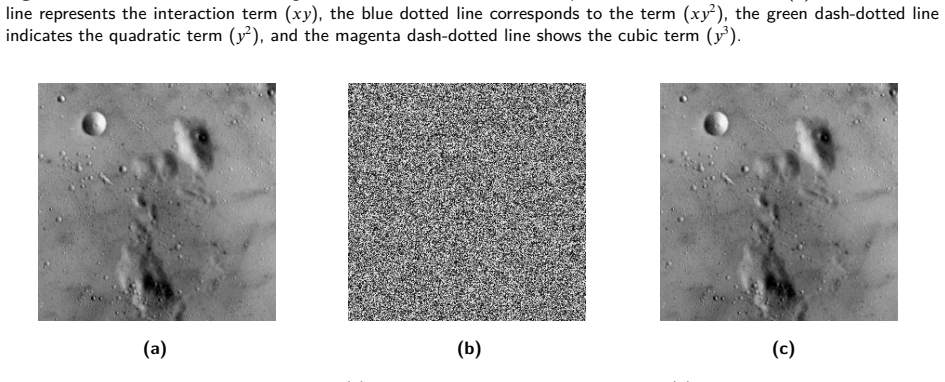
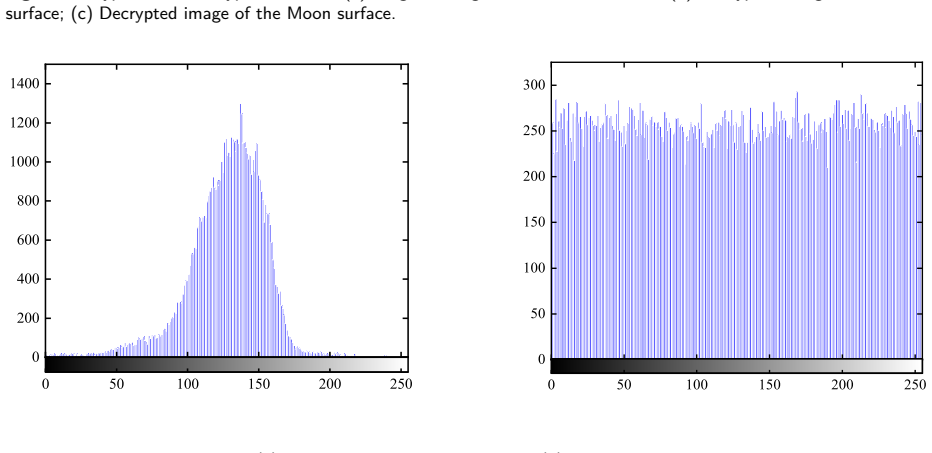
By applying the identification algorithm to observational data, the approach learns the complete explicit form of discrete chaotic maps, including nonlinear cross terms, and uses them for image encryption. The encryption key is reduced to the initial conditions alone because the map itself varies with the data, so that different data sets produce distinct maps and thus entirely different ciphertexts despite fixed initial conditions. This yields NPCR values near 99.6 percent and UACI near 33.5 percent, along with ideal entropy close to 8 bits per pixel and strong sensitivity where a 10 to the minus 16 change in initial conditions prevents decryption.
What carries the argument
The data-dependent chaotic map identified from observational data, which replaces fixed predefined maps and makes the dynamics adapt to the input image.
If this is right
- The scheme requires only initial conditions as the secret key since the map is derived from the data.
- Even with fixed initial conditions, variations in the training data produce entirely different ciphertexts.
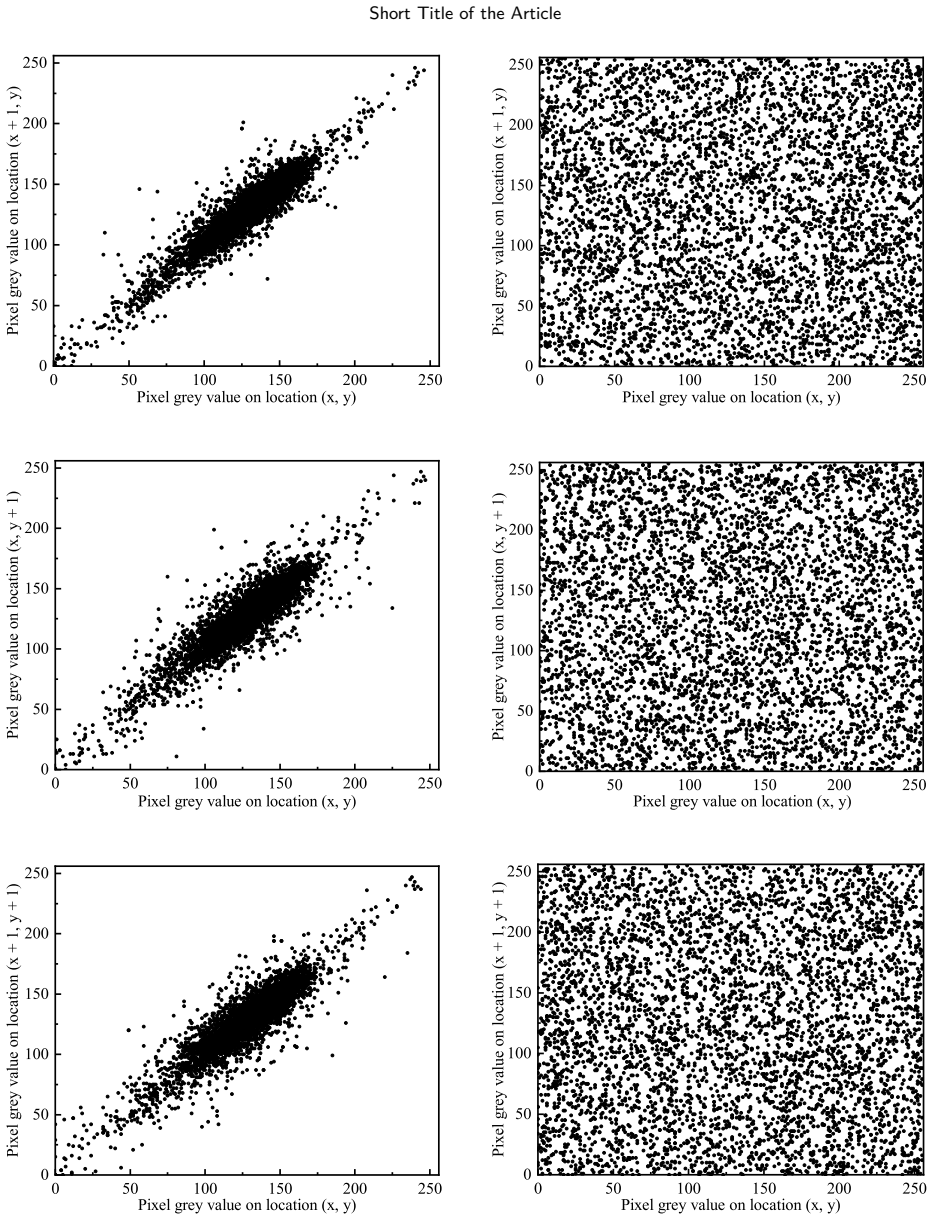
- The encrypted images exhibit near-ideal statistical properties including entropy of about 8 bits and negligible pixel correlations.
- The method resists differential attacks as evidenced by NPCR and UACI values close to theoretical ideals.
Where Pith is reading between the lines
- This approach might extend to other forms of data encryption by learning maps from their specific trajectories.
- Tests with real noisy image data could show whether the chaotic behavior persists outside of clean textbook examples.
- The data-dependent nature could lead to new key management strategies where the map serves as an additional private component.
Load-bearing premise
The map identified from real or noisy image data will stay chaotic and produce unpredictable sequences suitable for secure encryption.
What would settle it
Apply the identification process to data from real images containing noise and verify if the resulting map still shows chaotic behavior and if encryption fails completely under tiny initial condition changes of 10 to the minus 16.
Figures


read the original abstract
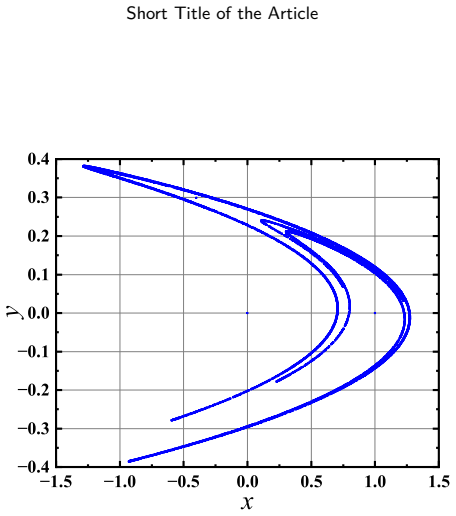
In this work, we propose a data-driven image encryption framework that identifies chaotic maps directly from data using the SINDy-PI algorithm. Unlike conventional encryption schemes relying on predefined maps, our method learns the full explicit dynamics -- including cross-terms and higher-order nonlinearities -- from observational data. The validity of this approach is verified on three distinct chaotic systems: the H{\'e}non map, the three-dimensional logistic map, and the piecewise-linear Lozi map, demonstrating its generality. The encryption key consists solely of initial conditions; the map structure itself becomes data-dependent, introducing an extra layer of security. Moreover, even when the initial conditions are fixed, different training data (e.g., with a tiny noise seed) lead to slightly different maps, which produce completely different ciphertexts (NPCR $\approx 99.6\%$, UACI $\approx 33.5\%$). Numerical experiments on the H{\'e}non system show near-ideal information entropy ($\approx 8$ bits), negligible inter-pixel correlation, and extreme sensitivity to initial conditions: a perturbation of $10^{-16}$ causes total decryption failure. The scheme resists both differential and statistical attacks, with NPCR and UACI values matching theoretical ideals. Our results establish a new paradigm for chaos-based cryptography beyond fixed maps.
Editorial analysis
A structured set of objections, weighed in public.
Referee Report
Summary. The manuscript proposes a data-driven image encryption framework that uses the SINDy-PI algorithm to identify explicit discrete chaotic maps (including cross-terms and higher-order nonlinearities) directly from observational data. The method is verified on the Hénon map, three-dimensional logistic map, and Lozi map. The authors state that the encryption key consists solely of initial conditions while the data-dependent map structure supplies an extra security layer; they further report that, even at fixed initial conditions, different training data (e.g., with tiny noise) produce distinct maps and completely different ciphertexts (NPCR ≈ 99.6 %, UACI ≈ 33.5 %). Standard security metrics are presented: near-ideal entropy (≈ 8 bits), negligible inter-pixel correlation, extreme sensitivity to 10^{-16} perturbations in initial conditions, and resistance to differential and statistical attacks.
Significance. If the identified maps can be shown to remain chaotic under realistic image-derived or noisy training data and the security model is rendered internally consistent, the work could establish a new paradigm for chaos-based cryptography that moves beyond fixed, predefined maps. The explicit, data-identified dynamics via SINDy-PI constitute a technical strength that distinguishes the approach from conventional chaos-based schemes.
major comments (3)
- Abstract: The assertion that 'the encryption key consists solely of initial conditions' is directly contradicted by the claim that different training data at fixed initial conditions yield completely different ciphertexts (NPCR ≈ 99.6 %, UACI ≈ 33.5 %). For the data-dependent map to furnish an extra security layer, the training data or resulting coefficients must be secret and therefore form part of the effective key, creating a load-bearing inconsistency in the stated security model.
- Abstract: No derivation, Lyapunov analysis, or other guarantee is supplied that the SINDy-PI-identified map remains chaotic and unpredictable when the training data are drawn from real images or noisy observations rather than the clean trajectories of the three textbook systems used for verification.
- Abstract: The reported NPCR/UACI values are compared only to theoretical ideals; no baseline experiment is presented that applies the original known maps (Hénon, 3-D logistic, Lozi) with identical initial conditions to isolate any advantage conferred by the data-identified coefficients.
minor comments (1)
- Abstract: The entropy value is given only as '≈ 8 bits'; reporting the precise measured value together with the image or system on which it was obtained would improve clarity.
Simulated Author's Rebuttal
We thank the referee for the careful and constructive review of our manuscript. The comments raise important points regarding the consistency of our security model, the need for guarantees on chaotic behavior under realistic conditions, and the value of baseline comparisons. We address each major comment below and describe the revisions we will make.
read point-by-point responses
-
Referee: Abstract: The assertion that 'the encryption key consists solely of initial conditions' is directly contradicted by the claim that different training data at fixed initial conditions yield completely different ciphertexts (NPCR ≈ 99.6 %, UACI ≈ 33.5 %). For the data-dependent map to furnish an extra security layer, the training data or resulting coefficients must be secret and therefore form part of the effective key, creating a load-bearing inconsistency in the stated security model.
Authors: We thank the referee for identifying this inconsistency in how the security model is described. The current phrasing does not adequately reflect that the data-dependent map structure, derived from training data, supplies an additional security layer that requires the training data or identified coefficients to be kept secret. This effectively incorporates them into the key material. We will revise the abstract and the security analysis sections to present a consistent description of the effective key. revision: yes
-
Referee: Abstract: No derivation, Lyapunov analysis, or other guarantee is supplied that the SINDy-PI-identified map remains chaotic and unpredictable when the training data are drawn from real images or noisy observations rather than the clean trajectories of the three textbook systems used for verification.
Authors: This observation is correct: our verification used clean trajectories from the three textbook maps, and we do not supply a general derivation or Lyapunov analysis for maps identified from noisy or image-derived data. In the revision we will add Lyapunov exponent calculations for the identified maps under controlled noise levels and include a discussion of the conditions needed to preserve chaotic behavior. We will also note validation on real image data as future work. revision: partial
-
Referee: Abstract: The reported NPCR/UACI values are compared only to theoretical ideals; no baseline experiment is presented that applies the original known maps (Hénon, 3-D logistic, Lozi) with identical initial conditions to isolate any advantage conferred by the data-identified coefficients.
Authors: We agree that direct baseline experiments with the original analytical maps are needed to isolate the contribution of the data-identified coefficients. We will add these comparisons in the revised manuscript, encrypting the same images with the known Hénon, three-dimensional logistic, and Lozi maps using identical initial conditions and reporting the resulting NPCR, UACI, entropy, and correlation values alongside those from the SINDy-PI maps. revision: yes
Circularity Check
No significant circularity in the derivation chain
full rationale
The paper identifies explicit map dynamics via SINDy-PI from observational trajectories of the Hénon, 3-D logistic, and Lozi systems, then applies the resulting map (with initial conditions as the stated key) to generate encryption sequences. Reported metrics such as NPCR ≈ 99.6 %, UACI ≈ 33.5 %, and entropy ≈ 8 bits are computed directly from the produced ciphertexts using standard statistical definitions; these quantities are not algebraically forced by the identification coefficients or by any self-referential definition within the encryption step. No load-bearing self-citation, ansatz smuggled via prior work, or renaming of a known result appears in the abstract or described claims. The data-dependence feature is presented as an empirical observation rather than a prediction that reduces to the fitting inputs by construction, leaving the overall chain self-contained against external benchmarks.
Axiom & Free-Parameter Ledger
free parameters (1)
- SINDy sparsity threshold
axioms (1)
- domain assumption The observed time series are generated by a discrete dynamical system that can be expressed as a sparse polynomial vector field.
Lean theorems connected to this paper
-
IndisputableMonolith.Cost.FunctionalEquationwashburn_uniqueness_aczel unclear?
unclearRelation between the paper passage and the cited Recognition theorem.
even when the initial conditions are fixed, different training data... produce completely different ciphertexts (NPCR ≈ 99.6%, UACI ≈ 33.5%)
What do these tags mean?
- matches
- The paper's claim is directly supported by a theorem in the formal canon.
- supports
- The theorem supports part of the paper's argument, but the paper may add assumptions or extra steps.
- extends
- The paper goes beyond the formal theorem; the theorem is a base layer rather than the whole result.
- uses
- The paper appears to rely on the theorem as machinery.
- contradicts
- The paper's claim conflicts with a theorem or certificate in the canon.
- unclear
- Pith found a possible connection, but the passage is too broad, indirect, or ambiguous to say the theorem truly supports the claim.
Reference graph
Works this paper leans on
-
[1]
M. Saberikamarposhti, A. Ghorbani, M. Yadollahi, A comprehensive survey on image encryption: Taxonomy, challenges, and future directions, Chaos Solitons Fractals 178 (2024) 114361
work page 2024
-
[2]
Ozkaynak, Brief review on application of nonlinear dynamics in image encryption, Nonlinear Dyn
F. Ozkaynak, Brief review on application of nonlinear dynamics in image encryption, Nonlinear Dyn. 92 (2018) 305–313
work page 2018
- [3]
-
[4]
Z. Zhou, X. Xu, Y. Yao, Z. Jiang, K. Sun, Novel multiple-image encryption algorithm based on a two-dimensional hyperchaotic modular model, Chaos Solitons Fractals 173 (2023) 113630
work page 2023
-
[5]
X. Qian, Q. Yang, Q. Li, Q. Liu, Y. Wu, W. Wang, A novel color image encryption algorithm based on three-dimensional chaotic maps and reconstruction techniques, IEEE Access 9 (2021) 61334–61345
work page 2021
- [6]
-
[7]
P. Ping, Y. Mao, X. Lv, F. Xu, G. Xu, An image scrambling algorithm using discrete henon map, in: Proc. IEEE Int. Conf. Inf. Autom., 2015, pp. 429–432
work page 2015
-
[8]
H. Khan, M. M. Hazzazi, S. S. Jamal, I. Hussain, M. Khan, New color image encryption technique based on three-dimensional logistic map and grey wolf optimization based generated substitution boxes, Multimed. Tools Appl. 82 (2023) 6943–6964
work page 2023
- [9]
-
[10]
S. L. Brunton, J. L. Proctor, J. N. Kutz, Discovering governing equations from data by sparse identification of nonlinear dynamical systems, Proc. Natl. Acad. Sci. U.S.A. 113 (2016) 3932–3937
work page 2016
- [11]
- [12]
-
[13]
A. M. Escobar-Ruiz, L. Jiménez-Lara, P. M. Juárez-Flores, F. Montoya-Molina, J. Moreno-Séenz, M. A. Quiroz-Juárez, Data-driven reconstruction of chaotic dynamical equations: The Hénon-Heiles type system, Chaos Solitons Fractals 184 (2024) 115025
work page 2024
-
[14]
K. Kaheman, J. N. Kutz, S. L. Brunton, Sindy-pi: a robust algorithm for parallel implicit sparse identification of nonlinear dynamics, Proc. R. Soc. A 476 (2020) 20200279
work page 2020
-
[15]
M. Misiurewicz, S. Štimac, Symbolic dynamics for lozi maps, Nonlinearity 29 (2016) 3031–3046
work page 2016
-
[16]
R. Tuli, H. N. Soneji, P. Churi, PixAdapt: A novel approach to adaptive image encryption, Chaos Solitons Fractals 164 (2022) 112628
work page 2022
-
[17]
N. M. Mangan, S. L. Brunton, J. L. Proctor, J. N. Kutz, Inferring biological networks by sparse identification of nonlinear dynamics, IEEE Trans. Mol. Biol. Multi-Scale Commun. 2 (2016) 52–63
work page 2016
-
[18]
G. Massonis, A. F. Villaverde, J. R. Banga, Distilling identifiable and interpretable dynamic models from biological data, PLoS Comput. Biol. 19 (2023) e1011014
work page 2023
-
[19]
M. Lone, Encryption scheme for the security of digital images based on josephus traversal and chaos theory, in: In Proc. IntechOpen Conf., 2024, p. 1005121
work page 2024
-
[20]
A. K. Singh, K. Chatterjee, A. Singh, An image security model based on chaos and dna cryptography for iiot images, IEEE Trans. Ind. Inform. 19 (2023) 1957–1964
work page 2023
-
[21]
J. I. M. Bezerra, G. Machado, A. Molter, R. I. Soares, V . Camargo, A novel simultaneous permutation-diffusion image encryption scheme based on a discrete space map, Chaos Solitons Fractals 168 (2023) 113160
work page 2023
-
[22]
X. Chai, J. Bi, Z. Gan, X. Liu, Y. Zhang, Y. Chen, Color image compression and encryption scheme based on compressive sensing and double random encryption strategy, Signal Process. 176 (2020) 107684
work page 2020
-
[23]
H. Yang, X. Liao, K. Wong, W. Zhang, P. Wei, A new cryptosystem based on chaotic map and operations algebraic, Chaos Solitons Fractals 40 (2009) 2520–2531
work page 2009
-
[24]
M. Alawida, A. Samsudin, J. S. Teh, R. S. Alkhawaldeh, A new hybrid digital chaotic system with applications in image encryption, Signal Process. 160 (2019) 45–58
work page 2019
- [25]
-
[26]
X. Wang, H. Zhao, M. Wang, A new image encryption algorithm with nonlinear-diffusion based on multiple coupled map lattices, Opt. Laser Technol. 115 (2019) 42–57
work page 2019
-
[27]
F. Yang, J. Mou, K. Sun, Y. Cao, J. Jin, Color image compression-encryption algorithm based on fractional-order memristor chaotic circuit, IEEE Access 7 (2019) 58751–58763
work page 2019
-
[28]
X. Hu, L. Wei, W. Chen, Q. Chen, Y. Guo, Color image encryption algorithm based on dynamic chaos and matrix convolution, IEEE Access 8 (2020) 12452–12466. First Author et al.: Preprint submitted to Elsevier Page 13 of 13 Short Title of the Article /s49/s46/s53 /s49/s46/s48 /s48/s46/s53 /s48/s46/s48 /s48/s46/s53 /s49/s46/s48 /s49/s46/s53 /s48/s46/s52 /s48/...
work page 2020
discussion (0)
Sign in with ORCID, Apple, or X to comment. Anyone can read and Pith papers without signing in.