Decentralized Inexact Cubic Newton Method with Consensus Procedure
Pith reviewed 2026-05-22 09:32 UTC · model grok-4.3
The pith
Decentralized Cubic Newton method matches the iteration complexity of the exact version under gradient smoothness and Hessian Lipschitz conditions, adding only polylogarithmic communication rounds for consensus.
A machine-rendered reading of the paper's core claim, the machinery that carries it, and where it could break.
Core claim
Under L1-smoothness of gradients and L2-Lipschitz continuity of Hessians, the Decentralized Inexact Cubic Newton method with consensus achieves the same iteration complexity as the exact Cubic Newton method for convex optimization while requiring only additional polylogarithmic communication rounds to reach the necessary consensus accuracy; the theory tracks the inexactness terms arising from disagreement between local copies. The accelerated version does the same for strongly convex objectives.
What carries the argument
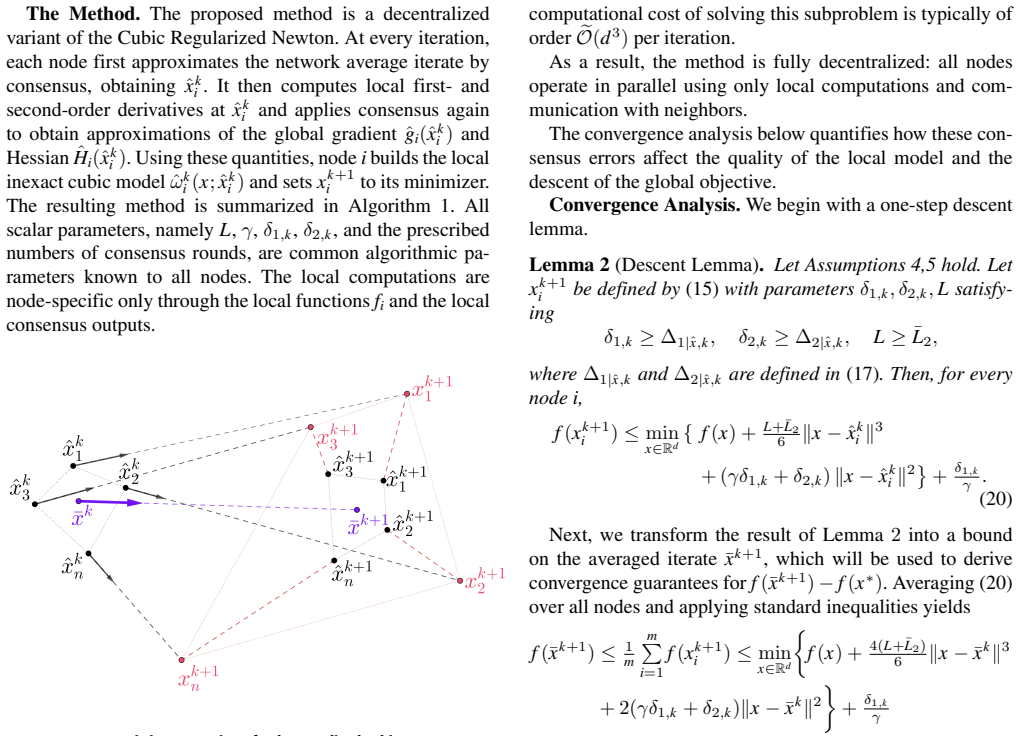
The inexact consensus procedure that approximately averages local iterates, gradients, and Hessians via neighbor-to-neighbor communications while controlling the resulting disagreement errors inside the cubic regularization step.
Load-bearing premise
The consensus procedure can be driven to sufficient accuracy using a number of rounds that is only polylogarithmic in the relevant parameters, without inflating the overall iteration complexity or breaking the cubic regularization guarantees.
What would settle it
A controlled numerical test that caps consensus rounds at a fixed constant (instead of polylog) and measures whether the number of outer iterations required to reach target accuracy exceeds that of the exact centralized Cubic Newton method.
Figures
read the original abstract
Distributed optimization is widely used in large-scale and privacy-preserving machine learning, where each agent stores a local objective and communicates only with its neighbors in a connected network. We study decentralized second-order optimization and focus on consensus procedures that approximately average local iterates, gradients, and Hessians through neighbor-to-neighbor communications. We propose a general Decentralized Cubic Newton method for convex optimization under $L_1$-smoothness of gradients and $L_2$-Lipschitz continuity of Hessians, and develop a theory that accurately tracks the inaccuracies caused by consensus and by disagreement between local iterates. Under these assumptions, the method matches the iteration complexity of the exact Cubic Newton method and requires only additional polylogarithmic communication-round overhead to reach the necessary consensus accuracy. We further propose an Accelerated Decentralized Cubic Newton method for strongly convex objectives and show that it matches the iteration complexity of the exact Accelerated Cubic Newton method, again with only additional polylogarithmic communication-round overhead. Finally, although the general method requires exchanging full $d \times d$ Hessian matrices, we show how it can be implemented for generalized linear models by transmitting only vectors, making the approach substantially more practical in high dimensions.
Editorial analysis
A structured set of objections, weighed in public.
Referee Report
Summary. The manuscript proposes a Decentralized Inexact Cubic Newton method for convex optimization over networks, where agents maintain local objectives and communicate only with neighbors. It develops an analysis that explicitly tracks inaccuracies arising from approximate consensus on iterates, gradients, and Hessians. Under L1-smoothness of gradients and L2-Lipschitz continuity of Hessians, the method is claimed to match the iteration complexity of the exact centralized Cubic Newton method while incurring only polylogarithmic additional communication-round overhead. An accelerated variant is presented for strongly convex objectives with analogous guarantees, and a practical implementation for generalized linear models is given that communicates only vectors rather than full Hessians.
Significance. If the central claims hold, the work is significant for distributed optimization because it shows that second-order methods can be decentralized with only logarithmic communication overhead while preserving the fast local convergence rates of cubic regularization. The explicit accounting for disagreement-induced inexactness in the analysis is a clear strength that distinguishes this from prior decentralized first-order work. The vector-only variant for GLMs also improves practicality in high dimensions.
minor comments (3)
- The main theorem statement would benefit from an explicit display of the polylogarithmic factor in the communication rounds (e.g., dependence on network size, condition number, or target accuracy) rather than leaving it implicit in the proof sketch.
- Notation for the consensus mixing matrix and the per-iteration accuracy parameter should be introduced in a dedicated preliminary subsection to improve readability before the complexity analysis begins.
- In the GLM implementation section, a short remark comparing total bits communicated per iteration (vector vs. matrix) would help quantify the practical savings.
Simulated Author's Rebuttal
We thank the referee for the positive review, accurate summary of our contributions, and recommendation for minor revision. The significance assessment correctly highlights the value of tracking consensus-induced inexactness and the practical GLM implementation. No specific major comments were provided in the report.
Circularity Check
No significant circularity in derivation chain
full rationale
The paper's central claim is that an inexact decentralized cubic Newton method, with consensus-induced errors in iterates/gradients/Hessians bounded via polylog communication rounds, preserves the iteration complexity of the exact cubic Newton method under L1-smoothness and L2-Hessian Lipschitz assumptions. The provided abstract and reader extraction indicate that the analysis explicitly accounts for disagreement errors as additive inexactness terms inside the tolerance budget of the exact method, without reducing the claimed complexity to a fitted parameter, self-defined quantity, or load-bearing self-citation. No equations or steps are shown to collapse by construction to the inputs; the result is presented as an independent extension that tracks consensus inaccuracies while inheriting the exact-method guarantees. This is the standard structure of an inexact-oracle analysis and qualifies as self-contained against external benchmarks.
Axiom & Free-Parameter Ledger
axioms (2)
- domain assumption Gradients are L1-smooth and Hessians are L2-Lipschitz continuous
- domain assumption A connected network allows neighbor-to-neighbor communication sufficient to achieve consensus accuracy
Lean theorems connected to this paper
-
IndisputableMonolith/Cost/FunctionalEquation.leanwashburn_uniqueness_aczel (J-cost uniqueness) unclear?
unclearRelation between the paper passage and the cited Recognition theorem.
We propose a general Decentralized Cubic Newton method for convex optimization under L1-smoothness of gradients and L2-Lipschitz continuity of Hessians... matches the iteration complexity of the exact Cubic Newton method and requires only additional polylogarithmic communication-round overhead
-
IndisputableMonolith/Foundation/DimensionForcing.leanalexander_duality_circle_linking (D=3 forcing) unclear?
unclearRelation between the paper passage and the cited Recognition theorem.
Assumption 3 (Contraction property)... W^k_τ U − Ū_F ≤ (1−λ)∥U−Ū∥_F
What do these tags mean?
- matches
- The paper's claim is directly supported by a theorem in the formal canon.
- supports
- The theorem supports part of the paper's argument, but the paper may add assumptions or extra steps.
- extends
- The paper goes beyond the formal theorem; the theorem is a base layer rather than the whole result.
- uses
- The paper appears to rely on the theorem as machinery.
- contradicts
- The paper's claim conflicts with a theorem or certificate in the canon.
- unclear
- Pith found a possible connection, but the passage is too broad, indirect, or ambiguous to say the theorem truly supports the claim.
Reference graph
Works this paper leans on
-
[1]
P . Kairouz, H. B. McMahan, B. Avent, A. Bellet, M. Bennis, A. N. Bhagoji, K. Bonawitz, Z. Charles, G. Cormode, R. Cummingset al., ‘‘Advances and open problems in federated learning,’’F oundations and trends®in machine learning, vol. 14, no. 1–2, pp. 1– 210, 2021. 10
work page 2021
-
[2]
I. Necoara, V . Nedelcu, and I. Dumitrache, ‘‘Parallel and distributed optimization methods for estimation and control in networks,’’Journal of Process Control, vol. 21, no. 5, pp. 756–766, 2011
work page 2011
-
[3]
Distributed dual gradient methods and error bound conditions
I. Necoara and V . Nedelcu, ‘‘Distributed dual gradient methods and error bound conditions,’’arXiv preprint arXiv:1401.4398, 2014
work page internal anchor Pith review Pith/arXiv arXiv 2014
-
[4]
T. T. Doan and A. Olshevsky, ‘‘Distributed resource allocation on dynamic networks in quadratic time,’’Sys- tems & Control Letters, vol. 99, pp. 57–63, 2017
work page 2017
- [5]
-
[6]
W. Ren, ‘‘Consensus based formation control strategies for multi-vehicle systems,’’ in2006 American Control Conference. IEEE, 2006, pp. 6–pp
work page 2006
-
[7]
J. N. Tsitsiklis, ‘‘Problems in decentralized decision making and computation.’’ Massachusetts Inst of Tech Cambridge Lab for Information and Decision Systems, Tech. Rep. LIDS-TH-1424, 1984
work page 1984
-
[8]
D. P . Bertsekas and J. N. Tsitsiklis,Parallel and dis- tributed computation: numerical methods. Prentice hall Englewood Cliffs, NJ, 1989, vol. 23
work page 1989
-
[9]
A. Nedić and A. Ozdaglar, ‘‘Distributed subgradient methods for multi-agent optimization,’’IEEE Transac- tions on Automatic Control, vol. 54, no. 1, pp. 48–61, 2009
work page 2009
-
[10]
A. Nedic and A. Ozdaglar, ‘‘Subgradient methods for saddle-point problems,’’Journal of optimization theory and applications, vol. 142, no. 1, pp. 205–228, 2009
work page 2009
-
[11]
W. Shi, Q. Ling, G. Wu, and W. Yin, ‘‘Extra: An exact first-order algorithm for decentralized consensus op- timization,’’SIAM Journal on Optimization, vol. 25, no. 2, pp. 944–966, 2015
work page 2015
-
[12]
A. Koloskova, N. Loizou, S. Boreiri, M. Jaggi, and S. U. Stich, ‘‘A unified theory of decentralized sgd with changing topology and local updates,’’ICML 2020, arXiv preprint arXiv:2003.10422, 2020
-
[13]
H. Li, C. Fang, W. Yin, and Z. Lin, ‘‘Decentralized accelerated gradient methods with increasing penalty parameters,’’IEEE Transactions on Signal Processing, vol. 68, pp. 4855–4870, 2020
work page 2020
- [14]
-
[15]
S. Pu, W. Shi, J. Xu, and A. Nedić, ‘‘Push–pull gradi- ent methods for distributed optimization in networks,’’ IEEE Transactions on Automatic Control, vol. 66, no. 1, pp. 1–16, 2020
work page 2020
- [16]
- [17]
-
[18]
S. A. Alghunaim, E. K. Ryu, K. Y uan, and A. H. Sayed, ‘‘Decentralized proximal gradient algorithms with lin- ear convergence rates,’’IEEE Transactions on Auto- matic Control, vol. 66, no. 6, pp. 2787–2794, 2020
work page 2020
- [19]
-
[20]
D. Kovalev, A. Salim, and P . Richtárik, ‘‘Optimal and practical algorithms for smooth and strongly convex decentralized optimization,’’Advances in Neural Infor- mation Processing Systems, vol. 33, 2020
work page 2020
-
[21]
D. Kovalev, E. Shulgin, P . Richtárik, A. V . Rogozin, and A. Gasnikov, ‘‘Adom: Accelerated decentralized optimization method for time-varying networks,’’ inIn- ternational Conference on Machine Learning. PMLR, 2021, pp. 5784–5793
work page 2021
-
[22]
D. Kovalev, E. Gasanov, A. Gasnikov, and P . Richtarik, ‘‘Lower bounds and optimal algorithms for smooth and strongly convex decentralized optimization over time- varying networks,’’Advances in Neural Information Processing Systems, vol. 34, 2021
work page 2021
-
[23]
A. S. Nemirovski and D. B. Y udin,Problem Complexity and Method Efficiency in Optimization, ser. A Wiley- Interscience publication. Wiley, 1983
work page 1983
-
[24]
Nesterov,Introductory Lectures on Convex Optimiza- tion: a basic course
Y . Nesterov,Introductory Lectures on Convex Optimiza- tion: a basic course. Kluwer Academic Publishers, Massachusetts, 2004
work page 2004
-
[25]
S. Boyd, N. Parikh, E. Chu, B. Peleato, J. Ecksteinet al., ‘‘Distributed optimization and statistical learning via the alternating direction method of multipliers,’’F ounda- tions and Trends®in Machine learning, vol. 3, no. 1, pp. 1–122, 2011
work page 2011
-
[26]
T.-H. Chang, ‘‘A proximal dual consensus admm method for multi-agent constrained optimization,’’ IEEE Transactions on Signal Processing, vol. 64, no. 14, pp. 3719–3734, 2016
work page 2016
-
[27]
A. Falsone, I. Notarnicola, G. Notarstefano, and M. Prandini, ‘‘Tracking-admm for distributed constraint-coupled optimization,’’Automatica, vol. 117, p. 108962, 2020
work page 2020
-
[28]
X. Wu, H. Wang, and J. Lu, ‘‘Distributed optimization with coupling constraints,’’IEEE Transactions on Auto- matic Control, vol. 68, no. 3, pp. 1847–1854, 2022
work page 2022
-
[29]
arXiv preprint arXiv:2310.15596 , year=
K. Gong and L. Zhang, ‘‘Decentralized proximal method of multipliers for convex optimization with coupled constraints,’’arXiv preprint arXiv:2310.15596, 2023
-
[30]
Nesterov,Lectures on Convex Optimization, 2nd ed
Y . Nesterov,Lectures on Convex Optimization, 2nd ed. Springer Cham, 2018
work page 2018
-
[31]
Y . Nesterov and B. T. Polyak, ‘‘Cubic regularization of Newton method and its global performance,’’ 11 Mathematical Programming, vol. 108, pp. 177– 205, 2006. [Online]. Available: https://doi.org/10.1007/ s10107-006-0706-8
work page 2006
-
[32]
N. Doikov and Y . Nesterov, ‘‘Gradient regularization of newton method with bregman distances,’’Mathematical programming, vol. 204, no. 1, pp. 1–25, 2024
work page 2024
-
[33]
K. Mishchenko, ‘‘Regularized Newton method with globalO 1 k 2 convergence,’’SIAM Journal on Optimization, vol. 33, pp. 1440–1462, 2023. [Online]. Available: https://doi.org/10.1137/22M1488752
- [34]
-
[35]
S. Hanzely, D. Kamzolov, D. Pasechnyuk, A. Gasnikov, P . Richtárik, and M. Takáč, ‘‘A damped Newton method achieves globalO 1 k 2 and local quadratic convergence rate,’’ inAdvances in Neural Information Processing Systems, S. Koyejo, S. Mohamed, A. Agarwal, D. Belgrave, K. Cho, and A. Oh, Eds., vol. 35. Curran Associates, Inc., 2022, pp. 25 320–25 334. [O...
work page 2022
-
[36]
R. Islamov, X. Qian, and P . Richtárik, ‘‘Distributed sec- ond order methods with fast rates and compressed com- munication,’’ inInternational conference on machine learning. PMLR, 2021, pp. 4617–4628
work page 2021
-
[37]
S. Wang, F. Roosta, P . Xu, and M. W. Mahoney, ‘‘Giant: Globally improved approximate newton method for dis- tributed optimization,’’Advances in neural information processing systems, vol. 31, 2018
work page 2018
-
[38]
M. Safaryan, R. Islamov, X. Qian, and P . Richtarik, ‘‘Fednl: Making newton-type methods applicable to federated learning,’’ inInternational Conference on Ma- chine Learning. PMLR, 2022, pp. 18 959–19 010
work page 2022
-
[39]
R. Islamov, X. Qian, S. Hanzely, M. Safaryan, and P . Richtárik, ‘‘Distributed newton-type methods with communication compression and bernoulli aggrega- tion,’’Transactions on Machine Learning Research, 2023
work page 2023
-
[40]
A. Agafonov, P . Dvurechensky, G. Scutari, A. Gasnikov, D. Kamzolov, A. Lukashevich, and A. Daneshmand, ‘‘An accelerated second-order method for distributed stochastic optimization,’’ in2021 60th IEEE Conference on Decision and Control (CDC), 2021, pp. 2407–2413. [Online]. Available: https://doi.org/10.1109/CDC45484.2021.9683400
-
[41]
A. Agafonov, D. Kamzolov, R. Tappenden, A. Gas- nikov, and M. Takáč, ‘‘Flecs: A federated learning second-order framework via compression and sketch- ing,’’Optimization Methods and Software, vol. 40, no. 5, pp. 1222–1248, 2025
work page 2025
-
[42]
A. Daneshmand, G. Scutari, P . Dvurechensky, and A. Gasnikov, ‘‘Newton method over networks is fast up to the statistical precision,’’ inInternational Conference on Machine Learning. PMLR, 2021, pp. 2398–2409
work page 2021
- [43]
- [44]
- [45]
- [46]
- [47]
-
[48]
A. Mokhtari, Q. Ling, and A. Ribeiro, ‘‘Network newton distributed optimization methods,’’IEEE Transactions on Signal Processing, vol. 65, no. 1, pp. 146–161, 2016
work page 2016
-
[49]
Y . Nesterov, ‘‘Accelerating the cubic regularization of Newton’s method on convex problems,’’Mathematical Programming, vol. 112, pp. 159–181, 2008. [Online]. Available: https://doi.org/10.1007/s10107-006-0089-x
- [50]
-
[51]
A. Agafonov, D. Kamzolov, P . Dvurechensky, A. Gasnikov, and M. Takáč, ‘‘Inexact tensor methods and their application to stochastic convex optimization,’’Optimization Methods and Software, vol. 39, no. 1, pp. 42–83, 2024. [Online]. Available: https://doi.org/10.1080/10556788.2023.2261604
-
[52]
D. Kamzolov, D. Pasechnyuk, A. Agafonov, A. Gas- nikov, and M. Takáč, ‘‘Optami: Global superlinear convergence of high-order methods,’’arXiv preprint arXiv:2410.04083, 2024
-
[53]
Second-Order Methods with Cubic Regularization Under Inexact Information
S. Ghadimi, H. Liu, and T. Zhang, ‘‘Second-order meth- ods with cubic regularization under inexact informa- tion,’’arXiv preprint arXiv:1710.05782, 2017
work page internal anchor Pith review Pith/arXiv arXiv 2017
-
[54]
K. Antonakopoulos, A. Kavis, and V . Cevher, ‘‘Extra-newton: A first approach to noise-adaptive accelerated second-order methods,’’ inAdvances in Neural Information Processing Systems, S. Koyejo, S. Mohamed, A. Agarwal, D. Belgrave, K. Cho, and A. Oh, Eds., vol. 35. Curran Associates, Inc., 2022, pp. 29 859–29 872. [Online]. Available: https: //proceeding...
work page 2022
-
[55]
A. Agafonov, D. Kamzolov, A. Gasnikov, A. Kavis, K. Antonakopoulos, V . Cevher, and M. Takáč, ‘‘Advanc- ing the lower bounds: an accelerated, stochastic, second- order method with optimal adaptation to inexactness,’’ inThe Twelfth International Conference on Learning Representations, 2024. [Online]. Available: https://openreview.net/forum?id=otU31x3fus AP...
work page 2024
-
[56]
Ifεis sufficiently small, namelyε≤12(L+ ¯L2)D3, we set: N= q 108(L+¯L2)D3 ε −2,(61) ˆ∆ˆx ≤min √ 2ε 288¯L1D , √ 3ε(L+¯L2) 144¯L2 √ D , √ε 3 √ (L+¯L2)D .(62)
-
[57]
Then after N+ 1iterations Algorithm 1 outputs anε-solution, i.e., f( ¯xN+1)−f(x ∗)≤ε
Otherwise, ifε >12(L+ ¯L2)D3, we set N= 1and: ˆ∆ˆx ≤min √ 2ε 288¯L1D , √ 3ε(L+¯L2) 144¯L2 √ D , ε1/3 (6(L+¯L2))1/3 ,D .(63) We also setγ= √ (N+1)(N+2) 6D . Then after N+ 1iterations Algorithm 1 outputs anε-solution, i.e., f( ¯xN+1)−f(x ∗)≤ε. Proof.By the conditions of Theorem 4, the regularization parameters must satisfyδ 1,k =δ 1 ≥max j∈[N] ∆1|ˆx,j andδ ...
-
[58]
= ε 8 ≤ ε 6 , 3δ1D 5√ 6 = 15√ 6 D √ 2 72 ε D = 5 24 √ 3 ε≤ ε 6 , 9δ2D2 5 6 = 15 2 D2 √ 3 36 q ε(L+¯L2) D ≤ 15 2·72 ε≤ ε 6 . Then, using the third and the fourth bounds from (63), for (65) we obtain: L+¯L2 3 (3) ˆ∆3 ˆx ≤(L+ ¯L2) h ε 6(L+¯L2) i = ε 6 , 9 6D δ1 ˆ∆2 ˆx ≤ 3 2D √ 2 72 ε D D2 = √ 2 48 ε≤ ε 12 , 3δ2 ˆ∆2 ˆx ≤3 √ 3 36 q ε(L+¯L2) D D2 ≤ ε 24 . Summi...
discussion (0)
Sign in with ORCID, Apple, or X to comment. Anyone can read and Pith papers without signing in.