Lumina: An AI-Augmented Multiscale Material Informatics Framework for Extreme Aero-Chemo-Thermo-Mechanical Regimes
Pith reviewed 2026-05-21 01:28 UTC · model grok-4.3
The pith
Lumina unifies multiscale material data from atomistic simulations to macro experiments in a single extensible repository.
A machine-rendered reading of the paper's core claim, the machinery that carries it, and where it could break.
Core claim
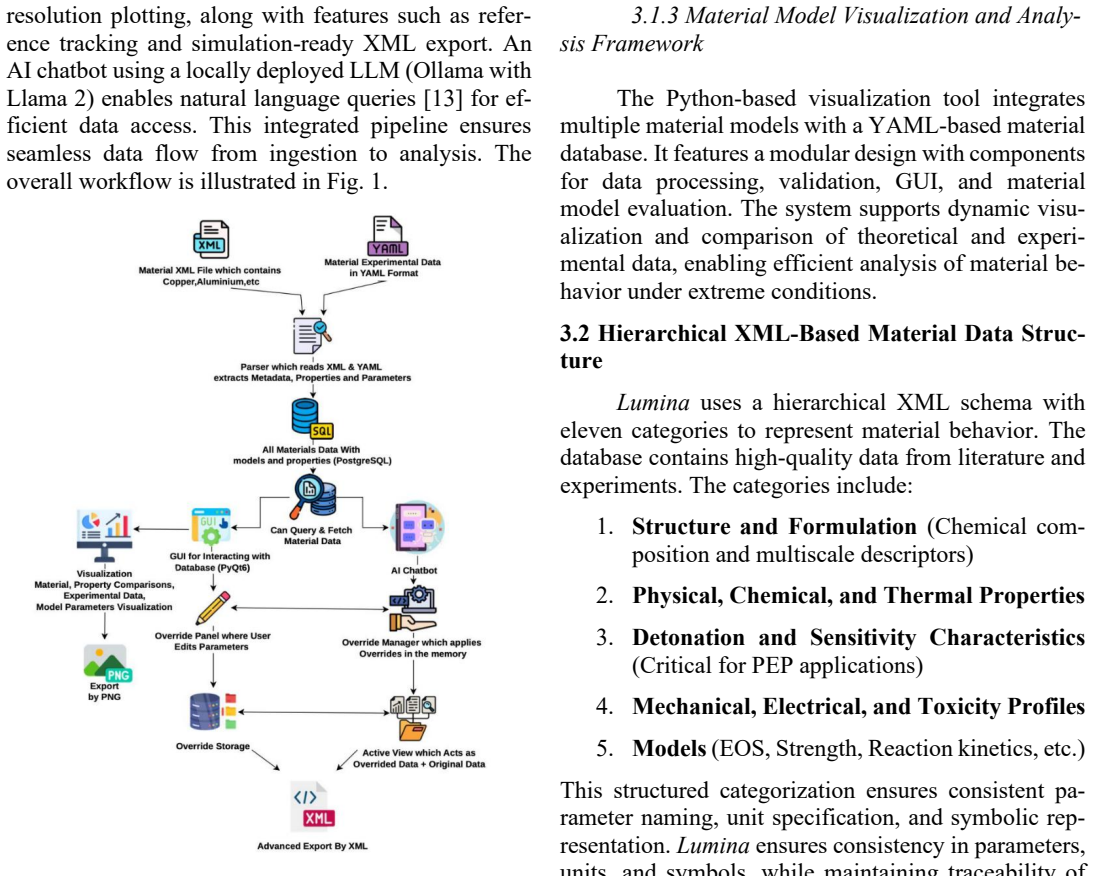
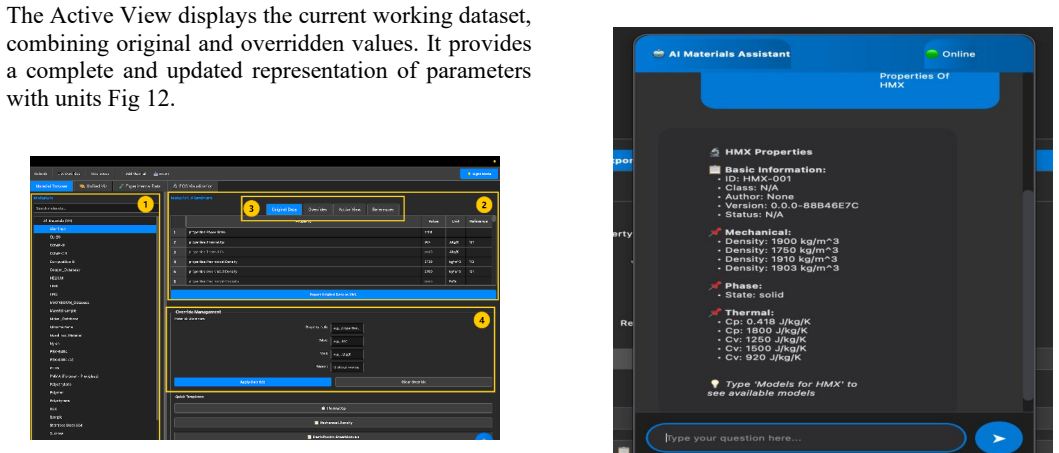
Lumina is a modular Python-based informatics framework that centralizes multiscale material data from atomistic simulation datasets to macro-scale experimental records within a unified repository. It employs a hierarchical XML-based schema and a dynamic runtime parsing mechanism to enable schema-independent parameter extraction. The platform supplies computational modules to visualize model fits and integrates a conversational AI assistant for intelligent material retrieval and natural language querying.
What carries the argument
Hierarchical XML-based schema with dynamic runtime parsing, which performs schema-independent parameter extraction across datasets from different material classes.
If this is right
- Experimentalists gain modules that visualize model fits and thereby optimize design-of-experiments choices.
- Formulators can directly compare chemical behaviors against stored benchmarks inside the same environment.
- Machine-learning pipelines receive consolidated, traceable data that should raise predictive accuracy for extreme-regime simulations.
- Multi-disciplinary teams can query the repository through natural language instead of manual file searches.
- The architecture supplies a traceable data backbone for scaling data-driven methods in defense and aerospace engineering.
Where Pith is reading between the lines
- The same parsing layer could be tested on live sensor streams from high-temperature test rigs to check whether runtime updates remain stable.
- If the repository grows, cross-material queries might expose scaling relations between polymer and metal response under combined thermal and mechanical loads.
- Adding export hooks to common simulation codes would let the AI assistant generate ready-to-run input decks directly from a spoken request.
Load-bearing premise
The hierarchical XML schema plus runtime parser can pull parameters reliably from all fragmented metal, polymer, and PEP datasets without meaningful loss or format conflicts.
What would settle it
Run the parser on a mixed collection of published metal, polymer, and PEP datasets and measure the fraction of parameters successfully extracted versus lost or mis-mapped; a drop below 90 percent completeness on any class would falsify reliable schema-independent extraction.
Figures


read the original abstract
Predictive simulations and experimental design involving extreme aero-chemo-thermo-mechanical regimes require high-fidelity material representation across diverse physical states. However, data for metals, polymers, and propellants, explosives, and pyrotechnics (PEP) remain fragmented, obstructing traceability for formulators, experimentalists, and simulation engineers. This work introduces Lumina, a modular Python-based informatics framework that centralizes multiscale material data from atomistic simulation datasets to macro-scale experimental records, within a unified repository. Lumina employs a hierarchical XML-based schema and a dynamic runtime parsing mechanism to enable schema-independent parameter extraction. Beyond storage, the platform provides computational modules to visualize model fits, allowing experimentalists to optimize design of experiments (DoE) and formulators to validate chemical behaviors against benchmarks. This structured architecture serves as a high-fidelity pipeline for training machine learning models and enhancing the accuracy of predictive simulations. To streamline multi-disciplinary workflows, Lumina integrates a conversational AI assistant for intelligent material retrieval and natural language querying. By consolidating multiscale data into an extensible ecosystem, Lumina provides a scalable foundation for data-driven discovery and predictive modeling in advanced defense and aerospace engineering.
Editorial analysis
A structured set of objections, weighed in public.
Referee Report
Summary. The manuscript introduces Lumina, a modular Python-based informatics framework for centralizing fragmented multiscale material data spanning atomistic simulations to macro-scale experimental records for metals, polymers, and propellants/explosives/pyrotechnics (PEP) in extreme aero-chemo-thermo-mechanical regimes. It relies on a hierarchical XML-based schema combined with dynamic runtime parsing to achieve schema-independent parameter extraction, supplies visualization modules for model fits and design-of-experiments optimization, supports machine-learning model training, and integrates a conversational AI assistant for natural-language material retrieval. The stated goal is to furnish a high-fidelity, extensible pipeline that improves traceability and predictive accuracy for defense and aerospace applications.
Significance. If the XML schema and parsing mechanism function as asserted, Lumina could meaningfully reduce data fragmentation and enable more reliable AI-augmented workflows in a domain where material properties under extreme conditions are currently scattered. The integration of visualization, DoE tools, and an AI query interface would be a practical contribution for experimentalists and simulators. At present, however, the absence of any implementation results, extraction-fidelity metrics, or benchmark comparisons prevents evaluation of whether these benefits are realized.
major comments (2)
- [Abstract] Abstract: The central claim that the hierarchical XML-based schema and dynamic runtime parsing deliver 'schema-independent parameter extraction' without significant data loss or compatibility problems across atomistic and macro-scale records for chemically dissimilar materials (metals, polymers, PEP) is load-bearing for the entire framework. No test cases, extraction-error statistics, or examples of parameter recovery from heterogeneous sources are supplied to substantiate this assertion.
- [Abstract] Abstract: The assertion that Lumina constitutes a 'high-fidelity pipeline for training machine learning models and enhancing the accuracy of predictive simulations' lacks any supporting validation data, error metrics, or comparative results against existing repositories or simulation workflows.
minor comments (2)
- The manuscript would benefit from a schematic diagram showing the data-flow architecture, XML schema hierarchy, and runtime parsing components to improve clarity for readers unfamiliar with the implementation.
- Specify the Python packages or libraries employed for XML handling, dynamic parsing, and the conversational AI interface to facilitate reproducibility.
Simulated Author's Rebuttal
We thank the referee for their constructive and detailed review of our manuscript on the Lumina framework. We have considered the comments carefully and provide point-by-point responses below, indicating where revisions will be made to address the identified gaps.
read point-by-point responses
-
Referee: [Abstract] Abstract: The central claim that the hierarchical XML-based schema and dynamic runtime parsing deliver 'schema-independent parameter extraction' without significant data loss or compatibility problems across atomistic and macro-scale records for chemically dissimilar materials (metals, polymers, PEP) is load-bearing for the entire framework. No test cases, extraction-error statistics, or examples of parameter recovery from heterogeneous sources are supplied to substantiate this assertion.
Authors: We agree that the claim in the abstract requires empirical support to be fully substantiated. The current manuscript emphasizes the design of the hierarchical XML schema and dynamic parser but does not include explicit test cases or quantitative metrics. In the revised version, we will add a dedicated subsection with concrete examples of parameter extraction from atomistic datasets (e.g., for metals) and macro-scale records (e.g., for polymers and PEP), along with extraction-error statistics and notes on any observed compatibility adjustments or data loss. revision: yes
-
Referee: [Abstract] Abstract: The assertion that Lumina constitutes a 'high-fidelity pipeline for training machine learning models and enhancing the accuracy of predictive simulations' lacks any supporting validation data, error metrics, or comparative results against existing repositories or simulation workflows.
Authors: The manuscript presents Lumina's architecture as enabling such a pipeline through unified data access, visualization, and DoE modules. However, we acknowledge the absence of validation results or comparative benchmarks in the current draft. We will revise the abstract to reflect the framework's intended role more precisely and incorporate preliminary results from ML model training on Lumina-extracted data, including relevant error metrics and comparisons to existing data-handling approaches where feasible. revision: yes
Circularity Check
No circularity: descriptive software framework paper with no derivations or self-referential claims
full rationale
The paper introduces Lumina as a modular Python-based informatics framework for consolidating multiscale material data using a hierarchical XML schema and dynamic runtime parsing. The abstract and provided text contain no equations, fitted parameters, predictions, or derivation chains. Claims about enabling schema-independent extraction, AI integration, and predictive modeling are presented as design goals and architectural features rather than results derived from prior inputs or self-citations. No load-bearing steps reduce to self-definition, fitted inputs renamed as predictions, or uniqueness theorems imported from the authors' prior work. This is a standard descriptive introduction to a new tool, fully self-contained without any circular reduction.
Axiom & Free-Parameter Ledger
Lean theorems connected to this paper
-
IndisputableMonolith/Cost/FunctionalEquation.leanwashburn_uniqueness_aczel unclear?
unclearRelation between the paper passage and the cited Recognition theorem.
Lumina employs a hierarchical XML-based schema and a dynamic runtime parsing mechanism to enable schema-independent parameter extraction... three-layer data management mechanism (Original, Override, and Active views)
-
IndisputableMonolith/Foundation/RealityFromDistinction.leanreality_from_one_distinction unclear?
unclearRelation between the paper passage and the cited Recognition theorem.
The system manages the linear Shock Velocity (Us) and Particle Velocity (Up) relationship... Mie-Gruneisen EOS... JWL Equation of State
What do these tags mean?
- matches
- The paper's claim is directly supported by a theorem in the formal canon.
- supports
- The theorem supports part of the paper's argument, but the paper may add assumptions or extra steps.
- extends
- The paper goes beyond the formal theorem; the theorem is a base layer rather than the whole result.
- uses
- The paper appears to rely on the theorem as machinery.
- contradicts
- The paper's claim conflicts with a theorem or certificate in the canon.
- unclear
- Pith found a possible connection, but the passage is too broad, indirect, or ambiguous to say the theorem truly supports the claim.
Reference graph
Works this paper leans on
-
[1]
Review on thermochemical codes,
E.-C. Koch, R. Webb, and V. Weiser, “Review on thermochemical codes,” in 4th Workshop on Pyro- technic Combustion Mechanism, 2009
work page 2009
-
[2]
Y. Caridi, A. Cucuzzella, and S. Berrone, “HEMSim: a new MATLAB software to simulate the behavior of highly energetic materials upon Chapman-Jouguet hypothesis,” J. Energ. Mater., pp. 1–17, 2025
work page 2025
-
[3]
P. C. H. Nguyen, Y. Nguyen, P. K. Seshadri, J. B. Choi, H. Udaykumar, and S. Baek, “A Physics‐ Aware deep learning model for energy localiza- tion in multiscale shock‐To‐detonation simula- tions of heterogeneous energetic materials,” Pro- pellants Explos. Pyrotech., vol. 48, no. 4, p. e202200268, 2023
work page 2023
-
[4]
Y. Nguyen, P. Seshadri, O. Sen, D. B. Hardin, C. D. Molek, and H. S. Udaykumar, “Multi-scale modeling of shock initiation of a pressed energetic material I: The effect of void shapes on energy lo- calization,” J. Appl. Phys., vol. 131, no. 5, p. 055906, Feb. 2022, doi: 10.1063/5.0068715
-
[5]
Y. T. Nguyen, P. K. Seshadri, O. Sen, D. B. Har- din, C. D. Molek, and H. S. Udaykumar, “Multi- scale modeling of shock initiation of a pressed en- ergetic material. II. Effect of void-void interac- tions on energy localization,” J. Appl. Phys., vol. 131, no. 21, p. 215903, Jun. 2022, doi: 10.1063/5.0090225
-
[6]
Y. T. Nguyen, P. K. Seshadri, and H. S. Udayku- mar, “Physically evocative meso-informed sub- grid source term for energy localization in shocked heterogeneous energetic materials.,” J. Appl. Phys., vol. 134, no. 16, p. 165901, 2023
work page 2023
-
[7]
Physically Evocative Meso-Informed Burn Model: Topology of Evolving Hotspot Fields,
H. S. Udaykumar, Y. T. Nguyen, and P. K. Sesha- dri, “Physically Evocative Meso-Informed Burn Model: Topology of Evolving Hotspot Fields,” J. Propuls. Power, vol. 38, no. 6, pp. 920–934, May 2022, doi: 10.2514/1.B38700
-
[8]
OpenFOAM | Free CFD Software | The Open- FOAM Foundation
“OpenFOAM | Free CFD Software | The Open- FOAM Foundation.” Accessed: Apr. 04, 2026. [Online]. Available: https://openfoam.org/
work page 2026
- [9]
- [10]
-
[11]
From Data to Discovery: How AI-Driven Materials Databases Are Reshap- ing Research,
Y. Qi and W. Yang, “From Data to Discovery: How AI-Driven Materials Databases Are Reshap- ing Research,” Comput. Mater. Contin., vol. 83, no. 2, p. 1555, 2025
work page 2025
-
[12]
Development of LLM-as- sisted data curation tools for the Starrydata materi- als science database,
Y. Katsura et al., “Development of LLM-as- sisted data curation tools for the Starrydata materi- als science database,” Sci. Technol. Adv. Mater. Methods, vol. 5, no. 1, p. 2590811, 2025
work page 2025
-
[13]
“27th IEEE International Conference on High Performance Computing, Data, and Analytics (HiPC 2020) Technical program,” in 2020 IEEE 27th International Conference on High Perfor- mance Computing, Data, and Analytics (HiPC), Dec. 2020, pp. xxiii–xxvi. doi: 10.1109/HiPC50609.2020.00013
-
[14]
Z. Pei, J. Yin, and J. Zhang, “Language models for materials discovery and sustainability: Pro- gress, challenges, and opportunities,” Prog. Ma- ter. Sci., vol. 154, p. 101495, 2025
work page 2025
-
[15]
Constituent properties of HMX needed for mesoscale simula- tions,
R. Menikoff and T. D. Sewell, “Constituent properties of HMX needed for mesoscale simula- tions,” Combust. Theory Model., vol. 6, no. 1, p. 103, 2002
work page 2002
-
[16]
Complete Equation of State for β-HMX and Implications for Initiation,
T. D. Sewell and R. Menikoff, “Complete Equation of State for β-HMX and Implications for Initiation,” in AIP Conference Proceedings, American Institute of Physics, 2004, pp. 157–162
work page 2004
-
[17]
Elasticity of crystalline molecu- lar explosives,
D. E. Hooks, K. J. Ramos, C. A. Bolme, and M. J. Cawkwell, “Elasticity of crystalline molecu- lar explosives,” Propellants Explos. Pyrotech., vol. 40, no. 3, pp. 333–350, 2015
work page 2015
-
[18]
Mo- lecular dynamics simulations of RDX and RDX- based plastic-bonded explosives,
W. Zhu, J. Xiao, W. Zhu, and H. Xiao, “Mo- lecular dynamics simulations of RDX and RDX- based plastic-bonded explosives,” J. Hazard. Ma- ter., vol. 164, no. 2–3, pp. 1082–1088, 2009
work page 2009
discussion (0)
Sign in with ORCID, Apple, or X to comment. Anyone can read and Pith papers without signing in.