Dark solitons in the fractional NLS equation
Pith reviewed 2026-05-21 03:29 UTC · model grok-4.3
The pith
The fractional nonlinear Schrödinger equation makes every branch of dark two-soliton solutions unstable, with odd branches oscillating and even branches decaying exponentially.
A machine-rendered reading of the paper's core claim, the machinery that carries it, and where it could break.
Core claim
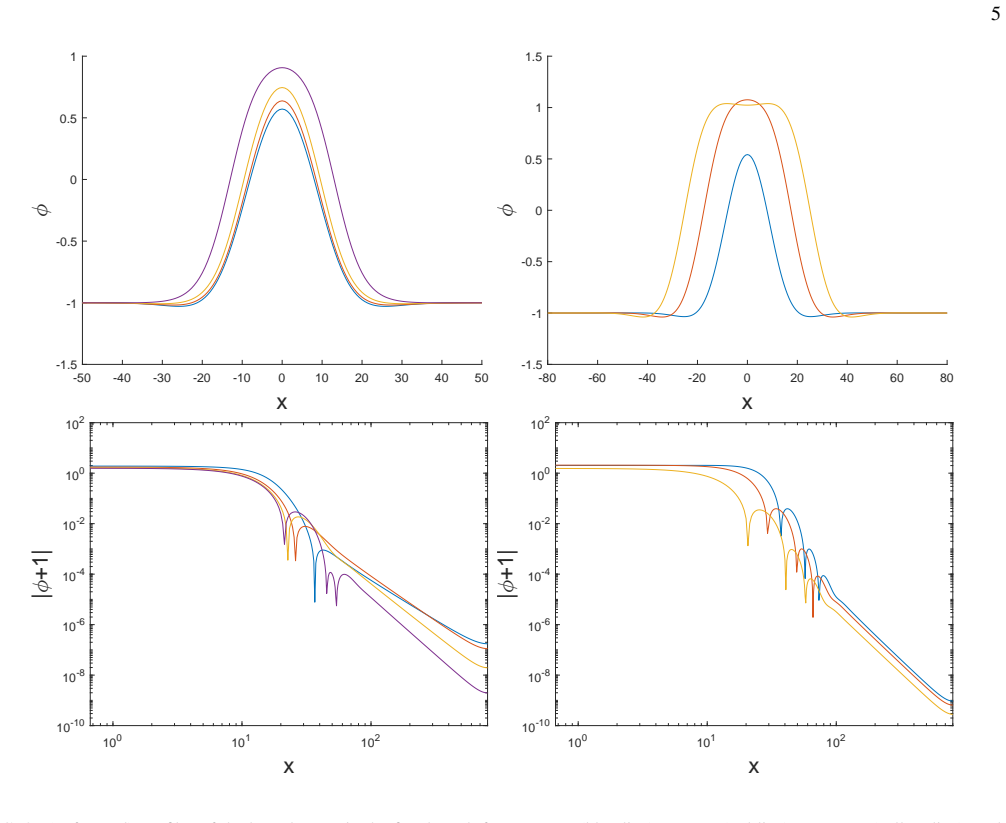
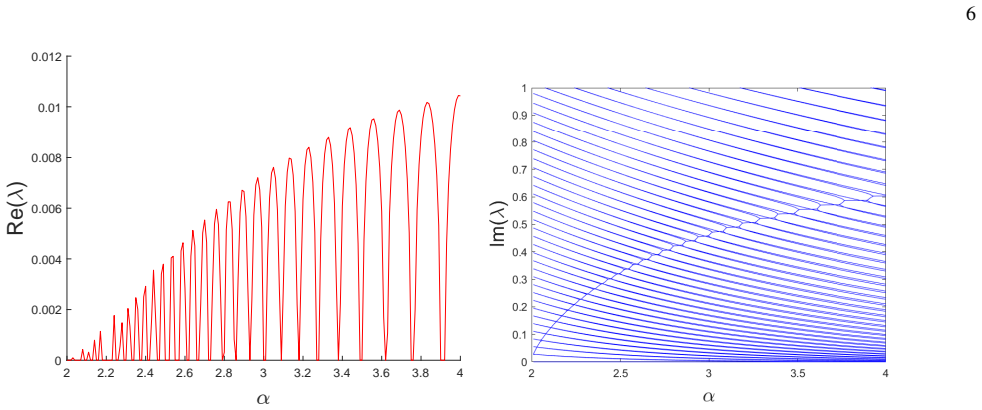
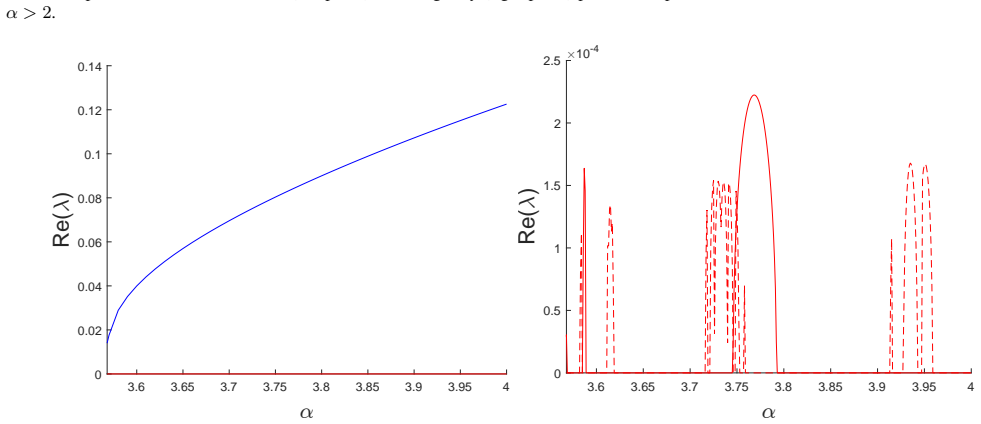
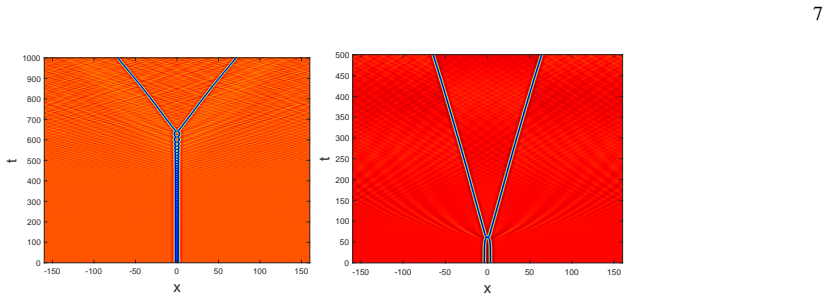
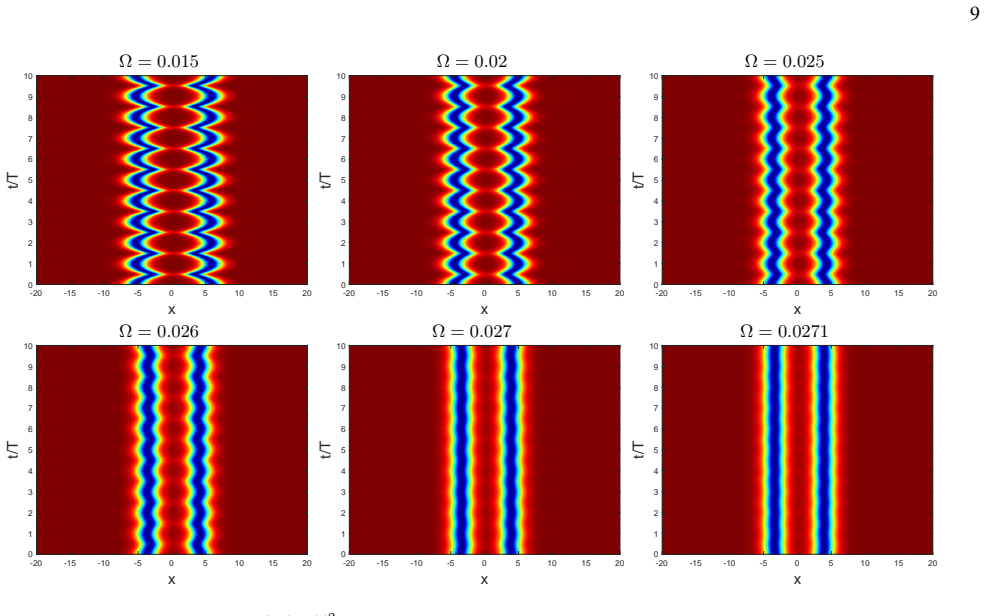
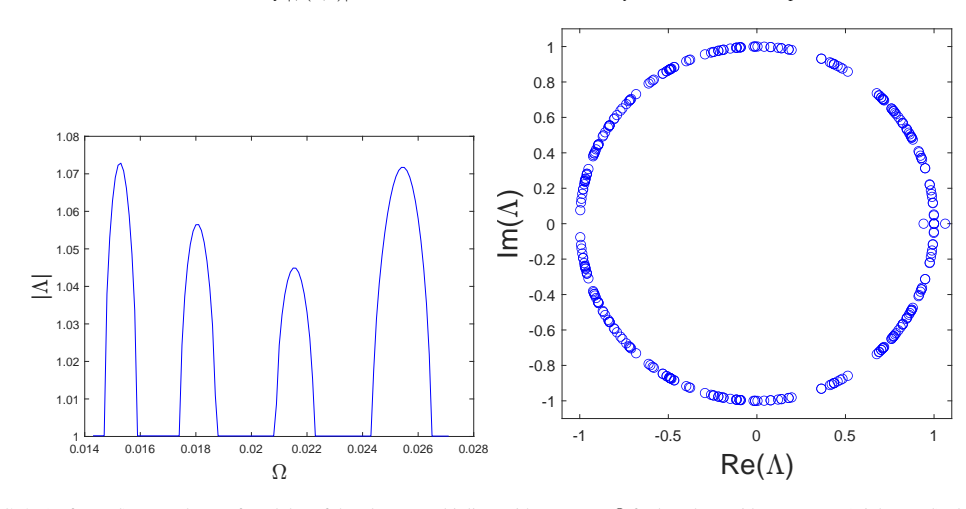
In the fractional NLS equation, dark two-soliton solutions form several distinct branches of equilibria. Contrary to real field theory, every branch is potentially unstable. Odd branches are subject to oscillatory instabilities while even branches are exponentially unstable. The resulting dynamics can exhibit breathing characteristics, for which periodic breathing orbits are located, and reduced-order ODE descriptions of the soliton interactions are shown to hold promise.
What carries the argument
Numerical continuation combined with linear stability analysis applied to the fractional Laplacian version of the NLS equation, used to track two-soliton branches and extract their instability spectra.
If this is right
- Instabilities of two-soliton states produce breathing motion in the fractional setting.
- Periodic breathing orbits exist as stable or metastable states tied to the soliton pairs.
- Simple ODE models based on particle-like interactions can approximate the full PDE dynamics of the solitons.
- Different instability types (oscillatory versus exponential) distinguish the odd and even branches.
Where Pith is reading between the lines
- Fractional dispersion may generically prevent stable bound states of dark solitons that exist in the classical case.
- The reduced ODE models could be tested against direct simulations to quantify how well they predict collision outcomes or long-term separation distances.
- Applications in optics or fluid systems with nonlocal dispersion might show the predicted breathing or decay signatures.
Load-bearing premise
The numerical continuation and linear stability methods remain accurate and artifact-free once the ordinary Laplacian is replaced by its fractional counterpart.
What would settle it
A direct numerical integration or spectral computation that shows a stable even two-soliton branch persisting for long times in the fractional NLS equation.
Figures





read the original abstract
In the present work we consider the subject of dark fractional solitary waves in the realm of generalized (fractional) forms of the nonlinear Schr\"odinger (NLS) equation. While earlier studies have examined such states in the realm of real field theories, we showcase the existence and stability of individual dark solitary waves in such NLS settings and subsequently turn to two-soliton solutions. We find different branches of such two-soliton solution equilibria and contrary to the real field-theoretic setting all possible branches of two-soliton equilibria are found to be potentially unstable, although with different types of instabilities. Odd branches are potentially subject to oscillatory instabilities, while even branches are always exponentially unstable. The dynamics that results from the instabilities is also examined and is found to potentially feature breathing characteristics. This prompts us to seek and find associated periodic (breathing) orbits that are also unprecedented in this context, to the best of our knowledge. The effective particle-like dynamics of the solitary waves also prompts us to seek ordinary differential equation (ODE) descriptions to the dark soliton interaction dynamics. These are shown to hold promise toward providing us with effective reduced order models, indicating some potential directions for further investigation.
Editorial analysis
A structured set of objections, weighed in public.
Referee Report
Summary. The manuscript investigates dark solitons in the fractional nonlinear Schrödinger equation. It establishes existence and stability properties of single dark solitary waves, then identifies multiple branches of two-soliton equilibria. All such branches are reported to be potentially unstable, with odd branches exhibiting oscillatory instabilities and even branches showing exponential instabilities, in contrast to real field-theoretic settings. The resulting dynamics are analyzed and found to feature breathing characteristics, prompting identification of associated periodic breathing orbits. Reduced-order ODE models for effective soliton interaction dynamics are also derived and shown to hold promise.
Significance. If the numerical results are robust, the work would offer valuable insights into nonlocal effects on soliton stability and interactions, particularly the universal instability of two-soliton branches and the emergence of breathing orbits not seen in integer-order cases. The reduced ODE constructions could provide useful effective models for further study in fractional media.
major comments (2)
- [Numerical Methods] Numerical Methods section: The central claims on two-soliton branch instabilities (odd: oscillatory; even: exponential) and their distinction from real field theory rest on numerical continuation and linear stability analysis. No convergence checks, error bars, grid-resolution studies, or explicit verification of consistent discretization of the fractional Laplacian (e.g., Fourier cutoff or quadrature accuracy for s < 2) are provided. This is load-bearing, as nonlocal operator truncation can introduce spurious eigenvalues or misclassify instability types.
- [Two-soliton equilibria] Two-soliton equilibria analysis: The assertion that 'all possible branches of two-soliton equilibria are found to be potentially unstable' lacks quantitative details such as eigenvalue magnitudes, growth rates, or their dependence on the fractional order s. Without these, the robustness of the reported instability classification and contrast to real field-theoretic results cannot be fully assessed.
minor comments (2)
- [Abstract] The abstract could specify the range of the fractional order s considered to better contextualize the results.
- [Introduction] Notation for the fractional Laplacian should be defined explicitly at first use and used consistently.
Simulated Author's Rebuttal
We thank the referee for the careful reading of our manuscript and the constructive comments. We address each major point below and have prepared revisions to strengthen the numerical aspects of the work.
read point-by-point responses
-
Referee: [Numerical Methods] Numerical Methods section: The central claims on two-soliton branch instabilities (odd: oscillatory; even: exponential) and their distinction from real field theory rest on numerical continuation and linear stability analysis. No convergence checks, error bars, grid-resolution studies, or explicit verification of consistent discretization of the fractional Laplacian (e.g., Fourier cutoff or quadrature accuracy for s < 2) are provided. This is load-bearing, as nonlocal operator truncation can introduce spurious eigenvalues or misclassify instability types.
Authors: We agree that additional documentation of the numerical procedures is warranted to confirm the robustness of the reported instabilities. In the revised manuscript we will add a new subsection detailing convergence tests with respect to spatial grid resolution and Fourier-mode cutoff for the fractional Laplacian. Representative eigenvalue spectra will be shown for multiple values of s, demonstrating that the classification into oscillatory (odd branches) and exponential (even branches) instabilities remains unchanged under refinement. Error estimates and a brief discussion of quadrature accuracy for s < 2 will also be included. revision: yes
-
Referee: [Two-soliton equilibria] Two-soliton equilibria analysis: The assertion that 'all possible branches of two-soliton equilibria are found to be potentially unstable' lacks quantitative details such as eigenvalue magnitudes, growth rates, or their dependence on the fractional order s. Without these, the robustness of the reported instability classification and contrast to real field-theoretic results cannot be fully assessed.
Authors: We accept that quantitative information on the unstable eigenvalues would improve clarity. The revised version will incorporate additional panels and a table summarizing the leading real and imaginary parts of the eigenvalues as functions of s for each branch. These data will explicitly illustrate the growth rates and confirm the persistence of the reported instability types across the examined range of the fractional order. revision: yes
Circularity Check
No significant circularity: numerical continuation and stability analysis are independent of target claims
full rationale
The paper's central results on two-soliton branches, their instabilities (oscillatory for odd, exponential for even), breathing orbits, and reduced ODE models are obtained via direct numerical continuation of equilibria and subsequent linearization of the fractional NLS operator. No step reduces by construction to a fitted parameter, self-defined quantity, or load-bearing self-citation that imports the uniqueness or form of the result. The fractional Laplacian is discretized and applied as an external operator; the reported distinctions from the integer-order case follow from the computed spectra rather than tautological renaming or ansatz smuggling. The derivation chain is therefore self-contained and externally falsifiable through independent numerical reproduction.
Axiom & Free-Parameter Ledger
axioms (1)
- domain assumption The generalized fractional NLS equation admits dark solitary wave solutions that can be continued numerically from the integer-order case.
Lean theorems connected to this paper
-
IndisputableMonolith/Foundation/AbsoluteFloorClosure.leanreality_from_one_distinction unclear?
unclearRelation between the paper passage and the cited Recognition theorem.
We consider a defocusing NLS equation with a dispersive term in the generalized form of Riesz derivative... ∂^α_x ψ(x,t) = −1/(2π) ∫ dk |k|^α ∫ dξ e^{ik(x−ξ)} ψ(ξ,t)
What do these tags mean?
- matches
- The paper's claim is directly supported by a theorem in the formal canon.
- supports
- The theorem supports part of the paper's argument, but the paper may add assumptions or extra steps.
- extends
- The paper goes beyond the formal theorem; the theorem is a base layer rather than the whole result.
- uses
- The paper appears to rely on the theorem as machinery.
- contradicts
- The paper's claim conflicts with a theorem or certificate in the canon.
- unclear
- Pith found a possible connection, but the passage is too broad, indirect, or ambiguous to say the theorem truly supports the claim.
Reference graph
Works this paper leans on
-
[1]
A. Blanco-Redondo, C. M. de Sterke, J. Sipe, T. F. Krauss, B. J. Eggleton, and C. Husko, Nature Communications7, 10427 (2016)
work page 2016
-
[2]
A. F. J. Runge, D. D. Hudson, K. K. K. Tam, C. M. de Sterke, and A. Blanco-Redondo, Nature Photonics14, 492 (2020)
work page 2020
-
[3]
C. M. de Sterke, A. F. J. Runge, D. D. Hudson, and A. Blanco-Redondo, APL Photonics6, 091101 (2021)
work page 2021
-
[4]
R. Parker and A. Aceves, Physica D: Nonlinear Phenomena422, 132890 (2021)
work page 2021
-
[5]
R. J. Decker, A. Demirkaya, N. S. Manton, and P. G. Kevrekidis, Journal of Physics A: Mathematical and Theoretical53, 375702 (2020)
work page 2020
-
[6]
G. A. Tsolias, R. J. Decker, A. Demirkaya, T. J. Alexander, R. Parker, and P. G. Kevrekidis, Communications in Nonlinear Science and Numerical Simulation125, 107362 (2023)
work page 2023
-
[7]
K. K. K. Tam, T. J. Alexander, A. Blanco-Redondo, and C. M. de Sterke, Opt. Lett.44, 3306 (2019)
work page 2019
-
[8]
K. K. K. Tam, T. J. Alexander, A. Blanco-Redondo, and C. M. de Sterke, Phys. Rev. A101, 043822 (2020)
work page 2020
-
[9]
R. I. Bandara, A. Giraldo, N. G. R. Broderick, and B. Krauskopf, Phys. Rev. A103, 063514 (2021)
work page 2021
-
[10]
Y . L. Qiang, T. J. Alexander, and C. M. de Sterke, Physical Review A105, 023501 (2022)
work page 2022
-
[11]
C. M. de Sterke and A. Blanco-Redondo, Optics Communications541, 129560 (2023)
work page 2023
-
[12]
J. Widjaja, Y . L. Qiang, A. F. J. Skelton, V . T. Hoang, T. J. Alexander, A. F. J. Runge, and C. M. de Sterke, Nature Communications16, 5196 (2025)
work page 2025
-
[13]
T. J. Alexander, G. A. Tsolias, A. Demirkaya, R. J. Decker, C. M. de Sterke, and P. G. Kevrekidis, Opt. Lett.47, 1174 (2022)
work page 2022
-
[14]
R. J. Decker, A. Demirkaya, T. Alexander, G. Tsolias, and P. Kevrekidis, Nonlinear Science4, 100051 (2025)
work page 2025
-
[15]
Qureshi, Chaos, Solitons & Fractals134, 109744 (2020)
S. Qureshi, Chaos, Solitons & Fractals134, 109744 (2020)
work page 2020
-
[16]
C. Ionescu, A. Lopes, D. Copot, J. A. T. Machado, and J. H. T. Bates, Communications in Nonlinear Science and Numerical Simulation 51, 141 (2017)
work page 2017
- [17]
-
[18]
S. Azam, J. E. Mac´ıas-D´ıaz, N. Ahmed, I. Khan, M. S. Iqbal, M. Rafiq, K. S. Nisar, and M. O. Ahmad, Computer Methods and Programs in Biomedicine193, 105429 (2020)
work page 2020
-
[19]
P. Kevrekidis and J. Cuevas,Fractional Dispersive Models and Applications(Springer Nature, Berlin, 2024)
work page 2024
-
[20]
H. Ming, J. Wang, and M. Fe ˇckan, Mathematics7, 665 (2019)
work page 2019
-
[22]
I. Podlubny,Fractional differential equations: an introduction to fractional derivatives, fractional differential equations, to methods of their solution and some of their applications, V ol. 198 (Elsevier, 1998)
work page 1998
- [23]
-
[24]
Mihalache, Romanian Reports in Physics73, 403 (2021)
D. Mihalache, Romanian Reports in Physics73, 403 (2021)
work page 2021
-
[25]
M. Yavuz and N. ¨Ozdemir, Discrete & Continuous Dynamical Systems-S13, 995 (2020)
work page 2020
-
[26]
K. M. Saad, D. Baleanu, and A. Atangana, Computational and Applied Mathematics37, 5203 (2018)
work page 2018
-
[27]
M. D. Ortigueira, Mathematical Methods in the Applied Sciences44, 8057 (2021)
work page 2021
-
[28]
M. D. Ortigueira and G. Bengochea, Symmetry13, 823 (2021)
work page 2021
-
[29]
S. I. Muslih and O. P. Agrawal, International Journal of Theoretical Physics49, 270 (2010)
work page 2010
-
[30]
V . E. Tarasov and G. M. Zaslavsky, Communications in Nonlinear Science and Numerical Simulation11, 885 (2006)
work page 2006
- [31]
-
[32]
S. Liu, Y . Zhang, B. A. Malomed, and E. Karimi, Nature Communications14, 222 (2023)
work page 2023
-
[33]
V . T. Hoang, J. Widjaja, Y . L. Qiang, M. K. Liu, T. J. Alexander, A. F. J. Runge, and C. M. de Sterke, Nature Communications16, 5469 (2025)
work page 2025
-
[34]
V . T. Hoang, Y . Qiang, T. J. Alexander, A. F. J. Runge, and C. M. de Sterke, Science Advances12, eaea5872 (2026), https://www.science.org/doi/pdf/10.1126/sciadv.aea5872
-
[35]
R. Kusdiantara, M. F. Adhari, H. A. Mardi, I. W. Sudiarta, and H. Susanto, Chaos36, 033109 (2026)
work page 2026
-
[36]
B. A. Malomed, Chaos: An Interdisciplinary Journal of Nonlinear Science34, 022102 (2024)
work page 2024
- [37]
- [38]
-
[39]
R. Carretero-Gonz ´alez, D. J. Frantzeskakis, and P. G. Kevrekidis,Nonlinear Waves & Hamiltonian Systems: From One To Many Degrees of Freedom, From Discrete To Continuum(Oxford University Press, 2024)
work page 2024
- [40]
-
[41]
N. S. Manton, Nuclear Physics B150, 397 (1979)
work page 1979
-
[42]
N. S. Manton, Journal of Physics A: Mathematical and Theoretical52, 065401 (2019)
work page 2019
-
[43]
D. E. Pelinovsky and P. G. Kevrekidis, Zeitschrift f¨ur angewandte Mathematik und Physik59, 559 (2008)
work page 2008
- [44]
-
[45]
I. C. Christov, R. J. Decker, A. Demirkaya, V . A. Gani, P. G. Kevrekidis, and R. V . Radomskiy, Phys. Rev. D99, 016010 (2019)
work page 2019
- [46]
-
[47]
P. Kevrekidis, D. Frantzeskakis, and R. Carretero-Gonz´alez,The Defocusing Nonlinear Schrodinger Equation(Society for Industrial and Applied Mathematics, Philadelphia, PA, 2015)
work page 2015
discussion (0)
Sign in with ORCID, Apple, or X to comment. Anyone can read and Pith papers without signing in.