Searching for links between energetic millisecond pulsars and repeating fast radio bursts
Pith reviewed 2026-05-21 03:30 UTC · model grok-4.3
The pith
No strong links are found between the giant pulses of energetic MSP M28A and the bursts of repeating FRB 20200120E.
A machine-rendered reading of the paper's core claim, the machinery that carries it, and where it could break.
Core claim
Observations of M28A across 700-4000 MHz confirm that its giant pulses retain their established traits of short durations, low spectral luminosities, strict periodicity, purely Poissonian wait times, steep energy distributions, and mostly broad-band spectra containing occasional narrow-band peaks of roughly 100 MHz width. In contrast, FRB 20200120E bursts last 50 times longer, reach 10^5 times higher spectral luminosities, show no periodicity, follow quasi-Poissonian waiting times, and appear only as narrow-band events. No genuinely narrow-band giant pulses are detected in the M28A data. The study therefore identifies no strong links between the two sources while noting that higher-cadence,
What carries the argument
Direct side-by-side comparison of burst properties including duration, spectral luminosity, periodicity, wait-time distribution, energy distribution, and spectral bandwidth between M28A giant pulses and FRB 20200120E bursts.
If this is right
- FRB 20200120E would have to be a rare and unique millisecond pulsar without any Galactic analogue.
- Higher-cadence monitoring of M28A over hundreds to thousands of hours could uncover rare but extremely luminous pulses.
- The steep energy distributions and minor dispersion-measure variability seen in both sources would remain as the only shared observational traits.
- The absence of truly narrow-band giant pulses in M28A would continue to distinguish it from the exclusively narrow-band FRB 20200120E bursts.
Where Pith is reading between the lines
- Globular-cluster repeating FRBs may require formation channels distinct from those producing Galactic millisecond pulsars.
- Targeted searches for similar activity in other high-energy millisecond pulsars could test whether M28A is simply atypical rather than representative.
- If an MSP origin is eventually confirmed for cluster FRBs, conventional young-magnetar models would need revision for dense stellar environments.
Load-bearing premise
M28A is treated as a representative energetic millisecond pulsar whose giant-pulse properties would be detectable and directly comparable if the same mechanism operated in FRB 20200120E.
What would settle it
A detection, in either long-term M28A monitoring or FRB 20200120E observations, of bursts that simultaneously match in duration, luminosity, periodicity, and narrow-band spectral structure would falsify the conclusion of no strong links.
Figures





read the original abstract
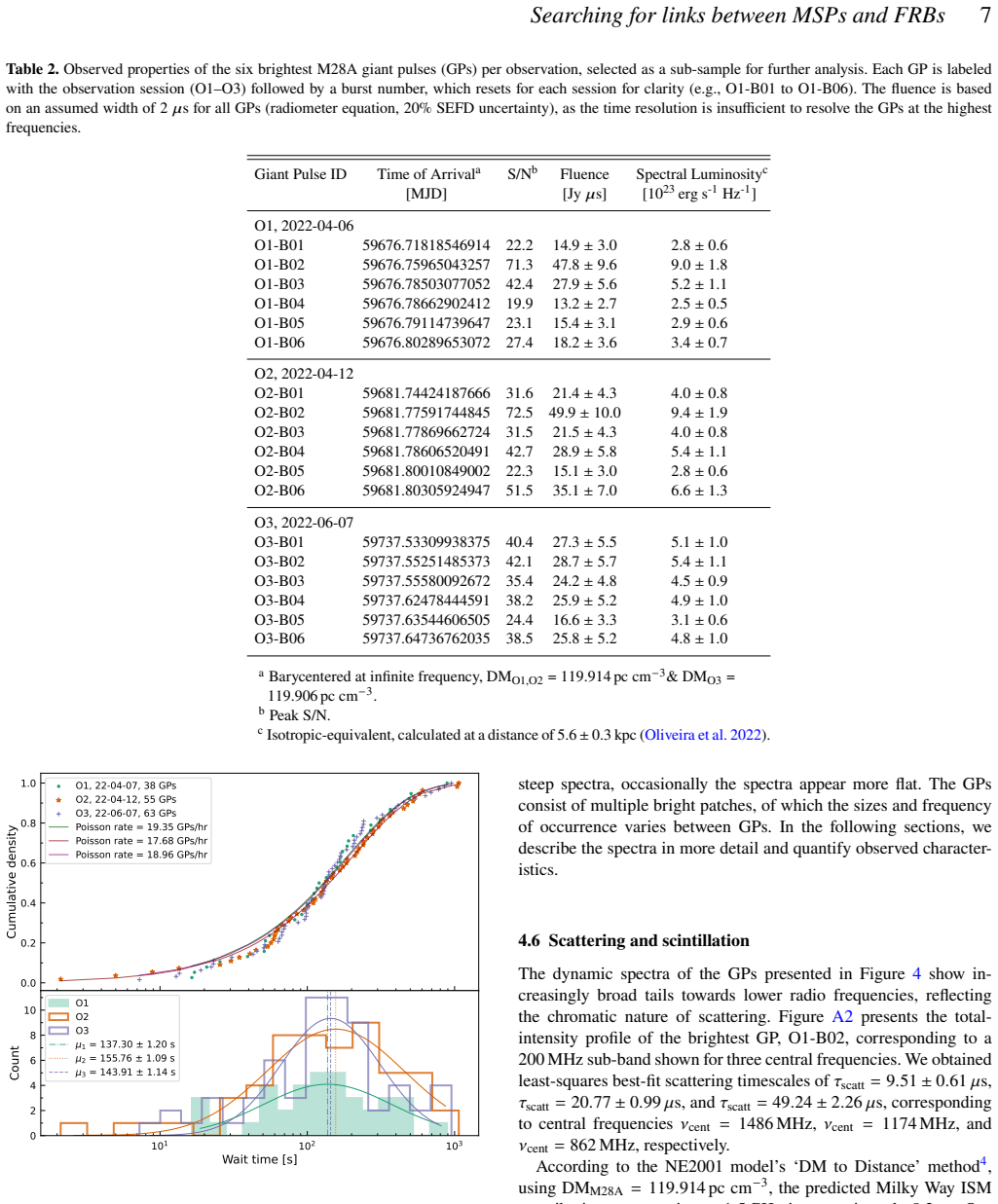
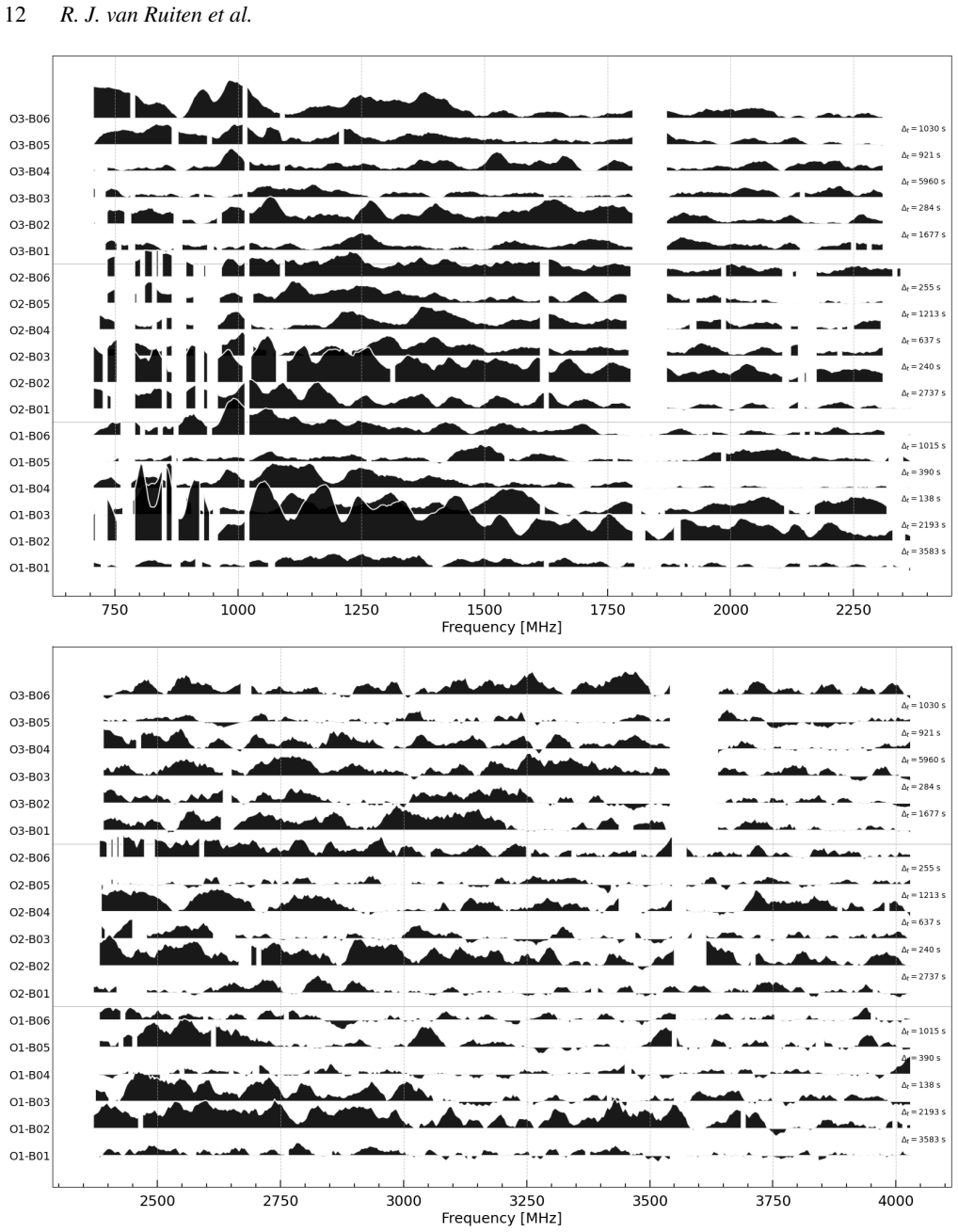
The unexpected localization of the repeating FRB 20200120E to a globular cluster challenges conventional FRB models based on magnetars formed via core collapse. One alternative model suggests that FRB 20200120E is a millisecond pulsar (MSP) producing giant pulses (GPs). To test this hypothesis, we compared the characteristics of FRB 20200120E bursts with the GPs of the most energetic Galactic MSP known, M28A (PSR B1821$-$24A), using observations with the Parkes (Murriyang) telescope's Ultra Wideband Low-frequency (UWL) receiver. Our analysis provides insight into the spectral structure and frequency extent of M28A's GPs, revealing broad-band spectra spanning $700-4000$ MHz (in some cases) with complex spectral peaks. We find that known M28A GP characteristics persist at this bandwidth, such as durations, luminosities, periodicity, wait-time, and energy distribution. A sub-band search for narrow-band GPs yielded no detection of genuinely narrow-band GPs. However, we do find narrow-band spectral peaks of $\sim100$ MHz bandwidth, a similar scale observed for FRB 20200120E's bursts. Compared to FRB 20200120E's bursts, M28A's GPs have $50\times$ shorter durations, $10^5\times$ lower spectral luminosities, clear periodicity (vs. no periodicity), a purely Poissonian wait-time distribution (vs. quasi-Poissonian), and generally broad-band spectra with narrow-band peaks (vs. only narrow-band bursts). Both sources show a steep energy distribution and minor dispersion measure variability. Our study finds no strong links between M28A and FRB 20200120E. However, we cannot rule out the possibility that FRB 20200120E is a rare and unique type of MSP with no Galactic analogue. Furthermore, higher-cadence monitoring of M28A, for hundreds to thousands of hours, might reveal rare but extremely luminous pulses.
Editorial analysis
A structured set of objections, weighed in public.
Referee Report
Summary. The manuscript compares multi-frequency observations of giant pulses (GPs) from the energetic Galactic MSP M28A (PSR B1821-24A) taken with the Parkes UWL receiver against the properties of bursts from the repeating FRB 20200120E. It reports that M28A GPs are 50 times shorter in duration, 10^5 times lower in spectral luminosity, exhibit clear periodicity and purely Poissonian wait times (versus no periodicity and quasi-Poissonian waits for the FRB), and display generally broad-band spectra with occasional ~100 MHz narrow-band peaks (versus exclusively narrow-band bursts for the FRB). A sub-band search finds no genuinely narrow-band GPs. The authors conclude there are no strong links between M28A and FRB 20200120E, while explicitly noting that the FRB could be a rare MSP without a Galactic analogue; they also suggest that longer monitoring might reveal rare luminous pulses.
Significance. If the reported differences hold under broader sampling, the work supplies a concrete observational constraint on MSP giant-pulse models for globular-cluster FRBs by quantifying mismatches across duration, luminosity, timing statistics, and spectral structure. The direct use of wide-band UWL data and the sub-band narrow-band search constitute useful additions to the existing literature on M28A GPs.
major comments (2)
- [Results section] Results section (sub-band search paragraph): the non-detection of genuinely narrow-band GPs is stated without quantitative upper limits, Poisson-rate confidence intervals, or error propagation on the search sensitivity; this weakens the strength of the spectral-structure comparison to FRB 20200120E's narrow-band bursts.
- [Discussion section] Discussion section: the central claim of 'no strong links' rests on comparison with a single energetic MSP (M28A); although the manuscript includes the caveat that FRB 20200120E could be a rare unique object, the load-bearing assumption that M28A's observed GP properties are representative enough for the comparison would benefit from explicit discussion of selection effects or the expected diversity among other high-energy MSPs.
minor comments (2)
- [Abstract] Abstract and results: the phrase 'minor dispersion measure variability' for both sources should be accompanied by the measured rms values or significance levels to allow readers to judge whether the variability is astrophysical or instrumental.
- Figure captions (spectral plots): ensure frequency axes and sub-band boundaries are labeled with the exact 700-4000 MHz coverage and any channelization used in the narrow-band search.
Simulated Author's Rebuttal
We thank the referee for their constructive review and recommendation for minor revision. We address each major comment below and will incorporate revisions to strengthen the manuscript where the points are valid.
read point-by-point responses
-
Referee: [Results section] Results section (sub-band search paragraph): the non-detection of genuinely narrow-band GPs is stated without quantitative upper limits, Poisson-rate confidence intervals, or error propagation on the search sensitivity; this weakens the strength of the spectral-structure comparison to FRB 20200120E's narrow-band bursts.
Authors: We agree that quantitative upper limits would make the non-detection claim more rigorous. In the revised manuscript we will add Poisson-rate confidence intervals on the non-detection, propagate uncertainties from the search sensitivity, and report an explicit upper limit on the rate of genuinely narrow-band GPs. These additions will be placed in the Results section immediately following the sub-band search description. revision: yes
-
Referee: [Discussion section] Discussion section: the central claim of 'no strong links' rests on comparison with a single energetic MSP (M28A); although the manuscript includes the caveat that FRB 20200120E could be a rare unique object, the load-bearing assumption that M28A's observed GP properties are representative enough for the comparison would benefit from explicit discussion of selection effects or the expected diversity among other high-energy MSPs.
Authors: We accept that an explicit discussion of selection effects and diversity among high-energy MSPs would improve the manuscript. While M28A remains the most energetic Galactic MSP and therefore the strongest available analogue, we will expand the Discussion to note possible observational biases that favor detection of the brightest objects and to briefly outline the range of GP properties reported for other energetic MSPs. This will be added as a short paragraph that complements the existing statement that FRB 20200120E could be a rare object without a Galactic counterpart. revision: yes
Circularity Check
No significant circularity in observational comparison
full rationale
The paper performs a direct observational comparison of measured properties (durations, spectral luminosities, periodicity, wait-time distributions, energy distributions, and spectral structure via sub-band searches) between FRB 20200120E bursts and M28A giant pulses, with no derivations, equations, fitted parameters presented as predictions, or self-citations that bear the central claim. The conclusion of no strong links follows from the quantified empirical differences, and the explicit caveat that FRB 20200120E could be a rare unique MSP with no Galactic analogue directly addresses representativeness without circular reduction to inputs. The analysis is self-contained against external data benchmarks.
Axiom & Free-Parameter Ledger
axioms (1)
- domain assumption Giant pulses from energetic MSPs exhibit the same statistical properties (duration, luminosity, spectral structure) across different observing epochs and bandwidths.
Lean theorems connected to this paper
-
IndisputableMonolith/Foundation/RealityFromDistinction.leanreality_from_one_distinction unclear?
unclearRelation between the paper passage and the cited Recognition theorem.
Compared to FRB 20200120E's bursts, M28A's GPs have 50× shorter durations, 10^5× lower spectral luminosities, clear periodicity (vs. no periodicity), a purely Poissonian wait-time distribution (vs. quasi-Poissonian), and generally broad-band spectra with narrow-band peaks (vs. only narrow-band bursts).
What do these tags mean?
- matches
- The paper's claim is directly supported by a theorem in the formal canon.
- supports
- The theorem supports part of the paper's argument, but the paper may add assumptions or extra steps.
- extends
- The paper goes beyond the formal theorem; the theorem is a base layer rather than the whole result.
- uses
- The paper appears to rely on the theorem as machinery.
- contradicts
- The paper's claim conflicts with a theorem or certificate in the canon.
- unclear
- Pith found a possible connection, but the passage is too broad, indirect, or ambiguous to say the theorem truly supports the claim.
Reference graph
Works this paper leans on
-
[1]
Compact Objects in Globular Clusters. arXiv e-prints , keywords =. doi:10.48550/arXiv.2508.14308 , archivePrefix =. 2508.14308 , primaryClass =
-
[2]
Multiwavelength constraints on the origin of a nearby repeating fast radio burst source in a globular cluster. Nature Astronomy , keywords =. doi:10.1038/s41550-024-02386-6 , archivePrefix =. 2308.10930 , primaryClass =
-
[3]
Machine-learning-based detection of repeating fast radio bursts in the Milky Way and from extragalactic space , author =. 2022 , month =
work page 2022
-
[4]
International Astronomical Union Colloquium , volume=
Giant Pulses from the Crab Pulsar , author=. International Astronomical Union Colloquium , volume=. 2000 , organization=
work page 2000
-
[5]
Gaia EDR3 view on galactic globular clusters , journal =. 2021 , month =. doi:10.1093/mnras/stab1475 , url =
-
[6]
Westerbork Telescope 50th Anniversary , year = 2018, volume =
Westerbork Telescope 50th Anniversary. Westerbork Telescope 50th Anniversary , year = 2018, volume =
work page 2018
-
[7]
Giant pulses from J1823-3021A observed with the MeerKAT telescope. , keywords =. doi:10.1093/mnras/staa2510 , archivePrefix =. 2008.07548 , primaryClass =
-
[8]
A population of gamma-ray emitting globular clusters seen with the Fermi Large Area Telescope
A population of gamma-ray emitting globular clusters seen with the Fermi Large Area Telescope. , keywords =. doi:10.1051/0004-6361/201014458 , archivePrefix =. 1003.3588 , primaryClass =
work page internal anchor Pith review Pith/arXiv arXiv doi:10.1051/0004-6361/201014458
-
[9]
Detection of Gamma-Ray Emission from the Starburst Galaxies M82 and NGC 253 with the Large Area Telescope on Fermi. , keywords =. doi:10.1088/2041-8205/709/2/L152 , archivePrefix =. 0911.5327 , primaryClass =
work page internal anchor Pith review Pith/arXiv arXiv doi:10.1088/2041-8205/709/2/l152 2041
-
[10]
The Second Fermi Large Area Telescope Catalog of Gamma-ray Pulsars
The Second Fermi Large Area Telescope Catalog of Gamma-Ray Pulsars. , keywords =. doi:10.1088/0067-0049/208/2/17 , archivePrefix =. 1305.4385 , primaryClass =
work page internal anchor Pith review Pith/arXiv arXiv doi:10.1088/0067-0049/208/2/17
-
[11]
Formation of Binary Millisecond Pulsars by Accretion-induced Collapse of White Dwarfs under Wind-driven Evolution. , keywords =. doi:10.1088/0004-637X/800/2/98 , archivePrefix =. 1412.7245 , primaryClass =
work page internal anchor Pith review Pith/arXiv arXiv doi:10.1088/0004-637x/800/2/98
-
[12]
FETCH: Fast Extragalactic Transient Candidate Hunter
-
[13]
FETCH: A deep-learning based classifier for fast transient classification. , keywords =. doi:10.1093/mnras/staa1856 , archivePrefix =. 1902.06343 , primaryClass =
-
[14]
The Journal of Open Source Software , keywords =
Your: Your Unified Reader. The Journal of Open Source Software , keywords =. doi:10.21105/joss.02750 , archivePrefix =. 2011.07627 , primaryClass =
-
[15]
Research Notes of the American Astronomical Society , keywords =
VLA/Realfast Detection of a Burst from FRB 180916.J0158+65 and Tests for Periodic Activity. Research Notes of the American Astronomical Society , keywords =. doi:10.3847/2515-5172/ab9f33 , archivePrefix =. 2006.10513 , primaryClass =
-
[16]
Comprehensive Analysis of a Dense Sample of FRB 121102 Bursts. , keywords =. doi:10.3847/1538-4357/ac2577 , archivePrefix =. 2107.05658 , primaryClass =
-
[17]
Observational Effects of Banded Repeating FRBs. , keywords =. doi:10.3847/2041-8213/ac2a3a , archivePrefix =. 2108.04474 , primaryClass =
-
[18]
The Fourth Catalog of Active Galactic Nuclei Detected by the Fermi Large Area Telescope. , keywords =. doi:10.3847/1538-4357/ab791e , archivePrefix =. 1905.10771 , primaryClass =
-
[19]
The Eleventh and Twelfth Data Releases of the Sloan Digital Sky Survey: Final Data from SDSS-III
The Eleventh and Twelfth Data Releases of the Sloan Digital Sky Survey: Final Data from SDSS-III. , keywords =. doi:10.1088/0067-0049/219/1/12 , archivePrefix =. 1501.00963 , primaryClass =
work page internal anchor Pith review Pith/arXiv arXiv doi:10.1088/0067-0049/219/1/12
-
[20]
Powerlaw: a Python package for analysis of heavy-tailed distributions
powerlaw: A Python Package for Analysis of Heavy-Tailed Distributions. PLoS ONE , keywords =. doi:10.1371/journal.pone.0085777 , archivePrefix =. 1305.0215 , primaryClass =
work page internal anchor Pith review Pith/arXiv arXiv doi:10.1371/journal.pone.0085777
-
[21]
Murchison Widefield Array rapid-response observations of the short GRB 180805A. , keywords =. doi:10.1017/pasa.2021.15 , archivePrefix =. 2104.14758 , primaryClass =
-
[22]
Magnetic field reversal in the turbulent environment around a repeating fast radio burst. Science , keywords =. doi:10.1126/science.abo6526 , archivePrefix =. 2202.11112 , primaryClass =
-
[23]
The fast radio burst dispersion measure distribution. , keywords =. doi:10.1093/mnras/staa3948 , archivePrefix =. 2012.15051 , primaryClass =
-
[24]
, year = 1972, month = jul, volume =
The Pulse-Height Distribution for NP 0532. , year = 1972, month = jul, volume =. doi:10.1086/180991 , adsurl =
-
[25]
An Ultraluminous X-ray Source Powered by An Accreting Neutron Star
An ultraluminous X-ray source powered by an accreting neutron star. , keywords =. doi:10.1038/nature13791 , archivePrefix =. 1410.3590 , primaryClass =
work page internal anchor Pith review Pith/arXiv arXiv doi:10.1038/nature13791
-
[26]
Temporal Variations of Pulsar Dispersion Measures. , keywords =. doi:10.1086/172317 , adsurl =
-
[27]
Multifrequency observations of SGR J1935+2154. , keywords =. doi:10.1093/mnras/stab749 , archivePrefix =. 2103.06052 , primaryClass =
-
[28]
Fermi Large Area Telescope Fourth Source Catalog Data Release 2. arXiv e-prints , keywords =. doi:10.48550/arXiv.2005.11208 , archivePrefix =. 2005.11208 , primaryClass =
-
[29]
The detection of an extremely bright fast radio burst in a phased array feed survey
The Detection of an Extremely Bright Fast Radio Burst in a Phased Array Feed Survey. , keywords =. doi:10.3847/2041-8213/aa71ff , archivePrefix =. 1705.07581 , primaryClass =
work page internal anchor Pith review Pith/arXiv arXiv doi:10.3847/2041-8213/aa71ff 2041
-
[30]
A single fast radio burst localized to a massive galaxy at cosmological distance
A single fast radio burst localized to a massive galaxy at cosmological distance. Science , keywords =. doi:10.1126/science.aaw5903 , archivePrefix =. 1906.11476 , primaryClass =
work page internal anchor Pith review Pith/arXiv arXiv doi:10.1126/science.aaw5903 1906
-
[31]
Formation of periodic FRB in binary systems with eccentricity. , keywords =. doi:10.1093/mnras/stac1562 , archivePrefix =. 2204.13489 , primaryClass =
-
[32]
Analysing astronomy algorithms for graphics processing units and beyond. , keywords =. doi:10.1111/j.1365-2966.2010.17257.x , archivePrefix =. 1007.1660 , primaryClass =
-
[33]
Accelerating incoherent dedispersion. , keywords =. doi:10.1111/j.1365-2966.2012.20622.x , archivePrefix =. 1201.5380 , primaryClass =
-
[34]
Enabling pulsar and fast transient searches using coherent dedispersion
Enabling pulsar and fast transient searches using coherent dedispersion. Astronomy and Computing , keywords =. doi:10.1016/j.ascom.2017.01.004 , archivePrefix =. 1607.00909 , primaryClass =
work page internal anchor Pith review Pith/arXiv arXiv doi:10.1016/j.ascom.2017.01.004 2017
-
[35]
FRB 121102 is coincident with a star forming region in its host galaxy
FRB 121102 Is Coincident with a Star-forming Region in Its Host Galaxy. , keywords =. doi:10.3847/2041-8213/aa7a0c , archivePrefix =. 1705.07698 , primaryClass =
work page internal anchor Pith review Pith/arXiv arXiv doi:10.3847/2041-8213/aa7a0c 2041
-
[36]
PS1-STRM: neural network source classification and photometric redshift catalogue for PS1 3 DR1. , keywords =. doi:10.1093/mnras/staa2587 , archivePrefix =. 1910.10167 , primaryClass =
-
[37]
The nature of SS433 and the ultraluminous X-ray sources. , keywords =. doi:10.1111/j.1365-2966.2006.10469.x , archivePrefix =. astro-ph/0604497 , primaryClass =
-
[38]
Periodicity in recurrent fast radio bursts and the origin of ultralong period magnetars. , keywords =. doi:10.1093/mnras/staa1783 , archivePrefix =. 2003.12509 , primaryClass =
-
[39]
What does FRB light-curve variability tell us about the emission mechanism?. , keywords =. doi:10.1093/mnras/staa2489 , archivePrefix =. 2007.07265 , primaryClass =
-
[40]
Exploring the epoch of hydrogen reionization using FRBs. , keywords =. doi:10.1093/mnras/stab309 , archivePrefix =. 2011.11643 , primaryClass =
-
[41]
Faraday depolarization and induced circular polarization by multipath propagation with application to FRBs. , keywords =. doi:10.1093/mnras/stab3730 , archivePrefix =. 2110.00028 , primaryClass =
-
[42]
Evidence for an abundant old population of Galactic ultra-long period magnetars and implications for fast radio bursts. , keywords =. doi:10.1093/mnras/stad208 , archivePrefix =. 2210.09323 , primaryClass =
-
[43]
Research Notes of the American Astronomical Society , keywords =
The First Fast Radio Burst Detected with VLITE-Fast. Research Notes of the American Astronomical Society , keywords =. doi:10.3847/2515-5172/abea22 , adsurl =
-
[44]
The Host Galaxies and Progenitors of Fast Radio Bursts Localized with the Australian Square Kilometre Array Pathfinder. , keywords =. doi:10.3847/2041-8213/ab672e , archivePrefix =. 2005.13160 , primaryClass =
-
[45]
Limits on Precursor and Afterglow Radio Emission from a Fast Radio Burst in a Star-forming Galaxy. , keywords =. doi:10.3847/2041-8213/abb462 , archivePrefix =. 2008.12488 , primaryClass =
-
[46]
Universe , year = 2021, month = apr, volume =
Probing the Universe with Fast Radio Bursts. Universe , year = 2021, month = apr, volume =. doi:10.3390/universe7040085 , adsurl =
-
[47]
Characterizing the Fast Radio Burst Host Galaxy Population and its Connection to Transients in the Local and Extragalactic Universe. , keywords =. doi:10.3847/1538-3881/ac3aec , archivePrefix =. 2108.01282 , primaryClass =
-
[48]
Constraints on the persistent radio source associated with FRB 20190520B using the European VLBI Network. arXiv e-prints , keywords =. doi:10.48550/arXiv.2308.12801 , archivePrefix =. 2308.12801 , primaryClass =
-
[49]
A Nearby Repeating Fast Radio Burst in the Direction of M81. , keywords =. doi:10.3847/2041-8213/abeaa6 , archivePrefix =. 2103.01295 , primaryClass =
-
[50]
Multifrequency Observations of Radio Pulse Broadening and Constraints on Interstellar Electron Density Microstructure. , keywords =. doi:10.1086/382680 , archivePrefix =. astro-ph/0401067 , primaryClass =
work page internal anchor Pith review Pith/arXiv arXiv doi:10.1086/382680
-
[51]
The Astronomer's Telegram , keywords =
uGMRT detection of more than a hundred bursts from FRB 20220912A in 300 - 750 MHz frequency range. The Astronomer's Telegram , keywords =
-
[52]
Kinematics of Crab Giant Pulses. , keywords =. doi:10.3847/1538-4357/ac1589 , archivePrefix =. 2105.08851 , primaryClass =
-
[53]
Constraining Pulsar Emission Physics through Radio/Gamma-Ray Correlation of Crab Giant Pulses
Constraining Pulsar Emission Physics through Radio/Gamma-Ray Correlation of Crab Giant Pulses. arXiv e-prints , keywords =. doi:10.48550/arXiv.0912.3944 , archivePrefix =. 0912.3944 , primaryClass =
work page internal anchor Pith review Pith/arXiv arXiv doi:10.48550/arxiv.0912.3944
-
[54]
A broadband radio study of the average profile and giant pulses from PSR B1821-24A
A Broadband Radio Study of the Average Profile and Giant Pulses from PSR B1821-24A. , keywords =. doi:10.1088/0004-637X/803/2/83 , archivePrefix =. 1412.7629 , primaryClass =
work page internal anchor Pith review Pith/arXiv arXiv doi:10.1088/0004-637x/803/2/83
-
[55]
The Observed Offset Distribution of Gamma-Ray Bursts from Their Host Galaxies: A Robust Clue to the Nature of the Progenitors. , keywords =. doi:10.1086/338893 , archivePrefix =. astro-ph/0010176 , primaryClass =
work page internal anchor Pith review Pith/arXiv arXiv doi:10.1086/338893
-
[56]
A fast radio burst associated with a Galactic magnetar. , keywords =. doi:10.1038/s41586-020-2872-x , archivePrefix =. 2005.10828 , primaryClass =
-
[57]
Localized Fast Radio Bursts Are Consistent with Magnetar Progenitors Formed in Core-collapse Supernovae. , keywords =. doi:10.3847/2041-8213/abd634 , archivePrefix =. 2009.13030 , primaryClass =
-
[58]
Clustering between high-mass X-ray binaries and OB associations in the Milky Way
Clustering between High-mass X-Ray Binaries and OB Associations in the Milky Way. , keywords =. doi:10.1088/0004-637X/744/2/108 , archivePrefix =. 1109.3466 , primaryClass =
work page internal anchor Pith review Pith/arXiv arXiv doi:10.1088/0004-637x/744/2/108
-
[59]
The Hyper Suprime-Cam Software Pipeline
The Hyper Suprime-Cam software pipeline. , keywords =. doi:10.1093/pasj/psx080 , archivePrefix =. 1705.06766 , primaryClass =
work page internal anchor Pith review Pith/arXiv arXiv doi:10.1093/pasj/psx080
-
[60]
Young Radio Pulsars in Galactic Globular Clusters
Young Radio Pulsars in Galactic Globular Clusters. , keywords =. doi:10.1088/0004-637X/742/1/51 , archivePrefix =. 1108.4402 , primaryClass =
work page internal anchor Pith review Pith/arXiv arXiv doi:10.1088/0004-637x/742/1/51
-
[61]
Faraday Rotation Measure Synthesis
Faraday rotation measure synthesis. , keywords =. doi:10.1051/0004-6361:20052990 , archivePrefix =. astro-ph/0507349 , primaryClass =
work page internal anchor Pith review Pith/arXiv arXiv doi:10.1051/0004-6361:20052990
-
[62]
A ~60-day super-orbital period originating from the ultraluminous X-ray pulsar in M82
A 60 day Super-orbital Period Originating from the Ultraluminous X-Ray Pulsar in M82. , keywords =. doi:10.3847/1538-4357/ab0215 , archivePrefix =. 1901.10491 , primaryClass =
work page internal anchor Pith review Pith/arXiv arXiv doi:10.3847/1538-4357/ab0215 1901
-
[63]
Extragalactic Globular Clusters and Galaxy Formation. , keywords =. doi:10.1146/annurev.astro.44.051905.092441 , archivePrefix =. astro-ph/0602601 , primaryClass =
-
[64]
Validating the Sub-Burst Slope Law: A Comprehensive Multi-Source Spectro-Temporal Analysis of Repeating Fast Radio Bursts. arXiv e-prints , keywords =. doi:10.48550/arXiv.2308.11729 , archivePrefix =. 2308.11729 , primaryClass =
-
[65]
The Astronomer's Telegram , keywords =
Back to radio: Parkes detection of radio pulses from the transient AXP 1E1547.0-5408. The Astronomer's Telegram , keywords =
-
[66]
Radio Bursts with Extragalactic Spectral Characteristics Show Terrestrial Origins
Radio Bursts with Extragalactic Spectral Characteristics Show Terrestrial Origins. , keywords =. doi:10.1088/0004-637X/727/1/18 , archivePrefix =. 1009.5392 , primaryClass =
work page internal anchor Pith review Pith/arXiv arXiv doi:10.1088/0004-637x/727/1/18
-
[67]
The High Time Resolution Universe Pulsar Survey - V. Single-pulse energetics and modulation properties of 315 pulsars. , keywords =. doi:10.1111/j.1365-2966.2012.20998.x , archivePrefix =. 1203.6068 , primaryClass =
-
[68]
, year = 1966, month = jan, volume =
On the depolarization of discrete radio sources by Faraday dispersion. , year = 1966, month = jan, volume =. doi:10.1093/mnras/133.1.67 , adsurl =
-
[69]
Properties and Interpretations of Giant Micropulses and Giant Pulses from Pulsars
Properties and Interpretations of Giant Micropulses and Giant Pulses from Pulsars. , keywords =. doi:10.1086/421756 , archivePrefix =. astro-ph/0404174 , primaryClass =
work page internal anchor Pith review Pith/arXiv arXiv doi:10.1086/421756
-
[70]
The SUrvey for Pulsars and Extragalactic Radio Bursts - III. Polarization properties of FRBs 160102 and 151230. , keywords =. doi:10.1093/mnras/sty1137 , archivePrefix =. 1804.09178 , primaryClass =
work page internal anchor Pith review Pith/arXiv arXiv doi:10.1093/mnras/sty1137
-
[71]
Are all fast radio bursts repeating sources?
Are all fast radio bursts repeating sources?. , keywords =. doi:10.1093/mnras/stz386 , archivePrefix =. 1902.00272 , primaryClass =
work page internal anchor Pith review Pith/arXiv arXiv doi:10.1093/mnras/stz386 1902
-
[72]
Constraining the era of helium reionization using fast radio bursts
Constraining the era of helium reionization using fast radio bursts. , keywords =. doi:10.1093/mnras/stz571 , archivePrefix =. 1902.06981 , primaryClass =
work page internal anchor Pith review Pith/arXiv arXiv doi:10.1093/mnras/stz571 1902
-
[73]
Simultaneous multi-telescope observations of FRB 121102. , keywords =. doi:10.1093/mnras/staa1791 , archivePrefix =. 2006.08662 , primaryClass =
-
[74]
Radio and X-ray observations of giant pulses from XTE J1810 - 197. , keywords =. doi:10.1093/mnras/stab3223 , archivePrefix =. 2111.01641 , primaryClass =
-
[75]
Transient pulsed radio emission from a magnetar
Transient pulsed radio emission from a magnetar. , keywords =. doi:10.1038/nature04986 , archivePrefix =. astro-ph/0605429 , primaryClass =
work page internal anchor Pith review Pith/arXiv arXiv doi:10.1038/nature04986
-
[76]
1E 1547.0-5408: a radio-emitting magnetar with a rotation period of 2 seconds
1E 1547.0-5408: A Radio-emitting Magnetar with a Rotation Period of 2 Seconds. , keywords =. doi:10.1086/521826 , archivePrefix =. 0708.0002 , primaryClass =
work page internal anchor Pith review Pith/arXiv arXiv doi:10.1086/521826
-
[77]
Radio disappearance of the magnetar XTE J1810-197 and continued X-ray timing
Radio Disappearance of the Magnetar XTE J1810-197 and Continued X-ray Timing. , keywords =. doi:10.3847/0004-637X/820/2/110 , archivePrefix =. 1603.02170 , primaryClass =
work page internal anchor Pith review Pith/arXiv arXiv doi:10.3847/0004-637x/820/2/110
-
[78]
The Astronomer's Telegram , keywords =
Swift observations of FRB20201124A. The Astronomer's Telegram , keywords =
-
[79]
A fast radio burst localized at detection to a galactic disk using very long baseline interferometry. arXiv e-prints , keywords =. doi:10.48550/arXiv.2307.09502 , archivePrefix =. 2307.09502 , primaryClass =
-
[80]
Evidence of a shared spectro-temporal law between sources of repeating fast radio bursts. , keywords =. doi:10.1093/mnras/stab2070 , archivePrefix =. 2010.14041 , primaryClass =
discussion (0)
Sign in with ORCID, Apple, or X to comment. Anyone can read and Pith papers without signing in.