Composite B-Spline Current Deposition and Interpolation Operators for Thin-Wire Finite-Difference Time-Domain Simulations
Pith reviewed 2026-06-30 17:00 UTC · model grok-4.3
The pith
Composite B-spline regularizations enforce exact charge conservation in thin-wire FDTD antenna models.
A machine-rendered reading of the paper's core claim, the machinery that carries it, and where it could break.
Core claim
Composite B-spline regularizations satisfy the discrete divergence-free condition for constant current to machine precision and, when paired with their adjoint interpolation operators, yield orientation-independent impedance values consistent with known characteristics in thin-wire FDTD simulations.
What carries the argument
Composite B-spline regularization of distributions, realized by integrating against piecewise polynomial B-spline kernels with breakpoints at grid-plane crossings for exact Gauss-Legendre quadrature.
If this is right
- The deposited current is discretely divergence-free to machine precision for constant currents.
- Preservation of skew-symmetry prevents net EMF around closed loops from irrotational electric fields.
- Impedance values become independent of wire orientation.
- Elimination of unphysical parasitic low-frequency currents in closed-loop antennas.
Where Pith is reading between the lines
- The approach could improve accuracy in simulations of complex antenna geometries by reducing numerical artifacts.
- Exact integration might lower computational costs in long-time simulations by minimizing error accumulation.
- This regularization technique may apply to other grid-based methods requiring strict conservation properties.
Load-bearing premise
The B-spline kernels are piecewise polynomial with a priori-known breakpoints that allow composite Gauss-Legendre quadrature to evaluate coupling line integrals exactly at grid-plane crossings.
What would settle it
A simulation of a closed square loop antenna using the new operators would show no low-frequency parasitic currents and impedance matching theoretical values, whereas the trilinear method would produce them.
Figures



read the original abstract
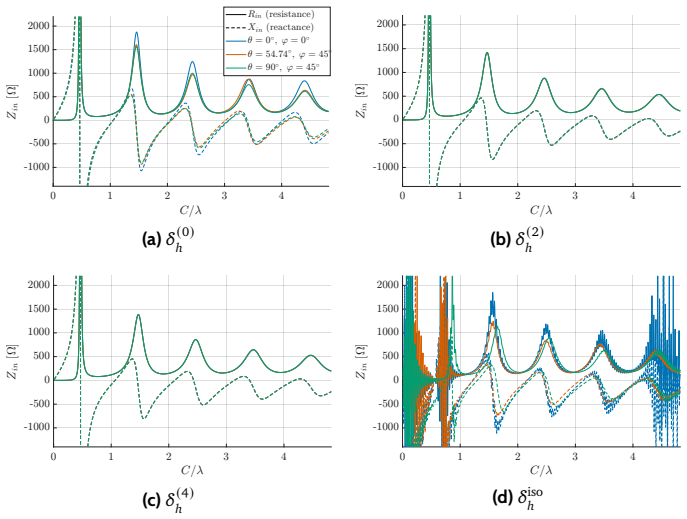
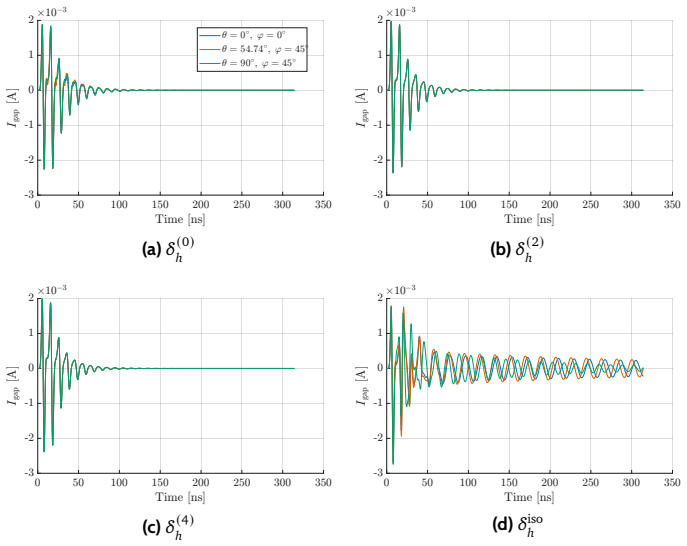
Holland-Simpson thin-wire finite-difference time-domain (FDTD) simulations of obliquely oriented closed-loop antennas exhibit persistent low-frequency parasitic currents because the current-deposition operator fails to conserve charge. This deposition operator, together with an interpolation operator that samples the tangential electric field along the wire, can be realized as regularizations of distributions: the wire current is deposited as a source term by integrating it against a regularized delta function along the wire, and the electric field is sampled back to the wire by integrating it against the same regularized delta function. We show that charge conservation requires the deposited current to be discretely divergence-free when the wire carries a constant current, and we introduce a family of composite B-spline regularizations that satisfy this condition to machine precision. Exact evaluation of the coupling line integrals is possible because the B-spline kernels are piecewise polynomial with a priori-known breakpoints, allowing composite Gauss-Legendre quadrature with subinterval breakpoints at every grid-plane crossing. Taking the interpolation operator as the discrete adjoint of the deposition operator preserves skew-symmetry and ensures that a discretely irrotational electric field drives no net electromotive force around a closed loop. Numerical experiments on a center-fed dipole and on circular and square loop antennas show that the proposed regularizations yield orientation-independent impedance values consistent with known characteristics, whereas a simple trilinear regularization produces unphysical parasitic low-frequency currents in closed loops.
Editorial analysis
A structured set of objections, weighed in public.
Referee Report
Summary. The paper claims that composite B-spline regularizations, constructed from regularized delta functions, enable current deposition and tangential E-field interpolation in thin-wire FDTD such that constant currents are discretely divergence-free to machine precision (via exact composite Gauss-Legendre quadrature on piecewise-polynomial kernels with a-priori breakpoints at grid planes) and that the adjoint interpolation operator preserves skew-symmetry so that irrotational fields produce zero net EMF on closed loops. Experiments on a center-fed dipole and on circular/square loops demonstrate orientation-independent impedances matching known results, in contrast to trilinear regularization which produces unphysical low-frequency parasitic currents.
Significance. If the central claims hold, the work supplies a parameter-free, machine-precision charge-conserving deposition scheme for oblique thin wires that directly eliminates a documented artifact in closed-loop antenna simulations. The explicit use of composite quadrature to realize exact discrete properties without fitted parameters is a clear technical strength.
minor comments (3)
- [Abstract] Abstract, final sentence: the phrase 'consistent with known characteristics' should be replaced by a specific reference or quantitative comparison (e.g., to Balanis or other standard results) so that the claim is falsifiable from the text alone.
- [Methods (quadrature subsection)] The description of breakpoint placement states they are 'a priori-known'; a short paragraph or pseudocode in the methods section clarifying how the crossing locations are computed from the wire parametrization (without iterative root-finding) would remove any ambiguity about floating-point reproducibility.
- [Numerical experiments] Figure captions for the loop-antenna results should state the exact spline degree, quadrature order per subinterval, and grid resolution used, so that the machine-precision claim can be directly reproduced.
Simulated Author's Rebuttal
We thank the referee for the positive assessment of the manuscript, the recognition of its technical contributions regarding exact discrete charge conservation via composite quadrature, and the recommendation for minor revision. No specific major comments were provided in the report.
Circularity Check
No circularity: construction satisfies stated discrete requirements by design without reduction to inputs
full rationale
The paper defines the discrete divergence-free condition as a necessary requirement for charge conservation under constant current, then constructs composite B-spline regularizations (with adjoint interpolation) that meet it via exact composite quadrature on piecewise-polynomial kernels. This is a forward engineering step justified by the continuous-to-discrete mapping and standard B-spline properties, not a self-referential definition, fitted parameter renamed as prediction, or load-bearing self-citation. The abstract and provided text contain no equations that equate the output operator to its own inputs by construction, and the quadrature exactness follows directly from a priori breakpoints rather than from the target result itself.
Axiom & Free-Parameter Ledger
axioms (1)
- standard math B-splines are piecewise polynomial with a priori-known breakpoints
Reference graph
Works this paper leans on
-
[1]
doi:10.1109/TEMC.2003.811294. 6Jean-Pierre Bérenger. Origin of Parasitic Solutions With Holland and Simpson Thin Wires in the FDTD Grid.IEEE Transactions on Electromagnetic Compatibility, 61(2):487–494, April 2019.doi: 10.1109/TEMC.2018.2814341. 7Christophe Guiffaut and Alain Reineix. Cartesian Shift Thin Wire Formalism in the FDTD Method With Multiwire J...
-
[2]
13ColeGruningerandBoyceE.Griffith
doi:10.1016/ 0010-4655(92)90169-Y. 13ColeGruningerandBoyceE.Griffith. CompositeB-splineregularizeddeltafunctionsfortheimmersed boundary method: Divergence-free interpolation and gradient-preserving force spreading.Journal of Computational Physics, 546:114472, February 2026.doi:10.1016/j.jcp.2025.114472. 14Lianxia Li, Cole Gruninger, Jae H. Lee, and Boyce ...
-
[3]
doi:10.1137/S0036142996314044. 18James M. Hyman and Mikhail Shashkov. Mimetic Discretizations for Maxwell’s Equations.Journal of Computational Physics, 151(2):881–909, May 1999.doi:10.1006/jcph.1999.6225. 19Douglas Arnold, Richard Falk, and Ragnar Winther. Finite element exterior calculus: From Hodge theory to numerical stability.Bulletin of the American ...
-
[4]
doi:10.1002/(SICI)1099-1204(199901/04)12:1/2<129::AID-JNM327>3.0.CO; 2-G. 23A. Bossavit and L. Kettunen. Yee-like schemes on staggered cellular grids: A synthesis between FIT and FEM approaches.IEEE Transactions on Magnetics, 36(4):861–867, July 2000.doi:10.1109/20. 877580. 18 24Carl De Boor.A Practical Guide to Splines. Number 27 in Applied Mathematical ...
-
[5]
doi:10.1016/j.cma.2009.12.002. 26R. N. Simpson, Z. Liu, R. Vázquez, and J. A. Evans. An isogeometric boundary element method for electromagnetic scattering with compatible B-spline discretizations.Journal of Computational Physics, 362:264–289, June 2018.doi:10.1016/j.jcp.2018.01.025. 27Ritoban Roy-Chowdhury, Tamar Shinar, and Craig Schroeder. Higher order...
-
[6]
doi:10.1016/j.jcp.2024.112831. 28S. D. Gedney.Introduction to the Finite-Difference Time-Domain (FDTD) Method for Electromagnetics. Morgan & Claypool, San Rafael, CA, USA,
-
[7]
29Jean-Pierre Berenger. Stability of the FDTD Method With Holland and Simpson Thin Wires.IEEE Transactions on Electromagnetic Compatibility, 63(3):880–887, June 2021.doi:10.1109/TEMC.2020. 3027515. 30Constantine A. Balanis.Antenna Theory: Analysis and Design. Wiley-Interscience, Hoboken, N.J,
-
[8]
Journal of Computational Physics409, 109313 (2020) https://doi.org/10.1016/j.jcp
31Björn Engquist, Anna-Karin Tornberg, and Richard Tsai. Discretization of Dirac delta functions in level set methods.Journal of Computational Physics, 207(1):28–51, July 2005.doi:10.1016/j.jcp. 2004.09.018. 32Bamdad Hosseini, Nilima Nigam, and John M. Stockie. On regularizations of the Dirac delta distribution.Journal of Computational Physics, 305:423–44...
-
[9]
doi:10.1137/110836699. 35Boyce E. Griffith and Charles S. Peskin. On the order of accuracy of the immersed boundary method: Higher order convergence rates for sufficiently smooth problems.Journal of Computational Physics, 208(1):75–105, September 2005.doi:10.1016/j.jcp.2005.02.011. 36James E. Storer. Impedance of thin-wire loop antennas.Transactions of th...
-
[10]
doi:10.1063/1.4816619. 39Warren L. Stutzman and Gary A. Thiele.Antenna Theory and Design. Wiley, Hoboken, NJ,
-
[11]
40R. King. Theory of the corner-driven square loop antenna.IRE Transactions on Antennas and Propagation, 4(3):393–407, July 1956.doi:10.1109/TAP.1956.1144431. 20 S1 Discrete Energy Conservation of the Leapfrog FDTD–Thin-Wire System We prove that, in the absence of absorbing boundary conditions, the leapfrog time-stepping scheme combined with the completel...
discussion (0)
Sign in with ORCID, Apple, or X to comment. Anyone can read and Pith papers without signing in.