Discernible signatures of fractionally charged anyons in a Pfaffian-Laughlin state
Pith reviewed 2026-05-21 02:48 UTC · model grok-4.3
The pith
A quantum dot coupled to a Pfaffian fluid reveals the energy dispersion of its e/4 quasiholes.
A machine-rendered reading of the paper's core claim, the machinery that carries it, and where it could break.
Core claim
Considering a quantum dot containing a few charged particles coupled to the incompressible Pfaffian state yields valuable information on the Pfaffian quasiholes, including the energy dispersion of e/4 quasiholes, the charge density distribution, and the quasihole creation energy. The energy dispersion clearly reflects the interaction between the quantum dot and the incompressible Pfaffian state.
What carries the argument
Quantum dot with few charged particles coupled to the surrounding incompressible Pfaffian fluid, used to extract quasihole properties.
If this is right
- Photoluminescence spectroscopy could probe the e/4 quasiholes in the 5/2 Pfaffian-Laughlin state.
- The derived dispersion would guide experiments on the energetics of these quasiparticles.
- Charge density distribution of the quasiholes becomes accessible through this coupling.
- The creation energy of the quasiholes can be determined from the model.
Where Pith is reading between the lines
- Similar coupling might apply to other fractional quantum Hall states to study their anyons.
- Confirmation could strengthen the case for using quantum dots as probes for anyonic excitations in general.
Load-bearing premise
The coupling between the quantum dot and the Pfaffian fluid follows the same theoretical framework as in Laughlin states without new uncontrolled approximations.
What would settle it
Photoluminescence measurements on a 5/2 quantum Hall system with a quantum dot that fail to match the predicted energy dispersion for e/4 quasiholes would falsify the extracted signatures.
Figures
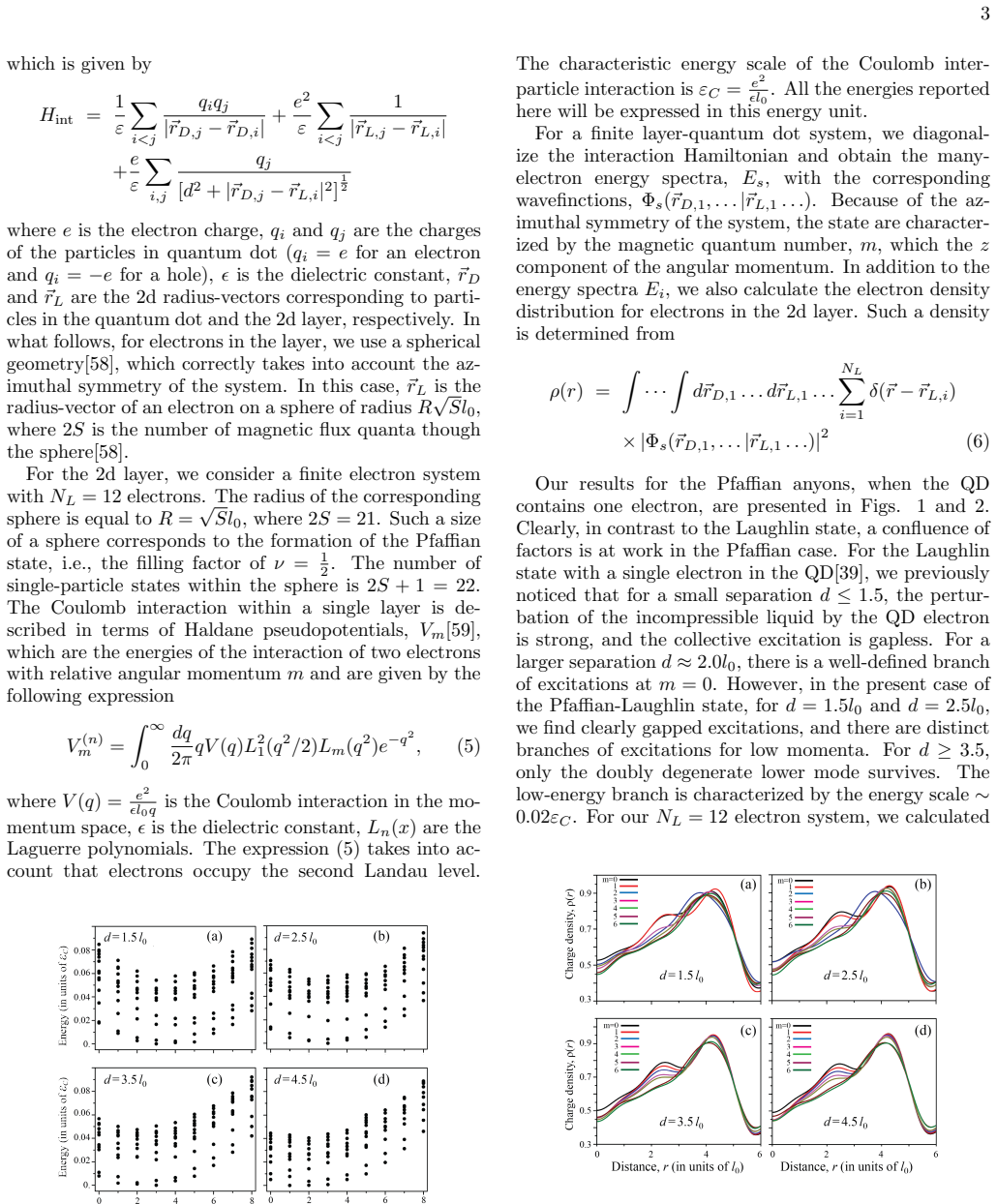

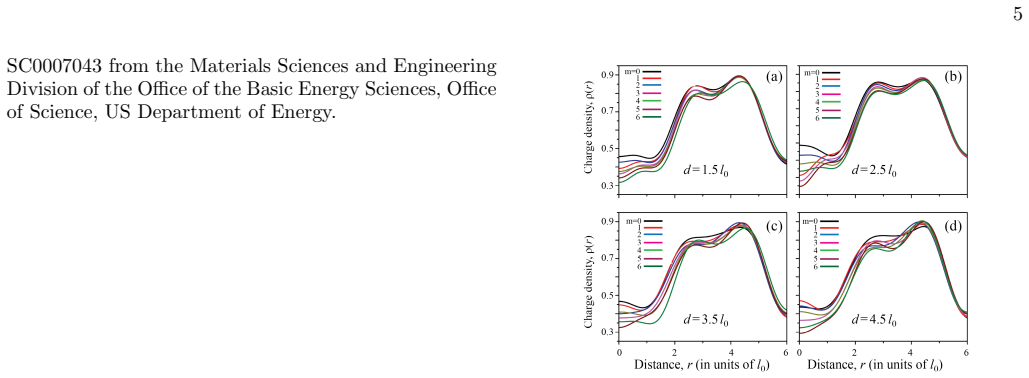
read the original abstract
Understanding the nature of quasihole excitations, i.e., anyons that have fractional charge and statistics, has been a challenging problem in condensed matter physics. Our theoretical approach to this problem has been to consider a quantum dot, containing a few charged particles, coupled to the incompressible fluid. It has provided important insights into the energetics of Laughlin quasiholes. Photoluminescence (PL) spectroscopy studies of this system have been able to probe these quasiholes that have confirmed our expectations. Turning to the Pfaffian state, we now observe that such a system is also able to provide valuable information about the Pfaffian quasiholes, viz., the energy dispersion, the charge density distribution and the quasihole creation energy. The energy dispersion of e/4 quasiholes derived here, clearly reflect the interaction between the quantum dot and the incompressible Pfaffian state. PL spectroscopy experiments on the 5/2 Pfaffian-Laughlin state could perhaps shed light on the energetics of these elusive quasiparticles.
Editorial analysis
A structured set of objections, weighed in public.
Referee Report
Summary. The manuscript extends a quantum-dot model previously applied to Laughlin quasiholes to the Pfaffian state at filling factor 5/2. It claims that coupling a few-particle quantum dot to the incompressible Pfaffian fluid yields the energy dispersion of e/4 quasiholes, their charge-density distribution, and creation energy, with these quantities reflecting the dot-fluid interaction. Photoluminescence spectroscopy on the 5/2 state is proposed as an experimental probe.
Significance. If the central derivation is valid, the work would supply concrete, potentially falsifiable predictions for the energetics of non-Abelian anyons, extending a framework that has already been tested on Abelian Laughlin states. Successful application could guide PL experiments aimed at the still-elusive 5/2 quasiparticles.
major comments (1)
- The central claim that the reported energy dispersion and creation energies follow from the same effective coupling Hamiltonian used for Laughlin states is load-bearing, yet the manuscript provides no explicit demonstration that the non-Abelian fusion rules, quasihole degeneracy, and additional edge modes of the Moore-Read state are incorporated without uncontrolled approximations. This omission directly affects whether the extracted dispersion reflects Pfaffian-specific anyonic physics or merely reproduces an Abelian-like result.
minor comments (2)
- Notation for the quasihole charge (e/4) and the incompressible background should be defined at first use rather than assumed from prior Laughlin literature.
- The abstract states that the dispersion 'clearly reflect[s] the interaction'; a quantitative statement of how the dispersion deviates from the non-interacting or Laughlin case would strengthen the presentation.
Simulated Author's Rebuttal
We thank the referee for the careful reading of our manuscript and for the constructive feedback. We address the major comment below.
read point-by-point responses
-
Referee: The central claim that the reported energy dispersion and creation energies follow from the same effective coupling Hamiltonian used for Laughlin states is load-bearing, yet the manuscript provides no explicit demonstration that the non-Abelian fusion rules, quasihole degeneracy, and additional edge modes of the Moore-Read state are incorporated without uncontrolled approximations. This omission directly affects whether the extracted dispersion reflects Pfaffian-specific anyonic physics or merely reproduces an Abelian-like result.
Authors: We appreciate the referee raising this key point regarding the applicability of the effective coupling Hamiltonian. In our framework the Hamiltonian is constructed from the electrostatic interaction between the quantum-dot electrons and the fractional charge density of the quasihole. For the Pfaffian state this density profile is obtained directly from the Moore-Read wave function (or its effective-field-theory counterpart), which already encodes the non-Abelian character of the quasiholes. The resulting energy dispersion is therefore determined by the specific charge distribution of the e/4 Pfaffian quasihole rather than by a generic Abelian anyon. Fusion rules and quasihole degeneracy govern the multi-quasihole sector and braiding statistics; they do not enter the single-quasihole energetics or creation energy that we compute. The additional edge modes of the Moore-Read state are incorporated through the incompressible-fluid background used to define the quasihole profile. We acknowledge that an explicit paragraph spelling out these distinctions and comparing the Pfaffian charge profile to the Laughlin case would strengthen the presentation. We will add such a discussion in the revised manuscript. revision: yes
Circularity Check
No circularity: extension of prior quantum-dot framework to Pfaffian state is an independent application
full rationale
The paper applies a previously developed quantum-dot-plus-incompressible-fluid model (originally for Laughlin quasiholes) to the Pfaffian state and reports derived quantities such as e/4 quasihole energy dispersion, charge density, and creation energy. The abstract explicitly distinguishes the prior Laughlin results from the new Pfaffian calculations ('Turning to the Pfaffian state, we now observe...'). No equations are presented in which a fitted parameter is relabeled as a prediction, a result is defined in terms of itself, or a uniqueness theorem is imported solely via self-citation to close the argument. The central claim therefore rests on the validity of the model extension rather than on any definitional or fitting loop internal to the present manuscript.
Axiom & Free-Parameter Ledger
Reference graph
Works this paper leans on
-
[1]
In the following, we assume that the electrons are spinless, i.e., the Zeeman energy is large enough that the the electron states are spin-polarized. The second layer is placed in a confinement potential of the following form Vconf(x, y) = 1 2 m∗ω2 0 x2 +y 2 ,(4) where the potential is characterized by the potential strengthω 0 and the corresponding oscil...
-
[2]
The number of single-particle states within the sphere is 2S+ 1 = 22. The Coulomb interaction within a single layer is de- scribed in terms of Haldane pseudopotentials,V m[59], which are the energies of the interaction of two electrons with relative angular momentummand are given by the following expression V (n) m = Z ∞ 0 dq 2π qV(q)L 2 1(q2/2)Lm(q2)e−q2...
-
[3]
Such an energy is ∆ 1/2 ≈0.0271ε C. Correspondingly, we can estimate the creation energy of onee/4 quasihole as half of ∆ 1/2, giving ∆ 1/4 ≈ 1 2∆1/2 ≈0.014ε C. This energy scale falls within the characteristic energy range of the lowest branches clearly visible in Fig. 1. Inciden- tally, for the Laughlin quasihole, the quasihole creation energy is 0.0276...
-
[4]
G. Tkachov,Topological Quantum Materials: Concepts, Models, and Phenomena (1st ed.)(Taylor & Francis, New York, 2022)
work page 2022
-
[5]
K. von Klitzing, T. Chakraborty, P. Kim, V. Madhavan, X. Dai, J. McIver, Y. Tokura, L. Savary, D. Smirnova, A. M. Rey, C. Felser, J. Gooth, and X. Qi, 40 years of the quantum Hall effect, Nature Reviews Physics2, 397 (2020)
work page 2020
-
[6]
T. Chakraborty, ed., Introduction, inEncyclopedia of Condensed Matter Physics (Second Edition)(Academic Press, Oxford, 2024) pp. ix–xvii
work page 2024
-
[7]
C. S. Gruber and M. Abdel-Hafiez, Interplay of electronic orders in topological quantum materials, ACS Materials Au5, 72 (2025)
work page 2025
-
[8]
X. Liu, Z. Tao, W. Luo, and T. Chakraborty, Correlated quantum phenomena in confined two-dimensional hexag- onal crystals, Physica E: Low-dimensional Systems and Nanostructures182, 116575 (2026)
work page 2026
-
[9]
D. S. L. Abergel and T. Chakraborty, Long-range Coulomb interaction in bilayer graphene, Physical Re- view Letters102, 056807 (2009)
work page 2009
-
[10]
D. S. L. Abergel, P. Pietil¨ ainen, and T. Chakraborty, Electronic compressibility of graphene: The case of van- ishing electron correlations and the role of chirality, Phys- ical Review B80, 081408 (2009)
work page 2009
-
[11]
J. Berashevich and T. Chakraborty, Interlayer repulsion and decoupling effects in stacked turbostratic graphene flakes, Physical Review B84, 033403 (2011)
work page 2011
-
[12]
J. Berashevich and T. Chakraborty, On the nature of interlayer interactions in a system of two graphene frag- ments, The Journal of Physical Chemistry C115, 24666 (2011)
work page 2011
-
[13]
T. Chakraborty and V. M. Apalkov, Traits and charac- teristics of interacting dirac fermions in monolayer and bilayer graphene, Solid State Communications175-176, 123 (2013)
work page 2013
-
[14]
V. M. Apalkov and T. Chakraborty, Gap structure of the hofstadter system of interacting dirac fermions in graphene, Physical Review Letters112, 176401 (2014)
work page 2014
-
[15]
V. M. Apalkov and T. Chakraborty, Fractal butterflies in buckled graphenelike materials, Physical Review B91, 235447 (2015)
work page 2015
-
[16]
V. M. Apalkov and T. Chakraborty, Electrically tunable charge and spin transitions in landau levels of interacting dirac fermions in trilayer graphene, Physical Review B 86, 035401 (2012)
work page 2012
-
[17]
H. L. St¨ ormer, Two-dimensional electron correlation in high magnetic fields, Physica B: Condensed Matter177, 401 (1992)
work page 1992
-
[18]
J. P. Eisenstein and H. L. Stormer, The fractional quan- tum Hall effect, Science248, 1510 (1990)
work page 1990
-
[19]
J. P. Eisenstein, H. L. Stormer, L. Pfeiffer, and K. W. West, Evidence for a phase transition in the fractional quantum Hall effect, Physical Review Letters62, 1540 (1989)
work page 1989
-
[20]
R. B. Laughlin, Anomalous quantum Hall effect: An in- compressible quantum fluid with fractionally charged ex- citations, Physical Review Letters50, 1395 (1983)
work page 1983
-
[21]
T. Chakraborty and P. Pietil¨ ainen,The Fractional Quan- tum Hall Effect(Springer, New York, 1988)
work page 1988
-
[22]
V. M. Apalkov and T. Chakraborty, Fractional quantum Hall states of dirac electrons in graphene, Physical Re- view Letters97, 126801 (2006)
work page 2006
-
[23]
V. M. Apalkov and T. Chakraborty, Controllable driven phase transitions in fractional quantum Hall states in bilayer graphene, Physical Review Letters105, 036801 (2010)
work page 2010
-
[24]
V. M. Apalkov and T. Chakraborty, Tunability of the fractional quantum Hall states in buckled Dirac materi- als, Phys. Rev. B90, 245108 (2014)
work page 2014
-
[25]
V. M. Apalkov and T. Chakraborty, Stable pfaffian state in bilayer graphene, Physical Review Letters107, 186803 6 (2011)
work page 2011
-
[26]
V. Apalkov and T. Chakraborty, Interacting dirac fermions and the rise of pfaffians in graphene, inEn- cyclopedia of Condensed Matter Physics (Second Edi- tion), edited by T. Chakraborty (Academic Press, Ox- ford, 2024) pp. 366–382
work page 2024
- [27]
-
[28]
R. Willett, J. P. Eisenstein, H. L. St¨ ormer, D. C. Tsui, A. C. Gossard, and J. H. English, Observation of an even- denominator quantum number in the fractional quantum Hall effect, Physical Review Letters59, 1776 (1987)
work page 1987
-
[29]
K. Ma, M. Peterson, V. Scarola, and K. Yang, Frac- tional quantum Hall effect at the filling factorν= 5/2, in Encyclopedia of Condensed Matter Physics (Second Edi- tion), edited by T. Chakraborty (Academic Press, Ox- ford, 2024) pp. 402–416
work page 2024
-
[30]
E. C. Rowell and Z. Wang, Mathematics of topologi- cal quantum computing, Bull. Amer. Math. Soc55, 183 (2018)
work page 2018
-
[31]
V. J. Goldman and B. Su, Resonant tunneling in the quantum Hall regime: Measurement of fractional charge, Science267, 1010 (1995)
work page 1995
-
[32]
L. Saminadayar, D. C. Glattli, Y. Jin, and B. Etienne, Observation of thee/3 fractionally charged laughlin quasiparticle, Physical Review Letters79, 2526 (1997)
work page 1997
-
[33]
G. F` eve, Anyon collisions and fractional statistics, in Encyclopedia of Condensed Matter Physics (Second Edi- tion), edited by T. Chakraborty (Academic Press, Ox- ford, 2024) pp. 402–416
work page 2024
-
[34]
D. Lundholm, Properties of 2d anyon gas, inEncyclopedia of Condensed Matter Physics (Second Edition), edited by T. Chakraborty (Academic Press, Oxford, 2024) p. 450
work page 2024
-
[35]
Y. Chen, Y. Huang, Q. Li, B. Tong, G. Kuang, C. Xi, K. Watanabe, T. Taniguchi, G. Liu, Z. Zhu, L. Lu, F.-C. Zhang, Y.-H. Wu, and L. Wang, Tunable even- and odd- denominator fractional quantum Hall states in trilayer graphene, Nature Communications15, 6236 (2024)
work page 2024
-
[36]
P. Ghising, A. Mondal, M. Baithi, J. Kim, J. Lee, K. Watanabe, T. Taniguchi, and Y. H. Young Hee Lee, bservation ofν= 5/2 fractional quantum Hall effect in trilayer graphene proximitized by v-doped wse2, Ad- vanced Materials38, e14268 (2025)
work page 2025
-
[37]
Y. Sha, K. Liu, C. Jiang, D. Ye, S. Liu, Z. Guo, J. Gao, M. Tian, N. Wan, K. Watanabe, T. Taniguchi, B. Tong, G. Liu, L. Lu, Y. Zhang, Z. Shi, Z. Hu, and G. Chen, Cascade of even-denominator fractional quan- tum Hall states in mixed-stacked multilayer graphene (2025), arXiv:2507.20695 [cond-mat.mes-hall]
-
[38]
M. Greiter, X.-G. Wen, and F. Wilczek, Paired Hall state at half filling, Physical Review Letters66, 3205 (1991)
work page 1991
-
[39]
M. Greiter, X. G. Wen, and F. Wilczek, Paired Hall states, Nuclear Physics B374, 567 (1992)
work page 1992
-
[40]
G. Moore and N. Read, Nonabelions in the fractional quantum Hall effect, Nuclear Physics B360, 362 (1991)
work page 1991
-
[41]
Muir, A treatise on the theory of determinants (Macmillan and Co., 1982) pp
T. Muir, A treatise on the theory of determinants (Macmillan and Co., 1982) pp. 195–205
work page 1982
-
[42]
V. M. Apalkov and T. Chakraborty, Interaction of a quantum dot with an incompressible two-dimensional electron gas, Physica E: Low-dimensional Systems and Nanostructures14, 289 (2002)
work page 2002
-
[43]
Chakraborty,Quantum Dots(North-Holland, Ams- terdam, 1999)
T. Chakraborty,Quantum Dots(North-Holland, Ams- terdam, 1999)
work page 1999
-
[44]
P. A. Maksym and T. Chakraborty, Quantum dots in a magnetic field: Role of electron-electron interactions, Physical Review Letters65, 108 (1990)
work page 1990
-
[45]
E. H. Rezayi and F. D. M. Haldane, Incompressible states of the fractionally quantized Hall effect in the presence of impurities: A finite-size study, Physical Review B32, 6924 (1985)
work page 1985
-
[46]
C. Schuller, K. B. Broocks, P. Schroter, C. Heyn, D. Heit- mann, M. Bichler, W. Wegscheider, T. Chakraborty, and V. M. Apalkov, Optical probing of a fractionally charged quasihole in an incompressible liquid, Physical Review Letters91, 116403 (2003)
work page 2003
-
[47]
C. Sch¨ uller, K. B. Broocks, P. Schr¨ oter, C. Heyn, D. Heit- mann, M. Bichler, W. Wegscheider, T. Chakraborty, and V. M. Apalkov, How to probe a fractionally charged quasihole?, Physica E: Low-dimensional Systems and Nanostructures22, 131 (2004)
work page 2004
-
[48]
C. Sch¨ uller, K.-B. Broocks, P. Schr¨ oter, C. Heyn, D. Heit- mann, M. Bichler, W. Wegscheider, V. M. Apalkov, and T. Chakraborty, Charged excitons in the quantum Hall regime: Optical probe of fractionally charged quasiholes, inAdvances in Solid State Physics, edited by B. Kramer (Springer Berlin Heidelberg, Berlin, Heidelberg, 2004) pp. 81–92
work page 2004
-
[49]
T. Chakraborty, Elementary excitations in the fractional quantum Hall effect, Physical Review B31, 4026 (1985)
work page 1985
-
[50]
R. Morf and B. I. Halperin, Monte carlo evaluation of trial wave functions for the fractional quantized Hall ef- fect: Disk geometry, Physical Review B33, 2221 (1986)
work page 1986
-
[51]
L. V. Kulik, A. S. Zhuravlev, L. I. Musina, E. I. Beloze- rov, A. B. Van’kov, O. V. Volkov, A. A. Zagitova, I. V. Kukushkin, and V. Y. Umansky, Laughlin anyon com- plexes with bose properties, Nature Communications12, 6477 (2021)
work page 2021
-
[52]
G. Wagner and T. Neupert, Sensing the binding and unbinding of anyons at impurities, Physical Review Re- search8, 013263 (2026)
work page 2026
-
[53]
N. Mostaan, N. Goldman, A. ˙Imamo˘ glu, and F. Grusdt, Anyon-trions in atomically thin semiconductor het- erostructures, PRX Quantum7, 010325 (2026)
work page 2026
-
[54]
W. Li, C. Wang Beach, C. Hu, T. Taniguchi, K. Watan- abe, J.-H. Chu, A. Imamo˘ glu, T. Cao, D. Xiao, and X. Xu, Signatures of fractional charges via anyon–trions in twisted MoTe2, Nature651, 48 (2026)
work page 2026
-
[55]
B. I. Halperin, Statistics of quasiparticles and the hierar- chy of fractional quantized Hall states, Physical Review Letters52, 1583 (1984)
work page 1984
- [56]
-
[57]
E. Fradkin, C. Nayak, A. Tsvelik, and F. Wilczek, A chern-simons effective field theory for the pfaffian quan- tum Hall state, Nuclear Physics B516, 704 (1998)
work page 1998
-
[58]
O. I. Motrunich and M. P. A. Fisher,d-wave correlated critical bose liquids in two dimensions, Physical Review B75, 235116 (2007)
work page 2007
-
[59]
R. L. Willett, L. N. Pfeiffer, and K. W. West, Measure- ment of filling factor 5/2 quasiparticle interference with observation of charge e/4 and e/2 period oscillations, Proceedings of the National Academy of Sciences106, 8853 (2009)
work page 2009
-
[60]
T. Alkalai, E. Hajigeorgiou, A. Gupta, T. Senapati, P. Ti- wari, C.-T. Tai, S. K. Singh, K. W. Baldwin, L. N. 7 Pfeiffer, M. Shayegan, M. Banerjee, and M. Heiblum, Observation of e/4 charge atν= 1/2 in GaAs (2026), arXiv:2602.08468 [cond-mat.mes-hall]
-
[61]
G. Fano, F. Ortolani, and E. Colombo, Configuration- interaction calculations on the fractional quantum Hall effect, Physical Review B34, 2670 (1986)
work page 1986
-
[62]
F. D. M. Haldane, Fractional quantization of the Hall ef- fect: A hierarchy of incompressible quantum fluid states, Physical Review Letters51, 605 (1983)
work page 1983
discussion (0)
Sign in with ORCID, Apple, or X to comment. Anyone can read and Pith papers without signing in.