On higher-order derivative ratios in turbulent flows
Pith reviewed 2026-05-22 02:33 UTC · model grok-4.3
The pith
Higher-order derivative ratios follow a power law near the enstrophy peak that bounds analyticity radius above sparseness scale in the Taylor-Green vortex.
A machine-rendered reading of the paper's core claim, the machinery that carries it, and where it could break.
Core claim
The central claim is that the power law relating the ratios at time t to T*-t is of a form that allows the machinery of dynamic interpolation-sparseness to produce a lower bound on the radius of spatial analyticity sufficient to overcome an upper bound on the scale of sparseness of the super-level sets in view, so that the mechanism of turbulent dissipation engages via the harmonic measure maximum principle, furnishing a rigorous explanation for the subsequent slump of the enstrophy. This indicates that the higher-order derivative ratios may be reasonable identifiers of the peak of the energy dissipation rate.
What carries the argument
The observed power-law form of higher-order derivative ratios, which supplies the input for the dynamic interpolation-sparseness technique to control the spatial analyticity radius against the sparseness of super-level sets.
If this is right
- The lower bound on the analyticity radius strictly exceeds the upper bound on the sparseness scale of the super-level sets near the enstrophy peak.
- The harmonic measure maximum principle applies directly to engage the turbulent dissipation mechanism.
- This engagement furnishes a rigorous explanation for the slump of the enstrophy after the peak.
- Higher-order derivative ratios act as identifiers of the peak energy dissipation rate, serving as higher-order analogs of the Taylor and Kraichnan scales.
Where Pith is reading between the lines
- If the same power-law form appears in simulations of other turbulent flows, the analyticity-sparseness argument could be applied more broadly to predict dissipation onsets.
- These ratios could serve as a practical diagnostic tool in large-scale computations to locate dissipation peaks without direct enstrophy monitoring.
- Verifying the power law at higher Reynolds numbers would test whether the analyticity bound mechanism remains effective in more developed turbulence.
Load-bearing premise
The computationally observed power-law form of the higher-order derivative ratios is sufficiently accurate and precisely matches the requirements of the dynamic interpolation-sparseness technique to generate a lower bound on the analyticity radius that strictly exceeds the upper bound on sparseness of super-level sets near the enstrophy peak.
What would settle it
A computation showing that the lower bound on the analyticity radius falls below the upper bound on super-level set sparseness at a time before the enstrophy peak would disprove the proposed triggering of dissipation.
Figures

read the original abstract
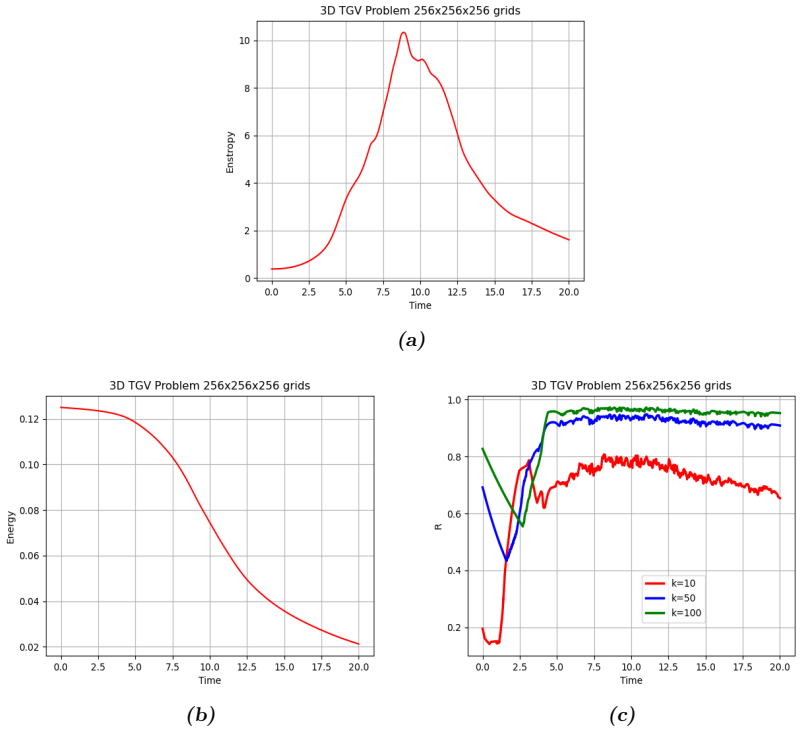
A computational study of higher-order derivative ratios on a time interval leading to the enstrophy peak is presented in the case of the 3D Taylor-Green vortex, a benchmark problem in the simulation of turbulent flows. The main finding is that the power law relating the ratios at time $t$ to $T^*-t$ where $T^*$ is the peak enstrophy time is of a form that allows the machinery of dynamic interpolation-sparseness to produce a lower bound on the radius of spatial analyticity sufficient to overcome an upper bound on the scale of sparseness of the super-level sets in view. As a consequence, the mechanism of turbulent dissipation engages via the harmonic measure maximum principle, furnishing a rigorous explanation for the subsequent slump of the enstrophy. This indicates that the higher-order derivative ratios -- which could be viewed as higher-order analogs of the classical Taylor and Kraichnan scales in turbulence phenomenology -- may be reasonable identifiers of the peak of the energy dissipation rate.
Editorial analysis
A structured set of objections, weighed in public.
Referee Report
Summary. The manuscript presents a computational study of higher-order derivative ratios in the 3D Taylor-Green vortex on the time interval leading to the enstrophy peak. It reports that the ratios obey a power-law dependence on (T* - t), where T* is the peak time, and claims that this specific form permits the dynamic interpolation-sparseness technique to produce a lower bound on the radius of spatial analyticity that exceeds the upper bound on the sparseness scale of super-level sets. Consequently, the harmonic measure maximum principle is invoked to furnish a rigorous explanation for the subsequent enstrophy slump, positioning the ratios as higher-order analogs of Taylor and Kraichnan scales.
Significance. If the quantitative match between the observed power law and the bound requirements is established, the work would supply a concrete rigorous mechanism linking derivative-ratio phenomenology to analyticity and dissipation in turbulent Navier-Stokes flows. The computational identification of the power-law form itself constitutes a useful observation that could be tested independently.
major comments (2)
- [Results section on power-law observation and subsequent bound application] The central claim requires that the computationally fitted power-law exponents and prefactors for the ratios r_k(t) yield, via the dynamic interpolation-sparseness formulas, a lower bound on the analyticity radius rho(t) that strictly exceeds the sparseness upper bound delta(t) near T*. The manuscript reports the power-law observation but does not substitute the fitted parameters back into the bound expressions or supply uncertainty estimates confirming that rho(t) > delta(t) holds with margin. This verification step is load-bearing for the explanation of the enstrophy slump.
- [Numerical methods / computational setup] The abstract and numerical-setup description provide no information on the spatial resolution, time-stepping scheme, method for computing higher-order derivatives, or convergence/error estimates used to extract the ratios and their power-law fits. Without these, the reliability of the observed functional form cannot be assessed, undermining support for the analytic bounds.
minor comments (2)
- [Introduction] The notation r_k(t) for the higher-order derivative ratios should be defined explicitly with the precise combination of derivatives involved, preferably in the introduction or a dedicated notation subsection.
- [Figure captions / results figures] Figures displaying the power-law fits would be improved by inclusion of residual plots or reported uncertainties on the exponents to allow readers to judge the quality of the fit.
Simulated Author's Rebuttal
We thank the referee for the careful reading and constructive comments on our manuscript. We address each major comment point by point below. The suggested additions will be incorporated into the revised version to strengthen the presentation and support for the central claims.
read point-by-point responses
-
Referee: [Results section on power-law observation and subsequent bound application] The central claim requires that the computationally fitted power-law exponents and prefactors for the ratios r_k(t) yield, via the dynamic interpolation-sparseness formulas, a lower bound on the analyticity radius rho(t) that strictly exceeds the sparseness upper bound delta(t) near T*. The manuscript reports the power-law observation but does not substitute the fitted parameters back into the bound expressions or supply uncertainty estimates confirming that rho(t) > delta(t) holds with margin. This verification step is load-bearing for the explanation of the enstrophy slump.
Authors: We agree that the verification step of substituting the fitted exponents and prefactors into the dynamic interpolation-sparseness formulas to confirm rho(t) > delta(t) with margin (including uncertainty estimates) is essential and load-bearing for the explanation. The original manuscript focused on identifying the power-law form but did not perform this explicit substitution. In the revised manuscript we will add this calculation, demonstrating that the resulting lower bound on the analyticity radius exceeds the sparseness scale near T* and thereby justifies application of the harmonic measure maximum principle. revision: yes
-
Referee: [Numerical methods / computational setup] The abstract and numerical-setup description provide no information on the spatial resolution, time-stepping scheme, method for computing higher-order derivatives, or convergence/error estimates used to extract the ratios and their power-law fits. Without these, the reliability of the observed functional form cannot be assessed, undermining support for the analytic bounds.
Authors: We acknowledge that the numerical methods description was incomplete. The revised manuscript will include a dedicated subsection specifying the spatial resolution, time-stepping scheme, method for computing higher-order derivatives, and convergence/error estimates used to obtain the ratios and their power-law fits. This will allow readers to assess the reliability of the observed functional form. revision: yes
Circularity Check
No significant circularity: observation from simulation is independent input to theoretical machinery
full rationale
The paper reports a direct computational extraction of a power-law form for higher-order derivative ratios r_k(t) versus (T*-t) from Taylor-Green vortex simulations. This observed functional form is then asserted to be compatible with the dynamic interpolation-sparseness technique, yielding rho(t) > delta(t) and thereby activating the harmonic-measure argument for the enstrophy slump. Because the power-law exponents and prefactors originate from external simulation data rather than being solved for or redefined to satisfy the analyticity-sparseness inequality, and because the interpolation-sparseness machinery is applied as a downstream consequence rather than presupposed in the data reduction, no step reduces by construction to its own inputs. The derivation chain therefore remains self-contained against the simulation benchmark.
Axiom & Free-Parameter Ledger
axioms (1)
- domain assumption The computationally observed power law for higher-order derivative ratios has the precise functional form needed for dynamic interpolation-sparseness to yield an analyticity lower bound exceeding the sparseness upper bound.
Lean theorems connected to this paper
-
IndisputableMonolith/Foundation/AlexanderDuality.leanalexander_duality_circle_linking unclear?
unclearRelation between the paper passage and the cited Recognition theorem.
the power law relating the ratios at time t to T*-t ... α≈0.89 ... any exponent less or equal to 1 would indeed suffice
-
IndisputableMonolith/Cost/FunctionalEquation.leanwashburn_uniqueness_aczel unclear?
unclearRelation between the paper passage and the cited Recognition theorem.
∥D^k u(t)∥^{1/(k+1)} / ∥D^{2k} u(t)∥^{1/(2k+1)} ≲ (T*-t)^{1/(k α)}
What do these tags mean?
- matches
- The paper's claim is directly supported by a theorem in the formal canon.
- supports
- The theorem supports part of the paper's argument, but the paper may add assumptions or extra steps.
- extends
- The paper goes beyond the formal theorem; the theorem is a base layer rather than the whole result.
- uses
- The paper appears to rely on the theorem as machinery.
- contradicts
- The paper's claim conflicts with a theorem or certificate in the canon.
- unclear
- Pith found a possible connection, but the passage is too broad, indirect, or ambiguous to say the theorem truly supports the claim.
Reference graph
Works this paper leans on
-
[1]
D. Albritton and Z. Bradshaw. Remarks on sparseness and regularity of Navier–Stokes solu- tions.Nonlinearity,35(6), 2858–287 (2022)
work page 2022
-
[2]
M. E. Brachet, D. I. Meiron, S. A. Orszag, B. G. Nickel, R. H. Morf and U. Frisch. Small-scale structure of the Taylor-Green vortex.J. Fluid Mech.,130, 411-452 (2006)
work page 2006
-
[3]
J. R. DeBonis. Solutions of the Taylor-Green vortex problem using high-resolution explicit finite difference methods.AIAA,0382(2013)
work page 2013
- [4]
-
[5]
Z. Gruji´ c and I. Kukavica. Space analyticity for the Navier-Stokes and related equations with the initial data inL p.J. Funct. Anal.,152(2), 447-466 (1998)
work page 1998
-
[6]
Z. Gruji´ c and L. Xu. Asymptotic criticality of the Navier-Stokes regularity problem.J. Math. Fluid Mech.,26(53) (2024)
work page 2024
-
[7]
Z. Gruji´ c and L. Xu. Time-global regularity of the Navier-Stokes system with hyper-dissipation: turbulent scenario.Ann. PDE,11(9) (2025)
work page 2025
-
[8]
G. I. Taylor and A. E. Green. Mechanism of the production of small eddies from large ones. Proc. A,158(895), 499-521 (1937) 9
work page 1937
discussion (0)
Sign in with ORCID, Apple, or X to comment. Anyone can read and Pith papers without signing in.