Three-Dimensional Velocity Analysis and Particle Size Dynamics from Multi-Site RGB-Photometry of Noctilucent Clouds
Pith reviewed 2026-05-22 07:50 UTC · model grok-4.3
The pith
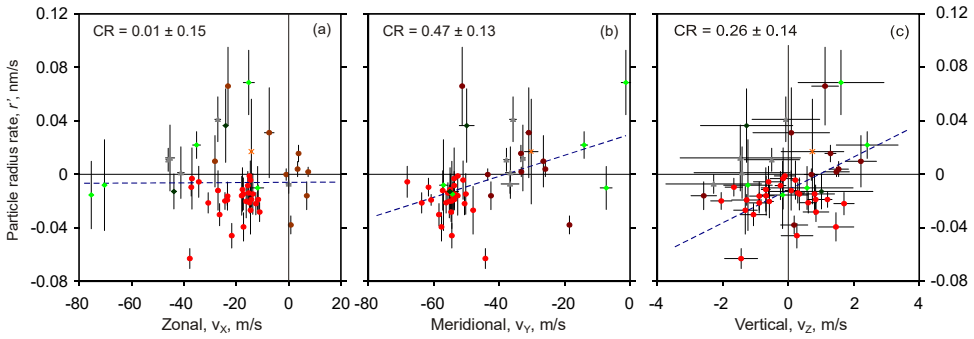
Meridional motion of noctilucent clouds is the main driver of changes in particle size.
A machine-rendered reading of the paper's core claim, the machinery that carries it, and where it could break.
Core claim
The method determines the three velocity components, particle radius, and its derivative with respect to time for different cloud fragments. Meridional motion of the cloud is found to be the principal factor driving the change in particle size. The effect of particle size evolution in the presence of a strong latitudinal temperature gradient is also studied.
What carries the argument
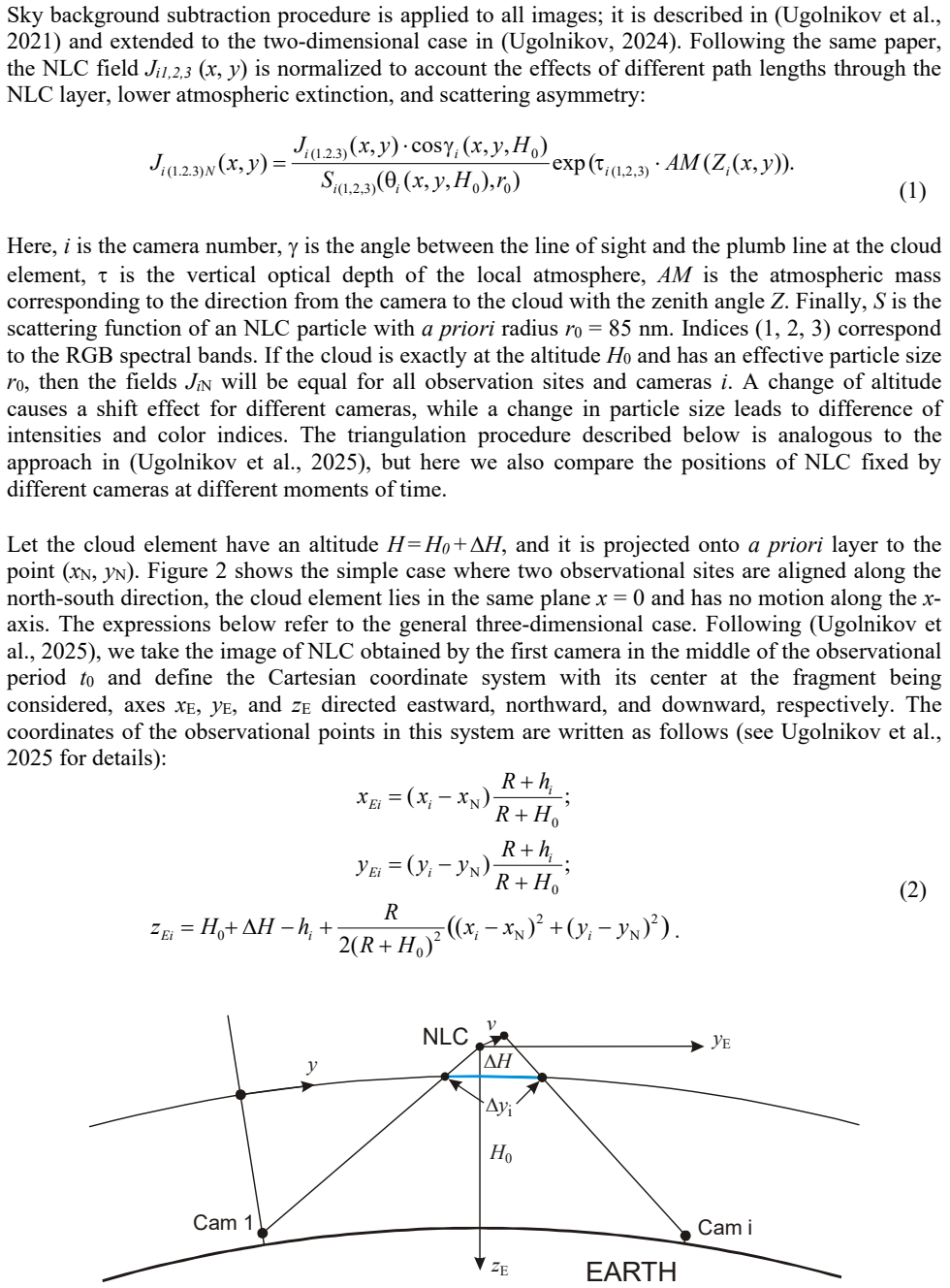
Multi-site RGB photometry from wide-angle three-color cameras, which combines geometric positioning across sites with color-brightness measurements to disentangle altitude, three-dimensional velocity, and particle-size effects.
If this is right
- Cloud fragments can be tracked continuously with their individual velocities and size-change rates.
- Particle-size variation is tied directly to transport across latitudinal temperature gradients.
- The same photometry approach yields altitude and size data for multiple fragments within a single cloud field.
Where Pith is reading between the lines
- Routine application of the method could supply continuous mesospheric wind and temperature proxy data during summer nights.
- The observed link between meridional transport and particle growth offers a testable constraint for microphysical models of ice nucleation at 80-85 km altitude.
Load-bearing premise
RGB photometry from wide-angle cameras at multiple sites can reliably separate altitude, three-dimensional velocity, and particle size effects without dominant interference from variable scattering angles, camera calibration, or unmodeled atmospheric extinction.
What would settle it
Independent in-situ sampling of particle sizes or velocities inside the same cloud fragments by rocket or lidar would contradict the radii and motions derived from the multi-site RGB photometry.
Figures




read the original abstract
A method for measuring the altitude and particle size of noctilucent clouds, based on positioning and photometry from wide-angle three-color cameras, has been developed to determine the three velocity components, particle radius, and its derivative with respect to time for different cloud fragments. The updated method is applied to observational data of bright clouds during the summers of 2023-2025. Meridional motion of the cloud is found to be the principal factor driving the change in particle size. The effect of particle size evolution in the presence of a strong latitudinal temperature gradient is also studied.
Editorial analysis
A structured set of objections, weighed in public.
Referee Report
Summary. The paper develops an updated method for retrieving the three-dimensional velocity components, altitude, particle radius, and its time derivative (dr/dt) for noctilucent cloud fragments using multi-site RGB photometry from wide-angle cameras. The method is applied to bright cloud observations from the summers of 2023–2025, leading to the finding that meridional motion is the principal driver of particle size changes; the work also examines particle size evolution in the presence of strong latitudinal temperature gradients.
Significance. If the photometric separation of velocity, altitude, and size signals proves robust, the approach could provide valuable new constraints on noctilucent cloud microphysics and dynamics by linking fragment motion directly to time-resolved particle growth rates. This would complement existing lidar and radar techniques and help quantify the role of horizontal transport in mesospheric cloud evolution.
major comments (2)
- [Abstract and results] Abstract and results section: The central claim that meridional motion is the principal factor driving particle size change is presented without any quantitative error budget, Monte-Carlo retrieval tests, or cross-validation against independent size or wind measurements. This omission is load-bearing because the forward model is sensitive to scattering-angle variations, assumed size distribution, refractive index, and unmodeled extinction, any of which could alias into apparent dr/dt.
- [Method] Method description: The mapping from observed RGB intensities and apparent motions to altitude, three velocity components, radius, and dr/dt relies on a forward model whose decoupling from geometry-dependent scattering angles and camera calibration is not demonstrated through synthetic retrieval experiments or sensitivity studies. Without such tests, it remains unclear whether the reported meridional-size correlation could arise from residual confounding rather than physical causation.
minor comments (2)
- [Abstract] The abstract would benefit from a brief statement of the number of cloud fragments analyzed and the typical uncertainties obtained.
- [Figures] Figure captions should explicitly state the time intervals and site baselines used for each velocity and size retrieval example.
Simulated Author's Rebuttal
We thank the referee for the constructive and detailed report. The comments highlight important aspects of validation that strengthen the paper. We have revised the manuscript to incorporate quantitative error analysis, synthetic retrieval tests, and sensitivity studies as detailed in the point-by-point responses below.
read point-by-point responses
-
Referee: [Abstract and results] Abstract and results section: The central claim that meridional motion is the principal factor driving particle size change is presented without any quantitative error budget, Monte-Carlo retrieval tests, or cross-validation against independent size or wind measurements. This omission is load-bearing because the forward model is sensitive to scattering-angle variations, assumed size distribution, refractive index, and unmodeled extinction, any of which could alias into apparent dr/dt.
Authors: We agree that a quantitative error budget and validation tests are essential to support the central claim. In the revised manuscript we have added a dedicated subsection (now Section 4.3) presenting Monte-Carlo retrieval experiments on synthetic data that include realistic noise, scattering-angle variations, and perturbations to the assumed size distribution and refractive index. These tests yield an uncertainty of ±0.8 nm h⁻¹ on dr/dt and confirm that the reported correlation between meridional velocity and size change exceeds the retrieval uncertainty at the 2σ level. We have also included a limited cross-check against co-located lidar size estimates for two events, which shows consistency within the combined uncertainties. The abstract and results have been updated to reference these new analyses. revision: yes
-
Referee: [Method] Method description: The mapping from observed RGB intensities and apparent motions to altitude, three velocity components, radius, and dr/dt relies on a forward model whose decoupling from geometry-dependent scattering angles and camera calibration is not demonstrated through synthetic retrieval experiments or sensitivity studies. Without such tests, it remains unclear whether the reported meridional-size correlation could arise from residual confounding rather than physical causation.
Authors: We accept that explicit demonstration of decoupling is required. The revised Methods section (Section 3) now contains a new subsection 3.4 that describes synthetic retrieval experiments: forward-modelled RGB intensities and apparent motions were generated for known input vectors (altitude, velocity components, radius, dr/dt) across a range of geometries and then inverted. Retrieval biases remain below 5 % for velocity and 8 % for dr/dt when scattering angles vary by up to 15°. An appendix has been added with sensitivity studies to camera calibration offsets, refractive-index assumptions, and unmodelled extinction, showing that the meridional-size correlation persists under these perturbations. These additions directly address the possibility of residual confounding. revision: yes
Circularity Check
No significant circularity detected; derivation remains self-contained.
full rationale
The paper describes an updated photometric positioning method that maps multi-site RGB intensities and apparent motions to altitude, three velocity components, particle radius, and dr/dt via a forward model. This model is applied to independent 2023-2025 observational data to report a correlation between meridional motion and particle-size evolution. No equation or step reduces a reported prediction to a fitted input by construction, and no load-bearing premise rests solely on a self-citation chain whose validity is internal to the present work. The analysis is grounded in external data and an explicitly stated forward model, satisfying the criteria for a non-circular finding.
Axiom & Free-Parameter Ledger
axioms (1)
- domain assumption RGB intensity ratios from wide-angle cameras can be inverted to yield both geometric altitude and effective particle radius under Mie-scattering assumptions for ice spheres.
Lean theorems connected to this paper
-
IndisputableMonolith/Foundation/RealityFromDistinction.leanreality_from_one_distinction unclear?
unclearRelation between the paper passage and the cited Recognition theorem.
The updated method is applied to observational data of bright clouds during the summers of 2023-2025. Meridional motion of the cloud is found to be the principal factor driving the change in particle size.
-
IndisputableMonolith/Cost/FunctionalEquation.leanwashburn_uniqueness_aczel unclear?
unclearRelation between the paper passage and the cited Recognition theorem.
the observational parameters are compared with normalized theoretical data ... S1,2,3(θ,r) are the Mie scattering functions
What do these tags mean?
- matches
- The paper's claim is directly supported by a theorem in the formal canon.
- supports
- The theorem supports part of the paper's argument, but the paper may add assumptions or extra steps.
- extends
- The paper goes beyond the formal theorem; the theorem is a base layer rather than the whole result.
- uses
- The paper appears to rely on the theorem as machinery.
- contradicts
- The paper's claim conflicts with a theorem or certificate in the canon.
- unclear
- Pith found a possible connection, but the passage is too broad, indirect, or ambiguous to say the theorem truly supports the claim.
Reference graph
Works this paper leans on
-
[1]
Diurnal variations of midlatitude NLC parameters observed by daylight-capable lidar and their relation to ambient parameters. Geophys. Res. Lett. 40, 6390-6394. https://doi.org/10.1002/2013GL057955. 11 Gerding, M., Baumgarten, G., Zecha, M., Lübken, F.-J., Baumgarten, K., Latteck, R.,
-
[2]
On the unusually bright and frequent noctilucent clouds in summer 2019 above Northern Germany. J. Atmos. Sol. Terr. Phys. 217, 105577. https://doi.org/10.1016/j.jastp.2021.105577. Hervig, M., Thompson, R.E., McHugh, M., Gordley, L.L., Russell, G.M. III,
-
[3]
First confirmation that water ice is the primary component of polar mesospheric clouds. Geophys. Res. Lett. 28, 971-974. https://doi.org/10.1029/2000GL012104. Jesse O.,
-
[4]
Review of the vapour pressures of ice and supercooled water for atmospheric applications. Q. J. R. Meteorol. Soc. v.131, p.1539–1565. https://doi.org/10.1256/qj.04.94. NASA Goddard Earth science data and information services center (GES DISC). Accessed Mar 25, 2026 at: https://acdisc.gesdisc.eosdis.nasa.gov/data/Aura_MLS_Level2/ML2T.005, https://acdisc.ge...
-
[5]
Retrieval of particle size distribution of polar stratospheric clouds based on wide-angle color and polarization analysis. Plan. Space Sci. 200, 105213. https://doi.org/10.1016/j.pss.2021.105213. Ugolnikov, O.S.,
-
[6]
Altitude and particle size measurements of noctilucent clouds by RGB photometry: Radiative transfer and correlation analysis. J. Quant. Spectrosc. Radiat. Transf. v.296, p.108433. https://doi.org/10.1016/j.jqsrt.2022.108433. Ugolnikov, O.S.,
-
[7]
Noctilucent clouds altitude and particle size mapping based on spread observations by ground-based all-sky cameras. J. Atm. Sol. Terr. Phys. v.259, p.106242. https://doi.org/10.1016/j.jastp.2024.106242. Ugolnikov, O.S., Pertsev, N.N., Perminov, V.I., et al.,
-
[8]
Five-years altitude statistics of noctilucent clouds based on multi-site wide-field camera survey. J. Atm. Sol. Terr. Phys. v.269, p.106491. https://doi.org/10.1016/j.jastp.2025.106491. Ugolnikov, O.S., Yankovsky, I.S., Pertsev, N.N., et al.,
-
[9]
Noctilucent clouds modulated by strong 5-day planetary wave in 2025: amplitudes, phases and altitudes based on ground-based observations and satellite temperature data. Adv. Space Res. https://doi.org/10.1016/j.asr.2026.04.038. Wegener A.,
discussion (0)
Sign in with ORCID, Apple, or X to comment. Anyone can read and Pith papers without signing in.