A Butterfly-Accelerated Manifold Harmonic Transform
Pith reviewed 2026-05-22 07:54 UTC · model grok-4.3
The pith
Butterfly factorization enables fast computation of manifold harmonic transforms on arbitrary surfaces.
A machine-rendered reading of the paper's core claim, the machinery that carries it, and where it could break.
Core claim
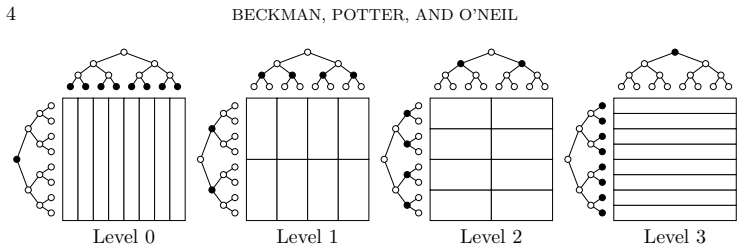
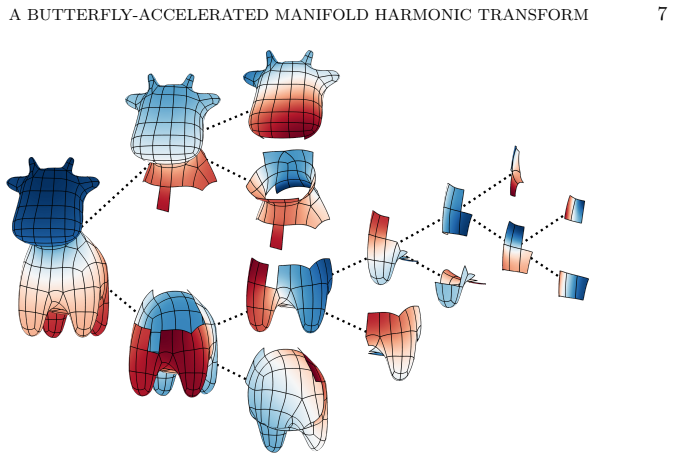
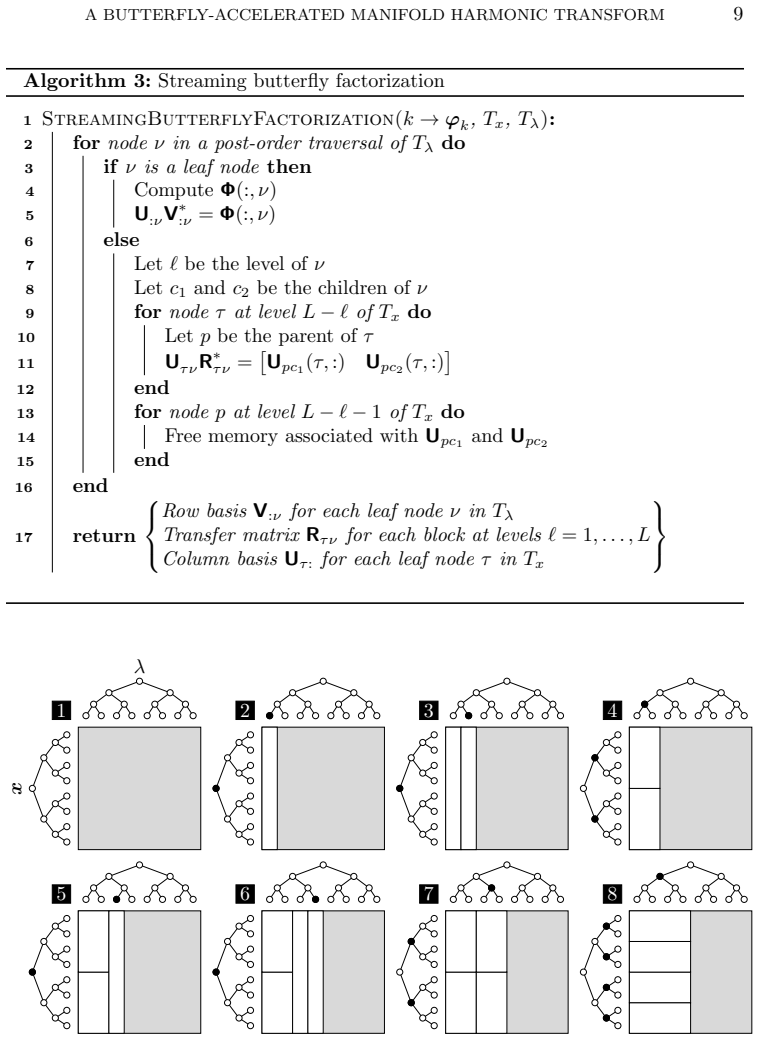
The central claim is that a butterfly factorization, constructed by hierarchically compressing the manifold harmonic transform matrix through nested low-rank approximations of carefully selected submatrices, yields a fast algorithm for computing linear combinations of Laplace-Beltrami eigenfunctions on arbitrary surfaces. This generalizes the classical fast transforms for complex exponentials and spherical harmonics. The resulting method reduces both runtime and storage compared with direct evaluation, as confirmed by examples across multiple geometries and discretizations.
What carries the argument
Butterfly factorization of the manifold harmonic transform matrix, which builds a hierarchy of nested low-rank approximations for selected submatrices.
If this is right
- Linear combinations of manifold harmonics become practical to evaluate on complex surfaces without quadratic cost.
- Memory footprint for the transform operator drops substantially through the hierarchical compression.
- The same framework applies across different surface discretizations and application domains.
- Error and complexity can be bounded explicitly when the surface is a flat periodic square.
Where Pith is reading between the lines
- The same low-rank hierarchical structure might appear in other integral operators on manifolds, allowing similar accelerations.
- Adaptive choice of the low-rank blocks could further reduce error for surfaces with sharp features.
- The approach supplies a concrete route toward real-time harmonic analysis in geometry-processing pipelines.
Load-bearing premise
The underlying surface discretization produces a transform matrix whose selected submatrices possess sufficient hierarchical low-rank structure for the butterfly compression to succeed with controlled error.
What would settle it
Running the algorithm on a surface discretization whose submatrices lack the expected low-rank structure and measuring whether the approximation error grows beyond the claimed tolerance or the runtime fails to improve.
Figures





read the original abstract
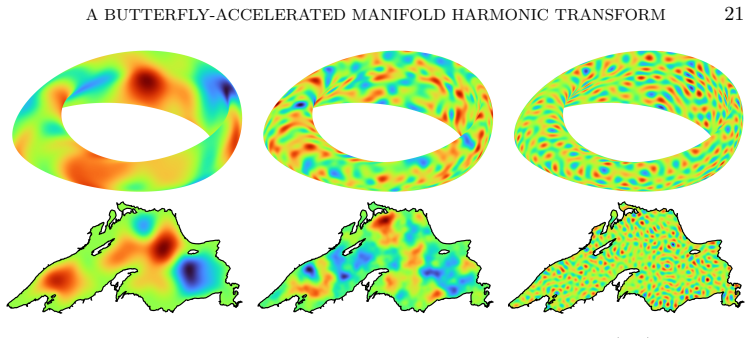
The eigenfunctions of the Laplacian are a natural basis of functions for many tasks in computational mathematics. On the circle and sphere, the eigenfunctions are given by complex periodic exponentials and spherical harmonics, respectively, and much work has been done to develop fast algorithms for analyzing and synthesizing data in these bases. In this work, we generalize these special-case transforms to Laplace-Beltrami eigenfunctions of arbitrary surfaces, referred to as manifold harmonics. The resulting fast algorithm for computing linear combinations of the manifold harmonics is based on a butterfly factorization, which hierarchically compresses the transform matrix by constructing nested low-rank approximations of carefully selected submatrices. Several numerical examples are provided which demonstrate the speedups and reduction in memory requirements achieved by our algorithm for a variety of geometries, discretizations, and applications. In addition, a detailed analysis of the algorithm is given in the case that the underlying manifold is the flat periodic square.
Editorial analysis
A structured set of objections, weighed in public.
Referee Report
Summary. The paper generalizes fast harmonic transforms from circles and spheres to Laplace-Beltrami eigenfunctions (manifold harmonics) on arbitrary surfaces. The fast algorithm for linear combinations of these harmonics is obtained by applying a butterfly factorization that hierarchically compresses the transform matrix via nested low-rank approximations of selected submatrices. Numerical examples on a variety of geometries and discretizations demonstrate speedups and memory savings; a detailed analysis of complexity and accuracy is supplied only when the manifold is the flat periodic square.
Significance. If the low-rank structure and error control extend beyond the flat case, the work would supply a practical O(N log N) method for manifold-harmonic analysis and synthesis, generalizing classical FFT-type algorithms to surfaces arising in graphics, geometry processing, and PDEs. The numerical demonstrations already indicate concrete gains in runtime and storage; the rigorous treatment of the flat square provides a useful benchmark and proof-of-concept for the compression technique.
major comments (2)
- [Abstract and general-algorithm section] Abstract and the section describing the general algorithm: the claim that the butterfly factorization yields a fast, accurate algorithm for arbitrary manifolds rests on the assumption that carefully chosen submatrices of the manifold-harmonic transform admit nested low-rank approximations whose ranks and errors remain controlled across the hierarchy. Rigorous singular-value decay estimates and error bounds are derived only for the flat periodic square; for curved or irregular surfaces the manuscript supplies only numerical evidence without rank-growth bounds or approximation guarantees. This gap is load-bearing for the central claim of general applicability.
- [Numerical-examples section] Numerical-examples section: the reported speedups and accuracy are convincing for the tested discretizations, yet without theoretical control on the effective rank or the constant in the O(N log N) complexity it remains unclear whether the observed performance extrapolates to finer meshes or more complex geometries, or whether it depends on favorable properties of the particular surface discretizations chosen.
minor comments (2)
- [Introduction] The notation distinguishing the continuous manifold-harmonic operator from its discrete matrix representation could be introduced earlier and used consistently to improve readability.
- [Numerical-examples section] A short table summarizing the observed compression ratios and wall-clock times across all examples would make the empirical results easier to compare at a glance.
Simulated Author's Rebuttal
We thank the referee for their careful reading of the manuscript and for highlighting the distinction between the rigorous analysis available for the flat periodic square and the numerical support for general manifolds. We address the major comments point by point below.
read point-by-point responses
-
Referee: [Abstract and general-algorithm section] Abstract and the section describing the general algorithm: the claim that the butterfly factorization yields a fast, accurate algorithm for arbitrary manifolds rests on the assumption that carefully chosen submatrices of the manifold-harmonic transform admit nested low-rank approximations whose ranks and errors remain controlled across the hierarchy. Rigorous singular-value decay estimates and error bounds are derived only for the flat periodic square; for curved or irregular surfaces the manuscript supplies only numerical evidence without rank-growth bounds or approximation guarantees. This gap is load-bearing for the central claim of general applicability.
Authors: We agree that the manuscript derives rigorous singular-value decay estimates and error bounds exclusively for the flat periodic square, as stated in the abstract and the analysis section. For arbitrary manifolds the algorithm is presented as a general procedure whose practical performance rests on the empirical observation that selected submatrices admit useful low-rank approximations; this observation is documented through numerical examples on curved and irregular surfaces. The flat-square case is supplied as a benchmark that proves the O(N log N) complexity under controlled rank growth. We will revise the abstract and the general-algorithm section to state more explicitly that theoretical guarantees are currently limited to the flat case while the method is shown to be effective more broadly via numerical validation. This clarification will be made without altering the algorithmic description or the reported experiments. revision: partial
-
Referee: [Numerical-examples section] Numerical-examples section: the reported speedups and accuracy are convincing for the tested discretizations, yet without theoretical control on the effective rank or the constant in the O(N log N) complexity it remains unclear whether the observed performance extrapolates to finer meshes or more complex geometries, or whether it depends on favorable properties of the particular surface discretizations chosen.
Authors: The numerical section already includes results on several distinct geometries and discretization types, all exhibiting comparable speedups and memory reductions. In the flat periodic square we supply the full complexity analysis with explicit rank bounds. For the remaining examples we report the observed effective ranks and runtimes, which remain modest. To address the extrapolation concern we will add a short discussion subsection that tabulates the measured rank growth with respect to mesh size and surface complexity, together with a brief statement on the empirical evidence for scalability. We acknowledge that a general theoretical bound on the rank constant is not yet available. revision: yes
- Deriving rigorous singular-value decay estimates and approximation guarantees that hold uniformly for arbitrary curved or irregular manifolds would require substantial additional theoretical work that lies outside the scope of the present manuscript.
Circularity Check
No significant circularity; derivation applies external butterfly compression to manifold-harmonic matrix
full rationale
The manuscript constructs the fast transform by applying a standard butterfly factorization (hierarchical low-rank compression of selected submatrices) to the manifold-harmonic operator. The only analytic error bounds and rank estimates are supplied for the flat periodic square; all other geometries are supported by numerical demonstration. No equation reduces a claimed prediction or complexity result to a fitted parameter or self-citation by construction, and the load-bearing step (existence of controlled nested low-rank structure) is an assumption about the discretization rather than a definitional tautology.
Axiom & Free-Parameter Ledger
Lean theorems connected to this paper
-
IndisputableMonolith/Foundation/AlexanderDuality.leanalexander_duality_circle_linking unclear?
unclearRelation between the paper passage and the cited Recognition theorem.
The resulting fast algorithm ... is based on a butterfly factorization, which hierarchically compresses the transform matrix by constructing nested low-rank approximations of carefully selected submatrices. ... a detailed analysis of the algorithm is given in the case that the underlying manifold is the flat periodic square.
-
IndisputableMonolith/Foundation/ArithmeticFromLogic.leanembed_strictMono_of_one_lt unclear?
unclearRelation between the paper passage and the cited Recognition theorem.
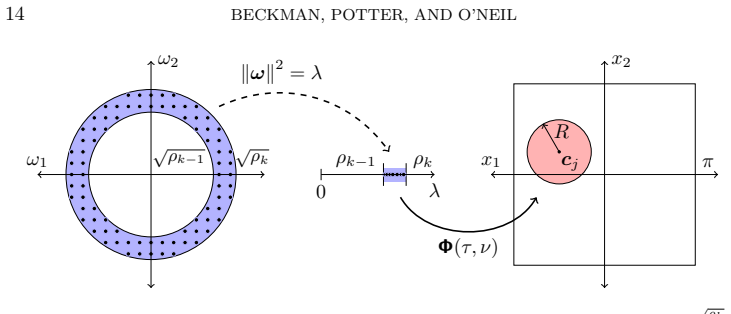
We now establish asymptotic storage and complexity results ... for the flat torus M = [−π, π]². ... rε ≤ 5/2 + log(ε−4) · ⌈e/2 bR + log(ε−1)⌉
What do these tags mean?
- matches
- The paper's claim is directly supported by a theorem in the formal canon.
- supports
- The theorem supports part of the paper's argument, but the paper may add assumptions or extra steps.
- extends
- The paper goes beyond the formal theorem; the theorem is a base layer rather than the whole result.
- uses
- The paper appears to rely on the theorem as machinery.
- contradicts
- The paper's claim conflicts with a theorem or certificate in the canon.
- unclear
- Pith found a possible connection, but the passage is too broad, indirect, or ambiguous to say the theorem truly supports the claim.
Reference graph
Works this paper leans on
-
[1]
A. Alsnayyan and B. Shanker,Iso-geometric integral equation solvers and their compression via manifold harmonics, IEEE Trans. Antennas Propag., 70 (2022), pp. 6893–6904. A BUTTERFLY-ACCELERATED MANIFOLD HARMONIC TRANSFORM23
work page 2022
-
[2]
A. M. Alsnayyan, L. Kempel, and S. Balasubramaniam,Manifold harmonics and their application to computational electromagnetics, IEEE J. Multiscale Multiphysics Comput. Tech., 7 (2022), pp. 336–345
work page 2022
-
[3]
P. G. Beckman and M. O’Neil,A nonuniform fast hankel transform, SIAM Journal on Scientific Computing, 48 (2026), pp. A784–A803
work page 2026
-
[4]
M. Belkin and P. Niyogi,Laplacian eigenmaps for dimensionality reduction and data repre- sentation, Neural computation, 15 (2003), pp. 1373–1396
work page 2003
-
[5]
J. K. Bennighof and R. B. Lehoucq,An automated multilevel substructuring method for eigenspace computation in linear elastodynamics, SIAM Journal on Scientific Computing, 25 (2004), pp. 2084–2106
work page 2004
- [6]
- [7]
-
[8]
V. Borovitskiy, A. Terenin, P. Mostowsky, et al.,Mat´ ern gaussian processes on riemannian manifolds, Advances in Neural Information Processing Systems, 33 (2020), pp. 12426–12437
work page 2020
- [9]
-
[10]
J. Cheeger,A lower bound for the smallest eigenvalue of the Laplacian, Problems in analysis, 625 (1970), p. 110
work page 1970
-
[11]
J. Chiu and L. Demanet,Sublinear randomized algorithms for skeleton decompositions, SIAM J. Matrix Anal. Appl., 34 (2013), pp. 1361–1383
work page 2013
-
[12]
R. R. Coifman and M. Maggioni,Diffusion wavelets, Applied and computational harmonic analysis, 21 (2006), pp. 53–94
work page 2006
-
[13]
A. Cortinovis and L. Ying,A sublinear-time randomized algorithm for column and row subset selection based on strong rank-revealing qr factorizations, SIAM Journal on Matrix Analysis and Applications, 46 (2025), pp. 22–44
work page 2025
-
[14]
L. Demanet, M. Ferrara, N. Maxwell, J. Poulson, and L. Ying,A butterfly algorithm for synthetic aperture radar imaging, SIAM J. Imag. Sci., 5 (2012), pp. 203–243
work page 2012
-
[15]
A. Dutt and V. Rokhlin,Fast Fourier transforms for nonequispaced data, SIAM J. Sci. Comput., 14 (1993), pp. 1368–1393
work page 1993
-
[16]
G. Dziuk and C. M. Elliott,Finite element methods for surface PDEs, Acta Numerica, 22 (2013), pp. 289–396
work page 2013
-
[17]
B. Engquist and L. Ying,A fast directional algorithm for high frequency acoustic scattering in two dimensions, Commun. Math. Sci., 7 (2009), pp. 327–345
work page 2009
-
[18]
M. Fiedler,A property of eigenvectors of nonnegative symmetric matrices and its application to graph theory, Czechoslovak mathematical journal, 25 (1975), pp. 619–633
work page 1975
-
[19]
D. Fortunato,A high-order fast direct solver for surface pdes, SIAM Journal on Scientific Computing, 46 (2024), pp. A2582–A2606
work page 2024
-
[20]
Giannakis,Data-driven spectral decomposition and forecasting of ergodic dynamical systems, Appl
D. Giannakis,Data-driven spectral decomposition and forecasting of ergodic dynamical systems, Appl. Comput. Harm. Anal., 47 (2019), pp. 338–396
work page 2019
-
[21]
G. H. Golub and C. F. Van Loan,Matrix computations, John Hopkins University Press, 1983
work page 1983
-
[22]
L. Greengard and J.-Y. Lee,Accelerating the nonuniform fast Fourier transform, SIAM Review, 46 (2004), pp. 443–454
work page 2004
-
[23]
A. Lang and M. Pereira,Galerkin–Chebyshev approximation of Gaussian random fields on compact Riemannian manifolds, BIT Numerical Mathematics, 63 (2023), p. 51
work page 2023
-
[24]
B. L´evy,Laplace-Beltrami eigenfunctions towards an algorithm that “understands” geometry, in IEEE International Conference on Shape Modeling and Applications 2006 (SMI’06), IEEE, 2006, pp. 13–13
work page 2006
- [25]
-
[26]
Y. Li, H. Yang, E. R. Martin, K. L. Ho, and L. Ying,Butterfly factorization, Multiscale Modeling & Simulation, 13 (2015), pp. 714–732
work page 2015
-
[27]
Y. Liu, X. Xing, H. Guo, E. Michielssen, P. Ghysels, and X. S. Li,Butterfly factorization via randomized matrix-vector multiplications, SIAM Journal on Scientific Computing, 43 (2021), pp. A883–A907
work page 2021
-
[28]
E. Michielssen and A. Boag,A multilevel matrix decomposition algorithm for analyzing scattering from large structures, IEEE Trans. Antennas Propag., 44 (1996), pp. 1086–1093
work page 1996
-
[29]
M. J. Mohlenkamp,A fast transform for spherical harmonics, Journal of Fourier analysis and applications, 5 (1999), pp. 159–184. 24BECKMAN, POTTER, AND O’NEIL
work page 1999
-
[30]
A. Nasikun, C. Brandt, and K. Hildebrandt,Fast approximation of Laplace-Beltrami eigenproblems, in Computer Graphics Forum, vol. 37, Wiley Online Library, 2018, pp. 121– 134
work page 2018
-
[31]
F. W. Olver, D. W. Lozier, R. Boisvert, and C. W. Clark,The NIST handbook of mathematical functions, (2010). [33]M. O’Neil,A new class of analysis-based fast transforms, tech. report, Yale University, 2007
work page 2010
- [32]
-
[33]
C. C. Paige and M. A. Saunders,Lsqr: An algorithm for sparse linear equations and sparse least squares, ACM Transactions on Mathematical Software (TOMS), 8 (1982), pp. 43–71
work page 1982
-
[34]
Q. Pang, K. L. Ho, and H. Yang,Interpolative decomposition butterfly factorization, SIAM J. Sci. Comput., 42 (2020), pp. A1097–A1115
work page 2020
-
[35]
Patan`e,Laplacian spectral basis functions, Computer aided geometric design, 65 (2018), pp
G. Patan`e,Laplacian spectral basis functions, Computer aided geometric design, 65 (2018), pp. 31–47
work page 2018
- [36]
-
[37]
D. Seljebotn,Wavemoth–fast spherical harmonic transforms by butterfly matrix compression, The Astrophysical Journal Supplement Series, 199 (2012), p. 5
work page 2012
-
[38]
S. Seo, M. K. Chung, and H. K. Vorperian,Heat kernel smoothing using Laplace-Beltrami eigenfunctions, in Medical Image Computing and Computer-Assisted Intervention–MICCAI 2010: 13th International Conference, Beijing, China, September 20-24, 2010, Proceedings, Part III 13, Springer, 2010, pp. 505–512
work page 2010
- [39]
-
[40]
A. Singer,From graph to manifold laplacian: The convergence rate, Applied and Computational Harmonic Analysis, 21 (2006), pp. 128–134
work page 2006
-
[41]
R. M. Slevinsky,Fast and backward stable transforms between spherical harmonic expansions and bivariate Fourier series, Appl. Comput. Harm. Anal., 47 (2019), pp. 585–606
work page 2019
-
[42]
A. Solin and M. Kok,Know your boundaries: Constraining gaussian processes by variational harmonic features, in The 22nd International Conference on Artificial Intelligence and Statistics, PMLR, 2019, pp. 2193–2202
work page 2019
-
[43]
A. Solin and S. S ¨arkk¨a,Hilbert space methods for reduced-rank gaussian process regression, Statistics and Computing, 30 (2020), pp. 419–446
work page 2020
-
[44]
G. W. Stewart,A Krylov–Schur algorithm for large eigenproblems, SIAM J. Matrix Anal. Appl., 23 (2002), pp. 601–614
work page 2002
- [45]
-
[46]
A. D. Szlam, M. Maggioni, R. R. Coifman, and J. C. Bremer Jr,Diffusion-driven multiscale analysis on manifolds and graphs: top-down and bottom-up constructions, in Wavelets XI, vol. 5914, SPIE, 2005, pp. 445–455
work page 2005
-
[47]
A. Townsend,A fast analysis-based discrete Hankel transform using asymptotic expansions, SIAM Journal on Numerical Analysis, 53 (2015), pp. 1897–1917
work page 2015
-
[48]
Tygert,Fast algorithms for spherical harmonic expansions, III, J
M. Tygert,Fast algorithms for spherical harmonic expansions, III, J. Comput. Phys., 229 (2010), pp. 6181–6192
work page 2010
-
[49]
B. Vallet and B. L´evy,Spectral geometry processing with manifold harmonics, in Computer Graphics Forum, vol. 27, Wiley Online Library, 2008, pp. 251–260. [52]C. Van Loan,Computational frameworks for the fast Fourier transform, SIAM, 1992
work page 2008
-
[50]
C. K. Williams and C. E. Rasmussen,Gaussian processes for machine learning, vol. 2, MIT press Cambridge, MA, 2006
work page 2006
- [51]
discussion (0)
Sign in with ORCID, Apple, or X to comment. Anyone can read and Pith papers without signing in.