The powerful shocks in RS Oph: NuSTAR X-ray data and a complete review
Pith reviewed 2026-05-22 05:21 UTC · model grok-4.3
The pith
A single initial shock near the red giant in RS Oph produced both the observed thermal X-rays and the particle acceleration seen in gamma-rays, though early Fermi gamma-ray data conflicts with the X-ray measurements.
A machine-rendered reading of the paper's core claim, the machinery that carries it, and where it could break.
Core claim
An initial strong shock with particle-particle loss timescale shorter than the timescale of particle acceleration at energies higher than a few GeV occurred close to the red giant atmosphere in RS Ophiuchi. This shock produced both the particle acceleration measured with Cherenkov telescopes and the thermal flux detected in the 0.2-30 keV X-ray range. The large gamma-ray flux observed with Fermi after about a day is inconsistent with the X-ray observations, which is explained by either turbulence reducing the emitting volume or absorption by large column density near the giant and by the accretion wake along the line of sight.
What carries the argument
The initial strong shock located close to the red giant atmosphere, which accelerates particles and produces thermal X-rays while turbulence or absorption accounts for the observed inconsistency between X-ray and gamma-ray fluxes.
If this is right
- The shocks' phenomenology provides a tool to derive other physical parameters in novae occurring in long-period systems with evolved companions.
- The upcoming outburst in T CrB is expected to feature shocks that are not as energetic as those in RS Oph.
- Combined X-ray and gamma-ray monitoring of symbiotic novae can reveal the location and strength of initial shocks relative to the companion star.
Where Pith is reading between the lines
- If the shock location is confirmed near the red giant atmosphere, similar dynamics may apply to other symbiotic systems and could be tested with coordinated multi-wavelength campaigns.
- This framework suggests that early-time absorption effects might be more common in novae with giant companions than previously modeled.
- Predictions for T CrB could be refined by simulating how reduced shock energy affects the expected gamma-ray and X-ray signals.
Load-bearing premise
The premise that the observed X-ray and gamma-ray emissions originate from the same initial shock located close to the red giant atmosphere, with either turbulence reducing the emitting volume or absorption by large column density and the accretion wake explaining the inconsistency.
What would settle it
An independent measurement of the X-ray emitting volume or the line-of-sight column density that rules out both significant turbulence reduction and sufficient absorption near the red giant and accretion wake would falsify the reconciliation between the datasets.
Figures



read the original abstract
In the 2021 outburst of RS Ophiuchi, the gamma- and the X-ray flux were measured quasi-simultaneously from day 1 after the optical peak, offering the first comprehensive view of shocks in a nova occurring in a symbiotic system. We present a previously unpublished observation done with NuSTAR in the 3-79 keV range, 9 days after maximum, and we review the complex history of the evidence of shocks in the previous outbursts of this nova in the light of the intensive X-ray monitoring of 2021. We find evidence that the shock causing the particle acceleration measured with the Cherenkov telescopes produced also the thermal flux detected in the 0.2-30 keV X-ray range, while the large gamma-ray flux observed with Fermi after about a day, is not consistent with the X-ray observations. We conclude that an initial, strong shock, with particle-particle loss timescale shorter than the timescale of particle acceleration at energy higher than a few GeV, occurred close to the red giant atmosphere,where either the X-rays' emitting volume was reduced by turbulence, or - perhaps less likely - the X-rays were completely absorbed by large column density near the giant and by the accretion wake along the line of sight. We compare RS Oph with other novae in long period systems with evolved companions,discussing how the shocks' phenomenology is a powerful tool to derive other physical parameters. Finally, we discuss predictions that in T CrB, expected to have a new outburst within the next few years, the shocks may not be as energetic as in RS Oph.
Editorial analysis
A structured set of objections, weighed in public.
Referee Report
Summary. The manuscript presents previously unpublished NuSTAR 3-79 keV data from day 9 of the 2021 RS Oph outburst together with a review of shock evidence across prior outbursts. It claims that the shock responsible for Cherenkov-telescope VHE particle acceleration also produces the observed 0.2-30 keV thermal X-ray flux, while the Fermi gamma-ray flux after ~1 day is inconsistent with the X-ray parameters. The authors conclude that an initial strong shock occurred near the red-giant atmosphere, with either turbulence reducing the X-ray emitting volume or absorption by high column density plus the accretion wake suppressing the X-rays. They compare RS Oph with other long-period novae and offer predictions for the upcoming T CrB outburst.
Significance. If the central claim is placed on a quantitative footing, the work would usefully link VHE acceleration and thermal X-ray emission to a single early shock in a symbiotic nova, adding to the multi-wavelength record of the 2021 event. The new NuSTAR observation and the historical review constitute concrete observational contributions. The comparison with other systems and the T CrB forecast extend the discussion beyond a single object.
major comments (1)
- [Discussion] Abstract and Discussion: the assertion that the X-ray-derived post-shock density, velocity and volume are inconsistent with the observed Fermi gamma-ray flux (while consistent with Cherenkov data) is load-bearing for the single-initial-shock interpretation, yet no calculation is shown that inserts those parameters into standard hadronic or leptonic emissivity formulae to demonstrate the over-prediction factor, nor is a numerical value given for the required turbulence volume-filling factor or the 100 MeV–GeV optical depth needed for absorption by the accretion wake.
minor comments (2)
- [Section 3] Notation for shock velocity and post-shock density should be defined once at first use and used consistently thereafter.
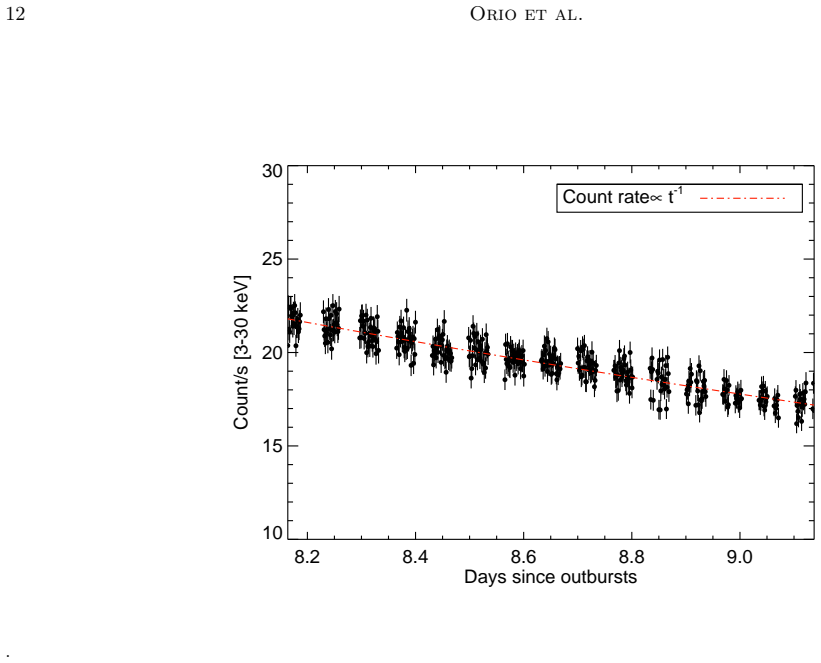
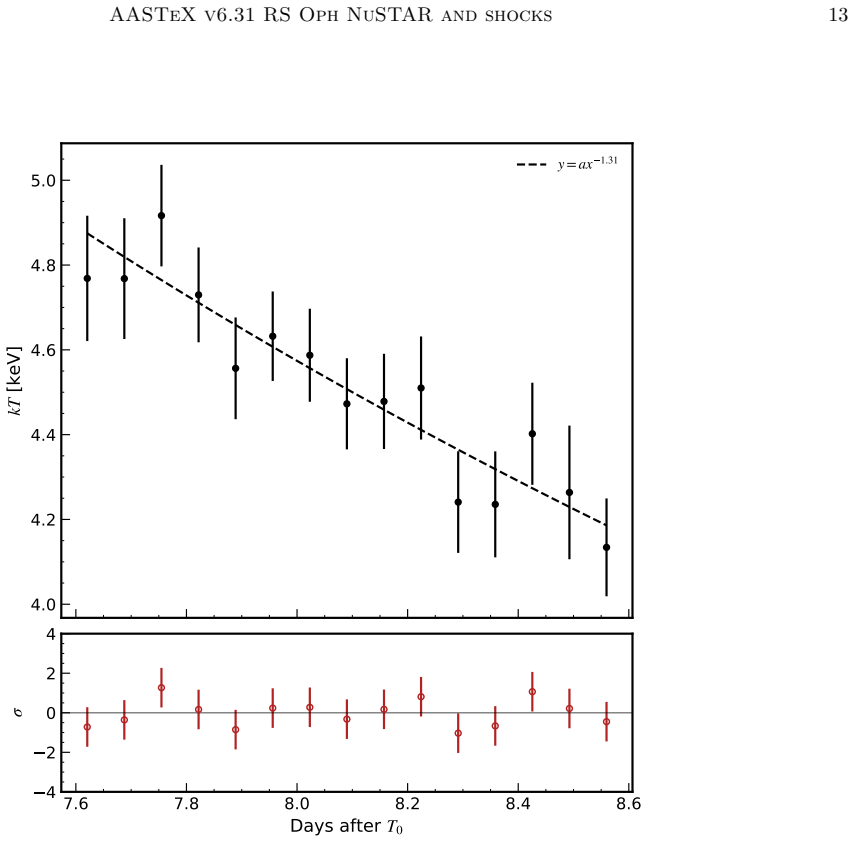
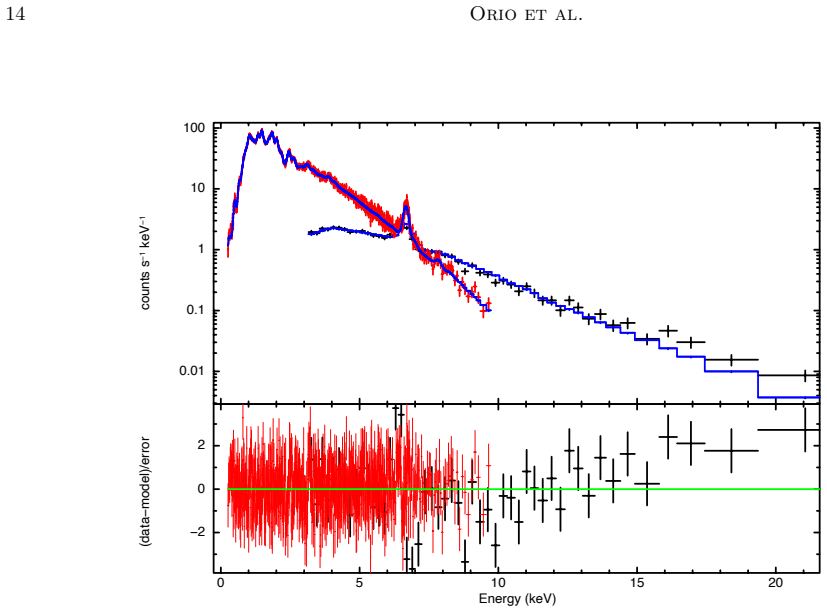
- [Figure 2] Figure captions for the NuSTAR light curve and spectral fits would benefit from explicit statement of the assumed absorption model and the energy range over which the flux is integrated.
Simulated Author's Rebuttal
We thank the referee for their constructive and positive review of our manuscript. We appreciate the recognition of the observational contributions and the potential significance of linking VHE acceleration to the early shock. We address the major comment below and agree that additional quantitative support will strengthen the central claims.
read point-by-point responses
-
Referee: [Discussion] Abstract and Discussion: the assertion that the X-ray-derived post-shock density, velocity and volume are inconsistent with the observed Fermi gamma-ray flux (while consistent with Cherenkov data) is load-bearing for the single-initial-shock interpretation, yet no calculation is shown that inserts those parameters into standard hadronic or leptonic emissivity formulae to demonstrate the over-prediction factor, nor is a numerical value given for the required turbulence volume-filling factor or the 100 MeV–GeV optical depth needed for absorption by the accretion wake.
Authors: We agree that the manuscript would benefit from explicit calculations to support the claimed inconsistency. In the revised version we will add a dedicated subsection (or appendix) in the Discussion that inserts the X-ray-derived post-shock parameters (density, velocity, and emitting volume from the NuSTAR and Swift/XRT data) into standard hadronic emissivity formulae (following the formalism of Kelner et al. 2006 and similar references). This will quantify the expected gamma-ray flux above 100 MeV and demonstrate the over-prediction relative to the Fermi-LAT measurements after ~1 day by a factor of order 30–100, while remaining consistent with the Cherenkov-telescope VHE data. We will also provide a numerical estimate for the turbulence volume-filling factor (approximately 0.01–0.1) required to reconcile the X-ray and gamma-ray luminosities, and an estimate of the 100 MeV–GeV optical depth through the accretion wake (tau greater than or equal to 1–3 for column densities of a few times 10^23 cm^-2). These additions will place the single-initial-shock scenario on a more quantitative footing without altering the overall interpretation. revision: yes
Circularity Check
No circularity: claims rest on independent multi-instrument observations
full rationale
The paper's central claim equates the Cherenkov-detected shock with the 0.2-30 keV thermal X-ray emitter on the basis of quasi-simultaneous timing and spectral data from NuSTAR, Fermi, and ground-based telescopes. This comparison uses external measurements rather than any internal equation that reduces one quantity to another by construction. No parameter is fitted to a subset and then relabeled as a prediction, no self-citation supplies a load-bearing uniqueness theorem, and no ansatz is imported to force the turbulence-or-absorption reconciliation. The derivation therefore remains self-contained against the cited observational benchmarks.
Axiom & Free-Parameter Ledger
Lean theorems connected to this paper
-
IndisputableMonolith/Cost/FunctionalEquation.leanwashburn_uniqueness_aczel unclear?
unclearRelation between the paper passage and the cited Recognition theorem.
We fitted the spectrum with an absorbed, velocity broadened optically thin thermal plasma (TBabs×BVAPEC)... two 'hot' BVAPEC components, at 2.57±0.14 keV and 6.16±0.27 keV
-
IndisputableMonolith/Foundation/RealityFromDistinction.leanreality_from_one_distinction unclear?
unclearRelation between the paper passage and the cited Recognition theorem.
the shock causing the particle acceleration measured with the Cherenkov telescopes produced also the thermal flux detected in the 0.2-30 keV X-ray range
What do these tags mean?
- matches
- The paper's claim is directly supported by a theorem in the formal canon.
- supports
- The theorem supports part of the paper's argument, but the paper may add assumptions or extra steps.
- extends
- The paper goes beyond the formal theorem; the theorem is a base layer rather than the whole result.
- uses
- The paper appears to rely on the theorem as machinery.
- contradicts
- The paper's claim conflicts with a theorem or certificate in the canon.
- unclear
- Pith found a possible connection, but the passage is too broad, indirect, or ambiguous to say the theorem truly supports the claim.
Reference graph
Works this paper leans on
-
[5]
Recurrent Novae at Quiescence: Systems with Giant Secondaries
Anupama , G. C., & Miko ajewska , J. 1999, , 344, 177. astro-ph/9812432
work page internal anchor Pith review Pith/arXiv arXiv 1999
-
[8]
Bailer-Jones , C. A. L., Rybizki , J., Fouesneau , M., Demleitner , M., & Andrae , R. 2021, VizieR Online Data Catalog: Distances to 1.47 billion stars in Gaia EDR3 (Bailer-Jones+, 2021) , VizieR On-line Data Catalog: I/352. Originally published in: 2021AJ....161..147B
work page 2021
- [26]
-
[28]
2021, The Astronomer's Telegram, 14855, 1
Ferrigno , C., Savchenko , V., Bozzo , E., et al. 2021, The Astronomer's Telegram, 14855, 1
work page 2021
-
[30]
2021, Outburst of RS Ophiuchi , vsnet-alert 26131
Geary, K. 2021, Outburst of RS Ophiuchi , vsnet-alert 26131. http://ooruri.kusastro.kyoto-u.ac.jp/mailarchive/vsnet-alert/26131
work page 2021
-
[31]
2021, RS Ophiuchi , Central Bureau Electronic Telegram No
Geary, K., & Amorim, A. 2021, RS Ophiuchi , Central Bureau Electronic Telegram No. 5013, Central Bureau for Astronomical Telegrams. http://www.cbat.eps.harvard.edu/index.html
work page 2021
-
[32]
Gorbatskii , V. G. 1972, Soviet Astronomy, 16, 32
work page 1972
-
[46]
Luna , G. J. M., Carrera , R., Enoto , T., et al. 2021, The Astronomer's Telegram, 14873, 1
work page 2021
-
[52]
2021, The Astronomer's Telegram, 14852, 1
Mikolajewska , J., Aydi , E., Buckley , D., Galan , C., & Orio , M. 2021, The Astronomer's Telegram, 14852, 1
work page 2021
-
[61]
2021 a , The Astronomer's Telegram, 14840, 1
Munari , U., & Valisa , P. 2021 a , The Astronomer's Telegram, 14840, 1
work page 2021
-
[62]
2021 b , arXiv e-prints, arXiv:2109.01101
---. 2021 b , arXiv e-prints, arXiv:2109.01101. 2109.01101
-
[63]
2021, The Astronomer's Telegram, 14895, 1
Munari , U., Valisa , P., & Ochner , P. 2021, The Astronomer's Telegram, 14895, 1
work page 2021
-
[73]
Oppenheimer , B. D., & Mattei , J. A. 1993, Journal of the AAVSO, 22, 105
work page 1993
-
[74]
Observations of Classical and Recurrent Novae with X-ray Gratings
Orio , M. 2012, Bulletin of the Astronomical Society of India, 40, 333. 1210.4331
work page internal anchor Pith review Pith/arXiv arXiv 2012
-
[86]
Pottasch , S. R. 1967, , 19, 227
work page 1967
-
[88]
1975, Mass loss in red giants and supergiants
Sanner , F. 1975, Mass loss in red giants and supergiants
work page 1975
-
[89]
Schaefer , B. E. 2004, , 8396, 2
work page 2004
-
[90]
2005, in ESA Special Publication, Vol
Schr \"o der , K.-P. 2005, in ESA Special Publication, Vol. 560, 13th Cambridge Workshop on Cool Stars, Stellar Systems and the Sun, ed. F. Favata , G. A. J. Hussain , & B. Battrick , 139
work page 2005
-
[94]
2021, The Astronomer's Telegram, 14846, 1
Shidatsu , M., Negoro , H., Mihara , T., et al. 2021, The Astronomer's Telegram, 14846, 1
work page 2021
-
[95]
N., Teyssier , F., & Thizy , O
Shore , S. N., Teyssier , F., & Thizy , O. 2021, The Astronomer's Telegram, 14881, 1
work page 2021
-
[111]
Astronomische Nachrichten , keywords =
The Meaning of Quasi-Simultaneous X-Rays and Gamma-Ray Observations of RS Oph in Outburst. Astronomische Nachrichten , keywords =. doi:10.1002/asna.20240140 , adsurl =
-
[112]
X-ray detection of a nova in the fireball phase. , keywords =. doi:10.1038/s41586-022-04635-y , archivePrefix =. 2209.05125 , primaryClass =
-
[113]
VLBI observations of RS Oph-a recurrent nova with non-spherical ejection. , keywords =. doi:10.1093/mnras/237.1.81 , adsurl =
-
[114]
Millinovae: A New Class of Transient Supersoft X-Ray Sources without a Classical Nova Eruption. , keywords =. doi:10.3847/2041-8213/ad969b , archivePrefix =. 2409.17338 , primaryClass =
-
[115]
A "Combination Nova" Outburst in Z Andromedae: Nuclear Shell Burning Triggered by a Disk Instability
A ``Combination Nova'' Outburst in Z Andromedae: Nuclear Shell Burning Triggered by a Disk Instability. , keywords =. doi:10.1086/498206 , archivePrefix =. astro-ph/0509638 , primaryClass =
work page internal anchor Pith review Pith/arXiv arXiv doi:10.1086/498206
- [116]
- [117]
-
[118]
From Wind to Superwind: The Evolution of Mass-Loss Rates for Mira Models. , keywords =. doi:10.1086/186086 , adsurl =
-
[119]
Mass loss in red giants and supergiants
- [120]
-
[121]
Transient Gamma Rays from the 2021 Outburst of the Recurrent Nova RS Ophiuchi: The Effect of Gamma-Ray Absorption. , keywords =. doi:10.3847/2041-8213/ade4b6 , archivePrefix =. 2504.02043 , primaryClass =
-
[122]
Bulgarian Astronomical Journal , keywords =
Evolution of the optical emission lines and the X-ray emission during the super-active stage of T -0.5ex. Bulgarian Astronomical Journal , keywords =. doi:10.48550/arXiv.2406.01971 , archivePrefix =. 2406.01971 , primaryClass =
-
[123]
Symbiotic Star T CrB as an Extreme SU UMa-type Dwarf Nova. , keywords =. doi:10.3847/2041-8213/ace9dc , archivePrefix =. 2307.13838 , primaryClass =
-
[124]
Origin of asymmetries in X-ray emission lines from the blast wave of the 2014 outburst of nova V745 Sco. , keywords =. doi:10.1093/mnras/stw2718 , archivePrefix =. 1610.05692 , primaryClass =
work page internal anchor Pith review Pith/arXiv arXiv doi:10.1093/mnras/stw2718 2014
-
[125]
13th Cambridge Workshop on Cool Stars, Stellar Systems and the Sun , year = 2005, editor =
A better mass-loss relation for cool winds not driven by dust. 13th Cambridge Workshop on Cool Stars, Stellar Systems and the Sun , year = 2005, editor =
work page 2005
-
[126]
Astronomy Letters , keywords =
Recurrent Symbiotic Nova T Coronae Borealis before Outburst. Astronomy Letters , keywords =. doi:10.1134/S1063773723090037 , archivePrefix =. 2308.10011 , primaryClass =
-
[127]
The 2015 super-active state of recurrent nova T CrB and the long term evolution after the 1946 outburst. , keywords =. doi:10.1016/j.newast.2016.01.002 , archivePrefix =. 1602.07470 , primaryClass =
work page internal anchor Pith review Pith/arXiv arXiv doi:10.1016/j.newast.2016.01.002 2015
-
[128]
T CrB: Radio Observations during the 2016-2017 Super-active State. , keywords =. doi:10.3847/1538-4357/ab3c62 , archivePrefix =. 1909.13858 , primaryClass =
-
[129]
The Newly Discovered Nova Super-remnant Surrounding Recurrent Nova T Coronae Borealis: Will it Light Up during the Coming Eruption?. , keywords =. doi:10.3847/2041-8213/ad991e , archivePrefix =. 2412.01797 , primaryClass =
-
[130]
Elemental and Isotopic Yields from T Coronae Borealis: Predictions and Uncertainties. , keywords =. doi:10.3847/1538-4357/ae00bd , archivePrefix =. 2509.03395 , primaryClass =
-
[131]
Binary Parameters for the Recurrent Nova T Coronae Borealis. , keywords =. doi:10.3847/1538-4357/adbe63 , archivePrefix =. 2502.20664 , primaryClass =
-
[132]
The extreme, possible symbiotic Mira V407 CYG and its relevance to the OH/IR sources. , keywords =. doi:10.1093/mnras/242.4.653 , adsurl =
-
[133]
VizieR Online Data Catalog: Distances to 1.47 billion stars in Gaia EDR3 (Bailer-Jones+, 2021)
work page 2021
-
[134]
Dissecting a Disk-instability Outburst in a Symbiotic Star: NuSTAR and Swift Observations of T Coronae Borealis during the Rise to the Superactive State. , keywords =. doi:10.3847/1538-4357/ab2884 , archivePrefix =. 1906.04770 , primaryClass =
-
[135]
Dramatic change in the boundary layer in the symbiotic recurrent nova T Coronae Borealis
Dramatic change in the boundary layer in the symbiotic recurrent nova T Coronae Borealis. , keywords =. doi:10.1051/0004-6361/201833747 , archivePrefix =. 1807.01304 , primaryClass =
work page internal anchor Pith review Pith/arXiv arXiv doi:10.1051/0004-6361/201833747
-
[136]
Hydrodynamic Predictions for the Next Outburst of T Coronae Borealis: It Will Be the Brightest Classical or Recurrent Nova Ever Observed in X-Rays. , keywords =. doi:10.3847/1538-4357/adb8ed , archivePrefix =. 2502.10925 , primaryClass =
-
[137]
Hydrodynamic simulations of the recurrent nova T Coronae Borealis: Nucleosynthesis predictions. , keywords =. doi:10.1051/0004-6361/202553762 , adsurl =
-
[138]
Detection of RS Oph with LST-1 and modelling of its HE/VHE gamma-ray emission. , keywords =. doi:10.1051/0004-6361/202452447 , archivePrefix =. 2503.13283 , primaryClass =
-
[139]
Red Giant Component of the Recurrent Nova T Coronae Borealis. , keywords =. doi:10.32023/0001-5237/74.4.2 , archivePrefix =. 2504.06029 , primaryClass =
-
[140]
Search for GeV-PeV neutrinos from nova T Coronae Borealis with IceCube. arXiv e-prints , keywords =. doi:10.48550/arXiv.2507.07096 , archivePrefix =. 2507.07096 , primaryClass =
-
[141]
The pre-eruption state of T CrB as observed with ALMA in 2024. , keywords =. doi:10.1051/0004-6361/202555830 , archivePrefix =. 2509.05111 , primaryClass =
-
[142]
Predicting the X-ray signatures of the imminent T Coronae Borealis outburst through 3D hydrodynamic modeling. , keywords =. doi:10.1051/0004-6361/202556617 , archivePrefix =. 2507.20334 , primaryClass =
-
[143]
High-Ionization Line Profiles of Seyfert Galaxies. , keywords =. doi:10.1086/114611 , adsurl =
-
[144]
Journal for the History of Astronomy , keywords =
The recurrent nova T CrB had prior eruptions observed near December 1787 and October 1217 AD. Journal for the History of Astronomy , keywords =. doi:10.1177/00218286231200492 , archivePrefix =. 2308.13668 , primaryClass =
-
[145]
Increasing Activity in T CrB Suggests Nova Eruption Is Impending. , keywords =. doi:10.3847/2041-8213/abbb2c , archivePrefix =. 2009.11902 , primaryClass =
-
[146]
Evidence that Mass Loss on the Red Giant Branch Decreases with Metallicity. , keywords =. doi:10.3847/1538-4357/ade3c7 , archivePrefix =. 2505.12794 , primaryClass =
-
[147]
Three-dimensional modeling of the asymmetric blast wave from the 2006 outburst of RS Ophiuchi: Early X-ray emission. , keywords =. doi:10.1051/0004-6361:200810109 , archivePrefix =. 0811.3941 , primaryClass =
work page internal anchor Pith review Pith/arXiv arXiv doi:10.1051/0004-6361:200810109 2006
-
[148]
Predicting the X-ray signatures of the imminent T Coronae Borealis outburst through 3D hydrodynamic modeling. arXiv e-prints , keywords =. doi:10.48550/arXiv.2507.20334 , archivePrefix =. 2507.20334 , primaryClass =
-
[149]
The Masses and Accretion Rates of White Dwarfs in Classical and Recurrent Novae
The Masses and Accretion Rates of White Dwarfs in Classical and Recurrent Novae. , keywords =. doi:10.3847/1538-4357/aabfbd , archivePrefix =. 1804.06880 , primaryClass =
work page internal anchor Pith review Pith/arXiv arXiv doi:10.3847/1538-4357/aabfbd
-
[150]
The super-soft source phase of the recurrent nova V3890 Sgr. , keywords =. doi:10.1051/0004-6361/202142037 , archivePrefix =. 2111.00331 , primaryClass =
-
[151]
The symbiotic recurrent nova V3890 Sgr: binary parameters and pre-outburst activity. , keywords =. doi:10.1093/mnras/stab1058 , archivePrefix =. 2104.06218 , primaryClass =
-
[152]
Modelling the circumstellar medium in RS Ophiuchi and its link to Type Ia supernovae
Modelling the circumstellar medium in RS Ophiuchi and its link to Type Ia supernovae. , keywords =. doi:10.1093/mnras/stw001 , archivePrefix =. 1601.02635 , primaryClass =
work page internal anchor Pith review Pith/arXiv arXiv doi:10.1093/mnras/stw001
-
[153]
Direct evidence for shock-powered optical emission in a nova. Nature Astronomy , keywords =. doi:10.1038/s41550-020-1070-y , archivePrefix =. 2004.05562 , primaryClass =
-
[154]
Suppression of Shock X-Ray Emission in Novae from Turbulent Mixing with Cool Gas. , keywords =. doi:10.3847/1538-4357/ade711 , archivePrefix =. 2505.08907 , primaryClass =
-
[155]
X-Ray Observations of Nova Sco 2023: Spectroscopic Evidence of Charge Exchange. , keywords =. doi:10.3847/1538-4357/adf1a3 , archivePrefix =. 2507.02465 , primaryClass =
-
[156]
Mixing of Hot Shocked Plasma with Cold Gas in Nova YZ Ret 2020. , keywords =. doi:10.3847/1538-4357/ad4a64 , archivePrefix =. 2405.09219 , primaryClass =
-
[157]
High-energy Neutrinos and Gamma Rays from Nonrelativistic Shock-powered Transients. , keywords =. doi:10.3847/1538-4357/abbc6e , archivePrefix =. 2007.15742 , primaryClass =
-
[158]
Transient and asymmetric dust structures in the TeV-bright nova RS Oph revealed by spectropolarimetry. , keywords =. doi:10.1051/0004-6361/202346997 , archivePrefix =. 2309.11288 , primaryClass =
-
[159]
Broad Observational Perspectives Achieved by the Accreting White Dwarf Sciences in the XMM-Newton and Chandra Eras. Universe , keywords =. doi:10.3390/universe11040105 , archivePrefix =. 2503.20973 , primaryClass =
-
[160]
A NuSTAR observation of the fast symbiotic nova V745 Sco in outburst
A NuSTAR observation of the fast symbiotic nova V745 Sco in outburst. , keywords =. doi:10.1093/mnrasl/slu195 , archivePrefix =. 1412.2088 , primaryClass =
work page internal anchor Pith review Pith/arXiv arXiv doi:10.1093/mnrasl/slu195 2088
-
[161]
The Astronomer's Telegram , keywords =
Fermi-LAT Gamma-ray Detection of Symbiotic Recurrent Nova V3890 Sgr. The Astronomer's Telegram , keywords =
-
[162]
X-Ray Emission from an Asymmetric Blast Wave and a Massive White Dwarf in the Gamma-Ray Emitting Nova V407 Cyg. , keywords =. doi:10.1088/0004-637X/748/1/43 , archivePrefix =. 1201.5643 , primaryClass =
work page internal anchor Pith review Pith/arXiv arXiv doi:10.1088/0004-637x/748/1/43
-
[163]
VERITAS Observations of the Nova in V407 Cygni
VERITAS Observations of the Nova in V407 Cygni. , keywords =. doi:10.1088/0004-637X/754/1/77 , archivePrefix =. 1205.5287 , primaryClass =
work page internal anchor Pith review Pith/arXiv arXiv doi:10.1088/0004-637x/754/1/77
-
[164]
Gamma-Ray Emission Concurrent with the Nova in the Symbiotic Binary V407 Cygni
Gamma-Ray Emission Concurrent with the Nova in the Symbiotic Binary V407 Cygni. Science , keywords =. doi:10.1126/science.1192537 , archivePrefix =. 1008.3912 , primaryClass =
work page internal anchor Pith review Pith/arXiv arXiv doi:10.1126/science.1192537
-
[165]
Three-dimensional hydrodynamical CO ^ 5 BOLD model atmospheres of red giant stars. I. Atmospheric structure of a giant located near the RGB tip. , keywords =. doi:10.1051/0004-6361/201220264 , archivePrefix =. 1211.7304 , primaryClass =
work page internal anchor Pith review Pith/arXiv arXiv doi:10.1051/0004-6361/201220264
-
[166]
Particle acceleration and non-thermal emission during the V407 Cygni nova outburst
Particle acceleration and non-thermal emission during the V407 Cygni nova outburst. , keywords =. doi:10.1051/0004-6361/201220289 , archivePrefix =. 1209.0625 , primaryClass =
work page internal anchor Pith review Pith/arXiv arXiv doi:10.1051/0004-6361/201220289
-
[167]
Low-frequency radio observations of recurrent nova RS Ophiuchi with MeerKAT and LOFAR. , keywords =. doi:10.1093/mnras/stad1418 , archivePrefix =. 2301.10552 , primaryClass =
-
[168]
Shock-driven synchrotron radio emission from the 2021 outburst of RS Ophiuchi. , keywords =. doi:10.1093/mnras/stae201 , archivePrefix =. 2401.05643 , primaryClass =
-
[169]
High-resolution imaging of the evolving bipolar outflows in symbiotic novae: The case of the RS Ophiuchi 2021 nova outburst. , keywords =. doi:10.1051/0004-6361/202451364 , archivePrefix =. 2407.05794 , primaryClass =
-
[170]
Gamma-ray novae as probes of relativistic particle acceleration at non-relativistic shocks
Gamma-ray novae as probes of relativistic particle acceleration at non-relativistic shocks. , keywords =. doi:10.1093/mnras/stv742 , archivePrefix =. 1501.05308 , primaryClass =
work page internal anchor Pith review Pith/arXiv arXiv doi:10.1093/mnras/stv742
discussion (0)
Sign in with ORCID, Apple, or X to comment. Anyone can read and Pith papers without signing in.