Effect of Pb Substitution at the Mo site on the Magnetic Properties of the Polar Magnet Fe₂Mo₃O₈
Pith reviewed 2026-05-22 04:46 UTC · model grok-4.3
The pith
Pb substitution at the Mo sites in Fe2Mo3O8 disrupts spin-singlet trimers and induces room-temperature ferromagnetic-like behavior.
A machine-rendered reading of the paper's core claim, the machinery that carries it, and where it could break.
Core claim
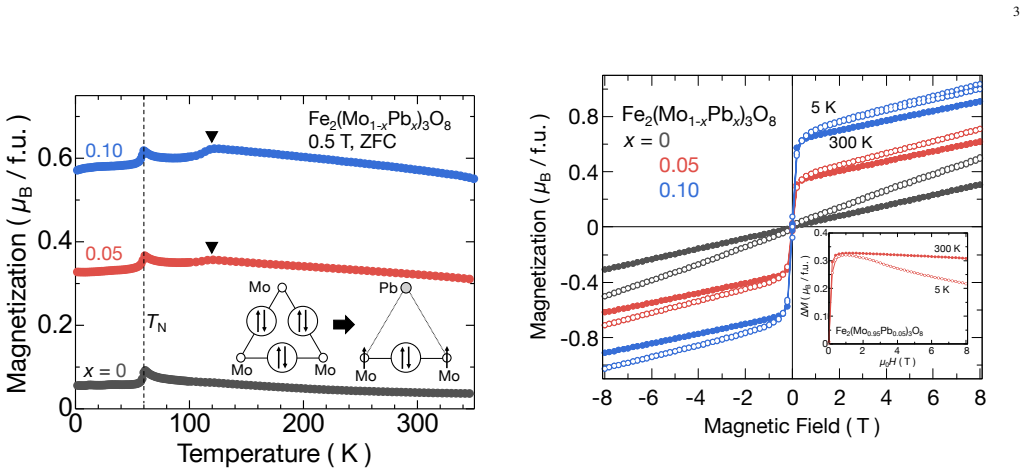
Disruption of the Mo spin-singlet state by Pb substitution at the Mo site induces active spins within the Mo layer, resulting in the emergence of a ferromagnetic-like behavior that persists even at room temperature. Quantitative analysis that takes into account the weight fraction of the main phase suggests an effective spin S = 1/2 state per active Mo ion upon trimer disruption.
What carries the argument
Intentional disruption of Mo4+ spin-singlet trimers in the kagome lattice by chemical substitution at the Mo site, which converts non-magnetic clusters into sources of local moments.
If this is right
- The Mo layer, normally non-magnetic, can be activated to carry local moments by breaking its trimer singlets.
- Room-temperature ferromagnetic-like order appears inside a polar host lattice.
- Chemical substitution targeting non-magnetic cluster states offers a route to new magnetoelectric materials.
- The effective S = 1/2 moment per active Mo ion provides a quantitative handle for predicting the induced magnetism.
Where Pith is reading between the lines
- The same substitution strategy could be tested with Zr or other tetravalent ions to separate the effects of ionic radius from valence.
- If the induced moments couple to the polar lattice, the material may exhibit magnetoelectric response at elevated temperatures.
- Extending the approach to related layered oxides with similar trimer or tetramer motifs might generate families of room-temperature magnets.
Load-bearing premise
The room-temperature magnetic signal arises from the substituted main phase after trimer disruption rather than from impurities, secondary phases, or incomplete substitution.
What would settle it
High-resolution neutron diffraction or magnetization measurements on a phase-pure single crystal with verified Pb occupancy that shows the magnetic moment per Mo ion deviates significantly from 1/2 or vanishes above a much lower temperature.
Figures



read the original abstract
The ternary transition-metal oxide Fe$_2$Mo$_3$O$_8$ is a polar magnet characterized by a layered structure of magnetic Fe honeycomb lattices and non-magnetic Mo kagome lattices. Whereas previous studies have primarily focused on the chemical substitution at the Fe sites to modulate the magnetic properties, the Mo sites have remained largely unexplored due to the strong spin-singlet trimerization of Mo$^{4+}$ ions. In this study, we investigated the effect of substituting non-magnetic Pb$^{4+}$ and Zr$^{4+}$ ions into the Mo sites to intentionally disrupt the Mo trimers. Our results reveal that the disruption of the Mo spin-singlet state induces active spins within the Mo layer, resulting in the emergence of a ferromagnetic-like behavior that persists even at room temperature. Quantitative analysis that takes into account the weight fraction of the main phase suggests an effective spin $S = 1/2$ state per active Mo ion upon trimer disruption. These findings demonstrate that controlling non-magnetic cluster states within a polar host via chemical substitution is a promising approach for designing room-temperature magnetoelectric materials.
Editorial analysis
A structured set of objections, weighed in public.
Referee Report
Summary. The paper examines Pb^{4+} (and Zr^{4+}) substitution at the Mo site in the polar magnet Fe₂Mo₃O₈. The central claim is that intentional disruption of the Mo^{4+} spin-singlet trimers activates spins within the Mo kagome layer, producing a ferromagnetic-like response that persists to room temperature. After correcting the magnetization data for the weight fraction of the main phase, the authors extract an effective S = 1/2 per active Mo ion.
Significance. If the room-temperature signal is shown to be intrinsic to the substituted main phase, the result would be of moderate significance for the design of room-temperature magnetoelectric materials. It extends prior Fe-site substitution studies by demonstrating control over non-magnetic cluster states in a polar host, offering a concrete chemical route to induce net moments in otherwise singlet layers.
major comments (2)
- [Abstract] Abstract and quantitative-analysis section: the claim that weight-fraction correction yields S = 1/2 per active Mo ion is load-bearing for the central interpretation, yet the abstract supplies neither the raw magnetization curves, the Rietveld-derived weight fractions, nor uncertainty estimates on the correction. Small errors in phase fraction directly propagate into the derived spin value and undermine the attribution of the room-temperature signal to trimer disruption rather than undetected impurities.
- [Magnetic Properties] Magnetic-properties section: the persistence of ferromagnetic-like behavior to 300 K is attributed to the substituted main phase, but the manuscript does not present explicit exclusion of secondary phases (e.g., Fe oxides or Pb-rich impurities that order above room temperature). Without additional data such as detailed impurity Rietveld fits, Mössbauer spectra, or magnetization subtraction protocols, the quantitative S = 1/2 assignment remains vulnerable to the alternative explanation raised in the stress-test note.
minor comments (2)
- [Abstract] Clarify whether Zr substitution produces quantitatively similar room-temperature behavior or serves only as a control; the abstract mentions both ions but reports results primarily for Pb.
- Add error bars to all magnetization and susceptibility plots and ensure figure captions explicitly describe how the weight-fraction correction was applied.
Simulated Author's Rebuttal
We thank the referee for the careful reading and constructive comments on our manuscript. We address each major comment below and indicate the changes planned for the revised version.
read point-by-point responses
-
Referee: [Abstract] Abstract and quantitative-analysis section: the claim that weight-fraction correction yields S = 1/2 per active Mo ion is load-bearing for the central interpretation, yet the abstract supplies neither the raw magnetization curves, the Rietveld-derived weight fractions, nor uncertainty estimates on the correction. Small errors in phase fraction directly propagate into the derived spin value and undermine the attribution of the room-temperature signal to trimer disruption rather than undetected impurities.
Authors: We agree that greater transparency in the abstract and quantitative section is warranted. In the revision we will expand the abstract to reference the weight-fraction correction and the derived effective spin value together with its estimated uncertainty. We will also add a concise description of the correction procedure and move the relevant raw magnetization curves, Rietveld weight-fraction results, and error-propagation analysis into the main text or a new supplementary figure so that readers can directly evaluate the robustness of the S = 1/2 assignment. revision: yes
-
Referee: [Magnetic Properties] Magnetic-properties section: the persistence of ferromagnetic-like behavior to 300 K is attributed to the substituted main phase, but the manuscript does not present explicit exclusion of secondary phases (e.g., Fe oxides or Pb-rich impurities that order above room temperature). Without additional data such as detailed impurity Rietveld fits, Mössbauer spectra, or magnetization subtraction protocols, the quantitative S = 1/2 assignment remains vulnerable to the alternative explanation raised in the stress-test note.
Authors: We acknowledge that an explicit discussion of impurity exclusion strengthens the attribution. The original Rietveld analysis already quantified the main-phase fraction used for the magnetization correction; we will now present the full impurity-phase fits, list the identified secondary phases and their weight percentages, and describe the subtraction protocol in the revised magnetic-properties section. These additions will directly address the possibility of high-temperature ordering from Fe oxides or Pb-rich impurities. While Mössbauer spectra are not available in the current data set, the temperature dependence of the magnetization and the low impurity fractions are inconsistent with such an origin; we will state this reasoning explicitly. revision: partial
Circularity Check
Experimental paper with no circular derivation chain
full rationale
This is an experimental materials science paper reporting magnetic properties of Pb-substituted Fe2Mo3O8. The central quantitative claim—an effective S = 1/2 per active Mo ion—is obtained by normalizing measured magnetization to the main-phase weight fraction determined via standard Rietveld/structural analysis. This is a conventional data-correction step, not a mathematical derivation, prediction, or first-principles result that reduces to its own inputs by construction. No equations, ansatzes, uniqueness theorems, or self-citations are invoked in a load-bearing way that would create circularity. The analysis chain remains self-contained against external benchmarks such as direct magnetization data and phase quantification.
Axiom & Free-Parameter Ledger
free parameters (1)
- weight fraction of main phase
Lean theorems connected to this paper
-
IndisputableMonolith/Cost/FunctionalEquation.leanwashburn_uniqueness_aczel unclear?
unclearRelation between the paper passage and the cited Recognition theorem.
Quantitative analysis that takes into account the weight fraction of the main phase suggests an effective spin S = 1/2 state per active Mo ion upon trimer disruption.
-
IndisputableMonolith/Foundation/ArrowOfTime.leanz_monotone_absolute unclear?
unclearRelation between the paper passage and the cited Recognition theorem.
the disruption of the Mo spin-singlet state induces active spins within the Mo layer, resulting in the emergence of a ferromagnetic-like behavior that persists even at room temperature
What do these tags mean?
- matches
- The paper's claim is directly supported by a theorem in the formal canon.
- supports
- The theorem supports part of the paper's argument, but the paper may add assumptions or extra steps.
- extends
- The paper goes beyond the formal theorem; the theorem is a base layer rather than the whole result.
- uses
- The paper appears to rely on the theorem as machinery.
- contradicts
- The paper's claim conflicts with a theorem or certificate in the canon.
- unclear
- Pith found a possible connection, but the passage is too broad, indirect, or ambiguous to say the theorem truly supports the claim.
Reference graph
Works this paper leans on
-
[1]
W. H. McCarroll, L. Katz, and R. Ward, ”Some Ternary Oxides of Tetravalent Molybdenum”,J.Am.Chem.Soc., vol. 79, no. 20, pp. 5410-5414, Oct. 1957
work page 1957
-
[2]
K. Momma and F. Izumi, ”VESTA 3 for three-dimensional visualization of crystal, volumetric and morphology data”,J.Appl.Cryst., vol. 44, no. 6, pp. 1272-1276, Dec. 2011
work page 2011
-
[3]
G. B. Ansell and L. Katz, ”A Refinement of the Crystal Structure of Zinc Molybdenum(IV) Oxide, Zn 2Mo3O8”,Acta Cryst., vol. 21, no. 4, pp. 482-485, Feb. 1966
work page 1966
-
[4]
H. Abe, A. Sato, N. Tsujii, T. Furubayashi, and M. Shimoda, ”Structural refinement ofT 2Mo3O8 (T= Mg, Co, Zn and Mn) and anomalous valence of trinuclear molybdenum clusters in Mn 2Mo3O8”,J.Solid State Chem., vol. 183, no. 2, pp. 379-384, Feb. 2010
work page 2010
-
[5]
S. P. McAlister and P. Strobel, ”Magnetic Order InM 2Mo3O8 Single Crystals (M= Mn, Fe, Co, Ni)”,J.M agn.M agn.M ater., vol. 30, no. 3, pp. 340-348, Jan. 1983
work page 1983
-
[6]
S. P. McAlister, ”Unusual ferrimagnetism in Mn 2Mo3O8 and Sm 2In”, J.Appl.P hys. vol. 55, no. 6, pp. 2343-2345, Mar. 1984
work page 1984
-
[7]
T. Kurumaji, S. Ishiwata, and Y . Tokura, ”Diagonal magnetoelectric sus- ceptibility and effect of Fe doping in the polar ferrimagnet Mn 2Mo3O8”, P hys.Rev.B, vol. 95, no. 4, Art. no. 045142 Jan. 2017
work page 2017
-
[8]
J. R. Morey, A. Scheie, J. P. Sheckelton, C. M. Brown, and T. M. Mc- Queen, ”Ni2Mo3O8: Complex antiferromagnetic order on a honeycomb lattice”,P hys.Rev.M ater., vol. 3, no. 1, Art. no. 014410, Jan. 2019
work page 2019
-
[9]
P. Yadav, S. Lee, G. L. Pascut, J. Kim, M. J. Gutmann, X. Xu, B. Gao, S. W. Cheong, V . Kiryukhin, and S. Choi, ”Noncollinear magnetic order, in-plane anisotropy, and magnetoelectric coupling in the pyroelectric honeycomb antiferromagnet Ni 2Mo3O8”,P hys.Rev.Research, vol. 5, no. 3, Art. no. 033099, Oct. 2023
work page 2023
-
[10]
S. W. Cheong and F. T. Huang, ”Altermagnetism with non-collinear spins”,npj Quantum M ater., vol. 9, no. 1, Art. no. 13, Jan. 2024
work page 2024
-
[11]
J. Dong, K. Wu, M. Zhu, F. Zheng, X. Li, and J. Zhang, ”Nonrelativistic spin-splitting multiferroic antiferromagnets and compensated ferrimagnet with zero net magnetization”,P hys.Rev.B, vol. 112, no. 2, Art. no. 024425, Jul. 2025
work page 2025
-
[12]
Y . Wang, G. L. Pascut, B. Gao, T. A. Tyson, K. Haule, V . Kiryukhin, and S. W. Cheong, ”Unveiling hidden ferrimagnetism and giant magne- toelectricity in polar magnet Fe 2Mo3O8”,Sci.Rep., vol. 5, no. 1, Art. no. 12268, Jul. 2015
work page 2015
-
[13]
T. Kurumaji, S. Ishiwata, and Y . Tokura, ”Doping-Tunable Ferrimagnetic Phase with Large Linear Magnetoelectric Effect in a Polar Magnet Fe2Mo3O8”,P hys.Rev.X, vol. 5, no. 3, Art. no. 031034, Sep. 2015
work page 2015
- [14]
-
[15]
S. Nakayama, R. Nakamura, M. Akaki, D. Akahoshi, and H. Kuwahara, ”Ferromagnetic Behavior of (Fe 1−yZny)2Mo3O8 (0≤y≤1) Induced by Nonmagnetic Zn Substitution”,J.P hys.Soc.Jpn., vol. 80, no. 10, Art. no. 104706, Sep. 2011
work page 2011
-
[16]
T. Kurumaji, Y . Takahashi, J. Fujioka, R. Masuda, H. Shishikura, S. Ishiwata, and Y . Tokura, ”Electromagnon resonance in a collinear spin state of the polar antiferromagnet Fe 2Mo3O8”,P hys.Rev.B, vol. 95, no. 2, Art. no. 020405(R), Jan. 2017. 5
work page 2017
-
[17]
T. Kurumaji, Y . Takahashi, J. Fujioka, R. Masuda, H. Shishikura, S. Ishiwata, and Y . Tokura, ”Optical Magnetoelectric Resonance in a Polar Magnet (Fe,Zn)2Mo3O8 with Axion-Type Coupling”,P hys.Rev.Lett., vol. 119, no. 7, Art. no. 077206, Aug. 2017
work page 2017
- [18]
- [19]
-
[20]
K. Ino, K. Matsuura, T. Nomoto, T. Kurumaji, Y . Tokura, and F. Kagawa, ”Magnetoelectric coupling and its impact on the multicaloric effect”, P hys.Rev.B, vol. 112, no. 2, Art. no. 024434, Jul. 2025
work page 2025
- [21]
-
[22]
A. A. Coelho, ”TOPAS and TOPAS-Academic: an optimization program integrating computer algebra and crystallographic object written in C++”, J.Appl.Cryst., vol. 51, no. 1, pp. 210-218, Feb. 2018
work page 2018
-
[23]
J. A. Groenink and G. Blasse, ”Some New Observations on the Lumi- nescence of PbMoO 4 and PbWO 4”,J.Solid State Chem., vol. 32, no. 1, pp. 9-20, Mar. 1980
work page 1980
- [24]
discussion (0)
Sign in with ORCID, Apple, or X to comment. Anyone can read and Pith papers without signing in.