A Simulation Methodology Testbed for Typhoon Sensitivity Analysis: Framework Development and Perturbation-Response Experiments with the Pangu Weather Model
Pith reviewed 2026-05-22 03:14 UTC · model grok-4.3
The pith
A testbed built on an operational AI weather forecasting model allows controlled experiments on typhoon sensitivity to localized perturbations.
A machine-rendered reading of the paper's core claim, the machinery that carries it, and where it could break.
Core claim
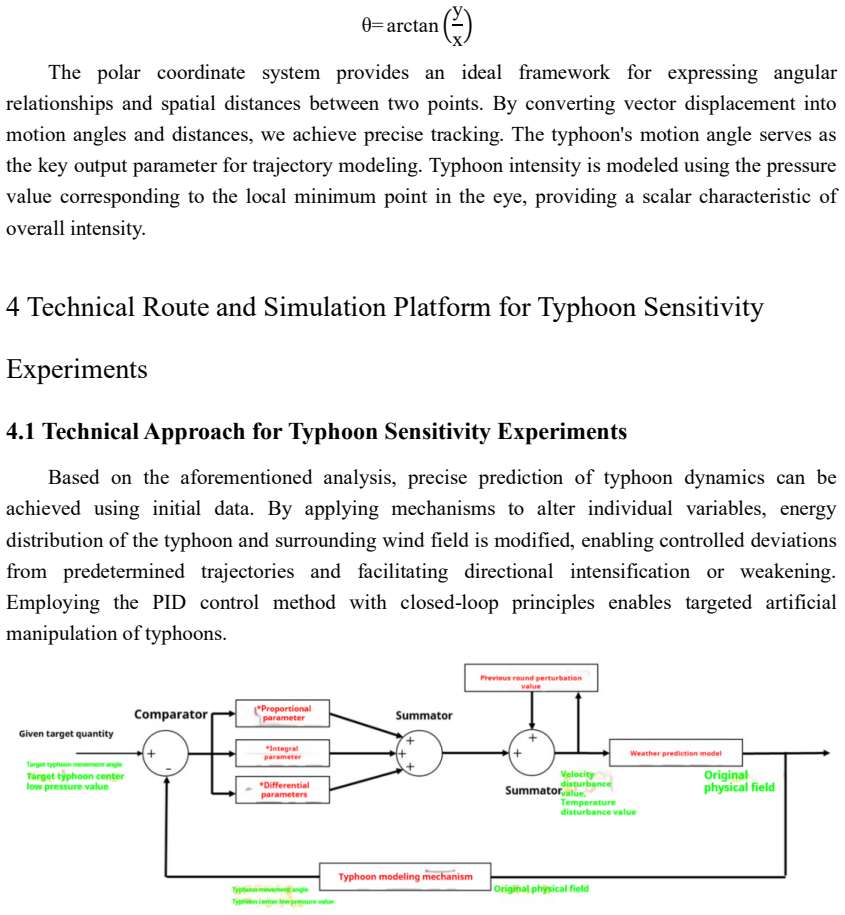
The central discovery is the development of a modular testbed that incorporates a meteorological prediction module based on an AI model, an artificial perturbation input interface, a typhoon quantitative modeling module, and a PID closed-loop test module. This architecture supports perturbation-response experiments that quantify the feasible ranges for inputs, the tuning of control parameters, and the energy-scale characteristics of the system's responses under different perturbation modes.
What carries the argument
The PID closed-loop test module combined with the artificial perturbation input interface within the overall modular framework.
If this is right
- The test system identifies feasible perturbation-response ranges for velocity and thermal inputs.
- Parameter tuning behavior in the PID module is characterized for the test system.
- Energy-scale response characteristics are quantified for different perturbation modes.
- Input-output coupling relationships are established for the single-input single-output setup.
- The framework supports future expansion to multi-input multi-output architectures and advanced control strategies.
Where Pith is reading between the lines
- This approach could link directly to assessing real limits of predictability in typhoon forecasting.
- Testable extensions might include validating simulated responses against historical typhoon event data.
- Such a platform might eventually support studies on the feasibility of intensity or track modification in controlled simulations.
Load-bearing premise
The AI weather forecasting model produces physically realistic responses to the localized artificial perturbations that align closely enough with real-world typhoon behavior.
What would settle it
If the magnitude or direction of simulated typhoon track shifts from a given perturbation fails to match observed shifts in real typhoons under comparable environmental changes, this would challenge the testbed's suitability for sensitivity analysis.
Figures


read the original abstract
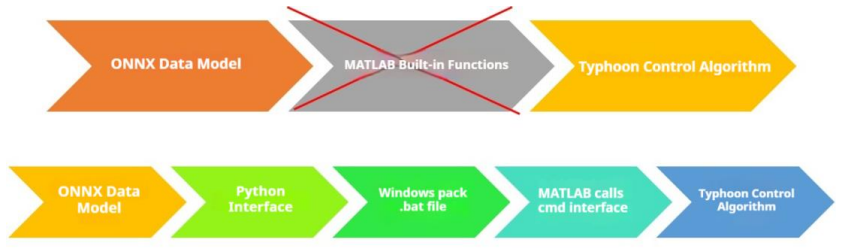
Understanding how typhoons respond to localized perturbations in their environmental fields is fundamental to assessing the limits of predictability and exploring the potential for track or intensity intervention. This study develops a dedicated simulation methodology testbed for typhoon sensitivity analysis by integrating the Pangu weather model, a high-precision AI forecasting system, with Proportional-Integral-Derivative (PID) closed-loop techniques. The testbed is constructed with modular functional blocks including a meteorological prediction module, an artificial perturbation input interface, a typhoon quantitative modeling module, and a PID closed-loop test module, implemented via a cross-platform MATLAB/ONNX technical framework. A Single-Input Single-Output (SISO) test system was built, with velocity and thermal perturbations set as the core inputs and typhoon track and intensity as the key output targets, to perform controlled perturbation-response experiments. The experiments reveal the feasible perturbation-response range, the parameter tuning behavior of the PID module, and the energy-scale response characteristics under different perturbation modes, and quantify the input-output coupling relationships of the test system. By constructing this testbed on an operational AI weather forecasting model, this study provides a framework that goes beyond idealized sensitivity studies typically validated only on low-order dynamical models. The testbed offers an expandable platform for investigating typhoon sensitivity to artificial environmental perturbations and provides a foundation for subsequent expansion toward multi-input multi-output architectures and advanced analysis strategies such as nonlinear PID or model predictive control.
Editorial analysis
A structured set of objections, weighed in public.
Referee Report
Summary. The paper develops a dedicated simulation methodology testbed for typhoon sensitivity analysis by integrating the Pangu AI weather forecasting model with PID closed-loop control in a cross-platform MATLAB/ONNX framework. It defines modular blocks (meteorological prediction, artificial perturbation input, typhoon quantitative modeling, and PID test module) and implements a SISO system with velocity/thermal perturbations as inputs and typhoon track/intensity as outputs. Experiments characterize feasible perturbation ranges, PID tuning behavior, energy-scale responses, and input-output couplings. The central claim is that the testbed, built on an operational AI model, provides a framework that goes beyond idealized sensitivity studies validated only on low-order dynamical models.
Significance. If the Pangu responses to localized artificial perturbations prove physically realistic and consistent with observed typhoon dynamics, the modular testbed could offer a useful expandable platform for perturbation-response studies and potential extensions to MIMO or advanced control strategies. The integration of an operational AI forecaster with standard PID methods is a practical strength, and the explicit SISO architecture allows controlled experiments that are harder to isolate in full physics-based models.
major comments (2)
- [Abstract and §3] Abstract and §3 (Framework Development): the claim that the testbed 'goes beyond idealized sensitivity studies typically validated only on low-order dynamical models' is load-bearing for the contribution, yet the manuscript provides no conservation checks, energy-balance diagnostics, or direct comparisons of perturbation responses against observations or physics-based models (e.g., WRF). Without such grounding, the transfer of Pangu's forecasting skill to realistic sensitivity under artificial perturbations remains an assumption rather than a demonstrated property.
- [§4] §4 (Perturbation-Response Experiments): the reported feasible ranges, PID tuning behavior, and input-output couplings are described qualitatively with no quantitative metrics, error bars, or statistical measures of robustness; this undermines assessment of whether the observed couplings are reproducible or physically meaningful.
minor comments (2)
- [Abstract and §4] Clarify the precise definition and units of 'energy-scale response characteristics' in the abstract and §4; the term appears without an explicit formula or reference to a conserved quantity.
- [Figures] Figure captions and axis labels in the perturbation-response plots should explicitly state the perturbation magnitudes and output variables to improve readability.
Simulated Author's Rebuttal
We thank the referee for their constructive and detailed review. The comments highlight important aspects of validation and quantitative rigor that we address below. We propose targeted revisions to strengthen the manuscript while preserving the core contribution of the modular testbed framework.
read point-by-point responses
-
Referee: [Abstract and §3] Abstract and §3 (Framework Development): the claim that the testbed 'goes beyond idealized sensitivity studies typically validated only on low-order dynamical models' is load-bearing for the contribution, yet the manuscript provides no conservation checks, energy-balance diagnostics, or direct comparisons of perturbation responses against observations or physics-based models (e.g., WRF). Without such grounding, the transfer of Pangu's forecasting skill to realistic sensitivity under artificial perturbations remains an assumption rather than a demonstrated property.
Authors: We acknowledge that the manuscript does not present explicit conservation checks, energy-balance diagnostics, or side-by-side comparisons against physics-based models such as WRF or observational datasets. The primary contribution lies in the construction of a modular, cross-platform testbed that enables controlled SISO perturbation-response experiments on an operational AI forecasting model. While Pangu's documented skill in standard forecasting tasks provides a foundation, we agree this does not automatically guarantee physical consistency under artificial perturbations. In the revised manuscript we will expand §3 with a dedicated limitations subsection that discusses these gaps and incorporates preliminary energy-balance diagnostics derived from the existing model outputs. We will also add a forward-looking paragraph outlining planned comparisons with WRF and reanalysis data. These changes clarify the current scope without overstating the demonstrated realism. revision: partial
-
Referee: [§4] §4 (Perturbation-Response Experiments): the reported feasible ranges, PID tuning behavior, and input-output couplings are described qualitatively with no quantitative metrics, error bars, or statistical measures of robustness; this undermines assessment of whether the observed couplings are reproducible or physically meaningful.
Authors: The experiments in §4 were designed as an initial characterization of the testbed's behavior rather than a comprehensive statistical study. We recognize that the purely qualitative presentation limits evaluation of reproducibility and physical significance. In the revised version we will augment §4 with quantitative metrics, including standard deviations across repeated runs for the reported ranges, integral-absolute-error values for PID tuning performance, and Pearson correlation coefficients together with p-values for the input-output coupling relationships. These additions will allow readers to assess robustness more directly while retaining the exploratory character of the current results. revision: yes
Circularity Check
No circularity: methodological framework built on external model
full rationale
The paper develops a simulation testbed by integrating the external Pangu AI weather model with standard PID closed-loop control and modular MATLAB/ONNX blocks for SISO perturbation-response experiments on typhoon track and intensity. No equations, fitted parameters, or predictions are defined in terms of outputs from the same study; the reported feasible ranges, coupling relationships, and energy-scale characteristics are observational results from running the pre-existing Pangu model under controlled inputs. The central claim of providing a framework beyond low-order dynamical models rests on the choice of an operational AI forecaster rather than any self-referential derivation or self-citation chain that reduces the result to its own inputs by construction. This is a self-contained engineering contribution with no load-bearing steps that collapse into fitted quantities or renamed ansatzes.
Axiom & Free-Parameter Ledger
axioms (2)
- domain assumption Pangu weather model responses to localized perturbations are sufficiently realistic for sensitivity analysis
- domain assumption PID controllers can be tuned to produce stable and interpretable input-output relationships in this meteorological setting
Reference graph
Works this paper leans on
-
[1]
R., Gila, M., Klein, M., Martinasso, M., and Schulthess, T
Alam, S. R., Gila, M., Klein, M., Martinasso, M., and Schulthess, T. C., 2023: Versatile software-defined HPC and cloud clusters on ALPS supercomputer for diverse workflows. The International Journal of High Performance Computing Applications , 37(3–4), 288 –305, https://doi.org/10.1177/10943420231167811
-
[2]
Nature, 525(7567), 47–55, https://doi.org/10.1038/nature14956
Bauer, P., Thorpe, A., and Brunet, G., 2015: The quiet revolution of numerical weather prediction. Nature, 525(7567), 47–55, https://doi.org/10.1038/nature14956
-
[3]
D., Hoefler, T., Quintino, T., Schulthess, T
Bauer, P ., Dueben, P . D., Hoefler, T., Quintino, T., Schulthess, T. C., and Wedi, N. P ., 2021: The digital revolution of Earth -system science. Nature Computational Science , 1(2), 104 –113, https://doi.org/10.1038/s43588-021-00023-0
-
[4]
Nature Reviews Earth & Environment, 4(8), 507–509, https://doi.org/10.1038/s43017-023-00468-z
Bauer, P ., Dueben, P ., Chantry, M., Doblas-Reyes, F., Hoefler, T., McGovern, A., and Stevens, B., 2023: Deep learning and a changing economy in weather and climate prediction. Nature Reviews Earth & Environment, 4(8), 507–509, https://doi.org/10.1038/s43017-023-00468-z. Ben Bouallègue, Z., Weyn, J. A., Clare, M. C. A., Dramsch, J., Dueben, P ., and Chan...
-
[5]
Sandu, I., Dueben, P., Chantry, M., and Pappenberger, F., 2024: The rise of data-driven weather forecasting: A first statistical assessment of machine learning -based weather forecasts in an operational-like context. Bulletin of the American Meteorological Society , 105, E864 –E883, https://doi.org/10.1175/BAMS-D-23-0162.1
-
[6]
arXiv preprint arXiv:2211.02556 , year=
Bi, K., Xie, L., Zhang, H., Chen, X., Gu, X., and Tian, Q., 2022: Pangu -weather: A 3D high-resolution model for fast and accurate global weather forecast. arXiv preprint arXiv:2211.02556, https://doi.org/10.48550/arXiv.2211.02556
-
[7]
doi: 10.1038/s41586-023-06185-3
Bi, K., Xie, L., Zhang, H., et al., 2023: Accurate medium-range global weather forecasting with 3D neural networks. Nature, 619, 533–538, https://doi.org/10.1038/s41586-023-06185-3
-
[8]
Bonavita, M., and Laloyaux, P ., 2020: Machine learning for model error inference and correction. Journal of Advances in Modeling Earth Systems , 12(12), e2020MS002232, https://doi.org/10.1029/2020MS002232
-
[9]
Wiley Interdisciplinary Reviews: Climate Change, 9(5), e535, https://doi.org/10.1002/wcc.535
Carrassi, A., Bocquet, M., Bertino, L., and Evensen, G., 2018: Data assimilation in the geosciences: An overview of methods, issues, and perspectives. Wiley Interdisciplinary Reviews: Climate Change, 9(5), e535, https://doi.org/10.1002/wcc.535
-
[10]
Sustainability, 15(24), 16681 , https://doi.org/10.3390/su152416681
Cheon, M., and Mun, C., 2023: The climate of innovation: AI’s growing influence in weather prediction patents and its future prospects. Sustainability, 15(24), 16681 , https://doi.org/10.3390/su152416681
-
[11]
Fan, P. Y ., Yang, J., Zhang, Z. P., Zang, N. H., Li, Y . F., and Feng, G. L., 2023: Summer precipitation prediction in eastern China based on machine learning. Climate Dynamics, 60(9–10), 2645– 2663, https://doi.org/10.1007/s00382-022-06464-1
-
[12]
Ham, Y . G., Kim, J. H., and Luo, J. J., 2019: Deep learning for multi-year ENSO forecasts. Nature, 573(7775), 568–572, https://doi.org/10.1038/s41586-019-1559-7
-
[13]
Ham, Y . G., Kim, J. H., Kim, E. S., and On, K. W., 2021: Unified deep learning model for El Niño/Southern Oscillation forecasts by incorporating seasonality in climate data. Science Bulletin, 66(13), 1358–1366, https://doi.org/10.1016/j.scib.2021.03.009
-
[14]
Hess, P., Drüke, M., Petri, S., Strnad, F. M., and Boers, N., 2022: Physically constrained generative adversarial networks for improving precipitation fields from Earth system models. Nature Machine Intelligence, 4(10), 828–839, https://doi.org/10.1038/s42256-022-00540-1
-
[15]
Hipel, K. W., Jamshidi, M. M., Tien, J. M., and White III, C. C., 2007: The future of systems, man, and cybernetics: Application domains and research methods. IEEE Transactions on Systems, Man, and Cybernetics, 37, 726–743, https://doi.org/10.1109/tsmcc.2007.900671
-
[16]
Kim, H., Ham, Y . G., Joo, Y . S., and Son, S. W., 2021: Deep learning for bias correction of MJO prediction. Nature Communications, 12, 3087, https://doi.org/10.1038/s41467-021-23406-3
-
[17]
LeCun, Y ., Bengio, Y ., and Hinton, G., 2015: Deep learning. Nature, 521, 436 –444, https://doi.org/10.1038/nature14539
-
[18]
I: Direct and inverse or optimal controlling problem for precipitation enhancement operation
Lei, H., Lei, W., and Zeng, Q., 2012: Cybernetics in the artificial weather modification. I: Direct and inverse or optimal controlling problem for precipitation enhancement operation. Climatic and Environmental Research (in Chinese), 17(6), 968 –978, https://doi.org/10.3878/j.issn.1006-9585.2012.06.33
-
[19]
Li, P. Y ., Yu, Y ., Huang, D. N., Wang, Z. H., and Sharma, A., 2023: Regional heatwave prediction using graph neural network and weather station data. Geophysical Research Letters , 50(7), e2023GL103405, https://doi.org/10.1029/2023GL103405
-
[20]
Ling, F. H., Luo, J. J., Li, Y ., Tang, T., Bai, L., Ouyang, W. L., and Yamagata, T., 2022: Multi-task machine learning improves multi -seasonal prediction of the Indian Ocean Dipole. Nature Communications, 13(1), 7681, https://doi.org/10.1038/s41467-022-35412-0
-
[21]
J., 2021: ENSO-ASC 1.0.0: ENSO deep learning forecast model with a multivariate air -sea coupler
Mu, B., Qin, B., and Yuan, S. J., 2021: ENSO-ASC 1.0.0: ENSO deep learning forecast model with a multivariate air -sea coupler. Geoscientific Model Development , 14(11), 6977 –6999, https://doi.org/10.5194/gmd-14-6977-2021
-
[22]
Pan, B. X., Anderson, G. J., Goncalves, A., Lucas, D. D., Bonfils, C. J. W., and Lee, J., 2022: Improving seasonal forecast using probabilistic deep learning. Journal of Advances in Modeling Earth Systems, 14, e2021MS002766, https://doi.org/10.1029/2021MS002766
-
[23]
Nature, 597(7878), 672–677, https://doi.org/10.1038/s41586-021-03854-z
Ravuri, S., and Coauthors, 2021: Skilful precipitation nowcasting using deep generative models of radar. Nature, 597(7878), 672–677, https://doi.org/10.1038/s41586-021-03854-z
-
[24]
Journal of Meteorological Research , 34, 675 –698, https://doi.org/10.1007/s13351-020-9847-6
Shen, X., Wang, J., Li, Z., Chen, D., and Gong, J., 2020, Research and operational development of numerical weather prediction in China. Journal of Meteorological Research , 34, 675 –698, https://doi.org/10.1007/s13351-020-9847-6
-
[25]
Song, J., Xue, H., Bao, X., Wu, D., Chai, F., Shi, L., Y ao, Z., Wang, Y ., Nan, F. and Wan, K., 2011, A spectral mixture model analysis of the Kuroshio variability and the water exchange between the Kuroshio and the East China Sea. Journal of Oceanology and Limnology , 29, 446 –459, https://doi.org/10.1007/s00343-011-0114-7
-
[26]
Song, J., Guo, J., Li, J., Mu, L., Liu, Y ., Wang, G., Li, Y . and Li, H., 2017: Definition of water exchange zone between the Bohai Sea and Y ellow Sea and the effect of winter gale on it. Acta Oceanologica Sinica, 36, 17–25, https://doi.org/10.1007/s13131-017-0989-z
-
[27]
Pedrycz, W., Smith, M. H., and Kozma, R., 2021: Systems science and engineering research in the context of systems, man, and cybernetics: Recollection, trends, and future directions. IEEE Transactions on Systems, Man, and Cybernetics: Systems , 51, 5 –21, https://doi.org/10.1109/tsmc.2020.3043192
discussion (0)
Sign in with ORCID, Apple, or X to comment. Anyone can read and Pith papers without signing in.