Broken Memories: Detecting and Mitigating Memorization in Diffusion Models with Degraded Generations
Pith reviewed 2026-05-25 06:05 UTC · model grok-4.3
The pith
Diffusion models detect memorization through numerical instability shown as broken artifacts during generation.
A machine-rendered reading of the paper's core claim, the machinery that carries it, and where it could break.
Core claim
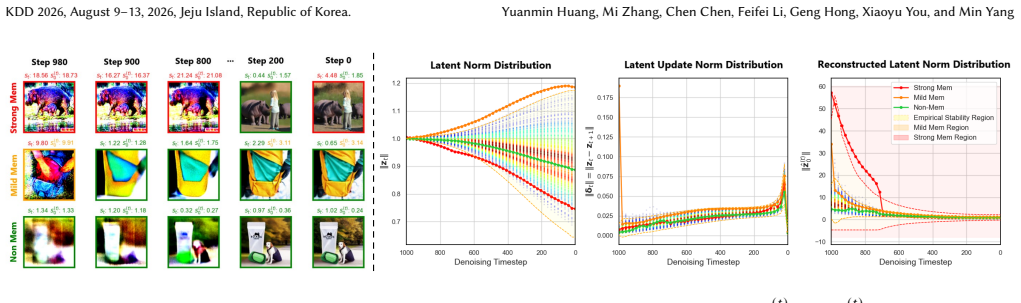
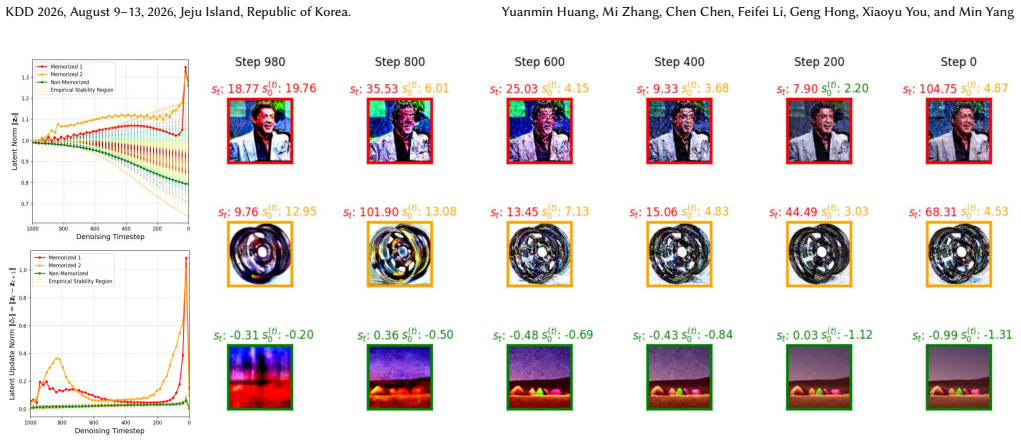
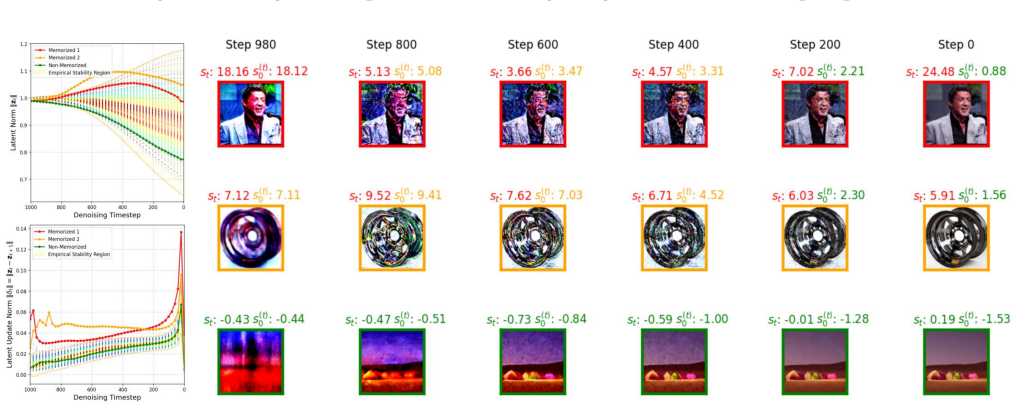
Memorization induces internal numerical instability often manifesting as visually broken artifacts. Inspired by stability analysis in numerical methods, empirical stability regions based on latent update norms quantitatively characterize stable behavior during generation. This supports a principled on-the-fly framework for step-wise detection and adaptive mitigation that suppresses memorization without altering prompts or guidance, preserving semantic fidelity and image quality.
What carries the argument
Empirical stability regions based on latent update norms that detect instability caused by memorization during the denoising steps.
If this is right
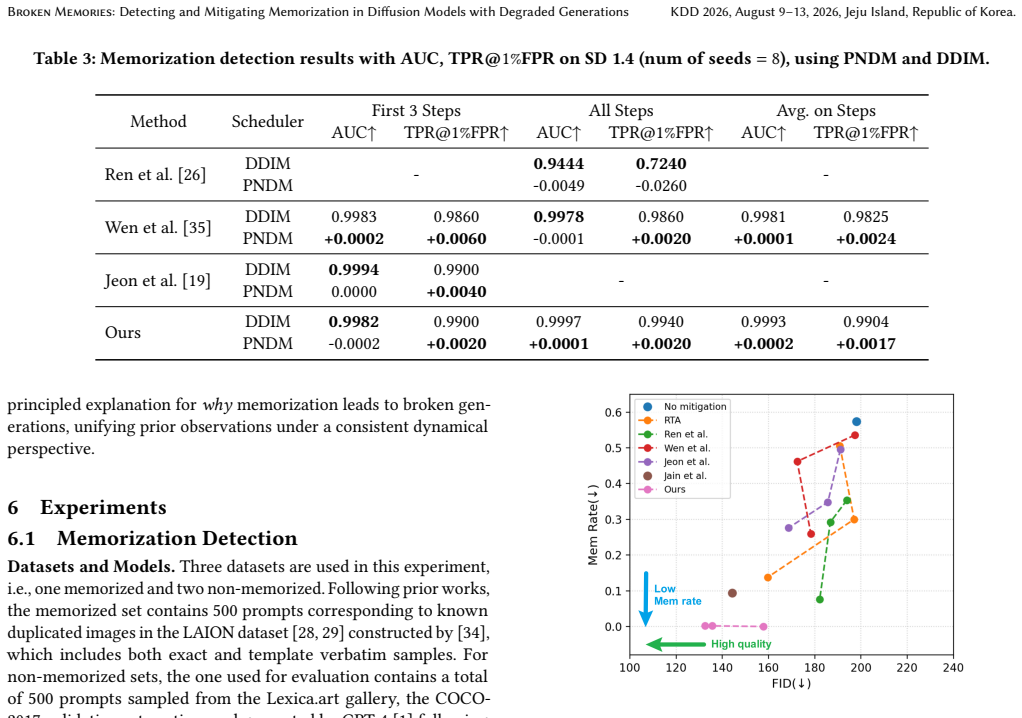
- Stable Diffusion 1.4 achieves AUC greater than 0.999 for detecting memorized generations.
- Mitigation brings the memorization rate down to 0.0 percent after application.
- The process adds only about 0.01 seconds per image in overhead.
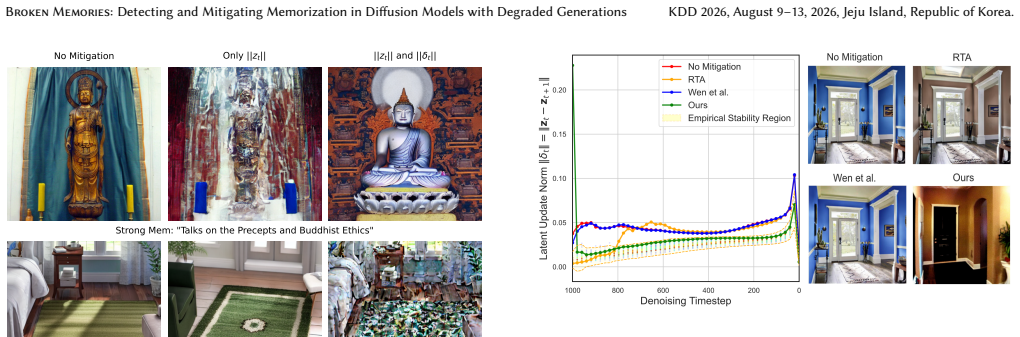
- Image quality and adherence to the prompt remain unchanged by the mitigation.
- The detection and mitigation happen during generation without any model retraining.
Where Pith is reading between the lines
- Similar instability checks could apply to other iterative generative processes like those in video or audio models.
- Deployed systems might use this to log and filter outputs that show signs of memorization in real time.
- Future work could explore whether adjusting the stability thresholds improves performance across different datasets.
- This approach suggests that monitoring internal dynamics can reveal overfitting without needing access to the training set.
Load-bearing premise
Memorization in the model causes measurable numerical instability during generation that reliably produces broken visual artifacts detectable by latent update norms.
What would settle it
Observe a set of images that are clearly memorized from the training data but generated without broken artifacts or exceeding the stability thresholds, or find that applying the mitigation still produces some memorized outputs.
Figures




read the original abstract
While diffusion models excel at generating high-quality images, their tendency to memorize training data poses significant privacy and copyright risks. In this work, we for the first time identify that memorization induces internal numerical instability, often manifesting as visually ``broken'' artifacts. Inspired by stability analysis in numerical methods, we introduce empirical stability regions based on latent update norms to quantitatively characterize stable behavior during generation. Leveraging this, we propose a principled, on-the-fly framework for step-wise detection and adaptive mitigation. Our approach suppresses memorization without altering prompts or guidance, thereby preserving semantic fidelity and image quality. Extensive experiments on Stable Diffusion 1.4 demonstrate that our method achieves an AUC $>0.999$ detection performance and a $0.0\%$ memorization rate after mitigation with negligible overhead ($\approx0.01$s per image).
Editorial analysis
A structured set of objections, weighed in public.
Referee Report
Summary. The paper claims that memorization in diffusion models induces internal numerical instability, often visible as 'broken' artifacts during generation. It introduces empirical stability regions based on latent update norms to characterize stable behavior, and proposes an on-the-fly step-wise detection and adaptive mitigation framework that suppresses memorization without altering prompts or guidance. Experiments on Stable Diffusion 1.4 report AUC >0.999 for detection, 0.0% post-mitigation memorization rate, and negligible overhead of ≈0.01s per image while preserving semantic fidelity and image quality.
Significance. If the reported empirical correlation between memorization and elevated latent update norms holds under broader validation, the work offers a practical, prompt-preserving approach to mitigating privacy and copyright risks in diffusion models. The on-the-fly nature, high detection AUC, zero post-mitigation memorization rate, and low overhead are strengths that could aid ethical deployment of generative models.
minor comments (4)
- The experimental section should explicitly state the dataset(s) used for training the base model and for evaluating memorization (including number of prompts and images), as these details are needed to interpret the AUC >0.999 and 0.0% rates.
- Clarify the precise definition and threshold used to label a generation as 'memorized' (e.g., exact pixel match, perceptual similarity, or membership inference), since this metric is central to the mitigation claims.
- Figure captions or the method section should include an example of a 'broken' artifact alongside the corresponding latent update norm trace to illustrate the stability-region concept.
- The overhead measurement (≈0.01s per image) should specify the hardware and implementation details for reproducibility.
Simulated Author's Rebuttal
We thank the referee for the positive summary, significance assessment, and recommendation of minor revision. No specific major comments were provided in the report.
Circularity Check
No significant circularity detected
full rationale
The paper presents an empirical framework that correlates memorization with elevated latent update norms during diffusion generation, using stability-region analysis for detection and mitigation on Stable Diffusion 1.4. No equations, fitted parameters renamed as predictions, or self-citation chains are shown that reduce the core claims (AUC >0.999 detection, 0% post-mitigation memorization) to inputs by construction. The stability regions are introduced as an empirical characterization inspired by numerical methods, without self-definitional loops, uniqueness theorems from the authors, or ansatzes smuggled via prior self-citations. The derivation remains self-contained against external benchmarks.
Axiom & Free-Parameter Ledger
Lean theorems connected to this paper
-
IndisputableMonolith/Cost/FunctionalEquation.leanwashburn_uniqueness_aczel unclear?
unclearRelation between the paper passage and the cited Recognition theorem.
We introduce empirical stability regions based on latent update norms... R^(t)_δ := [μ_t − γσ_t, μ_t + γσ_t]... Theorem 1 (Normal Trajectories Stability)... sub-Gaussian tail bound
-
IndisputableMonolith/Foundation/AlexanderDuality.leanalexander_duality_circle_linking unclear?
unclearRelation between the paper passage and the cited Recognition theorem.
PNDM... AB4... stability region RAB... scaled eigenvalues ν := λΔt
What do these tags mean?
- matches
- The paper's claim is directly supported by a theorem in the formal canon.
- supports
- The theorem supports part of the paper's argument, but the paper may add assumptions or extra steps.
- extends
- The paper goes beyond the formal theorem; the theorem is a base layer rather than the whole result.
- uses
- The paper appears to rely on the theorem as machinery.
- contradicts
- The paper's claim conflicts with a theorem or certificate in the canon.
- unclear
- Pith found a possible connection, but the passage is too broad, indirect, or ambiguous to say the theorem truly supports the claim.
discussion (0)
Sign in with ORCID, Apple, or X to comment. Anyone can read and Pith papers without signing in.