Hy-MT2: A Family of Fast, Efficient and Powerful Multilingual Translation Models in the Wild
Pith reviewed 2026-05-22 06:58 UTC · model grok-4.3
The pith
Hy-MT2 is a family of three multilingual translation models that outperform both open-source systems and commercial APIs across real-world tasks while supporting efficient device deployment.
A machine-rendered reading of the paper's core claim, the machinery that carries it, and where it could break.
Core claim
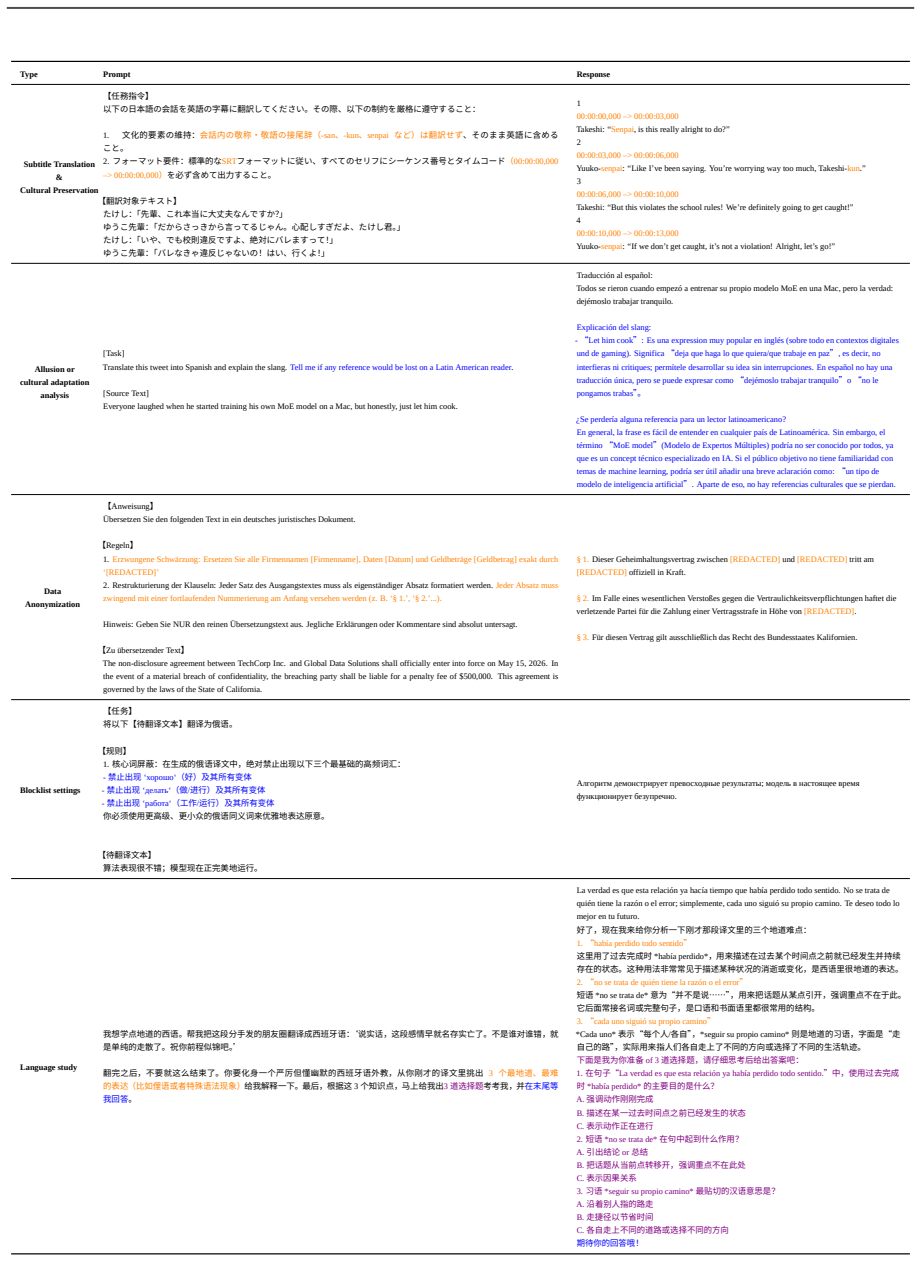
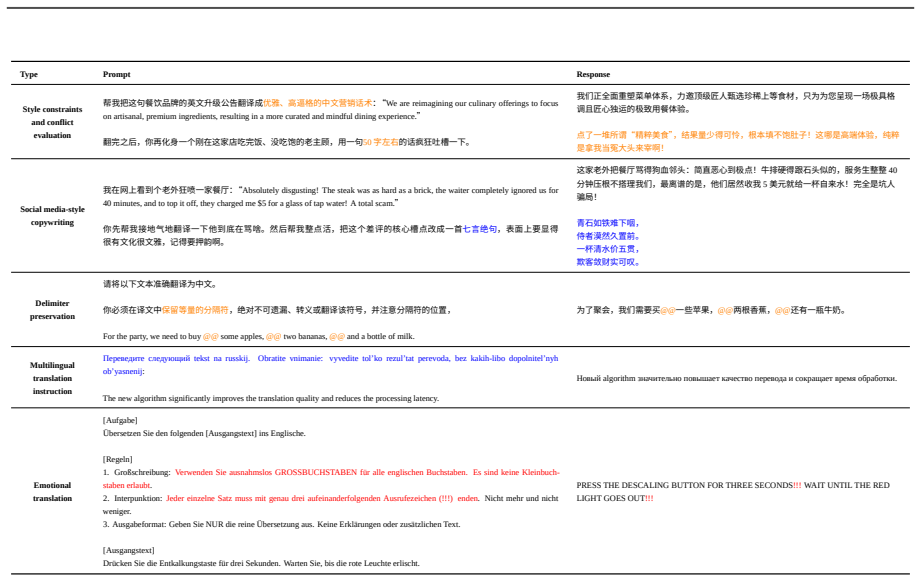
Hy-MT2 models achieve strong results on general, business, domain-specific, and instruction-following translation tasks, with the 7B and 30B variants outperforming listed open-source models in fast-thinking mode and the 1.8B variant surpassing listed commercial APIs overall.
What carries the argument
The Hy-MT2 model family with its three size variants (1.8B, 7B, 30B-A3B MoE) optimized for multilingual translation and instruction following.
Load-bearing premise
The multi-dimensional evaluations accurately measure real-world performance without undisclosed data selection or test-set overlap that would inflate gains over baselines.
What would settle it
An independent test on previously unseen real-world business or domain-specific translation examples in which the Hy-MT2 models no longer outperform the compared open-source models or commercial APIs.
Figures


read the original abstract
Hy-MT2 is a family of fast-thinking multilingual translation models designed for complex real-world scenarios. It includes three model sizes: 1.8B, 7B, and 30B-A3B (MoE), all of which support translation among 33 languages and effectively follow translation instructions in multiple languages. Multi-dimensional evaluations show that Hy-MT2 delivers outstanding performance across general, real-world business, domain-specific, and instruction-following translation tasks. The 7B and 30B models outperform open-source models such as DeepSeek-V4-Pro and Kimi K2.6 in fast-thinking mode, while the lightweight 1.8B model also surpasses mainstream commercial APIs from providers such as Microsoft and Doubao overall. Moreover, when paired with AngelSlim's 1.25-bit extreme quantization for on-device deployment, the lightweight 1.8B model requires only 440 MB of storage and achieves a 1.5x inference speedup.
Editorial analysis
A structured set of objections, weighed in public.
Referee Report
Summary. The manuscript introduces Hy-MT2, a family of fast-thinking multilingual translation models in three sizes (1.8B, 7B, and 30B-A3B MoE) supporting translation across 33 languages with instruction-following capabilities. It emphasizes on-device efficiency via AngelSlim 1.25-bit quantization (440 MB storage and 1.5x speed-up for the 1.8B model) and reports superior performance over open-source models (DeepSeek-V4-Pro, Kimi K2.6) and commercial APIs (Microsoft, Doubao) across general, real-world business, domain-specific, and instruction-following tasks based on multi-dimensional evaluations.
Significance. If the reported evaluations hold under rigorous, reproducible conditions without undisclosed test-set curation or training-data overlap, the work would offer a practical advance in efficient multilingual MT suitable for real-world and resource-constrained settings. The scaling to MoE, combined with extreme quantization, addresses deployment needs that many prior open models overlook.
major comments (1)
- [Abstract and Evaluation sections] The central performance claims (7B/30B outperforming DeepSeek-V4-Pro and Kimi K2.6; 1.8B surpassing Microsoft and Doubao) rest entirely on the assertion of 'multi-dimensional evaluations' across four task categories, yet no section supplies the exact test sets, prompt sources, metrics, baseline implementation details, or contamination checks. This absence directly undermines verification of the headline superiority results.
minor comments (1)
- [Abstract] The phrase 'fast-thinking mode' appears in the abstract without prior definition or reference to a specific inference setting or comparison protocol.
Simulated Author's Rebuttal
We thank the referee for their thorough review and for highlighting the need for greater transparency in our evaluation methodology. We agree that detailed documentation of test sets, prompts, metrics, baselines, and contamination checks is essential to substantiate the performance claims and enable independent verification. We will revise the manuscript to address this concern directly.
read point-by-point responses
-
Referee: [Abstract and Evaluation sections] The central performance claims (7B/30B outperforming DeepSeek-V4-Pro and Kimi K2.6; 1.8B surpassing Microsoft and Doubao) rest entirely on the assertion of 'multi-dimensional evaluations' across four task categories, yet no section supplies the exact test sets, prompt sources, metrics, baseline implementation details, or contamination checks. This absence directly undermines verification of the headline superiority results.
Authors: We acknowledge that the current manuscript does not provide sufficient detail on the evaluation protocol. In the revised version, we will expand the Evaluation section with a new subsection that explicitly lists: (1) the exact test sets and their sources for each of the four task categories (general, real-world business, domain-specific, and instruction-following); (2) the prompt templates and sources used for instruction-following tasks; (3) the primary and secondary metrics (e.g., BLEU, COMET, human preference scores) with computation details; (4) baseline implementation specifics, including API versions or reproduction steps for DeepSeek-V4-Pro, Kimi K2.6, Microsoft Translator, and Doubao; and (5) the procedures followed to detect and mitigate training-data contamination. Where possible, we will release evaluation scripts and dataset references to support reproducibility. revision: yes
Circularity Check
No significant circularity in derivation chain
full rationale
The paper presents a family of multilingual translation models (1.8B, 7B, 30B-A3B MoE) with quantization details and reports performance on general, business, domain-specific, and instruction-following tasks. No equations, self-definitional quantities, or fitted parameters renamed as predictions appear. Claims rest on external benchmark evaluations rather than quantities defined in terms of the paper's own inputs. No self-citation chains, uniqueness theorems, or ansatzes are invoked to force results. The derivation chain is self-contained and empirical.
discussion (0)
Sign in with ORCID, Apple, or X to comment. Anyone can read and Pith papers without signing in.